
iOS 27 Update Problems: Find the Right Fix for Your iPhone
An update not appearing, an installation error and a frozen screen need different fixes. Find your symptom below, start with reversible checks, and understand data-loss risks before system repair.
Download the latest version | Secure & verified
Start with your screen and symptom
For iOS 27 update problems, start with the free, reversible fix that matches the screen you can actually use. A carrier problem, a worn battery and an interrupted installation need different next steps.
Release check: October 22, 2026. Apple's release list includes iOS 27.0.1, released September 28, 2026. Use Settings > General > Software Update to see the public update offered to your model. The troubleshooting below also applies to many iOS 26 and iPadOS update errors; device eligibility and button sequences are not interchangeable.
| What you see | First action | Next route |
|---|---|---|
| No update in Settings | Confirm model, installed version and public-release channel; beta enrollment is not required. | Update not showing |
| Unable to Install / Software Update Failed | Check device storage, power and Wi-Fi; remove the downloaded update package if listed. | Installation checks |
| Unable to Check / Verify Update | Retry on a trusted network, then another network before using a computer. | Verification checks |
| Apple logo and progress bar | Keep power connected; a slow bar alone does not mean the installation failed. | Wait or restart? |
| Black screen, frozen screen or restore screen | Use the matching restart or computer Update-first path; Restore erases. | Black screen / frozen screen / recovery |
| Battery drain or warmth after startup | Read Battery Insights; background update work can be temporary. A temperature warning needs immediate cooling. | Battery / overheating |
| Only a message service, app or feature fails | Check that service's settings and availability before system repair. | RCS / iMessage / app glitches |
Before changing the system: if the phone is usable, make a current backup and verify that it finished. If it will not boot, do not assume a new backup can be created. If the data is irreplaceable and you have no backup, understand the consequences before choosing any erasing procedure.
Sources: Apple's wireless-update troubleshooting, Apple's release list.
Choose a fix: free Apple tools or desktop repair?
Use Settings first when the phone works. If wireless installation repeatedly fails, try Apple's computer Update before choosing Restore or paid repair. Third-party system repair is an optional alternative for supported software faults, not a way to add unsupported device or carrier features.
| Route | Best fit | Computer / cost | Data impact and limit | Go to |
|---|---|---|---|---|
| Settings and symptom checks | Phone works; download, storage, app or service issue | No computer for these checks; no repair-software purchase | Use reversible changes; deleting an app or personal media is different from deleting the update package. | Find your symptom |
| Finder / Apple Devices Update | Wireless update fails; or a failed boot needs a first recovery attempt | Mac or Windows PC; no paid repair-software license | Attempts to reinstall/update without erasing personal data; backup first when possible. Success is not guaranteed. | Computer Update |
| Apple Restore | Update has failed and you accept an erasing recovery | Mac or Windows PC; no paid repair-software license | Erases the iPhone. Restore a compatible backup afterward if available. | Recovery decisions |
| Dr.Fone Standard Repair | Supported persistent iOS software faults; you want a guided desktop alternative | Windows or Mac; repair requires the appropriate license, not merely downloading the app | Designed to retain data, not a guarantee. It can install a newer iOS version; confirm the offered firmware. | Desktop repair steps |
| Dr.Fone Advanced Repair | Standard Repair fails and you accept the erasure | Windows or Mac; paid feature entitlement applies | Erases device data. Not a solution for hardware damage, carrier provisioning or an unsupported model. | Modes and limits |
None of these software choices repairs physical damage or resolves a carrier outage. For RCS-only failure, start with carrier and Messages settings; for repeated camera/flash failure, use the camera checks and service route.
Tools for Before, During and After an iOS Update


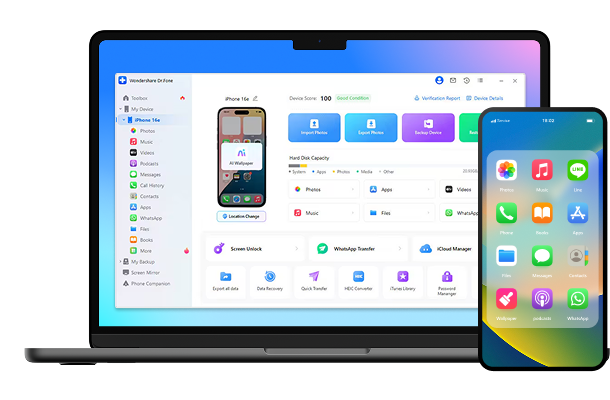
Dr.Fone - Full Toolkit
All the Tools You Need to Keep Your Mobile at 100%


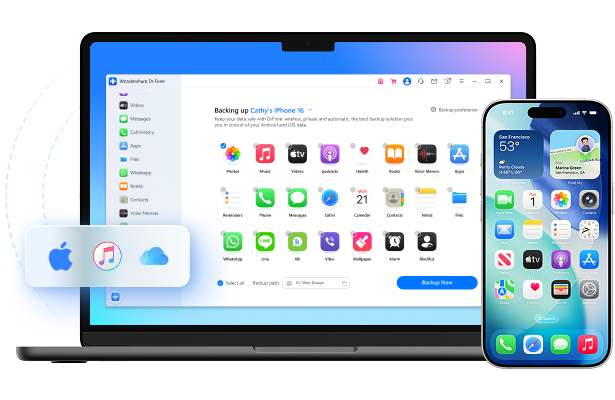
Dr.Fone Basic
Back up your data before iOS update. Say no to data loss stress.
Common iOS 27 Issues and Fixes
Use these checks for iOS 27 update issues, starting with the symptom you can observe. A problem after an update does not by itself prove a software bug; hardware, network, carrier and app conditions can also matter.

1. iOS 27 Update Not Showing Up
A missing update can mean the device is not eligible, is already up to date, or is looking at a different update channel. You do not need beta enrollment to install a compatible public release.
Solutions:
- Confirm the model and installed version: Open Settings > General > About, then Software Update. Apple's iOS 27 list includes iPhone 11, 11 Pro and 11 Pro Max; iPhone SE (2nd and 3rd generation); the iPhone 12, 13, 14, 15 and 16 families (including mini, Plus, Pro and Pro Max where offered); iPhone 16e; iPhone 17, 17 Pro, 17 Pro Max and 17e; iPhone Air; and iPhone 18 Pro and 18 Pro Max. iPhone XS, XS Max, XR and older models are not on that list. Feature availability can differ even on eligible models.
- Use the public-release channel: For normal updates, leave Settings > General > Software Update > Beta Updates off if that option is present. A public update does not require a developer profile. Turning beta updates off stops future beta offers; it does not remove an installed beta.
- Retry the connection: Connect to reliable Wi-Fi and power. Temporarily disconnect a personal VPN or proxy if it blocks the connection; do not remove work or school management profiles. Restart and check again.
- Choose the next route: Check Settings > General > Date & Time > Set Automatically if the date is wrong. If an eligible device still cannot retrieve the update, follow network and verification troubleshooting, then try a computer update. An incompatible model cannot be made eligible by repair software.
2. iPhone Overheating After an iOS 27 Update
Some warmth can be normal while a major update finishes background tasks. A temperature warning is different: stop troubleshooting until the device has cooled.
Solutions:
- Respond to a temperature warning: Turn the iPhone off, move it out of sunlight to a cooler environment, and allow it to cool before using or charging it again. Do not keep running repair or installation tasks while the warning is present.
- Reduce active workload: Pause games, navigation and camera recording; lower screen brightness. If there is no temperature warning, let background update work finish rather than repeatedly interrupting it.
- Check what is using power: Open Settings > Battery and look for update activity or unusually high app usage. Use the battery-drain checks to identify a specific cause instead of turning off all connectivity.
- Escalate persistent heat: After cooling, restart normally and install available public bug-fix updates. If overheating recurs during light use, or the device shows damage or battery swelling, stop using it and arrange service; software repair is not a hardware repair.
3. Black Screen After Updating iOS 27
A black screen can reflect low charge, an unresponsive system or a display/hardware fault. Start with power and a restart; deleting apps is not possible while the screen is unusable.
Solutions:
- Check power first: Use a known-working cable and charger. If the phone will not turn on, Apple's guidance is to charge for one hour and try again. If it shows the low-charge battery icon, check the cable and charging hardware, then charge for 30 minutes or until it starts.
- Force restart a supported iPhone: Press and quickly release Volume Up, then Volume Down; hold the Side button until the Apple logo appears. This sequence applies to iPhone 8 and later, including SE (2nd generation and later); do not hold a volume button and Side together as a substitute.
- Try the computer path: If it will not boot, connect to Finder on Mac or Apple Devices on Windows and follow the Update-first recovery steps. Restore erases data; do not select it expecting an ordinary restart.
- Separate software from hardware: If the screen becomes usable, update or remove a specifically malfunctioning app. For persistent system trouble, desktop Standard Repair is an optional software route, not a guaranteed data-preserving fix. A damaged display, liquid damage, or failed recovery requires service.
4. Unable to Install iOS 27 / Software Update Failed
Installation errors often involve insufficient device storage, an incomplete download or a connection problem. Try the reversible checks before deleting personal files or restoring the phone.
Solutions:
- Back up and check device storage: If the phone is usable, back it up first. Open Settings > General > iPhone Storage and use storage recommendations or Offload Unused Apps. There is no single storage amount that guarantees every update will install; follow the requirement shown on your device. iCloud storage does not replace free iPhone storage.
- Connect to power and Wi-Fi: Keep the phone on power and a reliable network. Retry once; if the network fails, try a different trusted Wi-Fi network. Avoid simultaneous large downloads.
- Remove only the downloaded update: Go to Settings > General > iPhone Storage, tap the iOS update if listed, then Delete Update. Return to Settings > General > Software Update and download it again. This removes the update package, not your photos.
- Update with a computer if it repeats: If no update package is listed or the error returns, use Finder or Apple Devices to Update. If verification fails instead, use the verification checks. Do not jump directly to an erasing Restore.
5. iPhone Glitches After the iOS 27 Update
First determine whether one app is failing or the whole phone is unstable. An app-specific problem does not automatically require system repair.
Solutions:
- Update the affected app: Open the App Store, tap your account picture and install available app updates. Close and reopen only the app that is unresponsive, then test the same action again.
- Restart and install public fixes: Restart the iPhone normally and check Settings > General > Software Update for an available public bug-fix release. A beta is not the default repair path for a public-release user.
- Offload carefully if reinstalling: In iPhone Storage, offloading removes an app but keeps its documents and data; it is not a universal clear-cache command. Back up important app data before reinstalling or deleting an app.
- Reserve settings reset for persistent issues: If basic checks fail, Settings > General > Transfer or Reset iPhone > Reset > Reset All Settings resets preferences without deleting your personal media. Network, privacy and other settings must be configured again. Do not choose Erase All Content and Settings. For repeated boot failures, use the computer recovery route.
6. Unable to Check for Update or Verify iOS 27
These alerts often mean the phone cannot retrieve or validate an update over the current connection. They do not by themselves establish an Apple Account problem or a confirmed Apple outage.
Solutions:
- Retry on the same network: Connect to Wi-Fi and power, then try Settings > General > Software Update again. Correct the date under General > Date & Time if it is wrong.
- Try another trusted network: If the alert returns, try a different Wi-Fi connection. Temporarily disconnect a personal VPN or proxy if appropriate. Keep managed work/school profiles intact and ask the administrator if the phone is restricted.
- Re-download the package: If the error persists across networks, remove the downloaded iOS package under General > iPhone Storage > [update] > Delete Update if present, then download it again. An outage cannot be diagnosed from this alert alone.
- Switch to a computer: Use Finder or Apple Devices Update if wireless checks keep failing. Record any computer error code for further support. Signing out of your Apple Account is not a necessary first-line update fix.
7. RCS Messaging Not Working After iOS 27
RCS is provided by your carrier, not by iMessage. A green bubble can be RCS or SMS/MMS and is not, on its own, evidence that messaging is broken.
Solutions:
- Use the actual RCS switch: Open Settings > Apps > Messages > RCS Messaging and turn it on. Turning on iMessage, Send as SMS or Wi-Fi Calling is not the same action.
- Confirm the service is available: RCS requires iOS 18 or later and a cellular plan with a carrier that supports RCS on iPhone. If the switch is missing, check your carrier's support and plan provisioning; system repair cannot enable an unsupported carrier service.
- Check connection and carrier settings: Test mobile data or Wi-Fi. Open Settings > General > About and install a carrier settings update if offered. Allow a short activation delay after first enabling RCS.
- Identify the failing message type: Test a new conversation with a recipient whose device and carrier support RCS. If blue-bubble iMessage fails instead, use the iMessage checks. For persistent RCS-only failure, contact the carrier before choosing system repair.
8. Siri Not Responding on iOS 27
Check whether Siri is enabled and can hear you before treating the issue as a system failure. Settings labels vary between current and earlier software.
Solutions:
- Enable Siri and voice requests: Open Settings > Siri and complete Turn On Siri if shown. Under Requests, enable "Siri" or "Hey Siri". On versions using the older label, open Apple Intelligence & Siri > Talk & Type to Siri.
- Test connectivity and another input: Confirm internet access, then try the Side button or typing to Siri. If those work but spoken requests fail, focus on voice recognition rather than reinstalling iOS.
- Retrain the voice trigger: Turn "Siri" or "Hey Siri" off and back on, then read the setup phrases. Test without an accessory covering the microphone. There is no separate Siri app permission switch to enable under the third-party microphone list.
- Check responses and restrictions: If Siri responds silently, use Siri > Responses > Prefer Spoken Responses. Restart if needed. If Siri is missing, check VPN or management restrictions rather than removing profiles at random.
9. iOS 27 Control Center Bugs
First separate an opening gesture problem from a specific control that fails. A blank or unresponsive control is not proof that the whole update is corrupt.
Solution:
- Use the correct opening gesture: On a Face ID iPhone, swipe down from the top-right corner, not the top center. On an iPhone with a Home button, swipe up from the bottom edge.
- Re-add a failing control: Open Control Center and tap the Add (+) button to edit. Remove the affected control, then use Add a Control to add it back. Current layout editing happens inside Control Center.
- Check the specific app or connection: For a smart-home or third-party control, open its app and test the action there. Check connectivity and app updates. Do not disable accessibility features indiscriminately.
- Restart only if necessary: If touch input freezes across the phone, use the frozen-screen steps. Install an available public patch after backing up; do not enroll in a beta just to obtain a presumed fix.
10. iMessage Not Working After the iOS 27 Update
iMessage uses Apple's service over the internet. Green RCS/SMS messages are different from blue iMessage conversations, so identify which service is failing.
Solutions:
- Enable iMessage: Open Settings > Apps > Messages and turn on iMessage. Test over working Wi-Fi or cellular data.
- Check Send & Receive: In Messages settings, open Send & Receive and select the phone number or email address you intend to use. Make sure it belongs to the intended Apple Account.
- Restart and test one conversation: Restart the phone, then send a new message to an iMessage user. If activation is pending, allow it to finish rather than repeatedly changing the setting. If messages fail only for one recipient, check their service too.
- Choose the correct escalation: Use RCS troubleshooting for a carrier-based green conversation. For continuing iMessage activation or service errors, follow Apple's messaging support; a desktop repair tool does not fix an Apple or carrier outage.
11. Camera Not Working After Updating iOS 27
Test the built-in Camera separately from camera access inside another app. Permission settings for third-party apps do not enable a separate permission for Apple's Camera app.
Solutions:
- Check accessories and temperature: Remove any case or accessory blocking the lens or placing a magnet near the camera. If the phone is too hot, let it cool using the temperature-warning guidance before testing again.
- Test both cameras and flash: Open Camera, try a photo with the front and rear camera, and test the flashlight from Control Center. Close and reopen Camera if it stops responding.
- Fix third-party access separately: If Camera works but another app cannot use it, enable that app under Settings > Privacy & Security > Camera. Update the app; preserve important app data before reinstalling it.
- Restart, update, then seek service: Restart the phone and install an available public iOS update. If Camera or flash still fails, arrange service, especially if the phone has been dropped or damaged; software repair cannot fix a broken camera.
12. iPhone Frozen After an iOS 27 Update
Use a force restart for an unresponsive iPhone, not routine closing of every app. If an installation progress bar is still active, read the update-progress branch first.
Solutions:
- Decide whether installation is ongoing: If the Apple logo has a progress bar, follow the wait-versus-interrupt checks before forcing a restart. A slowly moving bar is not enough to diagnose a failed installation.
- Force restart if the phone is unresponsive: For iPhone 8 or later, quickly press and release Volume Up, quickly press and release Volume Down, then hold Side until the Apple logo appears. Release the button when the logo appears.
- Check recurring freezes after startup: Once the phone is usable, back up, update the affected apps and check available public iOS fixes. If only one app freezes, use the app-specific checks rather than treating every freeze as an OS failure.
- Escalate a failed boot: If the phone still cannot start, follow the computer Update-first route. Desktop Standard Repair is optional for supported software faults; Advanced Repair and Apple's Restore erase data.
13. iOS 27 Developer Mode Not Showing
Developer Mode is for running locally installed development apps. It is not required to install a normal iOS update, App Store app or TestFlight build.
Solutions:
- Confirm you actually need it: If you only want an iOS public update or an App Store app, use the normal installation route. Do not install an unknown developer profile to make a missing switch appear.
- Initiate Mac pairing: For development, connect the iPhone to a Mac and initiate device pairing in Xcode's Device Hub. Apple says the Developer Mode setting appears after pairing begins or if the device was previously paired to a Mac.
- Enable and restart: On iPhone, open Settings > Privacy & Security > Developer Mode, turn it on and choose Restart. This reduces device security, so enable it only for a development task you trust.
- Confirm after reboot: After restarting, confirm Enable when prompted and enter the device passcode. If pairing is blocked, follow Xcode's pairing instructions or your organization's policy; beta enrollment is not a substitute.
14. iOS 27 Battery Drain
Battery life can temporarily decrease while update tasks continue in the background. Apple's guidance is to wait a few days and check again, not to assume every battery drop means a permanent iOS fault.
Solutions:
- Read Battery Insights: Open Settings > Battery. Look for Ongoing iOS Update, the Daily Usage chart and View All Battery Usage. Compare app and system activity; Battery Usage is not inside Battery Health & Charging.
- Change the actual high-drain activity: Update an unusually power-hungry app; review its Background App Refresh or Location Services only if you do not need that activity. Prefer strong Wi-Fi over a weak cellular signal rather than disabling Wi-Fi indiscriminately.
- Use Low Power Mode when needed: On iPhone 15 and later, use Settings > Battery > Power Mode > Low Power Mode. On iPhone 14 and earlier, use Settings > Battery > Low Power Mode. This limits features and background work; it does not repair a worn battery.
- Reassess and escalate: If drain remains excessive after a few days, compare usage again and check an available public patch. Review Battery Health (iPhone 15 and later) or Battery Health & Charging (earlier models). A Service message calls for battery-service consideration. A temperature warning requires immediate cooling, not waiting days.
15. iPhone Stuck on an iOS 27 Update
The next action depends on what is stuck: downloading in Settings, installing with a progress bar, or booting with an Apple logo and no bar. These states should not receive the same restart advice.
Solutions:
- Downloading or preparing in Settings: Keep power and Wi-Fi connected. If the download repeatedly fails and Settings remains usable, follow the delete-and-re-download steps; do not try to remove a package while an installation is running.
- Apple logo with a progress bar: The bar may appear static or restart while files are processed. Leave the iPhone connected to power and let it complete. If a button press shows an updating message, the update is still ongoing; do not force restart merely because it is slow.
- Installation never completes or phone is unresponsive: If the process never completes or the device is unresponsive, force restart: press and quickly release Volume Up, press and quickly release Volume Down, then hold Side until the Apple logo appears.
- Apple logo without a bar or restore screen: For a failed boot or Connect to computer screen, follow the computer recovery workflow. Choose Update first if you have not tried it. Restore erases the device; persistent failures may need service.
Update with a computer before you Restore
Update and Restore are not interchangeable. Update attempts to keep personal data while reinstalling/updating the system. Restore erases the device. Back up first if the phone is usable; if a failed boot prevents backup, that changes the risk of proceeding.
If your iPhone can unlock and be recognized
- Update the Mac or the Apple Devices app on Windows. On macOS Catalina or later, use Finder. Use iTunes only on an older Mac or a Windows setup without Apple Devices. Connect with a working USB cable and unlock/trust the computer if asked.
- Select the device. In Finder, open General > Check for Update > Download and Update. In Apple Devices, select the device, open General, check for an update and choose the offered Update action. Do not click Restore iPhone as a substitute.
- Enter the passcode when asked, keep the cable connected and allow the update to finish. If the Mac uses the iPhone's Personal Hotspot, switch the computer to a separate Wi-Fi or Ethernet connection first.
- After startup, confirm the version under Settings > General > About and test the original symptom. Record an error code if updating fails instead of repeatedly retrying different destructive methods.
If it will not boot or shows Connect to computer
- Connect the device and open Finder or Apple Devices. For an iPhone 8 or later, including SE (2nd generation and later), quickly press and release Volume Up, quickly press and release Volume Down, then keep holding Side past the Apple logo until the Connect to computer screen appears. Stopping at the logo performs a force restart instead.
- When Update or Restore appears, try Update first if you have not already done so. Keep the device connected while the software downloads and installs.
- If downloading takes more than 15 minutes and the device exits recovery, let the download finish, then repeat the recovery-entry sequence. That timeout does not mean the whole repair should have finished in 15 minutes.
- If Update fails, choose Restore only after accepting that it erases data and considering your backup. After restoration, set up the device and restore a compatible backup if available. If Update/Restore fails repeatedly, or a needed button is broken, arrange service.
iPad recovery is different: on an iPad without a Home button, press and quickly release the volume button closest to the top button, then press and quickly release the farthest volume button, and hold Top until recovery appears. On an iPad with a Home button, hold Home + Top; when the iPad turns off, release Top but keep holding Home until recovery appears. Do not apply an iPhone Side-button sequence to an iPad.
Sources: update with Finder, update with Apple Devices, Apple's iPhone recovery instructions, iPad recovery instructions.
Optional: repair a supported iOS software fault on a computer
Try the relevant free checks first; use this route for a supported system fault, not a carrier outage, a damaged component or an ineligible iPhone. See Dr.Fone - System Repair (iOS) for product details.
Before you begin: back up if possible, use a working USB cable and keep the computer online. Standard Repair is designed to retain data, but no repair outcome or data preservation is guaranteed. Advanced Repair erases data. The official Guide says the repair can update the device to a newer iOS version, remove a jailbreak and re-lock a previously unlocked device. Do not proceed expecting to keep a particular firmware version or modified/unlocked state.
Downloading is not the same as receiving a free repair license. Select the correct desktop product and entitlement before paying; the checkout identifies the current amount, term and renewal conditions. Confirm that the offered firmware is intended for your device before continuing.
-
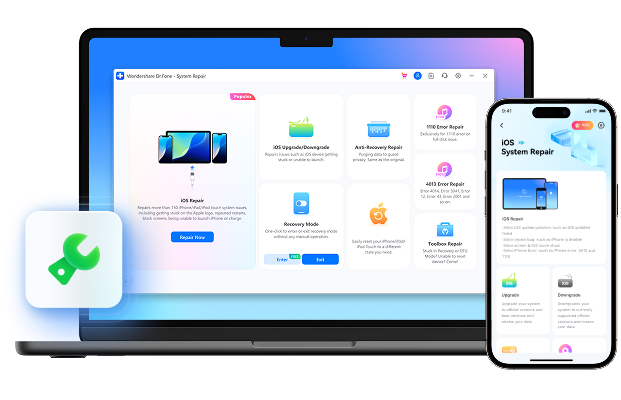
Open the iOS repair workflow
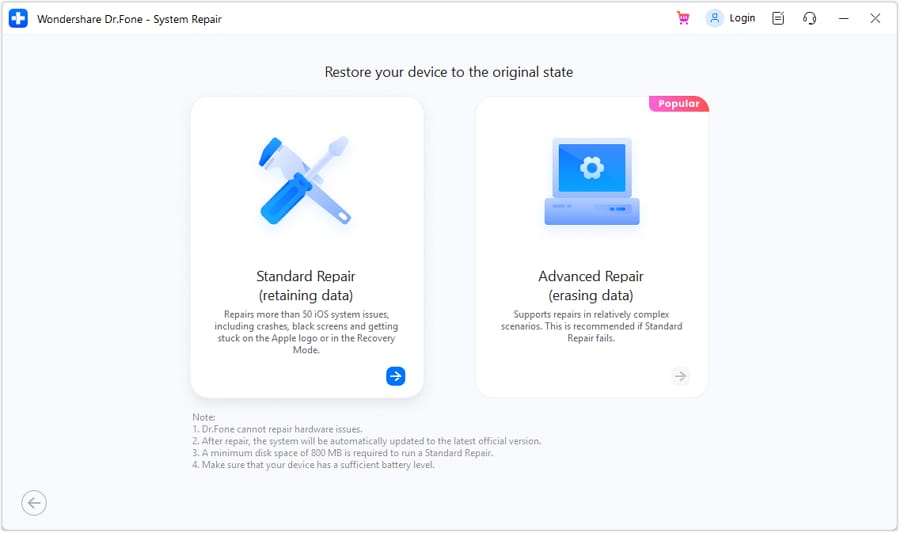
Install Dr.Fone on your computer and connect the device. In Toolbox, choose System Repair > iPhone > iOS Repair. Then choose Standard Repair if you want the data-retaining repair mode, rather than Advanced Repair.
-
Put the connected device into recovery mode
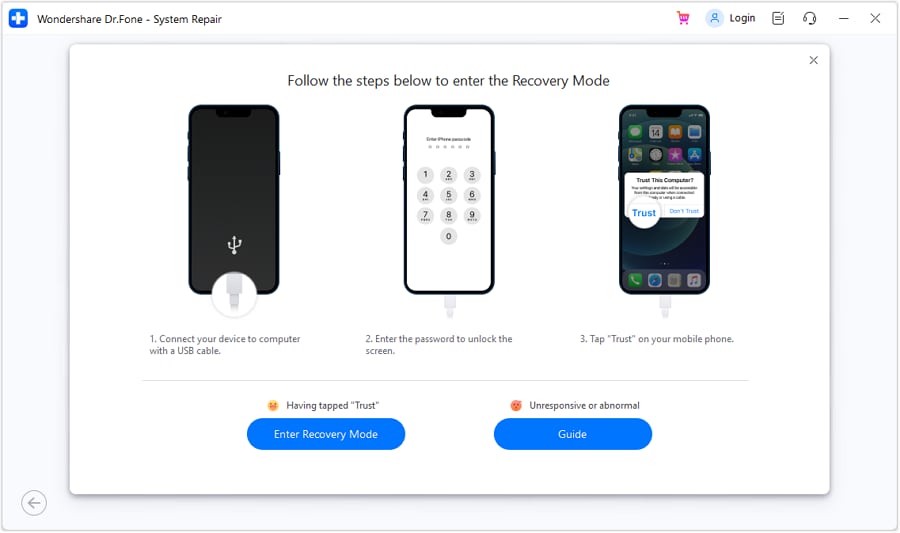
Follow the device-specific instructions. Use Enter Recovery Mode when the device responds; if it does not, use the displayed Guide for manual entry. Entering recovery alone does not repair the system.
-
Download the firmware offered for the device
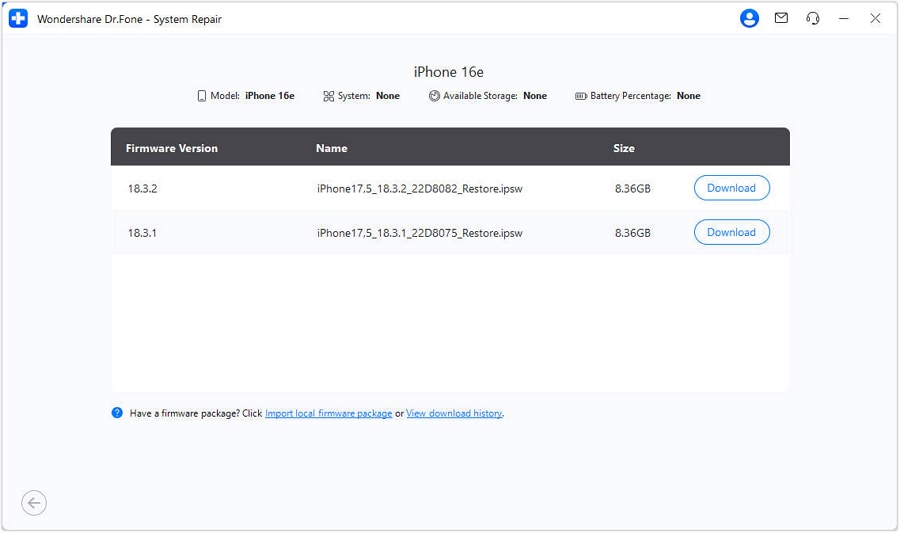
Confirm the detected device and the offered firmware version, then choose Download. Wait for both download and verification to complete. Do not substitute a firmware package for a different model.
-
Run the repair and check the original problem
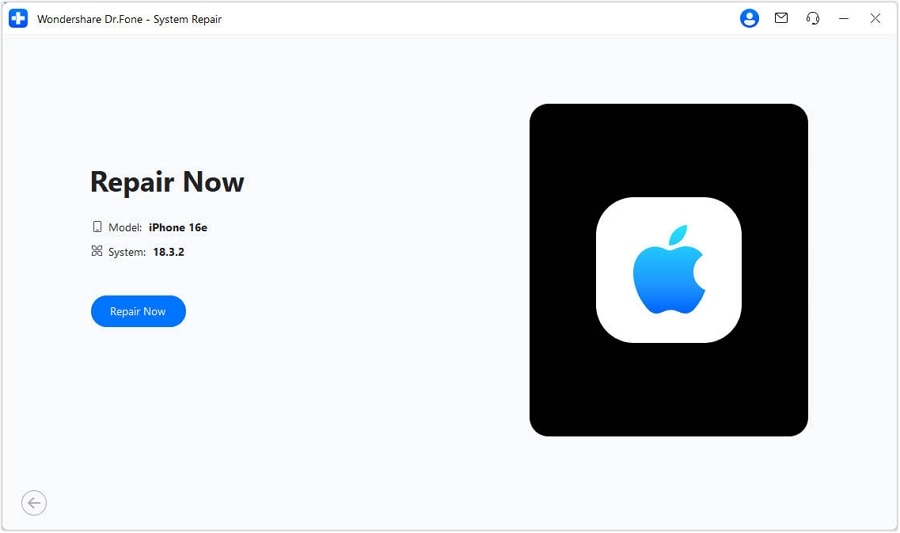
Choose Repair Now when the verified package is ready. Leave the cable connected through installation; select Done when the completion screen appears. After startup, test the original symptom. If it remains, consult support before switching to an erasing mode.
Download for Windows Download for Mac
For the complete interface sequence and mode warnings, see the official iOS System Repair Guide.
Questions before you update or repair
Should I update to the latest public iOS release if I have heard about bugs?
Use the compatible public release offered to your device and review its release notes after making a backup. Apple identifies updates as important for security. A report about an older release does not prove that your model will have the same problem; enrolling in a beta is not the default fix for a public-release issue.
Will deleting the downloaded iOS update delete my photos?
No. Delete Update in iPhone Storage removes the downloaded update package, not your photo library. Deleting photos or apps, choosing Erase All Content and Settings, or using an erasing Restore are different actions. If the update package is not listed, move to the computer-update route instead.
Can buying more iCloud storage solve an iPhone update storage error?
Not by itself. The update needs space on the iPhone to download and install. Review Settings > General > iPhone Storage and use app offloading or the device's recommendations. There is no fixed free-space number that guarantees every update will install.