Fix iPhone 'Liquid Detected' Error: Why It Happens and How to Resolve

Oct 27, 2026 • Filed to: Phone Repair Solutions • Proven solutions
 TL;DR:
A false "Liquid Detected" alert in a completely dry iPhone port is primarily caused by invisible condensation, debris bridging the internal pins, or iOS firmware bugs, and can usually be cleared by air-drying the device for 30 to 60 minutes or addressing the software directly.
● Prioritize physical clearing by gently tapping the downward-facing phone and allowing it to air-dry, strictly avoiding compressed air or cotton swabs that can permanently damage the Lightning or USB-C contact pins.
● For persistent alerts on iPhone 14, 15, and 16 models running iOS 14 or later, replace your current charging cord with an MFi or USB-IF certified cable and install the newest iOS update to resolve sensor calibration glitches specifically tied to iOS 17 and iOS 18.
● Avoid using the built-in Emergency Override feature as it risks permanent electrical damage if microscopic moisture remains; instead, use a MagSafe or Qi wireless charger for temporary power, or run Dr.Fone System Repair to safely reset a stuck iOS charging subsystem without data loss.
Ask AI for a summary
 ChatGPT
 Perplexity
 Gemini
 Claude
 Grok
Grok
Modern iPhones — including iPhone 14, iPhone 15, and iPhone 16 — are equipped with a built-in liquid detection system in their charging ports. This protection mechanism is designed to prevent serious electrical damage by halting the charging process the moment it senses moisture near the connector. The technology uses corrosion-sensing electrodes and software-level detection algorithms to trigger an alert the instant it identifies a risk. While this safety feature is genuinely valuable, it is not foolproof. In a significant number of real-world cases, the liquid detection system misfires — flagging a completely dry port as wet, blocking charging entirely, and leaving users stranded without a working power source.
If your iPhone is saying "liquid detected in lightning connector" but it's not wet, you are not alone — this is one of the most commonly reported iPhone charging issues. The good news is that in the vast majority of cases, this is a false liquid detected alert triggered by non-liquid factors such as humidity, condensation, port debris, a faulty cable, or a software glitch. Understanding exactly why your iPhone falsely detects liquid and knowing how to address each root cause is the fastest path to getting your phone charging again. This guide covers everything: the science behind the detection system, immediate physical remedies, and deeper software fixes — including solutions for iPhone 15 liquid detected but not wet and iPhone 16 liquid detected but not wet scenarios.


Part 1: Everything About iPhone's Liquid Detection System
Quick Answer: iPhone's liquid detection system uses corrosion-resistant electrodes embedded in the Lightning or USB-C port to detect electrical conductivity changes caused by moisture. When moisture is detected — real or false — iOS automatically blocks charging to protect internal components. False positives are common and are usually caused by humidity, condensation, port debris, a damaged cable, or a software bug. In most cases, the alert clears itself once the port is completely dry or after a restart.
Apple's iPhones feature one of the most sophisticated liquid detection systems of any consumer smartphone. Introduced with the iPhone 8 and refined through every subsequent generation — including iPhone 14, iPhone 15 (which transitioned to USB-C), and iPhone 16 — this system is deeply integrated into both the hardware and iOS software stack. Its primary purpose is to protect your device's logic board and charging circuitry from the devastating effects of electrical short circuits caused by liquid ingress.
The liquid detection mechanism works by monitoring the electrical resistance between the pins inside the charging port. In a dry, normal state, the resistance between these pins remains at a predictable baseline. The moment a conductive substance — most commonly water — bridges these pins, the resistance drops sharply. iOS detects this drop in real time and immediately disables the charging function, displaying the "Charging Not Available" or "Liquid Detected in Lightning Connector" alert. This response happens in milliseconds and is designed to be highly sensitive, erring on the side of caution to minimize risk of permanent damage.
Causes of False Liquid Detection
When your iPhone says "liquid detected" but is not wet in the lightning connector, several environmental and technical factors can be responsible. Understanding these causes is key to choosing the right fix:
- High Ambient Humidity: Living in a humid climate or stepping from a cold, air-conditioned room into warm outdoor air can cause microscopic condensation to form inside the charging port — even if no liquid ever touched your phone directly. The detection system reads this condensation as a genuine moisture event.
- Condensation from Temperature Swings: Rapid changes in temperature — such as taking your phone from a cold gym bag into a warm gym — can cause water vapor in the air to condense on the cooler metal surfaces inside the port, triggering a false alert.
- Residual Moisture Residue: If your iPhone was briefly exposed to water in the past (a splash, rain, or high-humidity environment), trace moisture may linger inside the port for hours. Even after the phone feels dry externally, the detector can still sense this residual moisture.
- Lint, Dust, and Port Debris: Fine particles of lint or dust — especially conductive metallic debris — can physically bridge the pins inside the charging port and mimic the electrical signature of liquid. This is one of the most underappreciated causes of false liquid detection alerts.
- Damaged or Low-Quality Charging Cable: A frayed, worn, or non-MFi-certified Lightning or USB-C cable can send irregular electrical signals that confuse the detection system. The phone may interpret the unusual current fluctuation as a sign of liquid contamination.
- iOS Software Glitch: In some cases, the liquid detection trigger is not caused by any physical substance at all, but rather by a bug in the iOS firmware. This is particularly common after major iOS version updates, where the detection sensitivity parameters may be misconfigured.
- Physical Damage to Port Pins: A bent or slightly corroded pin inside the Lightning or USB-C port can permanently alter the baseline resistance reading, causing the system to continuously report liquid detection even in a completely dry environment.
The persistent "liquid detected" alert — especially when your phone keeps saying liquid detected with no apparent cause — significantly disrupts everyday use. It can prevent charging entirely, force users to rely on wireless charging (if available), and create anxiety about potential device damage. For users who rely on their iPhones for work, navigation, or emergencies, even a temporary charging blockage represents a serious inconvenience. Fortunately, the cause in the vast majority of false alert cases is addressable without professional repair.
Which iPhone Models Are Affected?
Liquid detection alerts can occur on any iPhone model running iOS 14 or later, as Apple progressively enhanced the sensitivity of this feature across software updates. The most commonly reported models include:
- iPhone 14 & 14 Pro: Lightning connector — frequently flagged in humid environments.
- iPhone 15 & 15 Pro: USB-C connector — new port design introduced in 2023; iphone 15 liquid detected but not wet reports are common after iOS 17 updates.
- iPhone 16 & 16 Pro: USB-C connector — iphone 16 liquid detected but not wet false alerts often correlate with high ambient humidity or third-party cable use.
- iPad models: liquid detected iPad but not wet scenarios occur similarly, as iPads use the same detection architecture.
📱 iPhone Frozen? Fix It in 3 Steps – No Data Loss!
Struggling with a frozen iPhone screen? 🤔 Our guide covers 6 common causes, step-by-step fixes for all models (iPhone 6s to iPhone 17), and safe data recovery. 98.6% success rate! ✨
Part 2: What To Do if You're Getting Liquid Detection Alerts
Quick Answer: If your iPhone displays a liquid detection alert, first check whether liquid exposure actually occurred. If you are certain the port is dry, apply the physical drying methods below in order. These steps resolve the majority of false liquid detected alerts without any software intervention: gently tap the phone, blow air into the port, dab with a dry cloth, and let the port air-dry completely in a warm, low-humidity environment.
When your iPhone displays the "Charging Not Available — Liquid Detected" alert, the first and most important step is to treat it seriously, even if you suspect it is a false positive. Apple's liquid detection system, while prone to false alerts in certain conditions, exists for a critical reason: charging a phone with genuine liquid in the port can cause irreversible damage to the logic board, charging IC, and battery management system. The repair cost for this type of liquid-induced damage often exceeds the value of an older iPhone model. So before reaching for a workaround, take two minutes to physically inspect the port.
To inspect the Lightning or USB-C port, hold the iPhone under a bright light and look directly into the port opening. Look for visible moisture droplets, a dark or wet appearance on the pins, or any discoloration that might indicate liquid exposure. If any of these are present, the alert is likely genuine and you should follow the drying steps below carefully before attempting to charge. If the port appears completely clean and dry, the alert is most likely a false positive and can be resolved using the methods described in this section.
Before beginning any troubleshooting, power off your iPhone completely to eliminate any risk of electrical short-circuit while the port is potentially compromised.
Methods To Resolve Liquid Detection Alerts
The following step-by-step methods address how to get water out of lightning connector ports and USB-C ports alike. Work through them in order — most users resolve the issue before reaching the final step. After each method, reconnect your charger to test if the alert has cleared:
- Gently tap your phone: Hold the iPhone with the charging port facing downward and gently tap the back of the device several times with your palm. This motion uses gravity and vibration to help dislodge moisture droplets, lint particles, or dust that may be resting on the port's contact pins. Do not shake vigorously — controlled, firm taps are sufficient.
- Blow on the charging port: Hold the iPhone with the port facing you and blow a short, steady stream of air directly into the opening. Keep your breath natural — do not use compressed air canisters, as the high-pressure output can force moisture deeper into the port or damage the delicate pins. Two to three gentle blows are usually enough to displace any loose debris or superficial moisture causing the alert.
- Remove moisture using a cloth: If any visible moisture is present in or near the port, gently dab the area with a lint-free microfiber cloth or a folded corner of a clean paper towel. Keep the iPhone vertical with the port facing down while dabbing. Never insert any object — including a cotton swab — directly into the charging port, as this risks bending pins or leaving behind fibrous residue that worsens the problem.

- Let it evaporate: Place your iPhone in a dry, well-ventilated area at room temperature and leave it undisturbed for at least 30 minutes to 1 hour. Avoid placing it in direct sunlight or near a heat source such as a radiator or hair dryer, as excessive heat can damage the battery and internal components. For faster results, placing the phone in a room with active air circulation or next to a gentle fan works well. Alternatively, placing it inside a sealed bag with silica gel desiccant packets is highly effective at drawing out residual moisture from the port.
- Bonus tip for speaker moisture: If there's moisture near the speaker grille in addition to the charging port, play high-frequency audio content — such as a 165Hz or higher sine wave tone from a frequency generator app or streaming site. The speaker vibrations at these frequencies help pump trapped moisture out of the grille mesh. Several dedicated apps and websites offer "water eject" tones specifically designed for this purpose.
If you've worked through all of the above physical methods but your iPhone still displays "Charging not Available: Liquid Detected" but is not wet, the issue has almost certainly shifted from a physical to a software domain. This is especially likely if: the port looks and feels completely dry, the alert appeared suddenly without any liquid exposure, or the alert persists across multiple restarts. In these cases, continuing to apply physical drying methods will not resolve the problem — the false trigger is coming from iOS itself, not from actual moisture in the port.
The good news is that software-driven false liquid detection is entirely fixable without hardware repair. iOS can misread its own sensor data due to firmware bugs, corrupted system files, or misconfigured charging protocols. The next section provides a comprehensive set of software-level solutions — from simple restarts to full system repair — arranged in order of invasiveness, starting with the easiest and safest options. If you are also experiencing related issues such as an iPhone that won't charge even after the alert clears, the solutions in Part 3 address that as well.
More Articles About iPhone Problems:
- How to Fix Recent Calls Not Showing on iPhone
- iPhone Front Camera Not Working? Here's Every Possible Fix
- Apple Pencil Not Connecting And Pairing? Here's What To Do!
Tips: Looking for an all-in-one mobile management software? Look no further than Dr.Fone App - the ultimate choice for all your needs:
- For iOS Users: Free up space with Smart Clean, remove any restriction including screen lock, iCloud activation lock, MDM, or Apple ID, and transfer data easily between devices with our all-in-one iOS solution.
- For Android Users: Bypass screen locks and FRP with our Android unlocker, change your location with one click, and repair damaged Samsung devices with ease.
Discover more possibilities for mobile management solutions with Dr.Fone App (iOS) and Dr.Fone App (Android). Don't miss out, try it now and revolutionize your smartphone experience.



Part 3: What To Do When It Says Liquid Detected in Lightning Connector but It's Not Wet
Quick Answer: If your Lightning or USB-C connector repeatedly shows a liquid detected alert but the port is completely dry, the problem is almost always software-related. The most effective fixes — in order of recommended priority — are: (1) use a professional iOS repair tool like Dr.Fone System Repair to fix the underlying firmware glitch, (2) try a different certified charging cable, (3) restart your iPhone, (4) reset all settings, (5) update iOS to the latest version, and (6) use the Emergency Override option as a temporary measure. Work through these methods sequentially until the alert is permanently resolved.
A persistent false liquid detected in lightning connector alert that survives physical drying and multiple restarts is a clear signal of a software-level problem. iOS occasionally develops corrupted sensor calibration states, particularly after major software updates (iOS 17, iOS 18), after restoring from a backup, or following a sudden shutdown during charging. In these situations, the phone's charging subsystem becomes stuck in a "liquid detected" protection mode even though no liquid is present. The following six methods address this scenario systematically.
Method 1: Use a Professional Tool for System Issues
When iOS itself is the source of a persistent false liquid detection alert, the most reliable and data-safe solution is to use a professional iOS system repair tool. Wondershare's Dr.Fone is specifically designed to diagnose and repair deep iOS system glitches — including sensor calibration errors, corrupted charging protocols, and firmware-level bugs — without erasing your personal data. Unlike a full factory reset, Dr.Fone's System Repair feature surgically repairs the affected iOS components while leaving your photos, contacts, messages, and apps fully intact. This makes it the recommended first choice for resolving software-driven false liquid detected in lightning connector alerts on all iPhone models including iPhone 14, 15, and 16.
Dr.Fone - System Repair (iOS)
Fix iOS System Issues on Your Own
- Fixes various iOS issues like iPhone stuck on Apple logo, white screen, stuck in recovery mode, etc.
- Works smoothly with all versions of iPhone, iPad, and iPod touch.
- Retains existing phone data during the fix.
- Easy-to-follow instructions provided.
Follow these steps to resolve the "liquid detected" in the lightning connector, but it's not wet issue using Dr.Fone System Repair:
Note: You may find the iPhone won't accept the connection to a computer when liquid is detected, even if it's just a false. In such a case, please try more times. Please consider Apple's after-sales service if the phone still can't connect to your desktop.
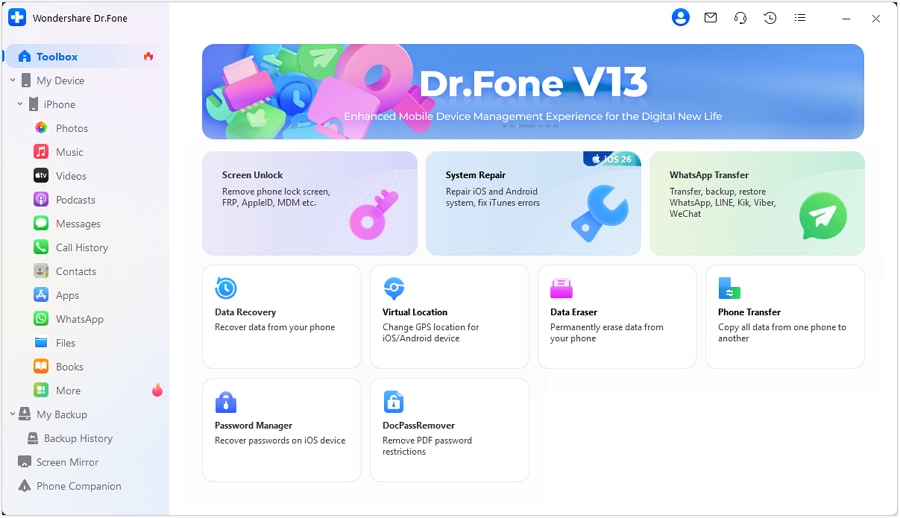
- Step 1: Launch Dr.Fone and click System Repair under Toolbox.
 safe & secure
- Step 2: On the next window, choose iPhone.
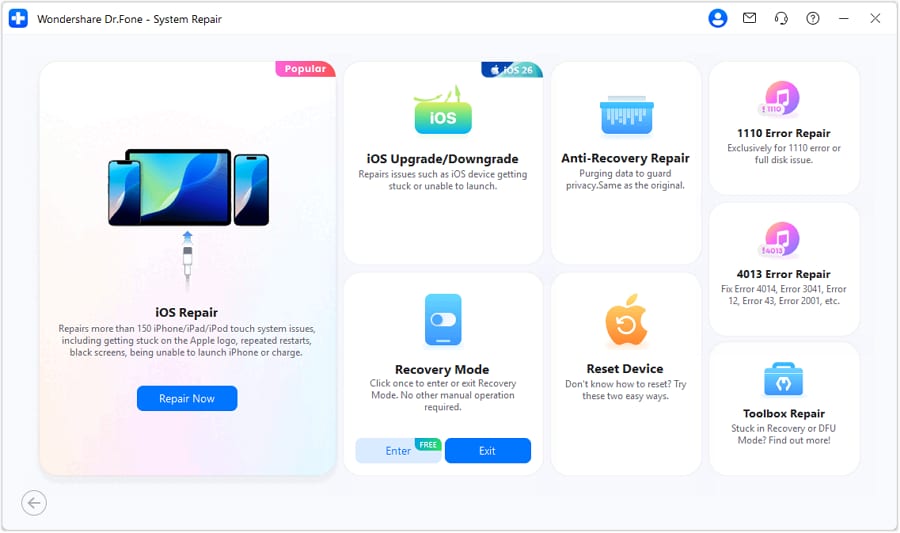
- Step 3: Click iOS Repair.
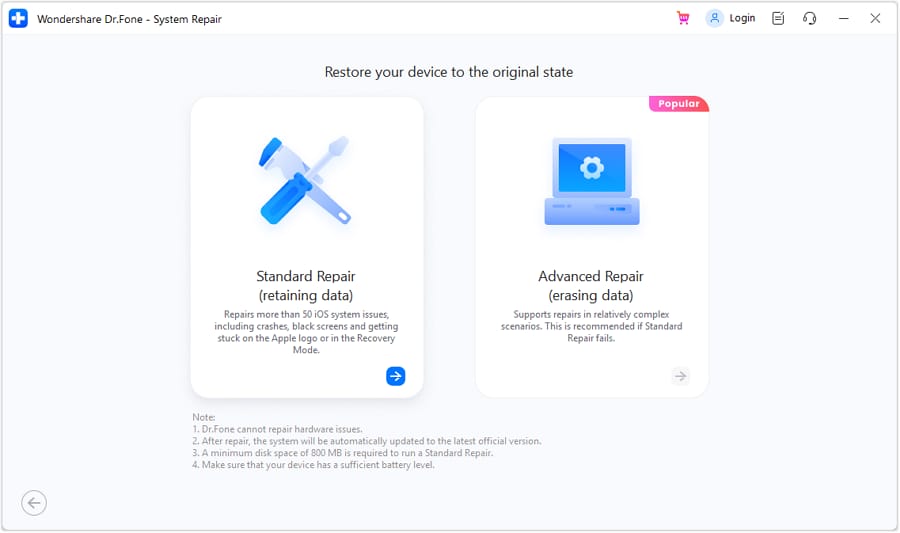
- Step 4: On the next screen, you'll be asked to choose between Standard Repair or Advanced Repair. For a sure-fire fix, choose Advanced Repair. However, if you want to keep your data, choose Standard Repair.
- Step 5: Put your iOS into Recovery Mode by following the on-screen instructions.
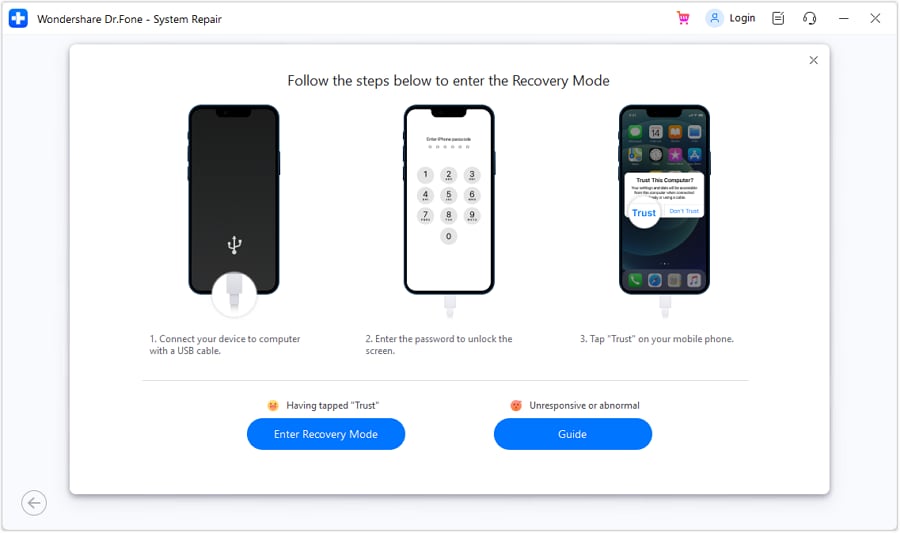
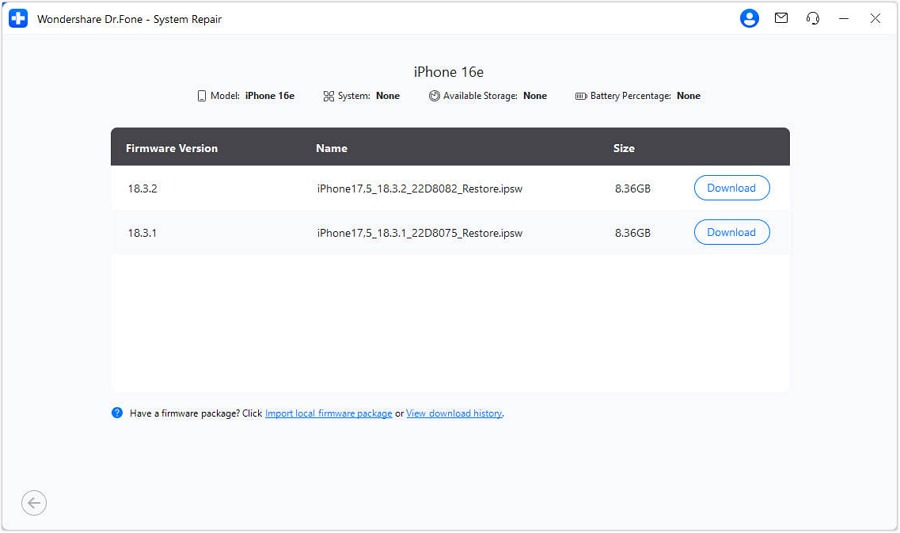
- Step 6: Click Download beside the firmware version you want to install. It will automatically begin downloading.
- Step 7: On the next screen, after downloading, click Repair Now.
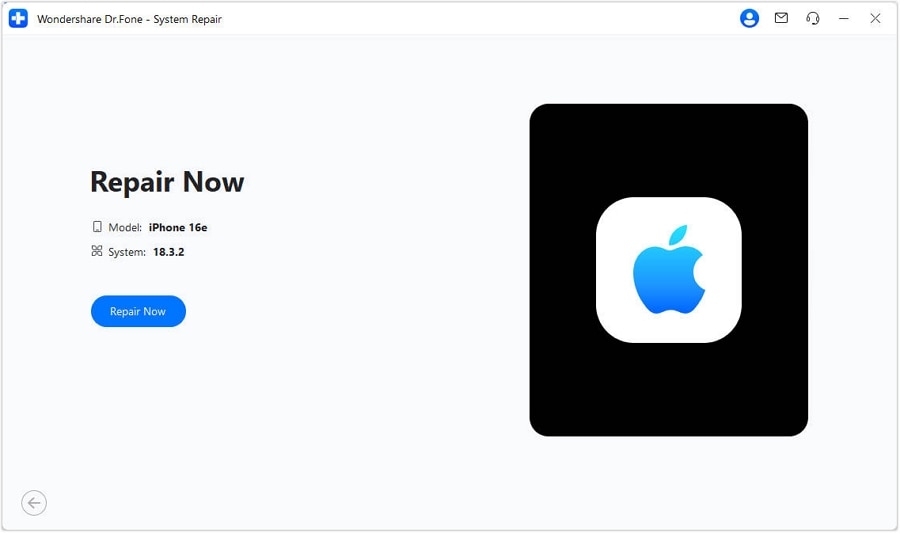
- Step 8: After the process is complete, click Done. The false liquid detection issue should now be resolved.
4,624,541 people have downloaded it
 safe & secure
Method 2: Try a New Charger
A damaged, frayed, or uncertified charging cable is one of the most frequently overlooked causes of persistent false liquid detection. Non-MFi-certified (Made for iPhone) Lightning cables and low-quality USB-C cables can send irregular voltage or resistance signals through the charging port that the iPhone's detection system misinterprets as the electrical signature of moisture. This is especially common with budget third-party cables that fail to meet Apple's strict accessory certification standards.
To test whether your cable is the problem: disconnect your current cable, inspect it carefully for any physical damage (fraying near the connectors, bent pins, or discoloration), and replace it with a different Apple-certified cable — ideally the original cable that came with your iPhone. Connect the new cable and check if the "liquid detected" alert reappears. If the alert disappears immediately with a new cable, the original cable was the culprit and should be discarded. If you're an iPhone 15 or 16 user on USB-C, ensure you're using a USB-C cable that has received USB-IF certification to avoid similar issues.
Method 3: Restarting the Phone
A full restart forces iOS to reinitialize all hardware sensor readings, including the charging port's liquid detection sensors. This clears any temporary sensor state that may have become stuck in a "liquid detected" condition due to a transient firmware glitch, a failed charging cycle, or an unexpected app interaction with the charging system. Unlike simply unplugging the charger, a complete power cycle resets the charging subsystem from scratch.
To restart your iPhone, press and hold the Side button (and either Volume button on iPhone X and later) until the power slider appears. Drag the slider to power off completely. Wait at least 30 seconds — this gives the charging IC time to fully reset. Then press and hold the Side button again to power back on. Once the iPhone restarts fully and reaches the home screen, reconnect your charger to test whether the liquid detection alert persists. For many users experiencing software-triggered false alerts, a single restart is all that is needed.
Method 4: Reset All Settings
If a simple restart doesn't resolve the persistent false liquid detection, the next step is to perform a "Reset All Settings" on your iPhone. This operation restores every iOS system configuration — including charging behavior parameters, sensor sensitivity settings, and hardware detection thresholds — back to their factory defaults. Critically, this process does not delete any of your personal data: your photos, contacts, messages, apps, and downloaded content are all preserved. Only system preferences, Wi-Fi passwords, VPN configurations, and display settings are reset.
To perform a Reset All Settings: Open the Settings app → Tap General → Scroll down and tap Transfer or Reset iPhone → Tap Reset → Select Reset All Settings. You will be prompted to enter your device passcode and confirm the action. The process takes one to three minutes, after which the iPhone restarts automatically. Once restarted, reconnect your charger to check if the "liquid detected" false alert has been cleared. This method is particularly effective for resolving false alerts that began after a major iOS update changed the default system configuration.
Method 5: Update iOS to the Latest Version
Apple frequently releases iOS updates that include targeted bug fixes for known hardware sensor issues, including liquid detection false positives. If your iPhone began displaying a false liquid detected in lightning connector alert after a specific iOS update, it is possible that Apple has already identified and patched the underlying bug in a subsequent release. Keeping your iOS up to date is both a security best practice and a practical troubleshooting step for sensor-related issues.
To update iOS: Open Settings → Tap General → Select Software Update. If an update is available, tap Download and Install. Ensure your iPhone has at least 50% battery or is connected to a power source (using wireless charging if the wired port is showing the alert) before beginning the update. After the update completes and the iPhone restarts, test the charging port again. Many documented cases of iphone 15 liquid detected but not wet and iphone 16 liquid detected but no liquid false alerts were resolved by installing the latest iOS patch. For a deeper repair solution beyond system updates, refer to the iOS System Repair Guide for advanced options.
Method 6: Use Emergency Override (Temporary Measure)
If you are in an urgent situation and absolutely need to charge your iPhone immediately despite the liquid detection alert, iOS provides a built-in Emergency Override option. When the "Charging Not Available — Liquid Detected" alert appears on your screen, a secondary prompt typically displays the option to Charge Anyway or Emergency Override. Tapping this option temporarily bypasses the liquid detection protection and allows charging to proceed.
Important warning: This is strictly a short-term emergency measure, not a solution. Using Emergency Override to charge a phone that has actually been exposed to liquid can cause permanent electrical damage to the charging circuitry and battery. Only use this option if you are completely certain the port is dry — for example, after a known false alert due to humidity — and only until you can address the underlying software cause using the methods above. Do not rely on Emergency Override as a long-term workaround.
To summarize: if your iPhone displays false liquid detection alerts despite being dry, begin with the physical drying methods in Part 2, then use Dr.Fone System Repair as your primary software fix. If the issue persists, work through Methods 2 through 5 in order. Emergency Override is available as a last resort when you need immediate charging and can verify the port is physically dry. Regardless of which method resolves the issue for you, addressing it properly — rather than relying on repeated override — ensures your iPhone's charging system remains healthy and accurate over the long term.
Conclusion
Dealing with an iPhone that persistently says "liquid detected" when the charging port is completely dry is a frustrating experience — but it is almost always fixable without a trip to the Apple Store. As this guide has explained, false liquid detection alerts arise from a range of causes spanning both hardware and software: high ambient humidity, condensation, port debris, a faulty cable, or a firmware-level glitch in iOS itself. Understanding which category your issue falls into is the most important step toward a permanent resolution.
Start by applying the physical drying methods outlined in Part 2 — gentle tapping, careful air-blowing, cloth dabbing, and allowing adequate drying time. These steps resolve the majority of liquid detected iphone but not wet cases quickly. If the alert persists after the port has been confirmed dry, the problem lies in iOS software. In this case, Dr.Fone - System Repair (iOS) provides the safest, most effective solution — repairing the corrupted iOS charging subsystem without touching your data. Supplementary steps such as trying a new MFi-certified cable, performing a full restart, resetting all settings, or updating iOS cover the full spectrum of software-related causes.
Whether you are experiencing charger saying liquid detected on an iPhone 14, facing an iphone 15 liquid detected but not wet alert after an iOS 17 update, or dealing with a stubborn charging not available liquid detected but not wet message on your iPhone 16, the solutions in this guide address every scenario. For iPad users encountering liquid detected iPad but not wet issues, the same methods apply — the underlying detection architecture is identical across all modern Apple devices. Do not let a false alert disrupt your productivity. Apply the appropriate fix, verify the result, and restore your device to full charging functionality.
4,624,541 people have downloaded it
safe & secureFrequently Asked Questions


iPhone Problems
- iPhone Hardware Problems
- iPhone Home Button Problems
- iPhone Keyboard Problems
- iPhone Headphone Problems
- iPhone Touch ID Not Working
- iPhone Overheating
- iPhone Flashlight Not Working
- iPhone Silent Switch Not Working
- iPhone Sim Not Supported
- iPhone Call Volume Low
- iPhone Software Problems
- iPhone Passcode Not Working
- Google Maps Not Working
- iPhone Screenshot Not Working
- iPhone Vibrate Not Working
- Apps Disappeared From iPhone
- iPhone Emergency Alerts Not Working
- iPhone Battery Percentage Not Showing
- iPhone App Not Updating
- Google Calendar not Syncing
- Health App Not Tracking Steps
- iPhone Auto Lock Not Working
- iPhone Screen Recorder No Sound
- Find My iPhone Not Sharing Location
- iPhone Battery Problems
- iPhone Media Problems
- iPhone Echo Problem
- iPhone Camera Black
- iPhone Won't Play Music
- iOS Video Bug
- iPhone Calling Problem
- iPhone Ringer Problem
- iPhone Camera Problem
- iPhone Front Camera Problem
- iPhone Not Ringing
- iPhone Not Sound
- iPhone Mail Problems
- Reset Voicemail Password
- iPhone Email Problems
- iPhone Email Disappeared
- iPhone Voicemail Not Working
- iPhone Can't get Mail connection
- Gmail Not Working
- Yahoo Mail Not Working
- iPhone Update Problems
- iPhone Stuck at the Apple Logo
- Software Update Failed
- iPhone Verifying Update
- Software Update Server Couldn't Be Contacted
- iOS update Problem
- iPhone Won't Update
- iPhone Connection/Network Problems

 > How-to > Phone Repair Solutions > Fix iPhone 'Liquid Detected' Error: Why It Happens and How to Resolve
James Davis
staff Editor
Generally rated4.5(105participated)