Effortlessly manage data through preview, delete, export, etc.

 100% Security Verified | No Subscription Required | No Malware

 :
: 
 ChatGPT
 Perplexity
 Gemini
 Claude
 Grok
Grok
I connected to my campus Wi-Fi months ago, but now I want to connect my new laptop. I completely forgot the password. Is there any way to find wifi password android without having to ask the IT department again?
Android User Forum

Since the initial release of the Android OS in 2008, our digital ecosystem has undergone a dramatic transformation. Today, in 2026, Android devices control a massive portion of our daily communications and internet usage. As developers continually refine the interface, the capabilities of our smartphones expand, making them indispensable hubs for connectivity.
Most of the time, our Android usage relies heavily on internet access. The built-in Wi-Fi capability allows us to seamlessly surf the web, stream media, and work remotely. Over time, your device connects to countless networks—at school, sub-way cafes, gyms, buses, hospitals, hotels, and various towns. Passwords secure the majority of these networks. Naturally, it is nearly impossible to memorize all these credentials for future use, especially when you need to connect a secondary gadget, like a newly purchased tablet or a laptop. If you are stuck in this situation, this comprehensive guide will introduce you to reliable methods to android show wifi password on both rooted and unrooted Android devices.
In this article
Part 1: Show Wi-Fi Password on Rooted Android Device
If you have a rooted device, retrieving saved Wi-Fi credentials is a straightforward process. However, before diving into the steps to find wifi password android, it is essential to understand what rooting entails.
1-1. What is Rooting?
First of all, what exactly does rooting mean? If you have ever used a Windows or Linux computer, you are likely familiar with administrator privileges. For instance, in Windows, when you attempt to install new software, a dialog box often prompts, "Administrator permission required to run this program." Without these permissions, the installation is blocked. In the Android ecosystem, acquiring this level of deep system access is called rooting. Simply put, it grants you "root permission" or superuser access to your phone's internal framework. Certain advanced Android applications require root permission to function, such as flashing custom ROMs or accessing hidden system files.
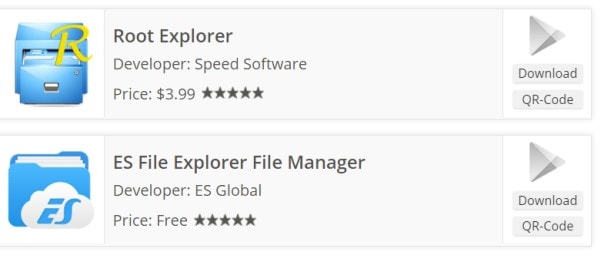
To successfully perform an android show wifi password operation on a rooted phone, you need a specialized file explorer app capable of navigating root directories. Excellent choices include ES File Explorer or Root Explorer. Since Root Explorer is typically a paid application, we will demonstrate the process using the widely available ES File Explorer.
1-2. Steps of getting Wi-Fi password on Android with root
By following these four precise steps, you can quickly locate and reveal the password of any Wi-Fi network previously saved on your rooted Android phone.
Step 1 Install the ES File Explorer
Begin by launching the Google Play Store on your device. Search for ES File Explorer (or a similar root-capable file manager), download it, install it, and then open the application.

Step 2 Enable Root Explorer
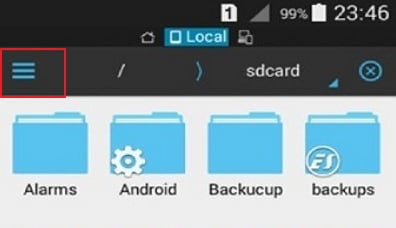
To reach the restricted system folders containing your Wi-Fi credentials, the root explorer functionality must be activated. By default, this feature is disabled in ES File Explorer for safety. To enable it, tap on the menu icon (usually three horizontal lines) located in the top left corner of the screen.
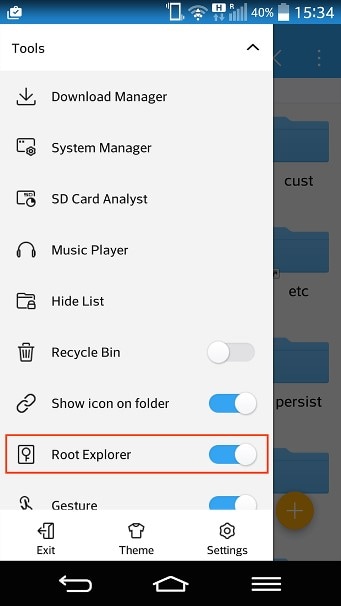
This action will drop down a comprehensive list of settings and controls. Scroll down through this list until you find the Root Explorer option, and toggle the switch to enable it. Grant superuser permission if your root management app prompts you.
Step 3 Get the passwords' file
Now that root access is active within the app, navigate back to the main local directory in ES File Explorer. Look for the system folder named data and tap to open it.
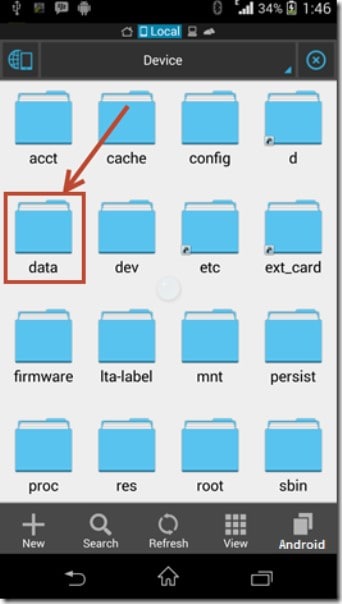
Once the data folder opens, scroll to locate another folder named misc. Open it, and inside, find the directory named wifi. Finally, look for a specific configuration file labeled wpa_supplicant.conf. This file acts as the vault for all your saved network information.

Step 4 Retrieve the wifi password on Android
Tap on the wpa_supplicant.conf file and choose the built-in HTML/text viewer to read it. Crucial Warning: Ensure that you do not edit or delete anything inside this file. Altering its contents might corrupt your network data, causing you to lose access to your saved Wi-Fi networks in the future.
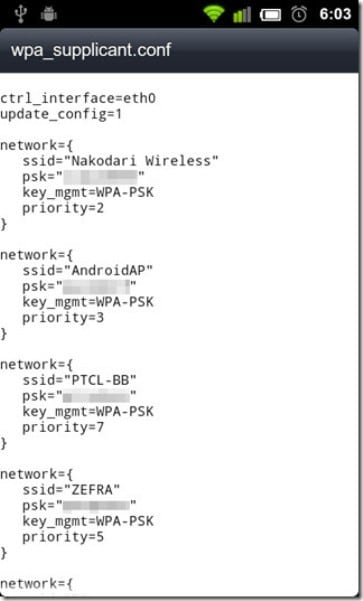
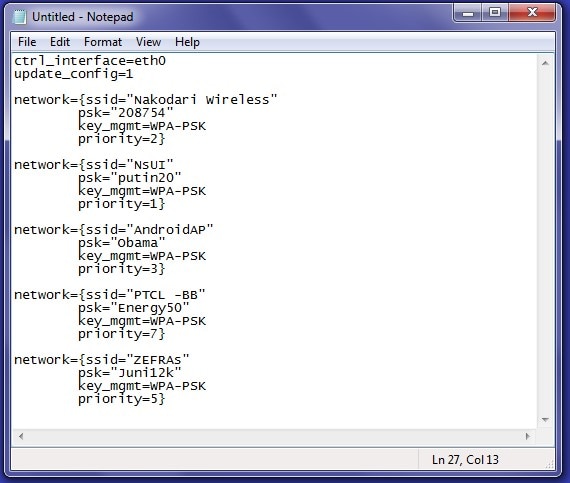
As illustrated in the image above, the file clearly displays the saved network details. For each network profile, the network name is represented by ssid="{the name}", the actual network password is represented by psk, the security access protocol by key_mgmt=WPA-PSK, and its connection priority by priority. You have successfully managed to find wifi password android.
Part 2: Show Wi-Fi Password on Android without Root
What if you do not have root access to your Android device? Can you still view saved Wi-Fi credentials? The short answer is yes. However, the process is slightly more involved, though still quite manageable. You do not need to be an advanced programmer to execute it, but you will require a computer and internet access to download necessary tools. The core concept is to find a pathway to extract the password configuration file from the phone without requiring an on-device root protocol. We accomplish this by utilizing the Windows Command Prompt and Android Debug Bridge (ADB).
2-1. Steps to show Wi-Fi password on Android without root
Follow these precise instructions to fetch your network credentials using a PC interface.
Step 1 Access the Developer authority
To interact with the deeper files that Android relies on, you must first unlock Developer Options on your device. This is a built-in, simple procedure.
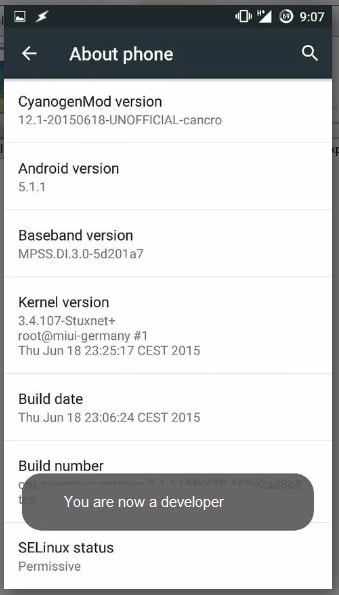
Grab your Android phone and navigate to the Settings menu. Scroll all the way down and tap on About phone. Within this section, scroll down again to locate the Build number entry.

Tap rapidly on this "Build number" about 5 to 7 times. A small countdown toast message will appear, eventually stating, "You are now a developer!"
Step 2 Enable the debugging
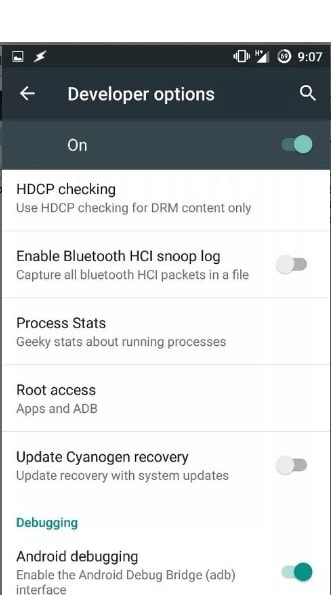
Return to the main Settings menu. You will now see a new menu item labeled Developer options (sometimes located under 'System'). Tap to enter it, scroll down to the debugging section, and toggle on the switch for USB debugging.
Step 3 Install ADB drivers
Next, move over to your Windows computer. You need to download and install universal ADB drivers to ensure your PC recognizes the phone. (Use this download link adbdriver.com). Furthermore, you must download and extract the Android platform tools (minimal ADB and fastboot) from http://forum.xda-developers.com/...
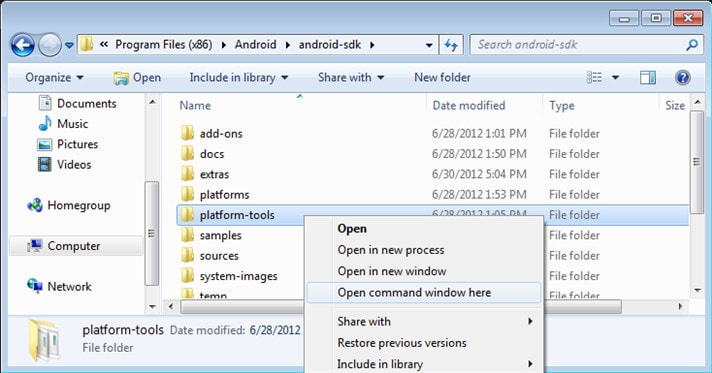
After extracting, navigate to the folder containing these tools. By default, it might be located in your local drive at C\windows\system32\platform_tools, or wherever you chose to unpack them. Once inside the correct folder, hold down the Shift key on your keyboard and right-click on an empty space inside the folder. From the context menu, select "Open Command Window Here" or "Open PowerShell window here".
Step 4 Test the ADB connection
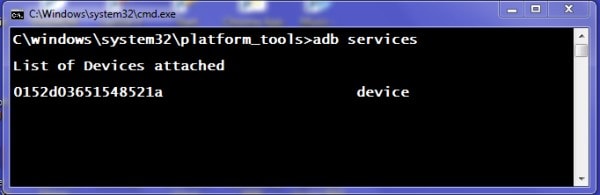
It is vital to verify that ADB is functioning and communicating with your phone. Connect your Android device to the PC using a reliable USB cable. Keep your phone screen unlocked. In the command prompt window on your PC, type the command adb devices and press Enter. If everything is configured correctly, the system will start the daemon and display an alphanumeric string representing your attached device.
Step 5 Find the Android wifi password
With the connection confirmed, it is time to execute the command that will retrieve the file. In the command prompt, carefully type the following command exactly as shown: adb pull /data/misc/wifi/wpa_supplicant.conf c:/wpa_supplicant.conf and hit Enter. This specific instruction tells ADB to fetch the configuration file from your phone's deep storage and copy it to the root of your PC's C: drive.
Step 6 Get the wifi passwords
Finally, navigate to your local C: drive on your computer. Locate the newly transferred wpa_supplicant.conf file. Right-click it, select "Open with," and choose a basic text editor like Notepad. There you go—the passwords (next to psk=) are now completely visible on your desktop.
You have now successfully mastered how to android show wifi password without needing to alter your device's core firmware.
 Effortlessly manage data through preview, delete, export, etc.
- Transfer all data between devices.
- Robust backup solutions for reliable data protection.
- Mirror screens to PC for meetings, teaching, and control.
Conclusion
In this digital era, having a dependable method to retrieve network credentials can save you from significant connectivity headaches. Whether you opt for utilizing a root file explorer to access the wpa_supplicant.conf file directly on your handset, or you leverage the power of ADB commands to extract the data to your PC without rooting, both methods provide a definitive solution to find wifi password android. Remember to handle system files with care, and you will never have to worry about forgetting a critical Wi-Fi password again.
FAQ
1. Is it safe to use ADB to find wifi password android?
Yes, using Android Debug Bridge (ADB) is generally safe as it is an official developer tool provided by Google. However, it requires following the command line instructions carefully. Pulling the configuration file to your PC poses no risk to your phone, provided you do not execute malicious commands or randomly delete system files via the command prompt.2. Can I use a third-party app to view passwords without root?
Most standard third-party apps available on the Play Store that claim to show Wi-Fi passwords will require root access to function. This is due to Android's strict sandboxing and security protocols that prevent regular apps from accessing sensitive system directories like/data/misc/wifi. For unrooted devices, the ADB method via PC remains the most reliable workaround.3. What happens if I accidentally edit the wpa_supplicant.conf file?
Thewpa_supplicant.conffile contains crucial data regarding your saved network profiles and their respective security keys. If you accidentally edit, delete, or incorrectly format text within this file, your device may lose the ability to automatically connect to previously saved networks. If this happens, you will likely need to manually re-enter the passwords for all your Wi-Fi connections.4. Are there alternative ways to share Wi-Fi on newer Android versions?
Yes. On modern Android versions (Android 10 and above), Google introduced a built-in feature to share Wi-Fi credentials via QR codes. You can navigate to your Wi-Fi settings, tap on the currently connected network, and select the 'Share' option. This generates a QR code that another device can scan to connect, effectively bypassing the need to extract the raw text password from system files.
 Add Wondershare Dr.Fone as a preferred source on Google