 Teleport your device anywhere instantly with one click.


 100% Security Verified | No Subscription Required | No Malware


 :

 ChatGPT
 Perplexity
 Gemini
 Claude
 Grok
You can simulate an Android GPS location without rooting by selecting a mock-location app in Developer options. That changes the coordinates supplied through the testing mechanism; a VPN instead changes the network route and public IP address. These methods solve different problems and neither makes you invisible to every app.
If an untrusted app asks for location, start with Android's permission controls rather than granting access and hoping fake coordinates provide complete protection. You can restrict access, use approximate location where offered, or remove the app. For legitimate location testing, the following sections explain use cases, GPS-versus-VPN differences and the complete setup shown in the original screenshots.

In this article
Part 1: Why people simulate an Android GPS location
People investigate ways to fake the GPS location on your Android device for app testing, map demonstrations and location-dependent experiences. Before choosing a tool, identify which location signal the target app uses and whether simulation is permitted.
- Location-based games: changing coordinates may move a map marker, but competitive games can prohibit it and penalize accounts.
- Location sharing: a mock position does not guarantee that a family, employer or other service stops receiving real or previously stored information. Review the actual sharing settings.
- Regional app availability: a Play Store country or account restriction is not guaranteed to change when GPS changes.
- Social demonstrations: a simulated place can illustrate app behavior, but it should not be presented as evidence that you physically travelled there.

The original article groups games, social platforms, dating services and streaming restrictions together. Their location systems are not interchangeable. The following distinctions prevent a successful map test from being mistaken for a universal bypass.
Pokemon Go and real-world game locations
Pokemon Go places encounters and other activities on a real-world map. A simulator can report a selected coordinate to Android, but that does not make remote captures legitimate or ensure that the game accepts the result. The current official player guidelines explicitly prohibit falsifying location.
The source's example of appearing in the United States while physically in Japan describes the intention of spoofing, not a verified outcome. Do not rely on it as a way to collect Pokemon without travel or avoid penalties. Use the official game with genuine location for ordinary play.

Instagram, Snapchat and Facebook location sharing
A social post can contain several different kinds of location information: an explicitly added place label, a photo's metadata, a map-sharing setting or coordinates requested by the app. Changing one GPS input does not automatically remove the others. If you do not want a post to reveal a location, inspect its tags and the app's sharing controls before posting.
Location simulation also does not provide anonymous story viewing, erase account activity or defeat screenshot protections. For privacy, limit app permissions and remove unwanted location information deliberately. A vacation hashtag is descriptive text, not proof that the phone or person visited that destination.

Tinder and other dating-app discovery regions
Dating services may use device location alongside account settings and their own rules. A simulated GPS point might not change the discovery region you expect, and it does not unlock paid travel features or private profiles. First check the location options officially available in your account.
If you are planning a trip or want to meet people elsewhere, describe that intention honestly. Changing a marker is not a substitute for accurate profile information, and the original promise of effortless cross-border matches is not a guaranteed result.

Media blackouts and regional access limits
Streaming restrictions can depend on IP-based region, account country, subscription rights and other checks, not just phone GPS. Therefore, a fake GPS app alone does not reliably remove a sports blackout or make a region-locked service available.
The source names several countries as examples, but no current broadcast rights or access results are verified here. Check the provider's licensed availability and terms. A VPN connection likewise does not guarantee access or permission to view content outside your subscription region.

Part 2: GPS simulation versus a VPN
Choose according to the input you need to test. A GPS simulator changes reported device coordinates through software. A VPN routes network traffic through a server, affecting the public IP seen by online services. Combining their names under a single location-hiding label obscures that difference.
What GPS spoofing means in this Android guide
Phones can determine location using satellite navigation and other signals. GPS, Galileo, GLONASS and BeiDou are satellite navigation systems, but an ordinary Android mock-location app does not rewrite the radio signals transmitted by those satellites. It supplies simulated location data through the operating system's test facility.
This distinction corrects the original explanation: software simulation and radio-frequency signal spoofing are not the same mechanism. An app can also identify or reject mock data, and other signals may disagree with the chosen coordinates. No rooting is inherently required to use Android's documented mock-location selection.

What a VPN changes
A virtual private network creates an encrypted connection between the device and the VPN endpoint for traffic it carries. Online services commonly see the endpoint's public IP rather than the connection's usual public IP. That can change IP-based regional estimates, but it does not by itself replace GPS latitude and longitude.
- Encryption protects the VPN tunnel, not every piece of information an account or app already knows about you.
- The chosen server influences the apparent public-IP region; available destinations depend on the provider.
- Some services restrict VPN use or detect VPN endpoints, so regional access is not assured.
- A VPN is not a firewall replacement and does not eliminate trust in the provider.
The source's IP-address description also needs precision. IPv4 commonly uses dotted decimal notation; IPv6 uses hexadecimal groups separated by colons. Neither address format is a literal street address or an exact GPS coordinate.

Key differences at a glance
| Comparison | Android GPS simulation | VPN connection |
|---|---|---|
| Location input affected | Reported device coordinates in supported app workflows | Public IP visible to services using the tunnel |
| Underlying mechanism | Software mock-location or supported device-location control | Network traffic routed through a VPN endpoint |
| How a place is selected | Map pin, address or latitude and longitude | Available server or server region |
| What remains separate | Public IP, saved profile region and past activity | Phone GPS, photo tags and account country |
| Security and access limits | Does not encrypt traffic or guarantee app acceptance | Encrypts carried tunnel traffic but does not guarantee regional access |
Part 3: Setting a mock Android location without root
Use a trusted utility only on a device you control and for an app workflow that permits simulated coordinates. The original demonstration uses Lexa Fake GPS. Screens and names vary by Android release and manufacturer, so the images below illustrate the source workflow rather than certify a current app build.
-
Step 1 Open the phone information screen
In Settings, locate About phone. On some devices, the relevant build information is inside an additional information submenu.

-
Step 2 Find software information
Open Software information if your phone provides it, or use the equivalent page containing Build number. Do not change unrelated system settings.

-
Step 3 Enable Developer options
Tap Build number seven times, as Android's official instructions describe, and complete any device-authentication prompt. Return to Settings to locate Developer options.

Assign the mock-location provider next. Install the intended, trusted GPS test app before selecting it if your Android release requires a named provider.
-
Step 1 Open Developer options
Find the developer-settings page in Settings or its System submenu. The manufacturer may use a different path from the retained image.

-
Step 2 Choose the installed mock-location app
Current Android documentation calls this Select mock location app. Choose the trusted utility you intend to use. The original screenshot's generic mock-location switch reflects an earlier interface and is not the exact control on every phone.

Run the Lexa demonstration only where compatible. Verify the installed app's publisher and follow its current permission prompts. The three source screens show the map-selection stage after Android preparation.
-
Step 1 Open the GPS utility
Launch Lexa Fake GPS and wait for its map. If it asks for mock-provider selection, return to Developer options and confirm the correct app rather than downloading a different APK at random.

-
Step 2 Position the map marker
Use the location-selection control or move the map pin to the intended test point. Confirm the city or coordinates before starting the simulation.

-
Step 3 Start, verify and stop the test
Apply the selected point using the app's current start control, then inspect a permitted map or test application. A notification alone does not prove that every app uses the simulated position. Stop the utility when finished and clear the mock-provider selection if appropriate.

Part 4: Using a VPN for IP-based location, not GPS
The original section called this faking Android location with a VPN. More precisely, the workflow changes the network endpoint seen by services, while the phone's GPS can remain at its actual position. Use it only when the network route or IP-based estimate is the relevant concern.
-
Step 1 Evaluate a compatible VPN provider
Review the publisher, privacy policy, permissions, server locations and subscription terms in the legitimate store listing. Do not choose solely because an app claims unrestricted access.

-
Step 2 Install and review the connection request
Follow the provider's setup prompts and read Android's VPN connection notice. Only approve a provider you trust to carry the traffic routed through it.

-
Step 3 Select a server and confirm connection
Open the VPN app and choose an available destination. The source interface groups servers into Recommended, All and Favorites; your provider may use different labels. Wait for a connected status rather than assuming that tapping a country has activated the tunnel.

After connecting, inspect the public-IP region with an appropriate network check. A GPS map may still show the actual phone location, which is expected. Disconnect when you no longer need the VPN. Neither the server choice nor an apparent IP-region change guarantees streaming rights or a different app-store country.
Dr.Fone - Virtual Location for desktop-controlled GPS simulation
 Set your map route to simulate GPS movement.
- Set your wanted movement speed.
- HD and large map view to check location.
- Fake GPS location to anywhere.

Dr.Fone - Virtual Location lets you select a position on a desktop map and simulate GPS movement on a supported connected phone. Teleporting, route selection and speed controls address location testing; they do not encrypt internet traffic, replace a VPN or guarantee that another service accepts the coordinates.
Check the current device and OS requirements before starting. Keep the intended test limited to applications and accounts where simulation is allowed. The following map workflow is independent of the Lexa and VPN demonstrations above.
-
Step 1 Connect the phone
Open the desktop program, select Virtual Location and complete the connection and device-permission prompts for your supported model.
-
Step 2 Choose the test coordinates
Select Teleport Mode, search for the destination and check the map pin. Use Move Here to confirm the intended position.

-
Step 3 Verify and restore
Open the phone's map to inspect its reported location. When testing is complete, use the program's restoration instructions or restart-device prompt and confirm that the actual location returns.
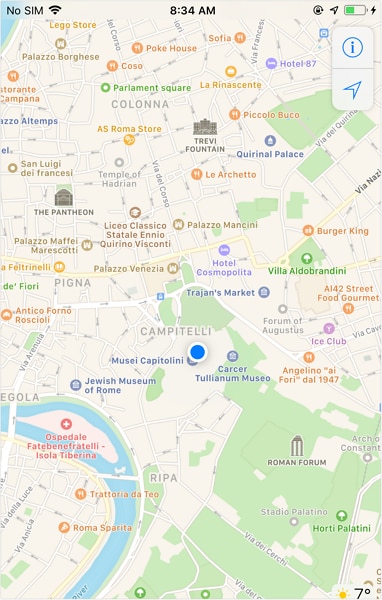
Map verification checks the GPS test only. Separately inspect network routing, account-region settings and sharing permissions when those are the actual issue.




Conclusion
For fake GPS on Android without root, use the developer mock-location workflow when the target activity permits it. For IP-based routing, choose a trustworthy VPN instead; these are not substitutes. Privacy starts with permissions and sharing settings, not a promise of invisible tracking. If you prefer a computer-controlled GPS map for a supported phone, Dr.Fone - Virtual Location is the separate option above. Compliance depends on the use and service rules, not a blanket claim that every commercial use is illegal.
FAQ
-
1. Can I set a fake Android GPS position without root?
Android provides Select mock location app in Developer options for testing. A trusted installed utility and a compatible target workflow are still required. -
2. Does a VPN replace my phone's GPS coordinates?
No. A VPN changes the network path and public IP for carried traffic; GPS simulation changes reported device coordinates. -
3. Will mock GPS stop every app from tracking me?
No. Apps may use account data, permissions, network information or stored history. Review location sharing and permission controls directly. -
4. Why does one app reject a simulated location?
Apps can detect or disregard mock data and use other location inputs. A successful map test is not a guarantee of game, dating or streaming compatibility.
 Add Wondershare Dr.Fone as a preferred source on Google



