 Teleport your device anywhere instantly with one click.


 100% Security Verified | No Subscription Required | No Malware


 :

 ChatGPT
 Perplexity
 Gemini
 Claude
 Grok
You can supply a test location on many Android phones through Developer options and a compatible mock-location app. That changes the coordinates supplied to participating apps; it does not replace your IP address, repair satellite reception, or guarantee access to another country's services. Some applications detect or reject mock positions.
This fake GPS Android guide explains the use cases, three phone-based tools, and a desktop alternative without treating every location claim as equally reliable. Use a device you control, check its current Android support, and restore real positioning after testing. If privacy is your main concern, restricting an app's location permission is often more direct than supplying invented coordinates.
In this article
- Part 1: When Can You Fake Your GPS Location?
- Part 2: Spoofing Your Location on Android Devices
- Method 1: Using the Fake GPS Location App to Alter GPS on Android
- Method 2: Using PoGoskill Android App to Fake GPS
- Method 3: Using GPS Joystick App to Fake GPS on Android
- Part 3: Top Alternative Location Changer App to Fake GPS on Android
- Comparison of the Best Fake GPS Android Apps
- Author's Verdict
Part 1: When a Mock Android Location Helps, and When It Does Not
A GPS spoofer Android workflow is most appropriate for testing location-dependent behavior. The six common reasons below need different caveats: changing coordinates can affect an app's map response, but many regional and privacy decisions use information beyond GPS.
1. Checking Claims About Earlier Android Updates
Moving a map pin to a country with a newer rollout is not a dependable way to obtain an Android system update. Availability can depend on the phone model, carrier, build, and release schedule. Check Settings and your manufacturer's supported update route instead of assuming a fake GPS location changes eligibility.
On many devices, Settings > System > Software updates provides the supported check. Keep adequate battery and storage available. A mock-location utility does not install firmware, grant support to an unsupported model, or replace the manufacturer's update process.
2. Limiting Unnecessary Location Exposure
A test position may change the coordinates an app receives, but it does not make the device untraceable. An app can still have account information, an IP address, or other permitted signals. Review precise-location and background-access settings first, and deny location entirely when the feature does not need it.

3. Understanding Streaming Region Restrictions
Do not expect a fake GPS Android app to unlock a Netflix or Amazon Prime catalog. Streaming availability may depend on network location, account country, licensing, and the service's rules. GPS simulation is not a VPN, does not encrypt traffic, and cannot guarantee a change to the catalog a service permits you to watch.
4. Exploring Another Area in a Dating App
Location-dependent discovery can be useful when planning a move, but dating services may use their own travel features or enforce restrictions on simulated positions. Check the app's supported location controls and be clear with matches about where you actually live. Changing coordinates does not guarantee more profiles, more matches, or access to a paid travel feature.

5. Testing Coordinates When Reception Is Weak
Manually supplied coordinates can make an app test reproducible, but they do not strengthen a weak GPS signal. For genuine positioning problems, check permissions, location accuracy settings, obstructions, and device support. A simulated pin is not evidence that the hardware is locating you correctly.
Keep testing separate from navigation, deliveries, emergency functions, and family safety arrangements. Those situations need an honest position, not a coordinate chosen to make an inaccurate display look plausible.
6. Controlling Social App Location Information
A social application may use a supplied position for a nearby view or location tag. It may also retain previous posts, account details, or other location-related signals. Remove unnecessary geotags and review sharing permissions rather than promising that spoofing hides every trace of where you are.

Part 2: Three Android Mock-Location Workflows
Android's developer setting lets you nominate a mock-location provider for testing. App names, supported modes, pricing, and device requirements differ; these tools are not interchangeable. Check the developer and package listing rather than installing the first application with a similar name.
Only grant permissions that you understand. Do not disable device protection, downgrade core Google components, or add an unknown APK merely because an old tutorial presents those actions as universal prerequisites.
Method 1: Select a Fake GPS Location App as the Test Provider
A basic Fake GPS Location utility can be sufficient for a stationary test point. Several applications use similar titles, so confirm the current store listing, developer, and compatibility before installation; the title alone does not establish a particular publisher or a best-in-class result.

Step 1 Install the intended application
Use its verified Google Play listing where available. Read the permission and compatibility information, then install it on the Android phone you will test. Avoid assuming that every similarly named app has the same controls.
Step 2 Enable Developer options
Find Build number under About phone; Samsung commonly places it under Software information. Tap Build number seven times and complete the device's authentication prompt if requested. Menu names vary by manufacturer.
Step 3 Open the developer settings
Return to Settings and locate Developer options, sometimes under System or an Advanced submenu. Keep changes limited to the setting needed for the test rather than altering unrelated debugging controls.
Step 4 Choose the mock provider
Open Select mock location app and nominate the installed Fake GPS utility. This authorizes that application to provide test coordinates; it does not force all third-party apps to accept them.
Step 5 Start and verify the test
Open the utility, choose the intended point, and start its mock-location session. Check an appropriate map or your own test app. Afterward, stop the session and remove the selected mock provider if you no longer need it.
Method 2: Review the Current PoGoskill Android Workflow
The source describes PoGoskill as a map-based Android location utility with destination selection and coordinate entry. Treat its present edition and supported devices as purchase checks rather than assuming it needs no configuration. A product's gaming-oriented marketing is not proof of compatibility with any particular game.

Step 1 Check the publisher's supported installer
Consult the official product instructions for the edition you intend to use. Confirm Android requirements, installation source, and payment terms before downloading. Do not treat an unrelated reposted APK as the publisher's installer.
Step 2 Complete the documented setup
Review its location requests and follow the current device-specific configuration. If it asks you to weaken security or install a modified service client, stop and reassess rather than assuming that is essential for ordinary mock-location testing.
Step 3 Select and check a position
Use the supported map search or coordinate-entry control, review the destination, and apply the test position. Check the actual target app afterward. A successful selection inside the utility does not prove that a separate app accepts the result.
Method 3: Use GPS Joystick Without Treating Legacy Downgrades as Required
GPS Joystick by The App Ninjas is intended for map-based coordinate and movement control. Its setup documentation distinguishes different modes and devices. The source article's seven-stage sequence mixes ordinary mock-location selection with legacy Google Play services changes; those changes should not be carried forward as a general 2026 setup recipe.
Step 1 Obtain the correct GPS Joystick
Check The App Ninjas' current listing and documentation, then install the supported edition. Confirm the publisher so a similarly named utility is not mistaken for the same product.
Step 2 Keep an appropriate update policy
The old sequence advises disabling automatic updates. Do not disable updates globally just to run a location test. Keep applications supported, and use the developer's current compatibility guidance if a particular update changes behavior.
Step 3 Preserve device-finding protection
The source also tells readers to switch off Find My Device. That is not a blanket requirement for selecting an Android mock provider. Leave Find Hub and recovery protections enabled unless a documented, understood test genuinely needs a temporary change.
Step 4 Do not remove Google Play services updates as routine setup
Removing core-component updates can break unrelated functions. For a normal test, use the currently supported mock-location path instead of following a generic downgrade instruction from a different device generation.
Step 5 Avoid installing the old services package
The source names Google Play services 12.6.85. It is not a universal dependency or a recommendation for current Android devices. Do not sideload that version on the assumption it makes today's games or location checks work.
Step 6 Nominate GPS Joystick for ordinary testing
Where your supported workflow uses Android's standard provider, open Developer options > Select mock location app and choose GPS Joystick. Start a test position and confirm the receiving app's behavior.
Step 7 Match advanced settings to the documented mode
Do not enable Suspended Mocking simply because an old walkthrough says to toggle it. It belongs to particular advanced configurations. Use the setting only when the developer's instructions explicitly match your device and mode, then stop the simulation and verify restoration when finished.
Part 3: A Desktop Alternative for Supported Android Devices
For testing that benefits from a larger map and computer-controlled destination selection, a desktop workflow can be easier to inspect than a floating phone joystick. It still needs supported hardware, a working connection, and a target application that accepts the supplied coordinates.
Dr.Fone - Virtual Location
 Set your map route to simulate GPS movement.
- Set your wanted movement speed.
- HD and large map view to check location.
- Fake GPS location to anywhere.

Dr.Fone - Virtual Location offers Teleport Mode and route-simulation tools for supported connected devices. It can supply a selected position for legitimate app testing without presenting rooting as an ordinary requirement. It does not repair GPS hardware or provide network encryption, and it should not be described as a complete privacy shield.
The official Android product section explicitly says Pokémon GO is not supported. General Android location-changing support must not be interpreted as Android Pokémon GO compatibility. For any location-based service, check the device requirements and rules rather than assuming a joystick or cooldown timer removes account risk.
Step 1 Connect the phone and activate Teleport Mode
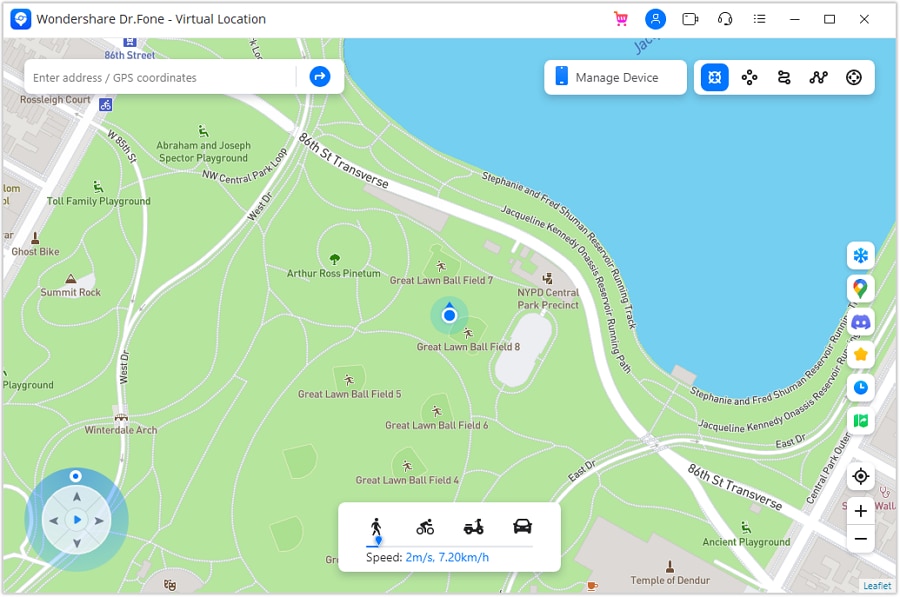
Launch the desktop module, connect your supported Android device, and complete its setup prompts. In the map toolbar, choose Teleport Mode. Interface placement can vary between editions.
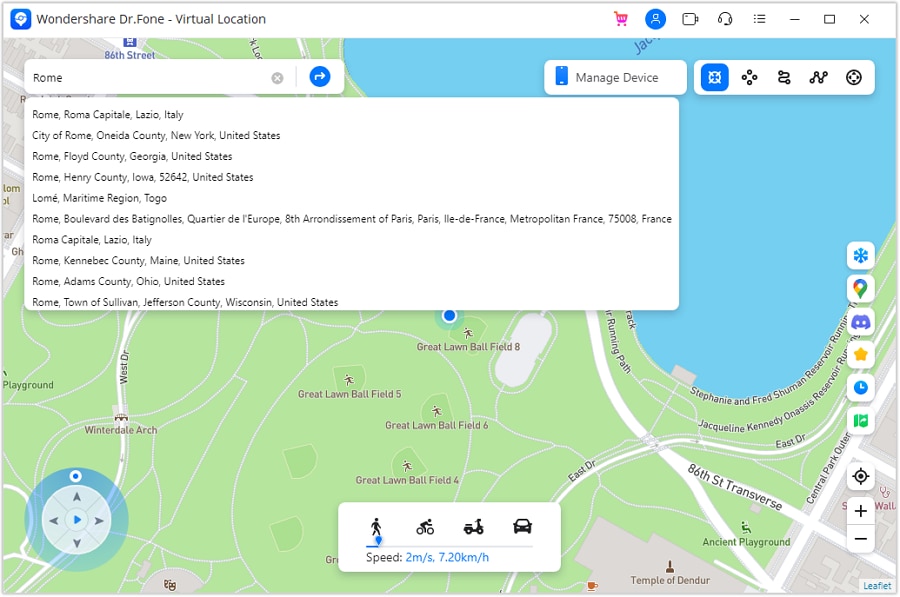
Step 2 Search a destination
Enter a place name, address, or coordinates in the search bar and submit the search. Check that the selected result is the intended destination rather than another place with a similar name.
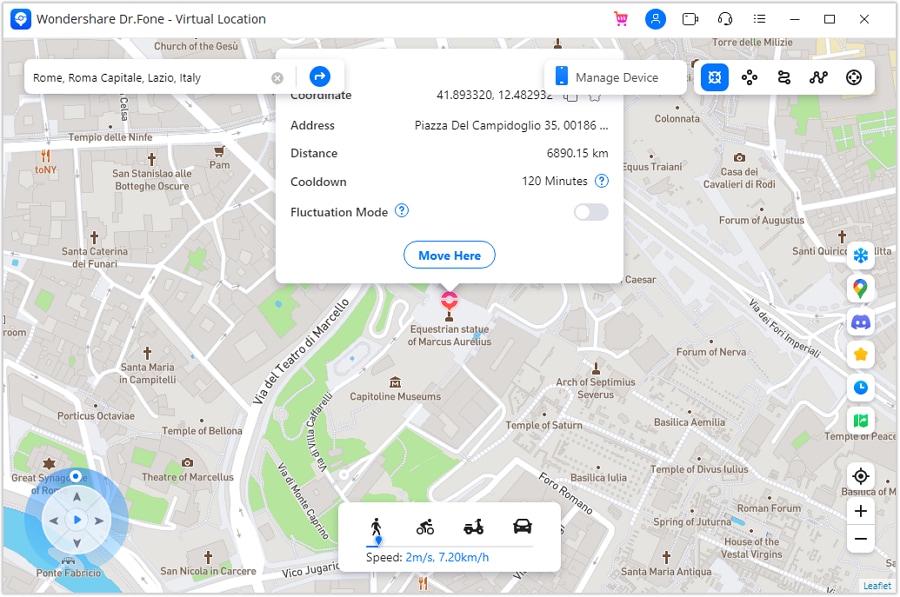
Step 3 Apply the reviewed point
Inspect the map preview and choose Move Here when it is correct. Let the connection complete its work before starting another change.
Step 4 Inspect the desktop result
The desktop map displays the selected virtual position. This confirms the program's state, but it is still worth checking what the connected phone actually reports.
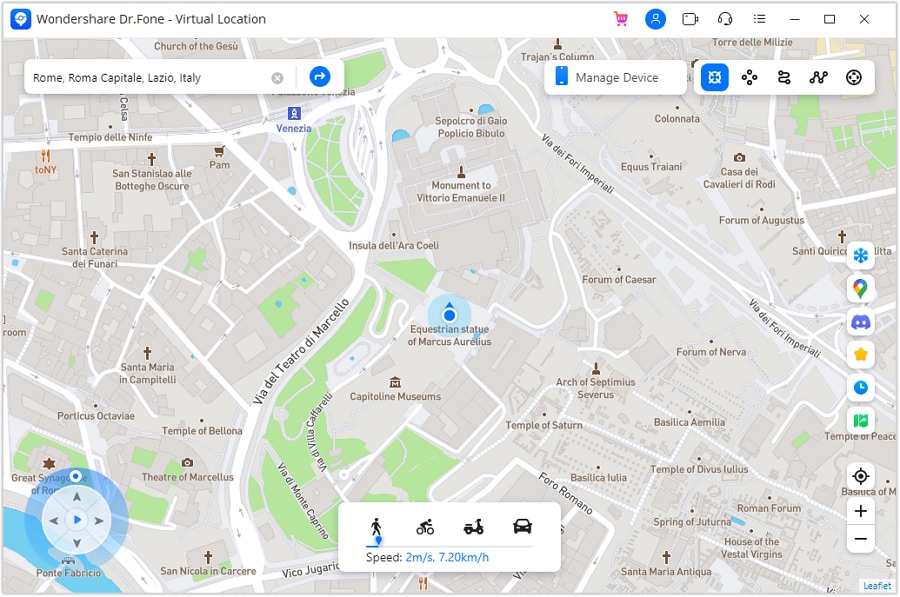
Step 5 Verify and restore on the phone
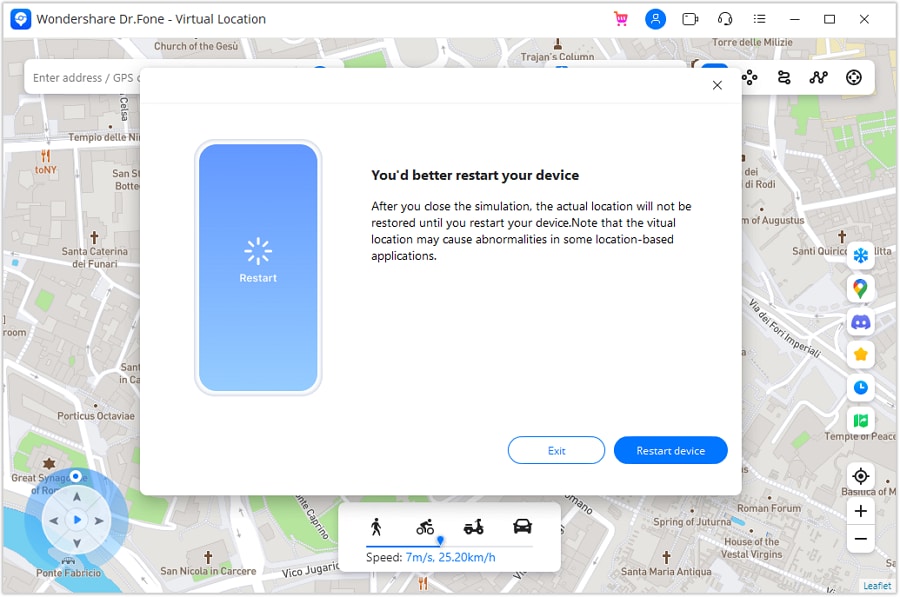
Open an appropriate map or your own test app on the phone and compare the reported location with the selected point. Stop the test afterward, follow the restoration prompt, and restart the device when instructed. Confirm real positioning before relying on navigation.
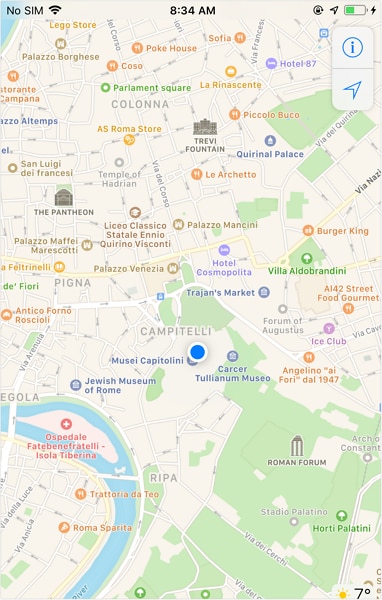
If the result differs between apps, review permissions, device support, and each app's treatment of mock locations. Do not resolve a failed test by assuming the phone needs an outdated Google service package.




Comparison of Four Fake GPS Android Options
This is a workflow comparison, not a measured ranking of accuracy or reliability. No test results were supplied to establish that one tool always performs better. Check present support and plan terms for the exact edition before committing to a setup.
| Tool | Main approach | Useful aspect | Important limitation | Suitable task |
|---|---|---|---|---|
| Dr.Fone - Virtual Location | Desktop teleport and supported route simulation | Larger map and computer-controlled workflow | Supported connection and license requirements; Android Pokémon GO excluded | Device-controlled app location tests |
| Fake GPS Location | Phone-based Android mock provider | Basic point selection with relatively few controls | Similar names across publishers; target apps may reject mocks | A stationary coordinate test |
| PoGoskill Android App | Publisher-specific map and coordinate workflow | Destination selection from the phone interface | Current setup, payment, and supported-device conditions need checking | A compatible map-based test after reviewing requirements |
| GPS Joystick by The App Ninjas | Position and movement controls with mode-specific setup | Interactive movement testing | Advanced configurations differ; legacy downgrades are not general prerequisites | Controlled movement scenarios on a supported test device |
Author's Verdict
Start with the least complicated workflow that answers your actual testing question. A stationary point may need only a basic mock provider; movement testing needs suitable route or joystick controls. Never equate a larger feature list with guaranteed compatibility or protection from detection.
A desktop interface is worth considering when inspecting destinations and repeatable routes is more important than a phone-only setup. Dr.Fone - Virtual Location fits that category, subject to its platform boundaries. Keep security components current, avoid unsupported service downgrades, and restore the phone when the test ends.
Conclusion
To change location on Android for testing, select a compatible provider, configure only the required permissions, apply a reviewed point, and check the receiving app. Neither a changed coordinate nor a successful internal map preview proves that streaming regions, update availability, or real GPS reception has changed.
For a computer-based alternative, Dr.Fone - Virtual Location provides a supported-device teleport workflow. Use it within the documented Android limits and the target service's rules, not as a promise of anonymity or unrestricted gaming.
Review installer sources and requested permissions before adding any location utility.
FAQ
1. Does a fake GPS Android app require root?
Ordinary Android mock-location testing can use Developer options without rooting. Particular advanced modes and apps have different requirements, and not every receiving app accepts a standard mock provider.2. Will fake coordinates improve a weak GPS signal?
No. Supplying a chosen point replaces a location value for testing; it does not improve satellite reception or prove genuine accuracy. Diagnose permissions, surroundings, and the device's location settings for real positioning problems.3. Must I downgrade Google Play services for GPS Joystick?
Do not treat that legacy instruction as routine setup. Use the developer's current mode-specific documentation, keep security protections intact, and avoid installing an old core package merely to follow an outdated walkthrough.4. Does Dr.Fone support Pokémon GO on Android?
The official product page explicitly excludes Pokémon GO from its Android support. General Android GPS simulation does not override that restriction, and spoofing a game can also conflict with its rules.
 Add Wondershare Dr.Fone as a preferred source on Google



