

Why Is Facebook Slow And Sluggish? How To Fix Facebook Loading Slow?

Oct 24, 2026 • Filed to: Social App Management • Proven solutions
 TL;DR:
What to try first when Facebook is loading slowly
- Slow on several devices and networks: check for a wider service problem and retry later before changing your settings.
- Slow only in the app: update Facebook and reopen it if it is unresponsive. On Android, try the app's Clear cache setting; on iPhone, use the update and reinstall sequence only if simpler checks fail.
- Slow only in a desktop browser: compare a private window, test extensions, then remove only Facebook site data if needed.
- Slow only on one network: compare Wi-Fi and cellular first. A reversible DNS test is a later option, not a fix for Facebook's servers.
Ask AI for a summary
 ChatGPT
 Perplexity
 Gemini
 Claude
 Grok
Dr.Fone Basic:
Better Control for Your Phone
Manage, transfer, back up, restore, and mirror your device
If Facebook is slow to load, first check whether the delay follows the app, browser, connection, or Facebook itself. A fast speed test does not rule out a Facebook-specific connection problem. Start with the comparisons below, then use the matching fix rather than deleting all your data or reinstalling immediately.
Part I: Why Is Facebook Slow?
Facebook slow loading can come from a temporary service problem, a particular network path, an app or browser issue, or a device struggling to respond. These are possibilities, not a diagnosis. If you are asking why does Facebook take so long to load, compare the same page or post before choosing a remedy.
A quick comparison before you change anything: open the same Facebook post in the app and a browser on the same device. Then, if available, try another device and switch between Wi-Fi and cellular. Keep the account and content the same where possible, and note which combination is slow. Cellular tests may use your data allowance. Only pause a VPN or filter if you own the device and are allowed to change it; ask your administrator about managed networks.
| What you observe | What it suggests, and what to do next |
|---|---|
| Facebook is slow today on more than one device and independent network; other sites work | A wider Facebook problem is possible. Compare recent user reports on Downdetector's Facebook page and any Facebook service notices you can access. User reports are not official outage confirmation. Retry later before clearing data or reinstalling. |
| Only the Facebook app is slow; the same content works in a browser | Start with update and relaunch, then the appropriate Android cache or in-app browser check. On iPhone, follow the iPhone sequence. |
| Only Chrome, Firefox, or Safari is slow; another browser works | Test a private session and extensions before deleting data. If needed, use the browser-specific data steps. |
| Facebook is slow but internet is fast, and Facebook improves on cellular or another Wi-Fi network | A speed test measures a different connection and does not prove Facebook requests are fast. Compare again at another time; troubleshoot the affected network. Consider DNS only after the simpler tests, particularly if the delay happens before a page begins loading. |
| Only Facebook videos or Reels buffer, or scrolling and comments lag | Compare another video or post, then the same item on another network and in a browser. One failing item may be content-specific; many failing videos on one network suggest a delivery/connection issue. If navigation also lags on the same phone, close unused heavy apps/tabs and check storage before restarting. These tests narrow the problem; they do not prove a particular cause. |
| Only Facebook Marketplace is slow, or the feed will not update at all | Test another Facebook area before treating the whole app as slow. For a feed stuck without new posts, use the separate Facebook feed not loading or updating guide. |
Cache normally helps content load faster. Damaged or stale data can cause problems, but the amount of cache alone does not establish why Facebook is lagging. Likewise, an improvement in another browser is a clue, not proof that your original browser is inherently too slow.
Part II: How To Fix Facebook Loading Slow?
Use the ten fixes below for the pattern you identified. Start with updates and reopening an unresponsive app; use login changes, data deletion, and reinstalling only when the earlier comparisons point to them. After each change, reopen the same content and compare before moving on.
Fix 1: Relaunch Facebook
Relaunch Facebook if it is stuck or not responding. First check for an update: on Android, open Google Play Store > profile > Manage apps & device and review available updates; on iPhone/iPad, open App Store > profile > App Updates. Install an available Facebook update. For a desktop slowdown, update your browser too; in Chrome use the three-dot menu > Help > About Google Chrome and relaunch when prompted.
On Android
Menu names vary by manufacturer. The image below shows an older OnePlus gesture-navigation layout.
Step 1: Swipe up from the bottom and hold to open Recent apps, or tap your device's Recents button if you use button navigation. It is not the same icon on every phone.

Step 2: Swipe away the Facebook card. On devices that use a different close gesture, use the card's close control.
Step 3: Open Facebook again and load the same post. If it is still unresponsive, use Settings > Apps > Facebook > Force stop, confirm, and reopen it.
On iOS/ iPadOS
Step 1: Swipe up from the bottom and pause to open the app switcher. On models with a Home button, double-click Home instead.

Step 2: Swipe up on Facebook's preview to close the unresponsive app.
Step 3: Reopen Facebook and compare the same content. Do not repeatedly force-close every app as routine maintenance: Apple notes that unnecessary force-closing can slow the device.
If reopening does not help, use Android cache checks or restart the device. Save reinstallation for later.
Fix 2: Re-login to Facebook
Re-login is worth trying when Facebook behaves abnormally only in your signed-in session. It refreshes authentication; it does not clear every app cache or fix an outage. Before signing out, make sure you know your password and can receive your two-factor authentication code or use an available recovery method. Otherwise, keep the session and try the non-destructive checks first.
Step 1: Open Facebook's Menu, scroll to Log out, and select it. The menu's location can differ by version; the screenshot is an older layout.

Step 2: Sign back in through the official Facebook app or website, then open the same content. If the delay remains, do not repeat login attempts; continue with the cache or browser checks below.
Fix 3: Clear Facebook Browser Cache
Facebook's in-app browser data and Android's Facebook app cache are different. If links opened inside Facebook are slow, the in-app Browser setting may help that link-browsing session. It is not a universal way to clear the Feed, videos, or all Facebook app data.
For links opened inside Facebook
The four screenshots below show an older Facebook layout. Use this path only if those options exist in your version. You can also search Facebook Settings for Browser; if no Browser data control appears, skip this branch rather than looking for an identical menu.
Step 1: Open the Facebook Menu.

Step 2: Open Settings using the gear icon, or Settings & privacy > Settings where shown.

Step 3: In the pictured layout, Browser is under Permissions. Open Browser if available; its grouping may differ in other versions.

Step 4: Read the label beside Clear and clear the offered browsing data only if that is the data you intend to remove. Reopen the same link inside Facebook to compare. This does not demonstrate that the whole app's cache was cleared.

For the Facebook app on Android
- Open your phone's Settings > Apps > Facebook. Some devices put this under See all apps or App management.
- Open Storage or Storage & cache, then tap Clear cache. Do not choose Clear storage or Clear data for this first test: those reset more app information and may sign you out or remove local data.
- Reopen Facebook and compare the same page. The first load may need to download cached items again. If it is still slow, try restarting before reinstalling.
On iPhone or iPad: there is no standard Android-style Clear cache button for every app in iOS Settings. An in-app Browser control, if present, is still only that browser's data. Check Settings > General > iPhone Storage (or iPad Storage) for available space, then follow the iPhone update/reinstall sequence. Offloading keeps an app's documents and data, so it is not equivalent to a fresh deletion and reinstall.
For storage pressure on Android, open Settings > Storage, review large downloads or unused apps, and remove only items you no longer need. Back up important files first. Built-in storage settings are the first option; a paid cleaner is not required for these checks.
Fix 4: Restart The Smartphone/Tablet
Restart if Facebook and other apps are unresponsive, or the problem persists after reopening Facebook. This may resolve a temporary device problem, but it cannot fix Facebook's servers.
Restart An Android Device
Step 1: Open your phone's power menu. On models where holding Power opens that menu, hold it; on newer phones it may use a different key combination or an on-screen power icon. Use the method provided for your device rather than assuming every Power button behaves the same way.
Step 2: Tap Restart and confirm if asked. Wait for startup, unlock the phone, then test Facebook again.
Restart An iOS Device
Step 1: Open Settings > General > Shut Down.
Step 2: Drag the slider and wait about 30 seconds for the device to turn off.
Step 3: Hold the Side button (or Top button on models that use it) until the Apple logo appears. Unlock the device and compare Facebook again. If only Facebook remains slow, continue with its app or browser checks rather than repeatedly restarting.
Fix 5: Reinstall Facebook
Reinstall only if Facebook is still slow in the app after updating, reopening, restarting, and the appropriate cache/storage checks. Uninstalling Facebook is not the same as deleting your Facebook account, but deleting an app can remove data stored locally, including unsynced drafts, offline items, settings, and saved sign-in state. Save anything important first and confirm your password and two-factor authentication access. Do not rely on a blanket promise that every item will survive.
On Android
Step 1: Open Settings > Apps > Facebook. The screenshot shows an older App Management screen; names vary by device.

Step 2: Tap Uninstall and confirm. If Facebook was preinstalled and no Uninstall option is offered, do not force its removal; use the update/cache checks instead.
Step 3: Download Facebook again from Google Play, sign in, and test. Avoid old APKs or unofficial modified apps as a shortcut.
On iOS
Before deleting: install an available Facebook update from App Store > profile > App Updates. If storage is tight, review Settings > General > iPhone Storage and free space from items you no longer need. Apple distinguishes Offload App, which keeps documents and data, from Delete App, which removes the app and its related local data.
Step 1: Touch and hold Facebook's icon until its menu appears.

Step 2: Choose Remove App > Delete App and confirm only after saving local items and checking your login access.
Step 3: Download Facebook again from the App Store, sign in, and open the same content. If both the fresh app and browser remain slow across networks, stop reinstalling and use the reporting checklist.
See Apple's app troubleshooting guidance and Google's Android app checks for the distinction between resetting app data and a simple restart.
Fix 6: Use Incognito Mode/ Private Browsing Mode
Private browsing is a comparison test, not a guaranteed speed boost. It starts a separate session, so Facebook will normally need a fresh sign-in. Chrome blocks third-party cookies by default in Incognito, and some extensions may still run if explicitly allowed there; those differences can affect results.
- Open a private window: Chrome's three-dot menu > New Incognito window (Ctrl+Shift+N on Windows, Command+Shift+N on Mac); Firefox's menu > New Private Window; or Safari's File menu > New Private Window.
- Go directly to facebook.com, sign in if needed, and load the same post or page on the same network. Compare like-for-like: an unsigned-in public page and a personalized signed-in feed are not the same test.
- If Facebook is faster there, test extensions and then Facebook site data in the normal window. If it is equally slow, compare another browser or network. Close the private window after the test.
One good private-session result does not prove which extension, cookie, or setting caused the delay. It narrows the next test; it does not make you invisible to websites or your network administrator.
Fix 7: Change The Web Browser
Try another up-to-date browser to distinguish a browser-profile problem from a wider Facebook issue. No browser is guaranteed to make Facebook faster for everyone.
- On the same device and network, open a different browser you trust, such as Chrome, Firefox, or Safari where available.
- Sign in to the same Facebook account and open the same content. Keep downloads, video calls, and other heavy activity unchanged during the comparison.
- If only the original browser is slow, return to it and test extensions and site data. If both are slow but another network helps, use the network comparison. You can use the working browser temporarily while diagnosing the original one.
Fix 8: Disable Browser Extensions
An extension can interfere with page scripts or consume resources, but a content blocker or privacy tool is not automatically the cause. Temporarily test one change at a time, reload the same Facebook content, then restore settings that did not help. Do not disable managed security tools or bypass your organization's policy.
In Chrome or Firefox
Step 1: In Chrome, use the three-dot menu > Extensions > Manage Extensions. In Firefox, open the menu > Add-ons and themes, or type about:addons in the address bar.
Step 2: Select the extensions list. The Firefox screenshot below is an older layout; menu wording can differ.

Step 3: Turn off one optional extension, reload Facebook, and compare the same page. Restore it if nothing changes, then try the next one. If several extensions interact, a temporary test with optional extensions off can help, followed by re-enabling them one at a time.
Step 4: If the slowdown returns when one extension is enabled, update it, review its site-specific settings, or remove it if you no longer need it. Restore unrelated protections after the test.
In macOS Safari
Step 1: Open Safari > Settings > Extensions. The screenshot shows an older version of the same settings area.

Step 2: Deselect one optional extension or content blocker, reload the same Facebook page, and compare. Re-select it if it made no difference; repeat as needed. Keep only an evidence-backed change rather than permanently disabling all blockers.
Fix 9: Clear Browser History
Clearing browser history is not the same as clearing cache or Facebook site data. History is the record of visited pages; cache stores reusable files; cookies and site data can keep your Facebook session and preferences. If a normal browser session is slow but a private session works, remove only Facebook's site data first where possible. Make sure you can sign back in before removing cookies. Initial loads after cache removal may be slower while files download again.
In Firefox
The screenshots show an older Firefox interface. Settings labels and Clear Data options vary by version; read each selection rather than checking every box.
Step 1: Open the menu > Settings.

Step 2: Select Privacy & Security and find Cookies and Site Data. If Manage Data is available, search for facebook.com, select its entries, remove the selected data, and save/confirm. This is a site-specific cookie/data reset and can sign you out of Facebook.
Step 3: For a separate cache test, open Clear Data in that settings area. The screenshot below illustrates the older dialog entry point, not a requirement to erase both categories.

Step 4: Select only temporary cached files/cache for the cache-only test. Leave cookies and other data unchecked unless you intentionally want the broader reset and understand that it can sign you out of other sites. Confirm the deletion.
Step 5: Reopen the same Facebook content, sign in if the site data was removed, and compare. Stop repeating deletions if they do not help.
In Chrome
Step 1: Open the three-dot menu > Settings > Privacy and security. The screenshots below show older labels in this area.

Step 2: For the smaller reset, open Third-party cookies > See all site data and permissions. Search for facebook.com, select the delete control beside its data, and confirm. Reopen Facebook and sign in to compare. This removes site data, not your entire browsing history.
Step 3: If you also need a cache-only test, open the three-dot menu > Delete browsing data (called Clear browsing data in older versions). The older screenshot illustrates that broader dialog.
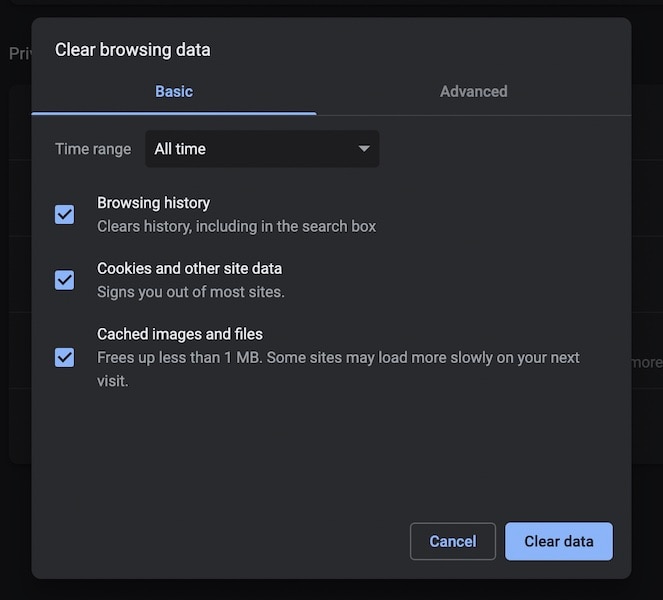
Step 4: Choose a time range relevant to the problem and select only Cached images and files for this test. Leave browsing history, cookies, passwords, autofill, and other categories unchecked unless you deliberately intend to remove them.
Step 5: Select Delete data/Clear data, reopen Facebook, and compare. Some account-saved browsing data can be removed on other devices when you delete it while signed in to Chrome; avoid an unnecessary all-data or all-time reset.
In macOS Safari
- For only Facebook, open Safari > Settings > Privacy > Manage Website Data.
- Search for Facebook, select its website data, and click Remove. Confirm, then reopen Facebook and sign in again if asked. Removing website data can also affect other apps using it.
Optional broader history deletion, not the first Facebook fix: the existing screenshot below shows the older Clear History dialog. Use it only if you intentionally want to remove history too.
Step 1: Open Safari's History menu > Clear History (some older versions show Clear History in the Safari menu).
Step 2: Choose the history period you actually want to delete rather than automatically choosing all history.
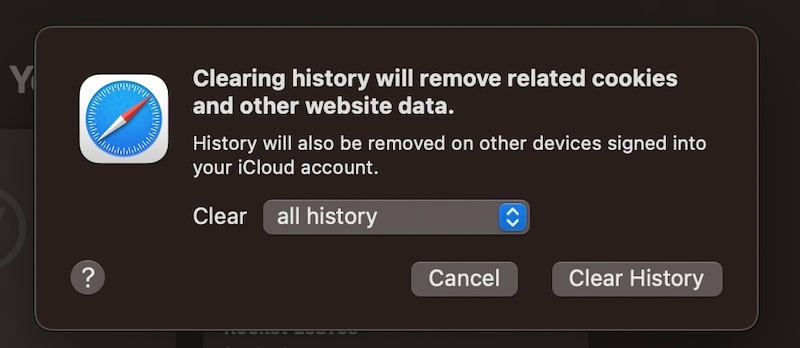
Step 3: Click Clear History. With iCloud set up for Safari, this clears browsing history across those devices. It is not a promise or instruction to close every open tab. Use Safari's website-data settings instead when only Facebook needs resetting.
Fix 10: Change DNS
DNS translates site names into addresses. A resolver problem may delay the start of a connection, so a DNS change can be a useful controlled test when Facebook is slow only on one network. It does not increase your connection's bandwidth, repair Facebook's servers, or guarantee a different ISP route. If the network comparison did not point to this connection, leave DNS alone.
Test on one personally managed PC first rather than changing a shared router. Record or screenshot the existing settings and do not change work/school DNS, VPN, or security policies without permission. The following Windows 11 example uses Cloudflare's published resolver addresses.
- Open Settings > Network & internet and select the active Wi-Fi or Ethernet connection. Open its properties (for Wi-Fi, Hardware properties where shown), find DNS server assignment, and select Edit.
- Record whether the current setting is Automatic (DHCP) or Manual, including existing addresses and encryption settings. Change the assignment to Manual and turn IPv4 on.
- Enter 1.1.1.1 as Preferred DNS and 1.0.0.1 as Alternate DNS. If you are also configuring IPv6 DNS on an IPv6-enabled connection, use 2606:4700:4700::1111 and 2606:4700:4700::1001. Do not turn off IPv6 merely for this test or leave an incomplete manual configuration.
- Save, reopen the browser, and compare the same Facebook page on the same connection. Note the result; changing several other settings at the same time would make the test inconclusive.
- If it does not help or connectivity worsens, return to DNS server assignment > Edit and restore Automatic (DHCP) if that was the original setting, or restore the original manual addresses and encryption settings. Save and retest.
Cloudflare documents the Windows DNS configuration. Choosing a resolver changes which provider handles DNS requests. For other operating systems, use the corresponding per-device network setting; do not guess router-wide changes from these Windows instructions.
If your phone is generally short of storage rather than Facebook alone being slow, the optional platform-specific tools below address separate device-management tasks. Try the free built-in storage controls first.
Dr.Fone App (iOS) & Dr.Fone App (Android)
Optional phone-management tools, not a Facebook accelerator. Dr.Fone - Clean Up iPhone offers media cleanup, while Dr.Fone's Android app focuses on photo/data recovery and private media storage. Neither is a remedy for a Facebook outage or a guarantee of faster feeds.
- On iPhone: identify duplicate or similar photos and videos for review before deleting media you no longer need.
- On iPhone: review and remove unwanted screenshots to reclaim storage.
- On iPhone: organize duplicate contacts as a separate phone-management task.
- On Android: use the app's photo/data recovery features for supported local recovery needs; results depend on what remains recoverable.
- On Android: organize private photos and videos in Private Space; this does not clear Facebook's app cache or repair your connection.



Conclusion
When Facebook takes a long time to load, use the comparison results rather than applying every fix at once: app-only trouble calls for an update/relaunch and platform-specific checks; browser-only trouble calls for a private-session, extension, and site-data test; network-only trouble needs a connection comparison before DNS. If several devices and networks show the same slowdown, wait and check for a wider service issue rather than deleting more local data.
If Facebook remains slow, record the date, time zone, device and OS, Facebook/browser version, affected feature, and whether the same content works on another device, browser, or network. Send a concise reproduction through Facebook's Help & support > Report a problem option where available, or start at Facebook's Report That Something Isn't Working help page. Include screenshots only after hiding private messages and personal information; never send passwords or authentication codes.
 Q1. Why does Facebook take so long to load?Q2. Why is my Facebook so slow even when my internet is fast?Q3. How can I fix Facebook loading slow on the app quickly?Q4. Why is Facebook slow on my browser (Chrome/Firefox/Safari)?
Dr.Fone Basic:
Better Control for Your Phone
Manage, transfer, back up, restore, and mirror your device


Facebook Manage
- Facebook on iOS
- 1. Download Facebook Videos on iOS
- 2. Block People in Facebook on iOS
- 3. Delete Facebook Messages on iOS
- 4. Send Facebook Messages on iOS
- 5. Recover Deleted Facebook Messages
- 6. Sync Facebook Contacts with iPhone
- 7. Fake Location on Facebook iOS
- 8. Facebook App Problems on iPhone
- Facebook on Android
- 1. Uninstall Facebook on Android
- 2. Delete Messages on Facebook Android
- 3. Save Facebook Messages on Android
- 4. Hide Facebook Messages on Android
- 5. Send Facebook Messages on Android
- 6. Read Old Facebook Messages
- 7. Retrieve Deleted Facebook Messages
- 8. Fake Location on Facebook Android
- 9. Facebook Crashing On Android
- Facebook Messages
- 1. Export and Print Facebook Messages
- 2. Messenger Notification Not Working
- 3. Use Facebook Without Messenger
- 4. Archive Facebook Messages
- 5. Record Facebook Messenger Calls
- 6. Deactivate Facebook Messages
- 7. Facebook Messenger Not Working
- 8. Messenger Video Call No Sound
- 9. Facebook Messenger Troubleshooting
- 10. Messenger Keeps Stopping/Crashing
- Facebook Upload/Download
- Facebook Problems
- 1. Can't Log into Facebook
- 2. Facebook Black Screen Issue
- 3. Facebook Loading Slow
- 4. Facebook Dating Is Showing Up
- 5. Facebook Video Chat Problems
- 6. Facebook Not Loading
- 7. Facebook Not Responding
- 8. Facebook Marketplace Not Working
- 9. Facebook Pay Not Working
- 10. Facebook Searches Not Working
- 11. Facebook News Feed Not Working
- Facebook Tricks
- ● Manage/transfer/recover data
- ● Unlock screen/activate/FRP lock
- ● Fix most iOS and Android issues
- Free Download Free Download Free Download


 > How-to > Social App Management > Why Is Facebook Slow And Sluggish? How To Fix Facebook Loading Slow?
Daisy Raines
staff Editor