Resolve common problems and system crashes on both iPhone and Android devices.

 100% Security Verified | No Subscription Required | No Malware

 :
: 
 ChatGPT
 Perplexity
 Gemini
 Claude
 Grok
Grok
When Odin fails during a Samsung firmware flash, the exact message on the phone or in the Odin log usually tells you what to check first. Connection errors such as SetupConnection or a missing COM port point to the USB path or driver. Messages such as FAIL! (Auth), SVB fail, AVB fail, boot load fail, or DT load fail more often point to firmware, bootloader, or verification compatibility. A Complete(Write) operation failed message can involve either the connection or the file/firmware being written.

Do not keep retrying the same flash blindly. Record the exact error, confirm the Samsung model and firmware details, then use the matching fix below. If the phone is only stuck on the Downloading/Odin Mode screen and no firmware is actively being written, start with the exit steps. If the system no longer boots after a failed flash, use a repair or service path that matches the risk to your data.
In this article
Quick Odin Fail Diagnosis
Use the exact text you see rather than treating every Odin failure as the same problem. This table gives you the safest first check and sends you to the matching section.
| Error or symptom | What to check first | Next step |
|---|---|---|
| SVB fail, AVB fail, boot load fail, invalid magic, DT load fail, DDI write failed | Exact model, firmware package, bootloader/binary compatibility, and file integrity | Verification and boot-related errors |
| FAIL! (Auth), SW REV CHECK FAIL | Firmware/model/CSC match and whether the attempted firmware requires an older bootloader than the phone allows | Auth and revision errors |
| SetupConnection, no COM port, device not detected, Odin not responding | USB data connection, Samsung USB driver, cable, port, and whether Odin actually sees the device | Connection and COM errors |
| Complete(Write) operation failed, succeed 0 / failed 1 | USB stability, firmware integrity, and the error lines immediately before the final failure | Write-stage failures |
| Phone remains on Downloading/Odin Mode screen | Whether a firmware write is still active | Exit Odin Mode safely |
Part 1: Understanding Samsung Odin Mode
Odin Mode, also called Download Mode on Samsung phones and tablets, is a special boot state used for firmware-level operations. Seeing the Downloading screen does not automatically mean the phone is broken. The problem starts when the device cannot leave the mode, a flash stops partway through, or the screen/log reports a verification, write, authentication, or connection failure.
A phone can enter Download Mode because the required hardware buttons were pressed, because a repair or firmware workflow placed it there, or because the device is trying to recover from a system-level problem. If you were actively flashing firmware, do not force a restart while files are still being written.
How to Enter Odin Mode on Samsung Devices
The button sequence varies by Samsung generation. Power the device off first, then use the sequence for your model. When the warning screen appears, follow the on-screen prompt to continue into Download Mode.
- Older phones with a physical Home button: Hold Volume Down + Home + Power until the warning screen appears, then follow the on-screen confirmation.
- Older phones with a Bixby key: Use the model-specific Bixby/volume/power combination shown for that device generation and follow the warning-screen prompt.
- Many newer Galaxy devices: The current workflow may use both volume keys while the device is connected by USB. Because combinations differ by model, follow the device-specific on-screen instructions rather than forcing a sequence that does not match your phone.
Once Download Mode is active, the phone can communicate with a firmware or guided repair workflow on a computer.

How to Exit Odin Mode on Samsung Devices
If no firmware write is running and the phone is simply stuck on the Downloading/Odin Mode screen, try the normal forced restart first:
- Confirm that Odin or another repair tool is no longer writing files to the device.
- Press and hold Volume Down + Power/Side together for about 7 seconds.
- Keep holding until the device restarts.
Important: Do not force the phone out of Download Mode while firmware is actively being written. Interrupting a write can leave the device unable to boot.
If the buttons do not work, Dr.Fone also provides a guided Enter & Exit Download Mode function for supported Samsung devices. Exiting Download Mode is different from running a full Samsung system repair; the full repair workflow has a separate data-erasure warning.
If the phone restarts and immediately returns to Download Mode, or if it cannot boot into Android, continue to Part 2 instead of repeating the same restart indefinitely.

Part 2: Fixing Samsung Stuck in Odin Mode
If the phone is still stuck after the normal exit sequence, choose the next step based on what happened before the problem. A phone that only needs to leave Download Mode is different from a phone whose system no longer boots after a failed firmware write.
Start with the least destructive option that fits your situation. If important data is still accessible, back it up before any system repair or firmware reinstallation.





Method 1: Repair a Damaged Samsung System with Dr.Fone - System Repair
If the Samsung device can leave Download Mode but still will not boot normally, keeps looping back to Download Mode, or became soft-bricked after a failed firmware operation, Dr.Fone - System Repair (Android) provides a guided firmware-repair workflow for supported Samsung devices on Windows.
Data warning: The current Samsung System Repair workflow can erase all data on the device. Back up accessible data before starting. If your only problem is that the phone is stuck on the Downloading screen, try the exit methods first instead of running a full repair.
Android System Repair is currently available on Windows only. macOS is not supported for this repair feature.
 Fix Android instantly – no skills needed.
- Solve boot loop, black screen, won’t turn on, etc.
- High success rate for all system issues.
- User-friendly interface with easy-to-follow steps.
Follow these core steps for a Samsung system repair. The full official workflow is available in the Dr.Fone Android Repair guide.
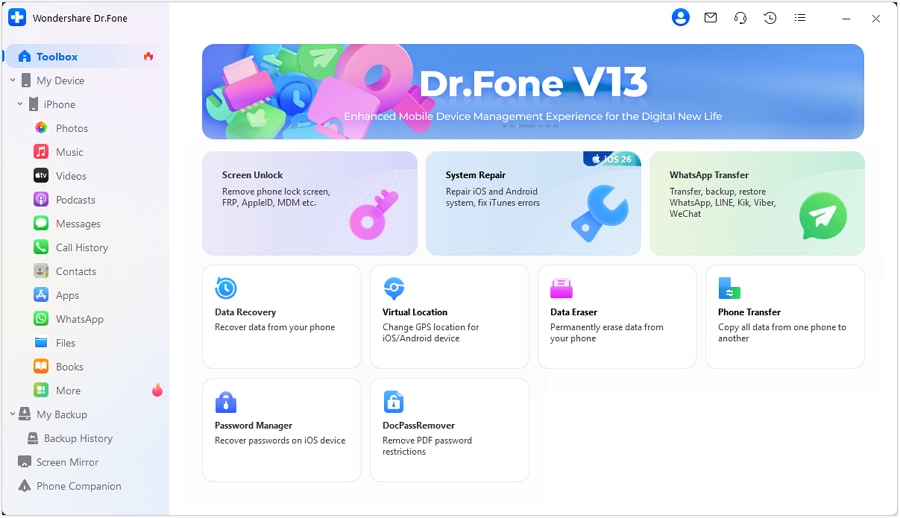
Step 1: Open System Repair
Launch Dr.Fone on a Windows PC, choose System Repair, and connect the Samsung device with a reliable USB cable.
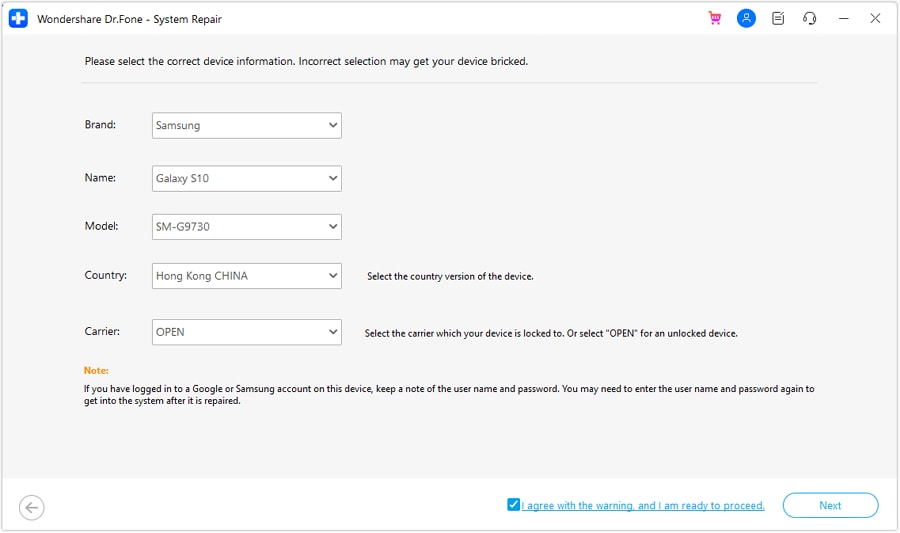
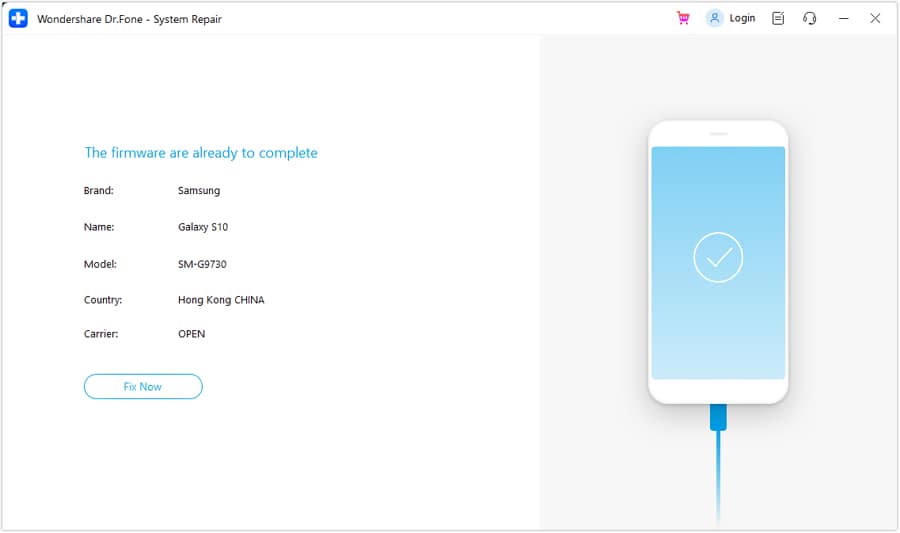
Step 2: Confirm the Exact Samsung Details
Select the Android repair workflow and verify the device name, model, country/region, and carrier information shown by the tool. Do not continue with details that do not match the device.
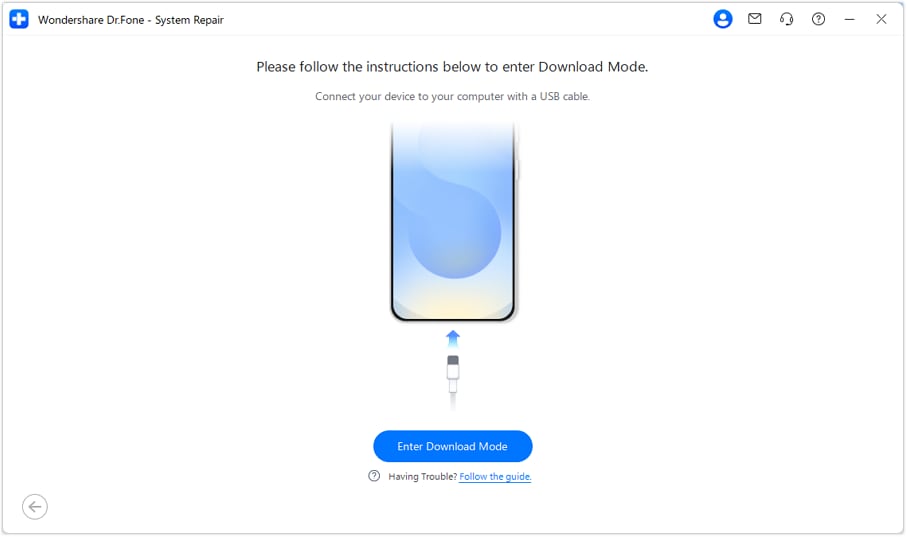
Step 3: Put the Device in Download Mode
Follow the on-screen instructions for the connected model. When supported, the tool can guide the device into Download Mode without requiring you to guess a button sequence.
Step 4: Verify the Firmware and Confirm the Repair
After the repair package is downloaded and verified, review the warning before installation. For Samsung repair, the process can erase all data on the phone or tablet. Continue only when you accept that risk and have backed up anything still accessible.
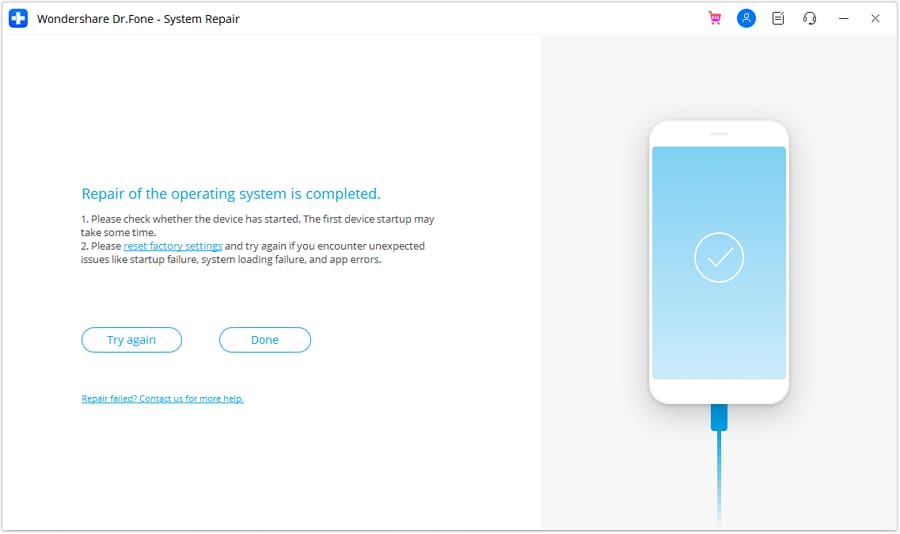
Step 5: Finish the Repair and Check the Reboot
Keep the device connected while the repair runs. When Dr.Fone reports completion, check whether the Samsung device starts normally. If it still cannot boot, avoid endless repeated repairs and consider professional service.
Method 2: Remove the Battery on Older Samsung Models
If the hardware restart does not work and your older Samsung phone has a removable battery, removing the battery can force a complete power-off. Use this only when no firmware write is active.
- Open the back cover. Remove the cover to access the battery.
- Remove the battery. Take it out so the device powers off completely.
- Wait about 30 seconds. This clears the temporary power state.
- Reinsert the battery and restart. Check whether Android boots normally or the phone returns to Download Mode.
If the phone immediately returns to Odin Mode, the problem is probably not just a frozen screen. Move to a system/firmware diagnosis instead of repeating the battery pull.

Method 3: Let an Unresponsive Device Power Down
For a non-removable-battery device whose buttons do not respond, allowing the battery to run down can eventually power the device off. This is a fallback for a frozen screen, not a fix for an active firmware write.
- Make sure no computer-side flash or repair process is still writing to the phone.
- Allow the phone to power down completely.
- Charge it for a while, then try a normal restart.
If it returns to Download Mode again, stop treating the issue as a temporary freeze and move to a firmware/system repair path or service diagnosis.
Method 4: Reinstall Matching Stock Firmware
If the system was damaged during a failed flash and you are experienced with Samsung firmware, reinstalling the correct stock firmware may restore the device. This is an advanced path. A mismatched package, an unsupported downgrade, or an interrupted write can make the problem worse or erase data.
Before you retry Odin, verify all of the following:
- Exact model number: The firmware must be intended for the exact Samsung model, not just the same marketing name.
- CSC/region/carrier package: Confirm that the package is appropriate for the device configuration you are trying to restore.
- Bootloader/binary compatibility: Do not assume an older Android build can be flashed just because it was once available for the model. A lower bootloader revision may be rejected.
- File integrity: Re-download a package that looks incomplete, corrupt, or produces hash/file errors.
- USB stability: Use a reliable data cable and direct USB port. Odin should detect the device before you start.
- Data risk: Back up anything still accessible. Firmware restoration can erase personal data depending on the files and workflow used.
Load only the files that belong to the verified firmware package into the intended Odin fields. Do not use Re-Partition, PIT files, patched tools, or other bypasses as generic fixes unless you have a device-specific, trusted procedure and understand the risk.
When the flash completes successfully, the phone should reboot and leave Download Mode. If the same failure returns after the model, firmware, and connection have been verified, stop repeating the flash and use the escalation guidance below.

Part 3: Fixing Odin Flash Failures by Error Message
The final FAIL! line is often less useful than the message immediately before it. Match the error family below, then make one controlled change at a time so you can tell what actually fixed the problem.
SVB Fail, AVB Fail, Boot Load Fail, DT Load Fail, or DDI Write Failed
These messages appear around boot, verification, loading, or writing stages. They should be treated as a compatibility or integrity warning first, not as a reason to keep trying random firmware files.
- SVB fail: Recheck the exact model and firmware environment, especially the boot-related files and bootloader/binary revision.
- AVB fail: Recheck whether the image/package is compatible and unmodified, then verify that the firmware is intended for the exact device.
- Boot load fail / invalid magic: Re-download the correct package and confirm you are not trying to load a boot component from an incompatible build or lower bootloader revision.
- DT load fail: Treat it as a low-level firmware/boot compatibility failure. Verify the package and model before trying again.
- DDI write failed: Start with the firmware package and USB path. If the same write-stage error repeats with known-correct files and a stable connection, stop and consider professional service because a deeper storage or hardware problem may be involved.
For all five messages, the first safe sequence is: confirm the model, confirm the firmware package, confirm the bootloader/binary relationship, re-download questionable files, then retry only after the connection is stable.
FAIL! (Auth) or SW REV CHECK FAIL
FAIL! (Auth) means the device rejected the attempted flash at an authorization/verification stage. In current search evidence, this frequently appears when users are changing firmware variants, regions, or attempting older builds. A SW REV CHECK FAIL message is an especially strong sign to check the bootloader/binary revision before trying again.
- Stop the current retry loop.
- Confirm the exact Samsung model number and intended CSC/region/carrier package.
- Compare the firmware's bootloader/binary revision with the revision already allowed by the device. Do not force a lower revision as a generic fix.
- Re-download the correct package if there is any doubt about file integrity.
- Retry only after the firmware and connection checks both pass.
If the phone still reports Auth/revision errors with a verified package, do not keep changing patches or bypass settings at random. Use a guided repair path for a supported device or move to Samsung/professional service.
SetupConnection, No COM Port, Device Not Detected, or Odin Not Responding
If Odin is stuck on SetupConnection, shows no COM port, does not detect the phone, or becomes unresponsive, troubleshoot the computer-to-phone connection before changing firmware. Odin should detect the Samsung device and show a COM connection before you start a flash.
- Disconnect the phone only after you confirm no write is active, then restart the phone/Download Mode and the PC if needed.
- Use a reliable data-capable USB cable. If one cable fails, test another known-good cable.
- Connect directly to another USB port on the computer instead of through a hub or adapter.
- Install or reinstall the current Samsung Android USB Driver for Windows.
- Reconnect the device and confirm that Odin detects it before loading or writing firmware.
If the connection repeatedly drops, the phone is not detected by Windows, or the USB port itself is damaged, do not treat repeated Odin flashes as the solution.
Complete(Write) Operation Failed or Succeed 0 / Failed 1
Complete(Write) operation failed and All threads completed. (succeed 0 / failed 1) are end-state messages. They do not tell you one universal root cause by themselves. Read the preceding log line and then check both the connection and the firmware/package.
- If the log shows a connection/setup problem first, fix the USB/driver/COM path before changing firmware.
- If the log reaches a specific image or partition before failing, recheck that the firmware package belongs to the exact model and that the download is complete.
- If the attempt is a downgrade, recheck the bootloader/binary revision rather than assuming an older Android version is automatically flashable.
- Avoid treating one community workaround, patched Odin build, or cable type as a universal fix. Use it only when it matches your exact device and failure context.
When to Stop Retrying Odin
Stop repeating the same Odin flash and change paths when any of these is true:
- The same error returns after you have verified the exact model, firmware package, bootloader/binary compatibility, and USB connection.
- The phone leaves Download Mode but cannot boot Android, repeatedly boot loops, or immediately returns to Download Mode.
- The PC cannot establish a reliable USB connection or the phone is not detected consistently.
- The device shows signs of physical damage, storage failure, overheating, liquid damage, or a broken USB port.
- You cannot confirm that the firmware package is correct for the device.
- Important data is at risk and you do not have a current backup.
For a supported Samsung software/firmware problem, a guided system repair can reduce the need to manually choose Odin files, but remember that the current Samsung repair workflow in Dr.Fone can erase device data and Android System Repair runs on Windows. For suspected hardware problems or an unsupported model, use Samsung or a qualified repair service instead.
Conclusion
Odin fail is not one error with one fix. The safest approach is to identify the exact message, separate connection failures from firmware/boot verification failures, and verify the Samsung model and firmware compatibility before another flash. Protect the existing high-value error paths such as SVB, boot load, DT load, AVB, and DDI write failures, but do not ignore newer search patterns around Auth, SetupConnection, and Complete(Write) errors.
If the phone is only stuck in Download Mode, exit the mode first rather than immediately running a full repair. If the system is damaged and the device is supported, Dr.Fone - System Repair (Android) can provide a guided Windows repair workflow. Back up accessible data first because Samsung system repair can erase the device. If verified software steps still fail or hardware symptoms appear, stop retrying Odin and move to professional service.
FAQs
1. What does SVB fail mean in Samsung Odin Mode?
SVB fail is a Samsung boot/security verification failure message. Start by checking the exact model, firmware package, and bootloader/binary compatibility rather than repeatedly flashing different files.2. How do I fix boot load fail or AVB fail in Odin Mode?
Use firmware intended for the exact Samsung model, verify the package is complete, and check bootloader/binary compatibility before retrying. If the same verification error returns with known-correct files, stop repeated flashes and use a supported repair or service path.3. What should I do when I see DT load fail or DDI write failed on Samsung?
Recheck the exact firmware package, model compatibility, and USB connection first. If a DDI/write-stage failure repeats with verified files and a stable connection, stop retrying and consider professional service because the issue may be deeper than a simple file mismatch.4. Why does Odin flash fail on Samsung phones?
Common causes include an unstable USB connection, an incorrect or incomplete firmware package, model/CSC mismatch, and bootloader or verification restrictions. The exact Odin log message is the best starting point for choosing the next check.5. What does FAIL! (Auth) mean in Odin?
FAIL! (Auth) means the device rejected the attempted flash at an authorization or verification stage. Check the exact model, CSC/firmware variant, and bootloader/binary compatibility before retrying, especially when you are changing regions or attempting an older build.6. Does fixing an Odin fail erase Samsung data?
It depends on the recovery path. Simply exiting Download Mode does not require a full repair, but firmware restoration can erase data, and the current Dr.Fone Samsung System Repair workflow can erase all data on the device. Back up accessible data before repair or reflashing.7. Can Odin unbrick a Samsung phone?
A correct stock-firmware restore can recover some software-bricked Samsung devices, but it cannot guarantee recovery from hardware damage, unsupported firmware changes, or storage failure. Use firmware for the exact model and stop if repeated verified flashes still fail.
 Add Wondershare Dr.Fone as a preferred source on Google