
Why Does My Phone Keep Turning Off By Itself? 6 Fixes Are Here!

Sep 24, 2026 • Filed to: Phone Repair Solutions • Proven solutions
 TL;DR:
Random shutdowns on Android phones are primarily triggered by battery degradation, thermal protection mechanisms activating above 45–50°C, or software corruption, requiring targeted hardware diagnostics or isolated app troubleshooting to resolve.
● Dial *#*#4636#*#* or *#*#INFO#*#* to access the hidden battery diagnostic menu; if the health status displays anything other than "Good," the physical unit is failing and requires replacement.
● Boot the device into Safe Mode to isolate third-party software conflicts; if the phone remains stable in this environment, a recently installed application is forcing the shutdowns and must be permanently uninstalled.
● Resolve persistent OS-level corruption by performing a Factory Reset or flashing the firmware via Dr.Fone - System Repair (Android), requiring a complete data backup beforehand to prevent irreversible file erasure.
Ask AI for a summary
 ChatGPT
 Perplexity
 Gemini
 Claude
 Grok
Grok
If your Android phone keeps turning off by itself, you're not alone — this is one of the most frequently reported issues among Android users worldwide. Whether it shuts down during a phone call, while gaming, or even when the battery reads 50%, a phone that turns off randomly without warning is a clear sign that something needs attention. The good news: in most cases, this problem is fixable without visiting a repair shop.
An Android phone that turns off by itself can stem from several causes — a degraded battery, software bugs, overheating, incompatible apps, or corrupted system files. Understanding the root cause is the first step toward finding the right solution. This guide walks you through 7 proven, step-by-step fixes to stop your phone from turning off by itself — from quick DIY checks to a reliable one-click repair tool.
So the next time you ask, "Why does my phone keep shutting off?", refer to this article and follow the techniques given hereunder.
- Part 1: Possible reasons for phone turning off by itself
- Part 2: Check the battery status on Android
- Part 3: One-click to fix Android phone keeps turning off (easy and effective solution)

- Part 4: Update software to the latest version to fix Android phone keeps turning off
- Part 5: Cool down your phone to avoid your phone keeps turning off
- Part 6: Narrow down the randomly turning off issue in Safe Mode
- Part 7: Back up your data and perform a factory reset
Part 1: Possible reasons for phone turning off by itself
Before jumping to fixes, it's important to understand why your Android phone keeps turning off by itself. The cause directly determines the most effective solution. Here are the six most common reasons behind this frustrating issue:
- 1. Incomplete or corrupted software updates: When a system or app update is interrupted mid-process — due to a lost connection, low storage, or a power cut — the incomplete installation can destabilize the OS, causing the phone to shut down repeatedly. Even a partially installed app update can trigger this behavior.
- 2. Incompatible or malicious third-party apps: Apps downloaded from outside the Google Play Store may not be fully compatible with your Android version. These apps can consume excessive RAM, interfere with core system processes, or introduce instability that forces the device to shut off unexpectedly. Adware or spyware apps can exhibit similar behavior.
- 3. Battery degradation or hardware failure: Lithium-ion batteries naturally degrade over time. A battery that has lost significant capacity may report an inaccurate charge level and suddenly cut power when the actual usable capacity is depleted. Physical battery damage — such as swelling — can also cause sudden shutdowns. If your phone is over 2 years old, battery wear is a strong suspect.
- 4. Overheating and thermal protection: Android devices have a built-in thermal protection mechanism. When the processor or battery temperature exceeds a safe threshold — typically around 45–50°C (113–122°F) — the device will automatically shut down to prevent permanent hardware damage. This is more likely during extended gaming, video streaming, or when using the phone while charging in warm environments.
- 5. Physical hardware issues: A damaged or overly tight phone case can apply continuous pressure to the power button, triggering accidental shutdowns. A cracked or loose battery connector can also cause power interruptions. If you notice the issue worsens when pressing the case sides, a physical cause is likely.
- 6. Corrupted system files or OS errors: System file corruption — caused by a failed update, sudden power loss during operation, or malware — can cause Android to crash and restart unexpectedly. This type of issue often requires a deeper fix, such as a system repair tool or factory reset, rather than simple app-level troubleshooting.
Once you've identified the most likely cause based on your situation, you can proceed directly to the corresponding fix below. If you're unsure, start from Part 2 and work through each step systematically.
Part 2: Check the battery status on Android
A failing or degraded battery is one of the most common reasons an Android phone turns off by itself — even when the battery indicator still shows a reasonable charge. Before trying software fixes, it's worth verifying whether your battery is healthy. Android includes a built-in battery diagnostic tool you can access via a hidden service code.
What this test checks: The battery info screen reveals key metrics including battery health status, charge level, voltage, temperature, and charge type. A healthy battery should show a status of "Good." If the status reads "Bad," "Over voltage," "Dead," or "Unknown," battery replacement is strongly recommended.
Step 1: First, open the dialer on your Android phone shown in the screenshot below.
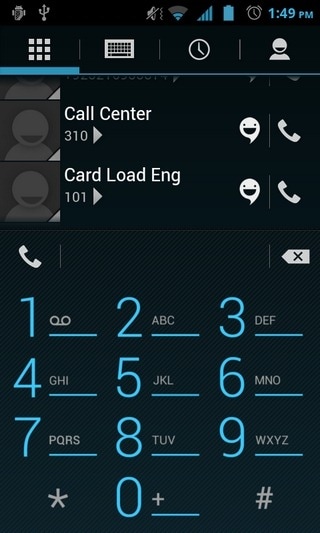
Step 2: Now dial *#*#4636#*#* just like dialing a usual phone number and wait for the "Battery Info" screen to pop up.
Note: Sometimes, the above-mentioned code may not work. In such cases, try dialing *#*#INFO#*#*. The following screen will appear now.
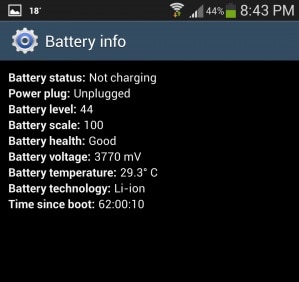
If the battery status shows "Good" and the temperature is within a normal range (20–35°C at rest), your battery is likely not the cause. However, if the voltage reading is unusually low or the health status shows anything other than "Good," consider having your battery professionally tested or replaced. Battery replacement is often the fastest and most cost-effective fix for phones that are 2+ years old and experiencing random shutdowns.
If the battery checks out fine, move on to the following solutions to address software or system-level causes.
Part 3: One-click to fix Android phone keeps turning off
When basic troubleshooting steps fail to resolve the issue and your Android phone keeps turning off by itself without any obvious cause, the problem likely lies deep within the operating system — in corrupted system partitions, damaged firmware, or OS-level errors that manual fixes cannot address. In these cases, a professional system repair tool is the most reliable and efficient solution.
Dr.Fone - System Repair (Android) is a dedicated tool designed to diagnose and fix a wide range of Android system issues with a single click — no technical expertise required. It repairs the device by downloading and flashing the correct firmware for your specific model, resolving the root cause of random shutdowns at the OS level rather than just masking symptoms.
Beyond fixing the phone keeps turning off issue, Dr.Fone - System Repair can also resolve: failed system updates, devices stuck on the boot logo, unresponsive touchscreens, the dreaded blue or black screen of death, and apps that crash repeatedly. It is compatible with virtually all major Android brands and OS versions.
Your trouble with "why does my phone keep shutting off?" can be resolved easily using Dr.Fone - System Repair (Android). But, before that, you need to ensure that the Android device has been backed up properly to eliminate the risk of data erasing.

Dr.Fone - System Repair (Android)
Repair Android System Errors without Any Trouble.
- Fix your Android to normal, no skills required.
- Fix various Android system issues, stuck in boot loop, black screen, or won't turn on, looping on start, etc.
- The high success rate in resolving Android system issues.
- Compatible with a wide range of Android devices and OS versions
- User-friendly interface with easy-to-follow steps.
Below are the steps that help easily fix Android device keeps turning off on its own:
Phase 1: Preparing your Android device and connecting it
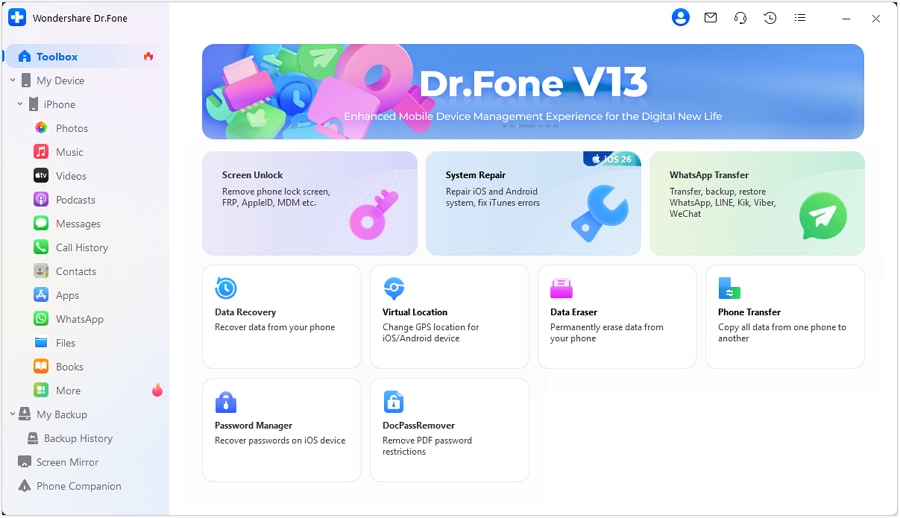
Step 1: On your computer, install and launch Dr.Fone. Now, click the 'System Repair' button over Dr.Fone window and connect the Android device to your computer.
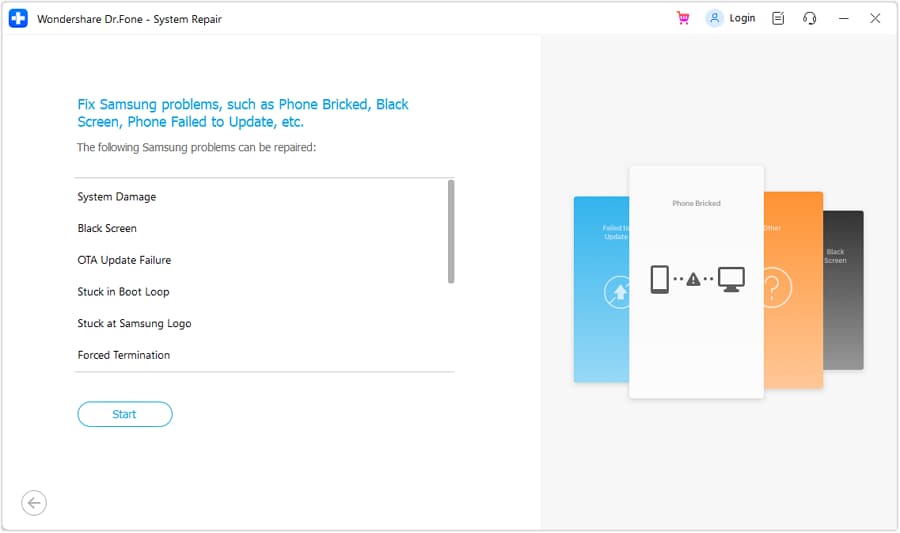
Step 2: Here, you need to press the 'Start' button right after hitting the 'Android'.
Step 3: Pick your Android device details over the device information interface. Click the 'Next' button afterward.
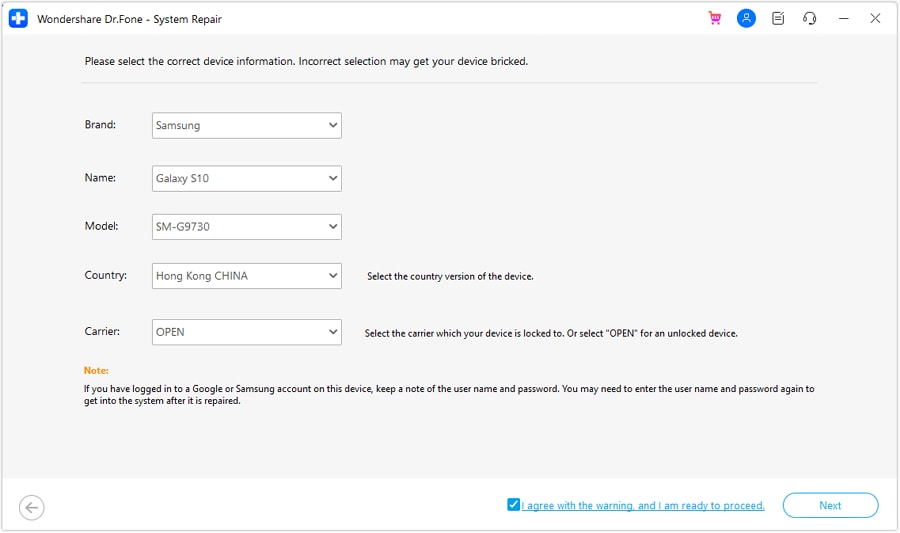
Phase 2: Enter 'Download' mode to repair and resolve 'why does my phone keep turning off'
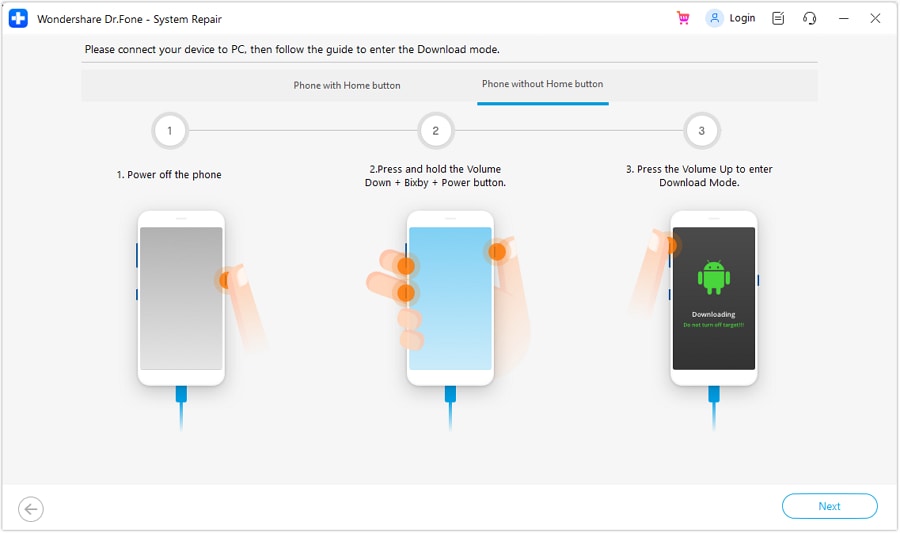
Step 1: On your Android device, go to 'Download' mode following the instructions.
For a device with the 'Home' button – Turn off the mobile and then hold down the 'Home', 'Volume Down', and 'Power' buttons together nearly for 10 seconds. Leave them all and then click the 'Volume Up' button to get into the 'Download' mode.
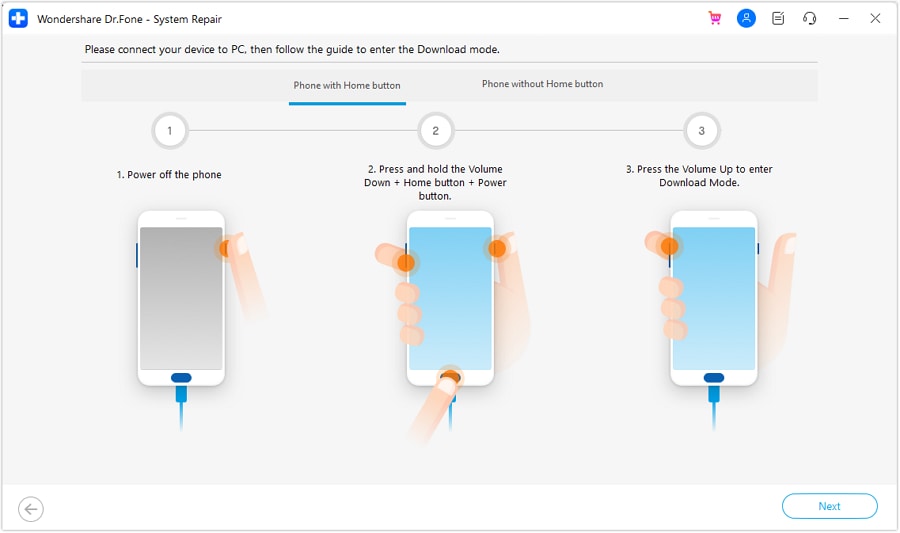
For a device lacking 'Home' button – After switching off the Android mobile, hold down 'Bixby', 'Power', 'Volume Down' key still 10 seconds. Now, un-hold them and tap the 'Volume Up' button to enter the 'Download' mode.
Step 2: Hitting the 'Next' button will start the Android firmware download.
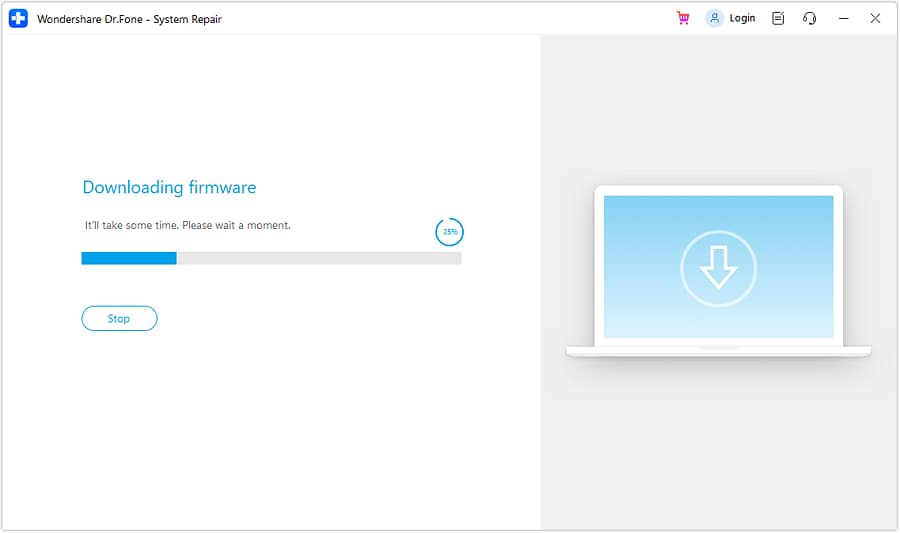
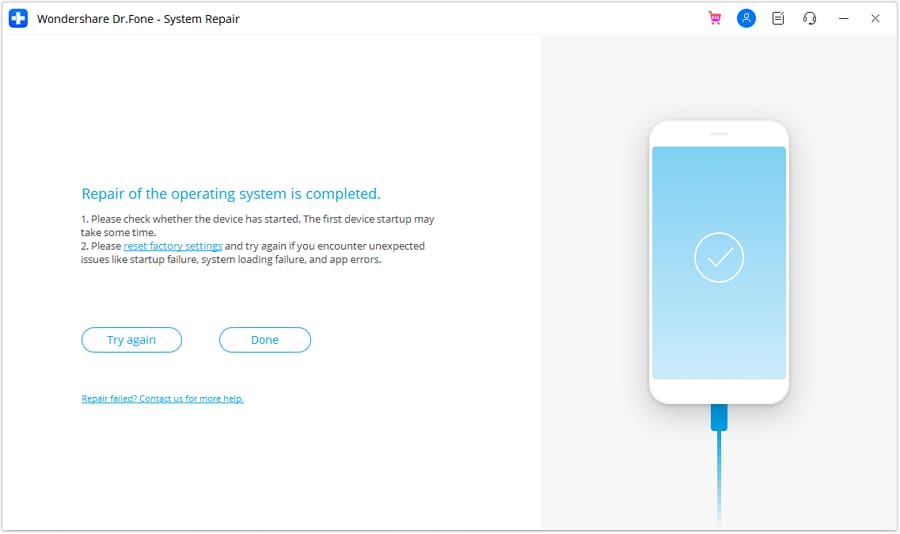
Step 3: Now, Dr.Fone - System Repair (Android) will verify the firmware once downloaded. Within some time the Android system gets repaired.
 safe & secure
Part 4: Update software to the latest version to fix Android phone keeps turning off
Outdated or buggy software is a surprisingly common — and easily overlooked — reason why an Android phone turns off by itself. Android OS updates and app updates are not just about new features; they regularly include critical bug fixes, memory management improvements, security patches, and stability enhancements that can directly resolve unexpected shutdown behavior.
When your system software is outdated, known bugs that cause crash loops, power management errors, or kernel-level instability may remain unpatched. Similarly, an app running on an outdated version of Android may encounter compatibility issues that force the system to terminate processes abruptly — triggering a shutdown.
How to update your Android software:
- Go to Settings on your Android phone.
- Scroll down and tap System (on some devices this may be labeled About Phone or General Management).
- Tap Software Update or System Update.
- Select Check for Updates and allow the device to scan for available updates.
- If an update is available, tap Download and Install. Ensure your battery is above 50% and connect to Wi-Fi before proceeding.

What to do if no update is available: If your device is already on the latest software version but the problem persists, the issue may be related to a specific app rather than the OS itself. Open the Google Play Store, tap your profile icon, go to Manage Apps & Device, and update all pending app updates. Pay particular attention to recently installed apps that may have introduced instability. You can also check how to fix apps crashing on Android for a deeper dive into app-level issues.
Part 5: Cool down your phone to avoid your phone keeps turning off
Overheating is a leading — and often underestimated — cause of random shutdowns on Android phones. Every Android device has a built-in thermal protection system. When the internal temperature of the CPU, GPU, or battery exceeds a critical threshold (typically 45–50°C / 113–122°F), the phone will automatically power off to prevent permanent damage to its internal components. This is a safety feature, not a defect.
Common signs your phone is overheating before shutdown:
- The back of the phone feels unusually hot to the touch
- Performance becomes sluggish or apps start lagging just before the shutdown
- A warning notification such as "Temperature too high" or "Device cooling down" appears
- The phone turns off specifically during charging, gaming, or video streaming
How to prevent your phone from turning off due to overheating:
- Avoid using the phone while charging: This combines two heat sources — charging generates heat, and active usage generates more. Together they can push temperatures beyond safe limits quickly.
- Remove the phone case during intensive tasks: Phone cases, especially thick silicone or leather ones, trap heat. Removing the case temporarily improves passive heat dissipation.
- Place the phone on a hard, flat surface: Fabric surfaces (sofas, beds, pillows) block the ventilation areas on your phone's back, causing heat to build up faster.
- Lower screen brightness and close background apps: Reducing unnecessary processor load lowers heat generation significantly.
- Keep the phone out of direct sunlight and hot car interiors: Ambient heat alone can raise internal temperature above the shutdown threshold in a hot car.
- Avoid running multiple heavy apps simultaneously: Multitasking with graphics-intensive apps pushes CPU and GPU usage to maximum, rapidly increasing internal temperature.

If your phone overheats frequently even during light use, this may indicate a deeper hardware problem — such as a failing battery that generates excessive heat, or a damaged thermal paste layer on the processor. In such cases, a professional repair may be necessary.
Part 6: Narrow down the randomly turning off issue in Safe Mode
If your phone keeps going off randomly and you suspect a third-party app may be responsible, booting into Safe Mode is the most effective way to test this hypothesis. Safe Mode is a diagnostic environment built into Android that loads only the core operating system and pre-installed system apps — all third-party apps you've installed are temporarily disabled.
How Safe Mode helps: If your phone runs stably in Safe Mode without shutting down unexpectedly, it confirms that one or more of your installed third-party apps is causing the issue. If the phone continues to shut off in Safe Mode, the problem is deeper — likely at the OS or hardware level — and you should proceed to Part 7 or revisit Part 3.
Step 1: Long press the power button to see the following options on the screen.
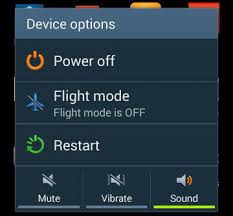
Step 2: Now tap on "Power Off" for about 10 seconds and click "OK" on the message that pops-up as shown below.
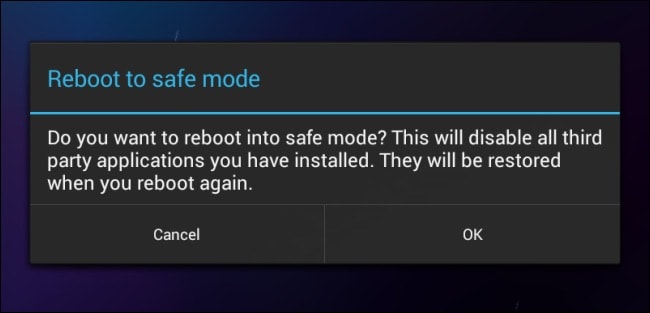
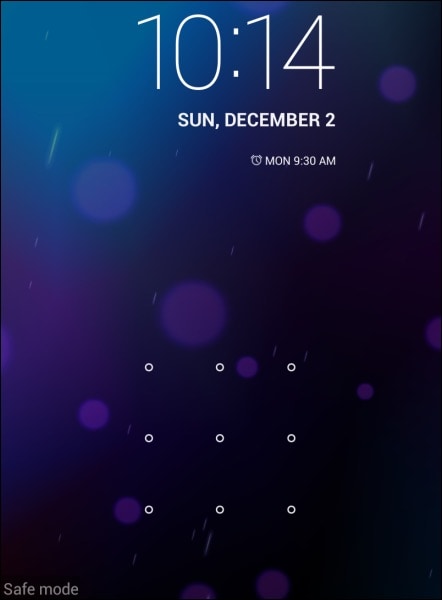
Step 3: Once done, the phone will reboot and you will see "Safe Mode" on the main screen.
How to identify and remove the problematic app: After confirming the issue is app-related, reboot your phone normally and start uninstalling recently installed or updated apps one by one. Begin with the most recently added app, reboot after each removal, and observe whether the random shutdowns stop. Battery-draining apps or apps that request unusual system permissions are prime suspects. Once you've identified the culprit, uninstall it permanently and consider reporting it via the Google Play Store.
Part 7: Back up your data and perform a factory reset
Note: You must take a back-up of all your data because once you perform a factory reset on your device, all media, contents, data, and other files are wiped out, including your device settings.
A factory reset is the most comprehensive software-level fix available when an Android phone keeps turning off by itself and all other methods have failed. It restores your device to its original out-of-box state, eliminating any software corruption, problematic app configurations, or OS-level errors that may be causing the random shutdowns. While it is a drastic step, it is highly effective when the issue is rooted in software rather than hardware.
Before performing a factory reset, back up your data. A factory reset will permanently erase everything on your device — contacts, photos, videos, app data, downloaded files, and all personal settings. Without a backup, this data cannot be recovered.
Wondershare Dr.Fone is a great way to back up all your data to prevent it from getting lost after resetting the phone. It works brilliantly as it backs up all data and allows users to retrieve it fully or selectively. You can backup all files from your Android to PC in just a click and restore them later. Try this software for free before purchasing it to understand it's working better. It does not tamper with your data and only requires you to follow the simple steps given below to backup your Android data:
Wondershare Dr.Fone
Flexibly Back up and Restore Android Data
- Back up Android data to the computer with one click.
- Preview and selectively restore the backup to any Android device.
- Supports 8000+ Android devices.
- There is no data lost during backup, export, or restoration.
Step 1: To start with, download and run the backup software on the PC. Once you have the main screen of the software with multiple options that will appear before you, choose the "My Backup" option.
Step 2: Now connect the Android phone to the PC and make sure that USB debugging is turned on. Then hit "Back Up Now" and wait for the next screen to open.
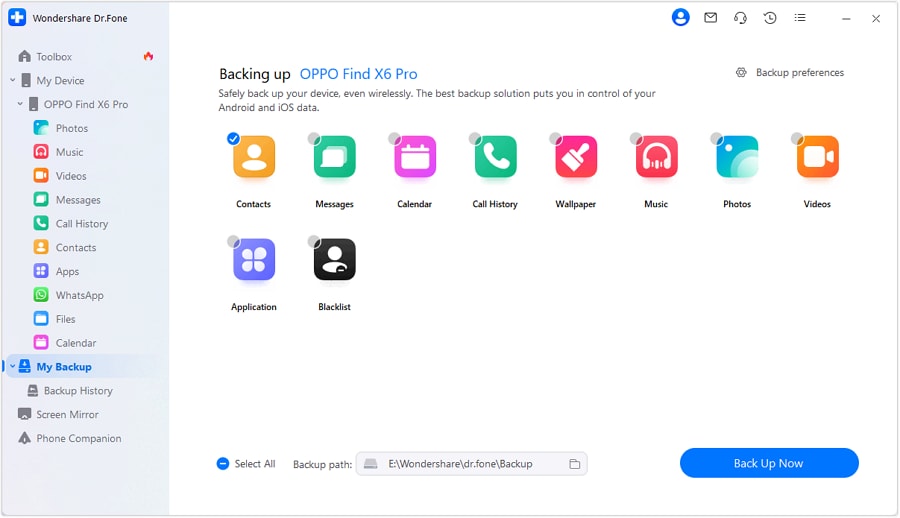
Step 3: You will see the file types that will be backed up. Wait for the backup process to complete.
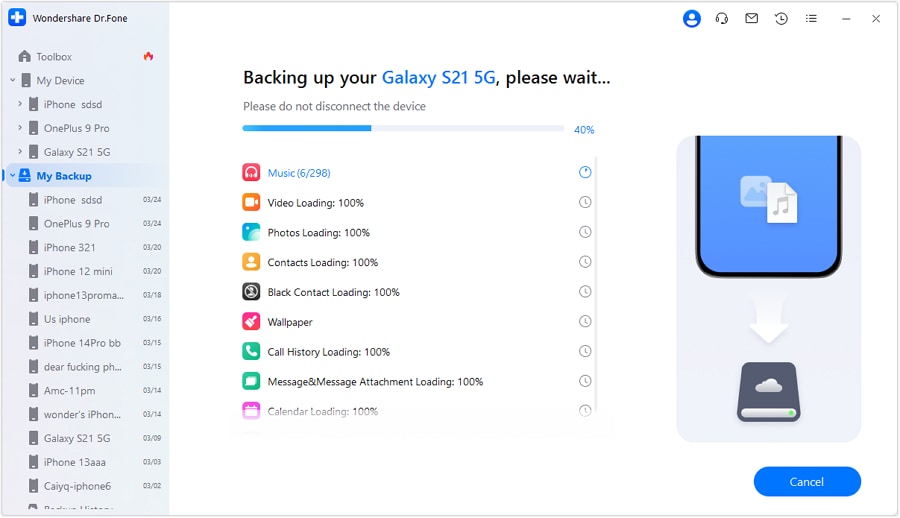
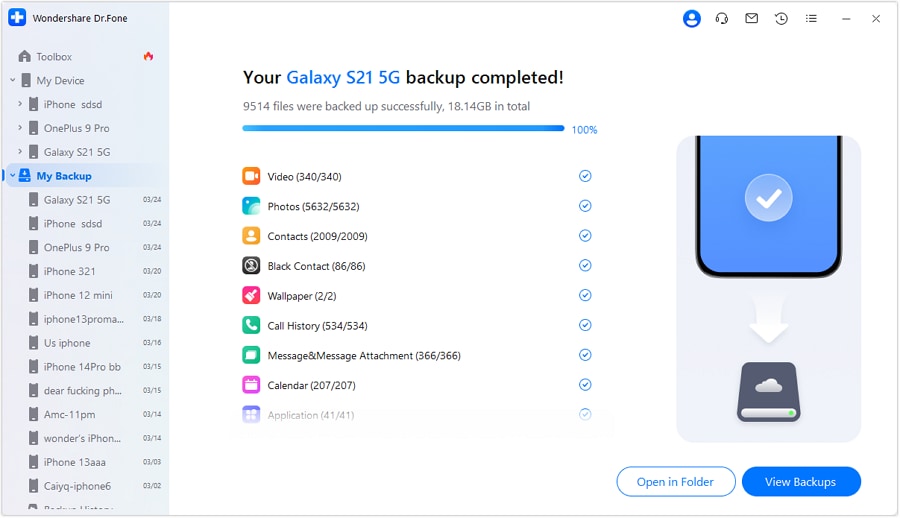
Step 4: There you go, you have successfully backed up data.
safe & secureDitch the hassle of multiple apps and simplify your mobile experience with Dr.Fone App, the ultimate all-in-one solution for iOS and Android users. Unlock your device, change your GPS location, and transfer WhatsApp data with ease. Plus, recover lost data from Android devices and transfer files, photos, and music between devices with ease. Fix common system issues and get the most out of Dr.Fone App with our "Tips" section below.
Dr.Fone App - Android Data Recovery
Get Back Your Valuable Data from Android Devices with Ease.
- Supports multiple data types: contacts, photos, videos, audios, and files.
- Compatible with over 6000+ Android brands.
- Recovery history available for review.
- High efficiency and success rate.



Now moving on to factory reset your phone:
Simply visit "Settings" on your Android phone by clicking the settings icon as shown below.
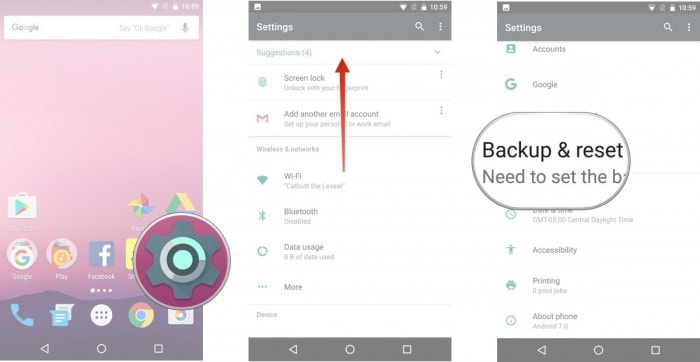
And then select the "Backup and Reset" option.
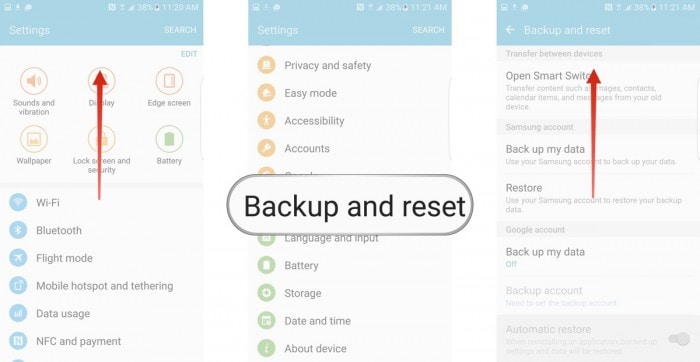
Once selected, tap on "Factory data reset" and then "reset device" as shown in the picture below.
Finally, tap on "ERASE EVERYTHING" as shown below to Factory Reset your device.
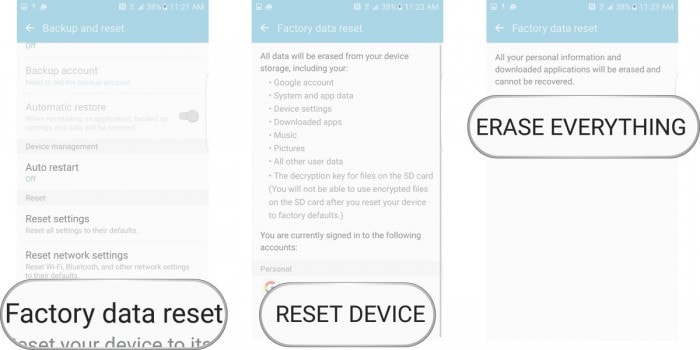
Note: Once the factory reset process is complete, your device will automatically restart and you will have to set it up once again. You can restore the backup data on your Android device once you factory reset it, again using the Dr.Fone toolkit.
Conclusion
If your Android phone keeps turning off by itself, don't panic — the issue is almost always fixable. The most common causes include battery degradation, overheating, incompatible apps, and OS-level software bugs. By working through the 7 solutions in this guide — from checking battery health and updating software, to using Safe Mode for app diagnosis and employing Dr.Fone - System Repair for deep OS fixes — you can systematically identify and resolve the root cause.
For the best results: start with the quick checks (battery status, software update, overheating prevention), then move to diagnostic steps (Safe Mode), and escalate to repair tools or factory reset only if needed. Always back up your data before taking any irreversible action. For added security, the Dr.Fone - Phone Backup (Android) feature lets you safely store and retrieve your data at any time.
safe & secureFAQs
 Q1. How do I stop my phone from turning off by itself?Q2. Why does my Android phone turn off by itself randomly?Q3. Why does my phone keep going off when I'm not using it?Q4. How do I make my phone turn off automatically at a scheduled time?


Android Issues
- Android Update
- 1. Download and Use Samsung Odin
- 2. Samsung Phone Stuck in Odin Mode
- 3. Android 9 Pie Problems & Fixes
- 4. Latest Updates in Android 11
- 5. Update Android Oreo 8.1
- Android Not Working
- 1. Solution To Bricked Android Phone
- 2. Fix 'Android Phone Won't Turn On'
- 3. Flash Dead Android Phone
- 4. Fix Phone Keep Turning Off
- 5. Fix Android Bootloop Problem
- 6. Fix Android Phones and Tablets
- Android Errors
- 1. Fix Error 495 While Download Apps
- 2. Fix Error 505 in Google Play Store
- 3. Fixes For Authentication Error
- 4. Fix Error Code 963 on Google Play
- 5. Fix Error Code 920 In Google Play
- 6. Fix Encryption Error
- Screen Problems
- 1. Fix Unresponsive Fire Tablet Screen
- 2. Fix Unresponsive Android Screen
- 3. Fix Android Screen Problem
- 4. Fix Phone Is Stuck on Boot Screen
- 5. Fixes for Tablet Screen Not Working
- 6. Tools for Removing Stuck Pixels
- 7. Fix Android Black Screen of Death
- 8. Fix Android Stuck on Boot Screen
- 9. Fix Android White Screen of Death
- 10.Fix Android Blue Screen of Death
- 11.Fix ONN Tablet Screen Not Working
- 12.Fix Android Touch Screen Proble
- 13.Fix Smartphone With a Black Screen
- 14.Fix Realme Screen Not Responding
- 15.Fix Phone Screen Not Responding
- Android Problems
- ● Manage/transfer/recover data
- ● Unlock screen/activate/FRP lock
- ● Fix most iOS and Android issues
- Free Download Free Download Free Download




Alice MJ
staff Editor
Generally rated4.5(105participated)