Resolve common problems and system crashes on both iPhone and Android devices.

 100% Security Verified | No Subscription Required | No Malware

 :
: 
 ChatGPT
 Perplexity
 Gemini
 Claude
 Grok
Grok

If a phone has a cracked screen and also will not boot normally, the first question is whether the problem is hardware, software, or both.
Dr. Phone Fix and Wondershare Dr.Fone solve different kinds of phone problems. Dr. Phone Fix is a physical repair business for issues such as cracked screens, worn batteries, and water damage, while Dr.Fone provides software tools for system repair, data recovery, screen unlock, transfer, and other digital tasks. The right choice depends on what actually failed.
If there is visible physical damage, swelling, liquid exposure, or a broken component, start with a hardware repair service. If the phone has no obvious physical damage but is stuck on the Apple logo, in a boot loop, on a black screen, or after a failed iOS update, a software-repair path may be appropriate. This guide explains where Dr. Phone Fix fits, where Dr.Fone fits, and where one should not be treated as a replacement for the other.
In this article
Part 1. Everything You Need to Know About Dr. Phone Fix
Dr. Phone Fix is a Canadian repair chain focused on physical device service. Its official site lists smartphone, tablet, and computer repairs, including screen replacement, battery replacement, and water-damage service. It also provides a store locator and online booking for customers who need in-person repair.
When searching for "drphonefix" or a local Dr. Phone Fix store, confirm the location and repair terms, as similarly named businesses may operate independently.
Why People Choose Dr. Phone Fix
The main advantage of Dr. Phone Fix is hands-on hardware service. Its official site says many repairs can be completed the same day and advertises a limited lifetime warranty on eligible repair parts and labor. Its FAQ specifically says water-damage service has no warranty, so confirm the terms for your repair rather than assuming every service is covered. That makes it a relevant option when the problem is a damaged screen, battery, charging-related component, or another physical fault that software cannot repair.
Limitations of Physical Repair Services
A physical repair service and a software-repair tool are not interchangeable. Hardware service is the right path for broken or damaged components, but a phone that is stuck in a boot loop, on an Apple logo, or after a failed update may instead have a software problem. In those cases, start with the least destructive software troubleshooting path that fits the symptoms. If the device has physical damage or cannot be detected reliably, software repair should not be presented as a substitute for inspection.

Part 2. What Services Does Dr. Phone Fix Offer?
Dr. Phone Fix focuses on physical electronics repair. The services below are the clearest options shown on its current official site and are useful for deciding whether you need a repair technician rather than a software tool.
1. Comprehensive Hardware Solutions
Its current repair pages highlight these common hardware needs:
- Screen Replacement: Repair or replacement for cracked or damaged phone screens.
- Battery Replacement: Service for batteries that no longer hold a reliable charge.
- Water-Damage Service: Physical inspection and repair after liquid exposure.
- Other Device Repairs: The chain also services tablets, computers, wearables, and other supported electronics, with availability depending on the device and location.
2. Store Locator, Booking, and Warranty
Instead of assuming every location offers doorstep or mail-in service, use the options that the current official site clearly documents:
| Repair Option | Details | Benefit |
|---|---|---|
| Find a Store | Use the official Canadian store locator and confirm the store address before visiting. | Shows the chain's actual locations; verify a separate local provider if you are in the US. |
| Book Online | Start through Dr. Phone Fix online booking; give your model and describe the fault. Its FAQ also says walk-ins are accepted. | Confirm parts availability, diagnostic fees, the quote and expected turnaround with that store. |
| Repair Warranty | The homepage advertises limited lifetime coverage; the official warranty FAQ says water-damage service has no warranty. | Ask which parts and labor are covered and what is excluded; keep the written terms and receipt. |
Before booking: compare the quote with replacement
There is no single verified Dr. Phone Fix price for every phone or fault. Ask for a written quote tied to your exact model and damage: replacement part type, labor, diagnostic charge, tax, expected completion, warranty exclusions and whether the work could erase data. For liquid damage, ask whether board work is included; the chain's FAQ excludes logic-board replacement from its water-damage service.
Compare that total with a comparable replacement phone and any coverage you already have. Repair can be sensible when one replaceable component has failed and the rest of the phone meets your needs. Multiple damaged components, an uncertain diagnosis or limited remaining usefulness can favor replacement. If you need data from the device, state that goal before authorizing an erase or replacement. For US Apple service options, use Apple's iPhone service and estimate page; its estimate depends on the device and service, and the final cost follows inspection.
Part 3. For Software Problems, Try Dr.Fone System Repair
If the problem appears to be software-related rather than physical, Dr.Fone - System Repair (iOS) provides a guided firmware-repair workflow for iPhone and iPad. It supports fixing 150+ iOS system issues, including Apple-logo, boot-loop, white-screen, and related system failures. Standard Repair is designed to preserve personal data, while deeper repair modes can erase data. Dr.Fone does not repair cracked glass, swollen batteries, liquid damage, or other broken hardware.
When Dr.Fone Is the Better Fit
- Software-focused problems: Use it for software-related iOS startup or system failures rather than physical damage.
- Guided firmware workflow: The software guides you through device selection, repair mode, Recovery Mode when needed, firmware download, and repair.
- Data-preserving first option: Standard Repair is designed to retain personal data; Advanced Repair is a deeper option that erases device data.
- Desktop availability: The current iOS System Repair specifications list support for Windows and macOS computers.
Compare the software paths and their data effects
| Path | Purpose | Data effect |
|---|---|---|
| Force restart | Restart an unresponsive phone | Does not perform an erase or firmware restore. |
| Apple Update in Recovery Mode | Attempt an iOS reinstall when offered | Attempts to keep personal data; back up an accessible phone first. |
| Dr.Fone Standard Repair | Guided repair for supported software-related iOS issues | Designed to retain data; this does not guarantee every fault can be fixed. |
| Dr.Fone Advanced Repair | Deeper software repair when Standard is insufficient | Erases device data. Confirm backup and accept the loss before starting. |
| Apple Restore | Erase and reinstall iOS | Erases the iPhone; available backups can be restored during setup. |
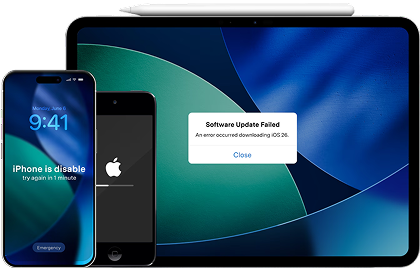
 Standard Repair is designed to preserve personal data.
- Guided repair for 150+ iOS system issues.
- Covers Apple logo, boot loop, black screen, Recovery Mode, and more.
- Upgrade or downgrade supported iOS firmware; availability depends on firmware support and feature access.
How to Use Dr.Fone Standard Repair for iOS System Issues
-
Step 1 Open System Repair and select your iPhone
Launch Dr.Fone on your computer and select System Repair from the Toolbox.
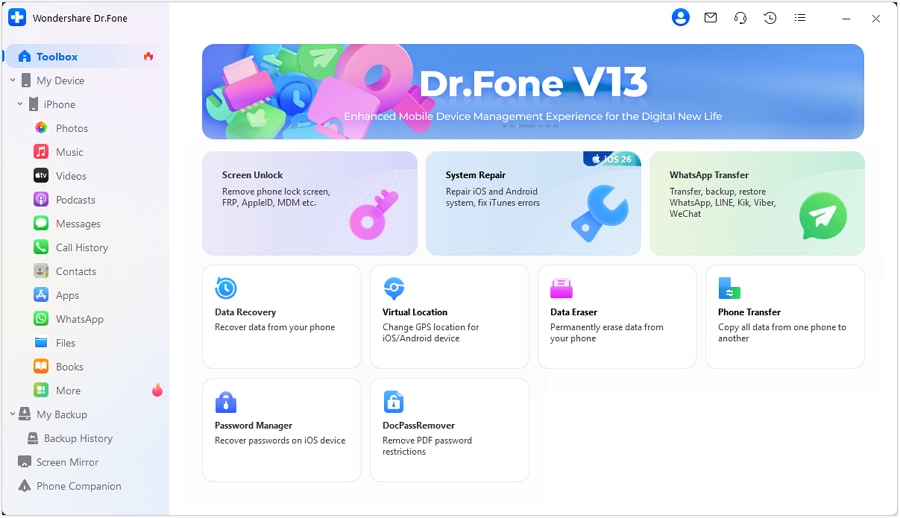
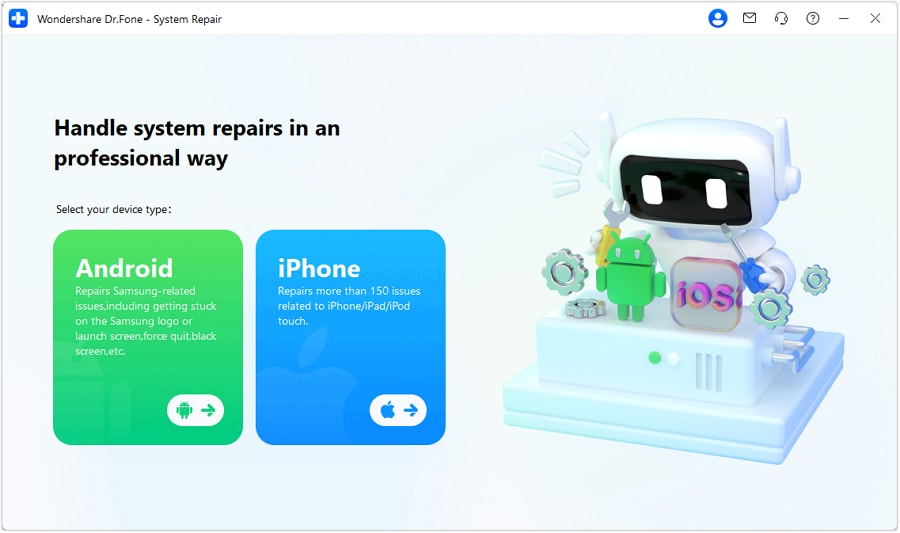
Connect the iPhone with a USB data cable, then choose iPhone as the device type.
-
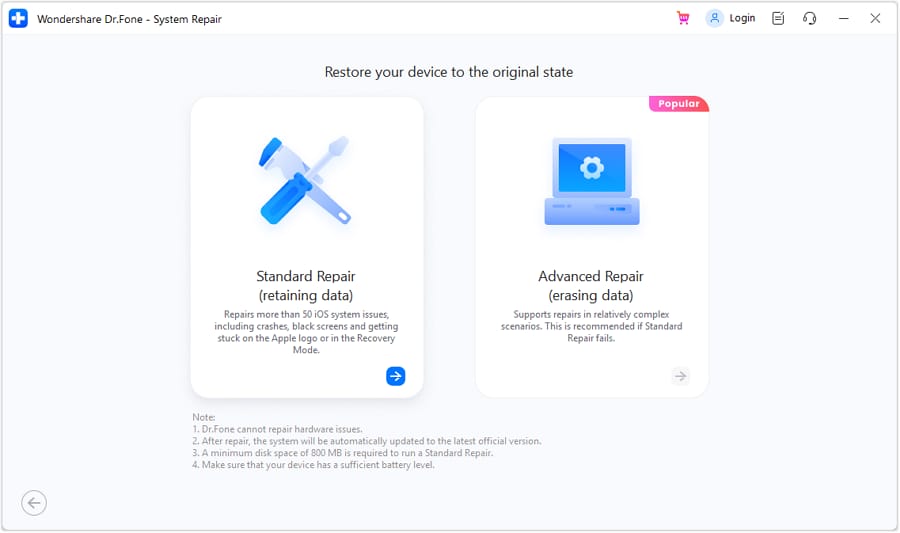
Step 2 Choose iOS Repair and Standard Repair
Select iOS Repair, then choose Standard Repair if you want the repair mode designed to preserve personal data. Use Advanced Repair only after you understand that it erases device data.
-
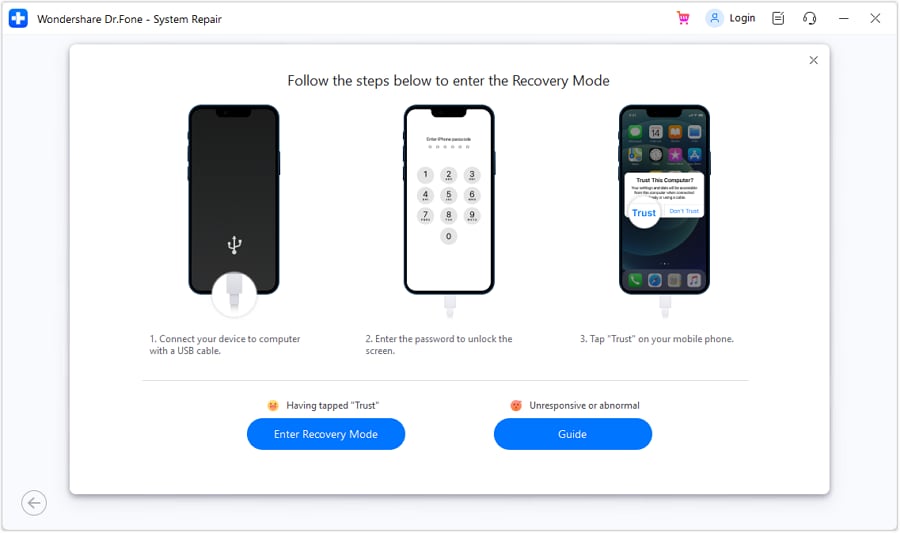
Step 3 Enter Recovery Mode If Prompted
Follow the on-screen instructions to put the iPhone into Recovery Mode. If the device is unresponsive, use the built-in Guide for the model-specific button sequence.
-
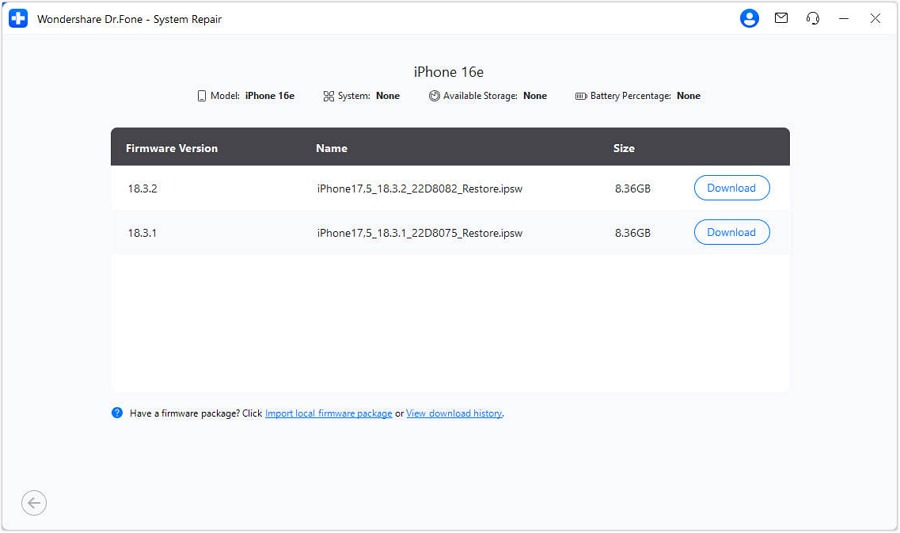
Step 4 Download the Firmware
Dr.Fone will show compatible iOS firmware for the connected device. Select the appropriate package and click Download, then wait while the software downloads and verifies it.
-
Step 5 Start the Repair
After the firmware is verified, click Repair Now. Keep the iPhone connected until the completion screen appears, choose Done, and check that it reaches a responsive lock screen. Test the original problem and verify your important data. If it fails or still will not boot, record the error; review backup and erase implications before choosing Advanced Repair, or seek service if hardware is suspected.
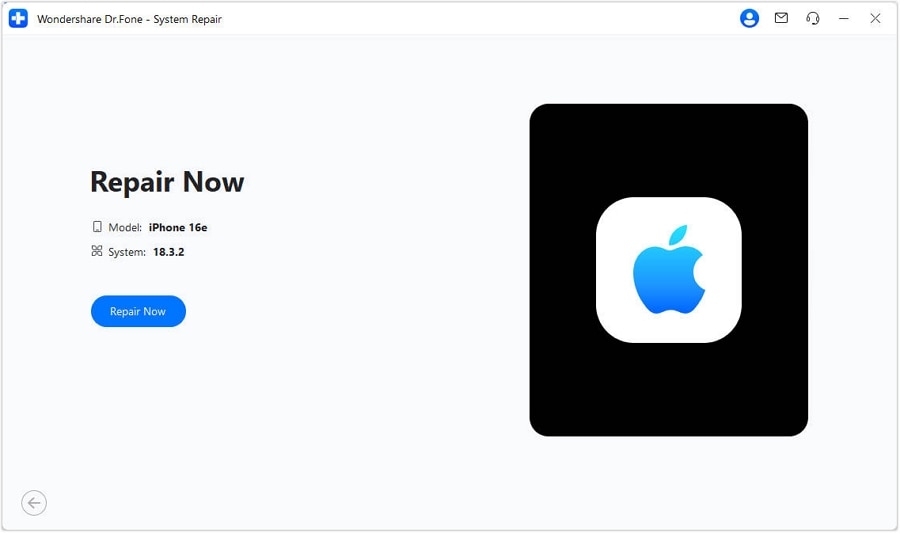
These five core steps combine the launch/device and download/verification screens in the official Standard Repair Guide. Follow the current interface if labels differ.


Part 4. What Dr.Fone Can and Cannot Replace
Dr.Fone is a toolkit with separate modules for separate jobs. System Repair is for operating-system problems; Screen Unlock is for supported lock-screen and FRP scenarios; Data Recovery and WhatsApp tools handle different data tasks. Keeping those jobs separate makes it easier to choose the right tool and avoid expecting software to fix physical damage.
1. System Repair Handles Software Problems, Not Broken Hardware
Use System Repair when the symptoms point to iOS software trouble, such as a boot loop, Apple-logo freeze, Recovery Mode problem, or failed update. If the phone has a shattered display, swollen battery, liquid damage, or a damaged port, the device still needs hardware inspection or repair.
2. Other Dr.Fone Tools Are Separate Modules
Dr.Fone also includes tools for screen unlock, data recovery, phone transfer, backup, and WhatsApp workflows. Those capabilities should not be described as functions of iOS System Repair. For example, Android screen-lock removal and FRP bypass belong to Dr.Fone - Screen Unlock (Android), while WhatsApp transfer and recovery use separate Dr.Fone workflows.
3. Data-Loss Risk Depends on the Repair Mode
For iOS system repair, Standard Repair is designed to preserve personal data. Advanced Repair is intended for more serious system problems and erases device data, so back up the device when possible before using an erasing mode. Lock-removal and data-recovery workflows have their own device-specific conditions and should be checked separately.
- Standard Repair is designed to preserve personal data.
- Guided repair for 150+ iOS system issues.
- Covers Apple logo, boot loop, black screen, Recovery Mode, and more.
- Upgrade or downgrade supported iOS firmware; availability depends on firmware support and feature access.
Part 5. How to Choose Between Dr. Phone Fix and Dr.Fone
Choose the repair path from the symptom, not from the brand name. This quick table separates hardware repair, iOS system repair, screen unlock, and data tasks before you move into the detailed guidance below.
A black screen alone does not tell you whether the fault is hardware or software. Physical damage, liquid exposure or a swollen battery calls for hardware inspection; stop charging a wet or swollen device. For a phone without those signs, follow the iPhone black screen guide for basic checks, then consider Standard Repair for a persistent software-related problem if the computer detects the device reliably.
| Problem | Best-fit path | Why |
|---|---|---|
| Cracked screen, swollen battery, liquid damage, broken port/button | Physical hardware repair | Software cannot replace or repair damaged components. |
| Boot loop, Apple logo, Recovery Mode or failed update; a black screen after basic power/restart checks with no obvious damage | Dr.Fone System Repair or native iOS recovery | A software cause is possible; reliable detection and the checks above guide whether firmware repair is appropriate. |
| Forgotten Android screen lock or FRP | Dr.Fone Screen Unlock | This is a separate unlock module, not System Repair. |
| Deleted files or WhatsApp data | Dr.Fone Data Recovery / WhatsApp tools | Recovery and transfer are separate data workflows. |
When to Choose Dr. Phone Fix (Hardware)
Choose physical repair when the evidence points to damaged hardware. In the US, use the verified local provider you intend to visit or Apple's service options; the Canadian Dr. Phone Fix chain should not be assumed to cover your location:
- Impact Damage: Cracked glass, a bent frame, or visible structural damage.
- Display Hardware Failure: Screen damage, lines, touch failure, or a display that remains dead after basic software checks.
- Battery or Power Hardware: A swollen battery, physical battery damage, or persistent charging/power faults.
- Liquid or Component Damage: Water exposure, damaged buttons, ports, speakers, or other physical components.
When to Choose Dr.Fone (Software)
Choose a software tool only when the task matches the software module:
- iOS System Problems: For a boot loop, Apple-logo freeze, Recovery Mode issue, failed update, or software-related black screen, review the hardware/software guidance above, then use Standard Repair if the supported software workflow fits. See the iPhone boot loop guide or iPhone black screen guide for symptom-specific checks.
- Screen Unlock: Use Dr.Fone - Screen Unlock for supported Android lock-screen or FRP tasks, not System Repair.
- Data Recovery: Use the relevant Data Recovery module when the goal is to recover supported deleted data.
- Transfer and Backup: Use Phone Transfer, Backup, or WhatsApp tools for migration and backup tasks rather than describing those jobs as system repair.
Conclusion
Dr. Phone Fix and Dr.Fone are not the same service. Dr. Phone Fix is a physical repair provider, while Dr.Fone is a software toolkit with separate modules for system repair, unlock, recovery, transfer, and other tasks. If the phone is physically damaged, choose hardware service. If the issue is software-related, begin with the least destructive software path and use Standard Repair before an erasing repair mode when it fits the problem. Matching the tool to the actual failure is safer than treating either option as a universal phone fix.
FAQ
1. Is Dr. Phone Fix the same as Wondershare Dr.Fone?
No. Dr. Phone Fix is a physical electronics repair business, while Wondershare Dr.Fone is a software toolkit. They can address different parts of the same phone problem, but one should not be treated as a direct replacement for the other.
2. Can Dr. Phone Fix repair a phone that will not turn on?
A repair shop can inspect battery, charging, display and component faults. A black screen alone does not identify the cause. For an undamaged, dry phone, review the hardware/software guidance above first; use hardware service if it stays off or shows physical damage. Do not keep charging a swollen or wet device.
3. Does Dr.Fone System Repair erase iPhone data?
Dr.Fone Standard Repair is designed to preserve personal data. Advanced Repair and other data-erasing modes can remove device data, so back up the iPhone when possible and read the mode description before starting.
4. Can software repair fix water damage or a broken screen?
No. Software can address operating-system problems, but it cannot replace damaged glass, a swollen battery, corroded components, or other broken hardware. Physical damage requires inspection or repair.
5. Do I need technical skills to use Dr.Fone System Repair?
The current Dr.Fone workflow is guided: select the device and repair mode, follow Recovery Mode instructions when required, download the compatible firmware, and start the repair. You should still understand the difference between data-preserving and data-erasing modes before proceeding.
6. Is the Canadian Dr. Phone Fix chain the same as a US shop with a similar name?
No affiliation should be assumed from the name. The docphonefix.com FAQ lists locations in Canada; similarly named US shops publish their own local information. Verify the website, address and terms of the actual shop before booking.
7. Is Dr.Fone System Repair free, and does it work in the mobile app?
Downloading or trying Dr.Fone does not mean full system repair is free. Entering Recovery Mode is available free; full repair and other actions may require a paid license. This iOS firmware-repair procedure requires the Windows or Mac application, a cable and supported device access. The mobile app provides separate workflows. Apple's Update option is an alternative to try when offered; Restore erases data.
 Add Wondershare Dr.Fone as a preferred source on Google