2026 Guide: How To Unbrick a Bricked Xiaomi Phone
Mar 24, 2026 • Filed to: Phone Repair Solutions • Proven solutions
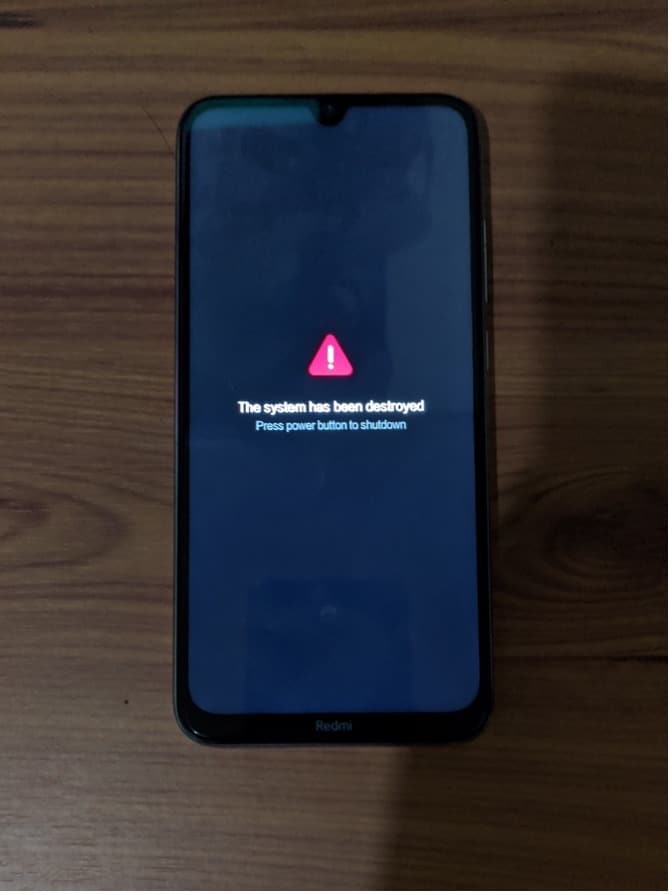
Xiaomi smartphones have earned a massive global following—not just for their exceptional value, but also for the freedom they offer power users. From unlocking the bootloader and flashing custom ROMs to rooting system partitions and tweaking kernel settings, the Xiaomi ecosystem attracts a uniquely adventurous user base. But that freedom comes with real risks. One misconfigured flash, one interrupted firmware update, or one incompatible ROM can leave you with a bricked Xiaomi phone—a device that refuses to boot, respond to input, or function in any meaningful way.
If your Xiaomi is stuck in a boot loop, shows a black screen, or won't power on at all, this guide is exactly what you need. A bricked Xiaomi phone is not necessarily a death sentence for your device—in most cases, recovery is entirely possible with the right tool and the right method. This comprehensive tutorial will help you accurately identify whether you're dealing with a soft brick or a hard brick Xiaomi scenario, then walk you through two proven, step-by-step recovery methods: the official Mi Flash Tool (MiFlash Tool) for advanced users comfortable with Fastboot mode, and Dr.Fone – System Repair for a safer, beginner-friendly alternative that recovers your device without data loss.
Before attempting any fix, it's worth understanding what type of brick you're dealing with. A soft brick means your phone still has some minimal hardware response—it may enter Fastboot or Recovery mode with button combinations, even if it won't boot normally. A hard brick is more severe: the device shows no signs of life whatsoever, making standard recovery methods ineffective and requiring deeper firmware intervention. Knowing the difference saves you hours of troubleshooting and helps you pick the correct repair approach from the start.

Part 1. Common Reasons Why Xiaomi Phones Get Bricked
A bricked Xiaomi phone is a device that has become completely non-functional—unable to power on, boot into the operating system, charge normally, or respond to any input. The term "brick" is used because the device becomes about as useful as a literal brick. Understanding what causes bricking is the first step toward preventing it—and toward choosing the right recovery path when it does happen.

Here are the most common causes of a bricked Xiaomi phone that users encounter:
- Flashing an incompatible or incorrect ROM. Custom ROMs are popular in the Xiaomi community, but every model—and even every regional variant—requires a specific ROM build. Flashing a ROM intended for a different device model, a different region (e.g., flashing a China ROM onto a Global device), or an incompatible MIUI version can overwrite critical bootloader and partition data, resulting in a hard brick Xiaomi that won't respond to standard recovery methods.
- Rooting errors and failed root exploits. Rooting grants superuser access to system-level files, but a failed root attempt—especially those that modify the
system,boot, orvendorpartitions incorrectly—can prevent the device from completing its startup sequence. Soft bricks from rooting are common and usually recoverable via soft brick recovery methods, but deep root failures may require full firmware re-flash. - Interrupted or failed OTA firmware updates. Over-the-air (OTA) updates rewrite core system partitions. If the update process is interrupted—due to a sudden battery drain, accidental disconnection, or system crash mid-update—your Xiaomi phone may be left in an inconsistent state where the OS is partially overwritten, causing a boot failure or bricked system.
- Incomplete or botched bootloader unlocking. Xiaomi requires official unlocking via the Mi Unlock Tool before Fastboot flashing is permitted. If users attempt unofficial unlock methods, interrupt the unlocking process, or unlock a device that doesn't support bootloader modification, the bootloader may become corrupted—rendering the device unbootable.
- Using unauthorized or third-party flashing tools. Tools not officially supported by Xiaomi—including certain regional "repair" services or untrusted Xiaomi phone repair software—may write incorrect firmware or damage partition tables. Always use the official Mi Flash Tool (MiFlash Tool) or a verified third-party tool like Dr.Fone for safe recovery.
- Bad TWRP installation or custom recovery errors. Installing an incompatible version of TWRP (Team Win Recovery Project) or making mistakes during custom recovery setup can corrupt the recovery partition, leaving your device unable to enter either stock or custom recovery mode.
How to Diagnose: Is Your Xiaomi Phone Soft Bricked or Hard Bricked?
Once you suspect your Xiaomi is bricked, the next critical question is: what type of brick are you dealing with? The answer determines which recovery method to use.
- Soft Brick symptoms: The device powers on but gets stuck on the MIUI logo, enters a continuous boot loop, or shows an error screen. Crucially, it may still respond to hardware button combinations—meaning you may be able to force it into Fastboot mode (Volume Down + Power) or Recovery mode (Volume Up + Power). Soft bricks are the most common outcome of failed ROM flashes or rooting and are almost always recoverable.
- Hard Brick symptoms: The device shows absolutely no signs of life—no screen, no vibration, no response to buttons, and it won't charge. In some hard-brick cases, the device may still be recognized by a PC via USB (as a "QHUSB_BULK" device in Device Manager on Windows), which means EDL (Emergency Download) mode recovery may still be possible using specialized Xiaomi unbrick tools.
If your device responds to button combinations and can enter Fastboot mode, start with Method 1 (Mi Flash Tool / MiFlash Tool) below. If your device is completely unresponsive, skip ahead to Method 2 (Dr.Fone System Repair), which can handle more complex recovery scenarios including advanced firmware corruption.
🔓 Xiaomi Account Lock Removal & Free Check
Locked out of your Xiaomi/Redmi/POCO phone? Get 100% remove Mi Account Lock without password or linked number.
Free check • No ads • Professional tech support • Refund guarantee
Part 2. Method 1: Use the Xiaomi Flash Tool To Recover Bricked Xiaomi Phones
The Xiaomi Flash Tool—officially known as MiFlash Tool or Mi Flash Tool—is the official PC-based firmware flashing utility developed and maintained by Xiaomi. It is the go-to Xiaomi unbrick tool for users who have experience with Fastboot mode and ROM management. When your Xiaomi phone is soft bricked, stuck in a boot loop, or refuses to boot after a failed ROM flash or update, the Mi Flash Tool can completely restore it by overwriting all existing firmware with a verified stock ROM—giving your device a clean, factory-fresh state.
Unlike third-party recovery apps, the MiFlash Tool communicates directly with your phone's Fastboot interface at a low level, writing official MIUI firmware directly to each system partition. This makes it extremely effective for both soft brick and many hard brick Xiaomi recovery scenarios, provided the device's bootloader is unlocked and the Fastboot mode is still accessible.
When Should You Use Mi Flash Tool (MiFlash Tool)?
The Xiaomi Flash Tool is the right choice for the following situations:
- Bricked Xiaomi Device Recovery. If your phone is soft bricked after a failed ROM flash or update and can still enter Fastboot mode, MiFlash Tool is the fastest and most direct solution to fully restore your device to working order.
- Official Firmware Updates via PC. You can use Mi Flash Tool to manually install the latest official MIUI or HyperOS firmware, bypassing OTA updates that may fail on compromised devices.
- Downgrading to a Stable ROM. If you've flashed a beta ROM that causes instability, MiFlash Tool lets you roll back to a stable MIUI release by flashing the appropriate older firmware package.
- Device Customization and ROM Management. Advanced users use Mi Flash Tool to switch between Global, China, and EEA ROM variants—or to install custom MIUI builds for better performance or regional features.
- Resolving Persistent Software Bugs. System-level bugs caused by corrupted partitions, bad Over-the-Air updates, or incomplete root operations can be completely eliminated by re-flashing the full firmware via MiFlash.
Prerequisites Before Using Mi Flash Tool
- Operating System: Mi Flash Tool only runs on Windows (Windows 7/8/10/11). Mac and Linux are not supported.
- Bootloader Status: Your Xiaomi phone's bootloader must be unlocked before MiFlash Tool can flash firmware. If it is not unlocked, use the official Mi Unlock Tool first.
- USB Drivers: Install the official Xiaomi USB drivers (or Mi PC Suite drivers) on your Windows PC to ensure the device is properly recognized in Fastboot mode.
- Data Backup: Flashing firmware via Mi Flash Tool will wipe all user data by default. Back up your contacts, photos, and app data before proceeding.
- Correct Firmware File: Download the stock ROM that exactly matches your device model number (e.g., Redmi Note 12, POCO X5 Pro). Flashing the wrong firmware is a leading cause of hard bricks.
How To Use the Xiaomi Flash Tool To Unbrick a Xiaomi Phone
Once you've confirmed your prerequisites, follow these detailed steps to use MiFlash Tool and recover your bricked Xiaomi phone:
- Step 1. Download the Xiaomi Flash Tool (MiFlash) and the correct stock firmware for your exact device model on your Windows PC. Extract the firmware archive to a folder with a simple path (e.g.,
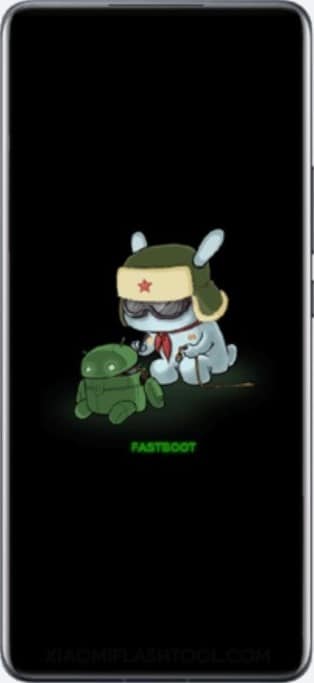
C:\Firmware\Redmi) to avoid path errors. - Step 2. Power off your Xiaomi phone completely. Then press and hold Volume Down + Power simultaneously for 6–8 seconds until the Fastboot screen appears. This forces the device into Fastboot mode, where the Mi Flash Tool can communicate with it.

- Step 3. Connect your phone to your PC using a high-quality USB data cable—avoid charge-only cables. Confirm that your PC recognizes the device; if Windows shows a driver error, reinstall Xiaomi USB drivers and try again.

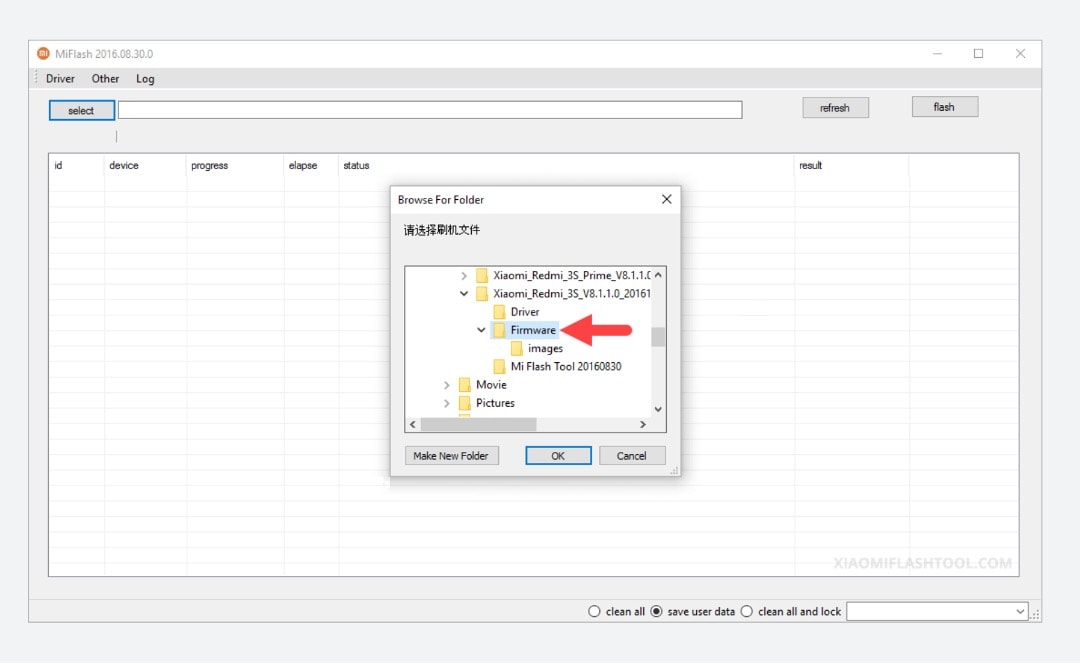
- Step 4. Open the Xiaomi Flash Tool (MiFlash) as Administrator. Click Select and navigate to the folder where you extracted the stock firmware. Select the root of the extracted firmware folder—not individual files.

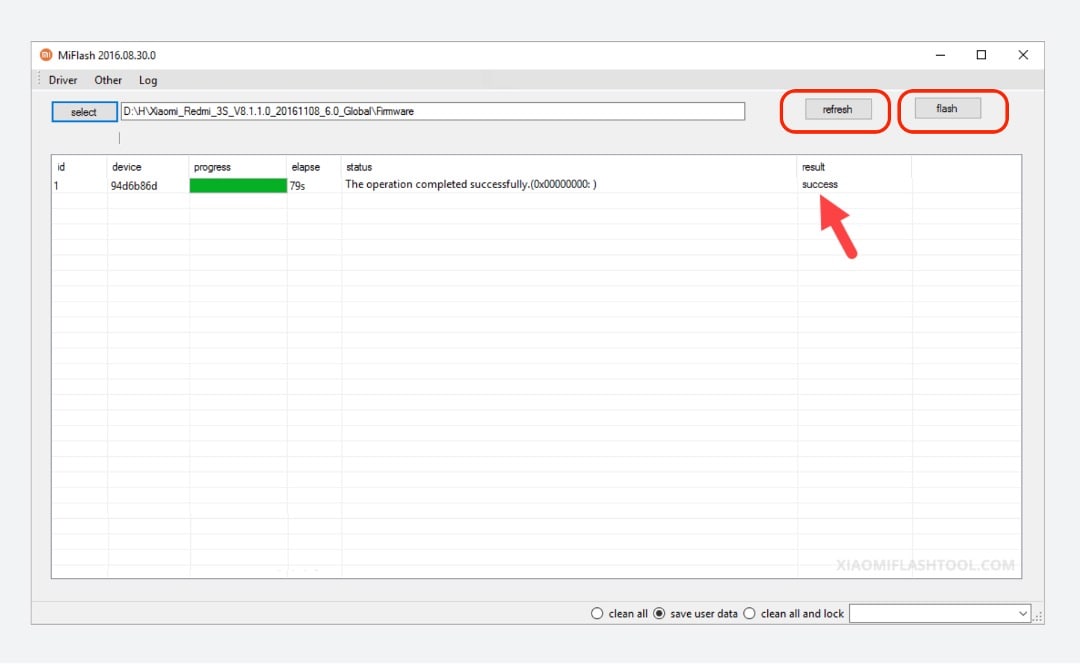
- Step 5. Click the Refresh button in MiFlash until your device appears in the device list. Select it, choose your flash option ("Clean All" for a full data wipe and complete restoration, or "Save User Data" if you want to attempt a repair without data loss), then click Flash. Wait for the process to complete—do not disconnect the USB cable. A "success" message in the result column confirms the flash was completed correctly.

Your phone will reboot automatically after a successful flash. It may take several minutes to complete the first boot—this is normal. Your Xiaomi phone should now be fully functional with a clean MIUI installation.
Mi Flash Tool not working? If your device isn't detected in MiFlash, confirm USB drivers are installed, try a different USB port, or check that Fastboot mode is active on the phone. If the tool shows an error or the flash fails, proceed to Method 2 (Dr.Fone System Repair) below for a more robust alternative.
Part 3. Method 2: Dr.Fone System Repair – Your One-Stop Shop for Unbricking Your Xiaomi Phone
If the Xiaomi Flash Tool (MiFlash) didn't resolve your bricked Xiaomi phone—or if you're not comfortable with Fastboot commands and manual firmware management—there's a more accessible and equally powerful solution. Dr.Fone - System Repair (Android) is a professional-grade Xiaomi phone repair software designed to handle deep firmware and software-level issues that standard flashing methods can't always resolve. What sets it apart is its ability to automatically identify your device, download the correct firmware, and execute the full repair process with minimal user input—making it the ideal solution for users who want reliable results without technical complexity.
Unlike the Mi Flash Tool, which requires manual driver installation, bootloader unlock confirmation, and correct firmware selection, Dr.Fone System Repair handles the entire repair workflow through a guided interface. It's particularly effective when your Xiaomi is bricked due to corrupted system apps, failed OTA updates, persistent boot loops, or black screen issues—and it's one of the few Xiaomi unbrick tools designed to recover devices while minimizing data loss risk.
Dr.Fone - System Repair (Android)
Repair Xiaomi System Errors without Data Loss.
- A completely user-friendly tool where no technical skills are needed.
- All Android models are easily supported.
- Fix various Android system issues, stuck in boot loop, black screen, or won't turn on, looping on start, etc.
- Full security is promised with the tool so there's no need to worry about harmful activities like viruses or malware.
- Trusted by a lot of users and carries a high success rate.
Why Choose Dr.Fone Over Mi Flash Tool for Bricked Xiaomi Phones?
Both tools are effective, but they serve different use cases. Here's a quick comparison to help you decide:
- No bootloader unlock required: Dr.Fone can repair many Xiaomi software issues without requiring a previously unlocked bootloader, whereas Mi Flash Tool (MiFlash) depends entirely on Fastboot access.
- Automatic firmware matching: Dr.Fone automatically identifies your device model and downloads the correct firmware package, eliminating the risk of flashing the wrong ROM—a common cause of hard brick Xiaomi incidents.
- Designed to protect user data: While MiFlash's "Clean All" mode wipes everything, Dr.Fone's repair process is engineered to preserve existing user data wherever possible.
- Handles a wider range of bricked systems: Dr.Fone can address software-level bricks caused by corrupted apps, failed updates, and system crashes that are not strictly partition-level failures.
Additional Capabilities of Dr.Fone Beyond System Repair
- Data Recovery: Even if your Xiaomi phone is fully bricked and unresponsive, Dr.Fone's data recovery module can attempt to extract photos, contacts, messages, and other critical files before or after the repair process.
- Data Transfer: Seamlessly move all data—apps, media, contacts, documents—between devices, even when the source phone has limited functionality.
- System Backup & Restore: Create a full system backup before any repair attempt so you can roll back to your previous state if needed.
- Screen Unlock & Account Recovery Tools: If you're locked out of your Xiaomi due to a forgotten PIN, pattern, or Mi Account issue following a system repair, Dr.Fone's unlock module can help regain access.
How To Use Dr.Fone System Repair Feature To Unbrick a Xiaomi Phone Without Data Loss
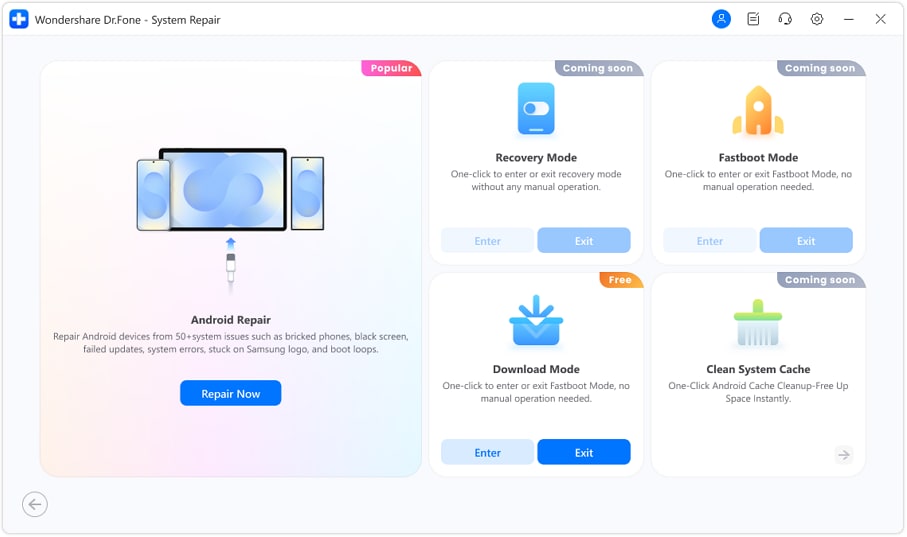
- Step 1. Launch Wondershare Dr.Fone on your Windows or Mac computer and connect your Xiaomi phone via USB cable. From the main dashboard, select System Repair, then choose Android as the device type. Click Android Repair → Repair Now to initiate the repair workflow.

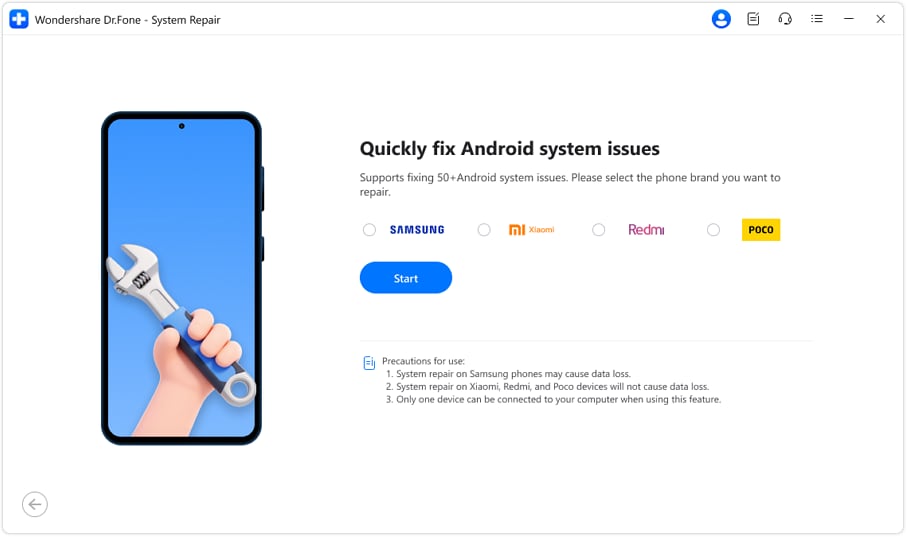
- Step 2. On the device brand selection screen, choose Xiaomi. Dr.Fone supports all major Xiaomi sub-brands including Redmi, POCO, and Black Shark.

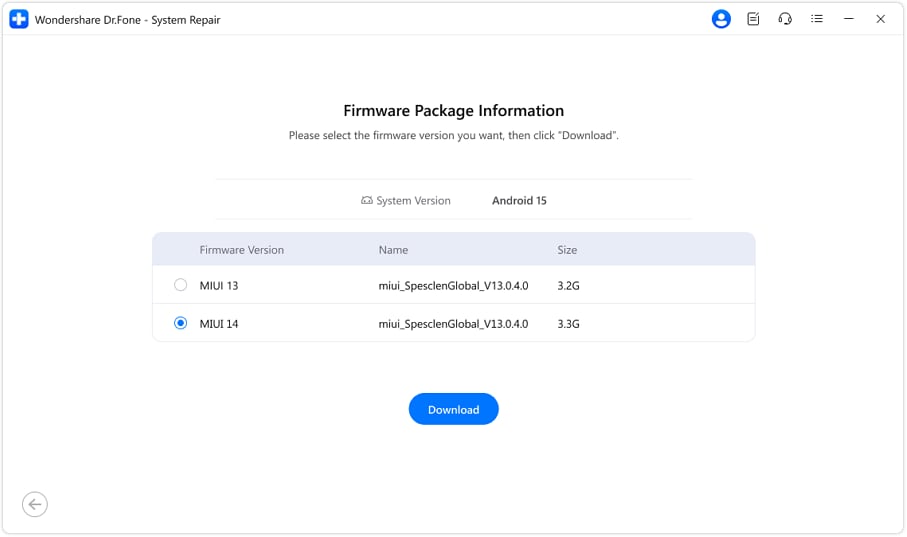
- Step 3. Dr.Fone will automatically scan and detect compatible firmware packages for your specific Xiaomi model and current system version. Review the detected options, confirm the correct firmware is selected, and click Download to fetch the repair package. This may take a few minutes depending on your internet speed.

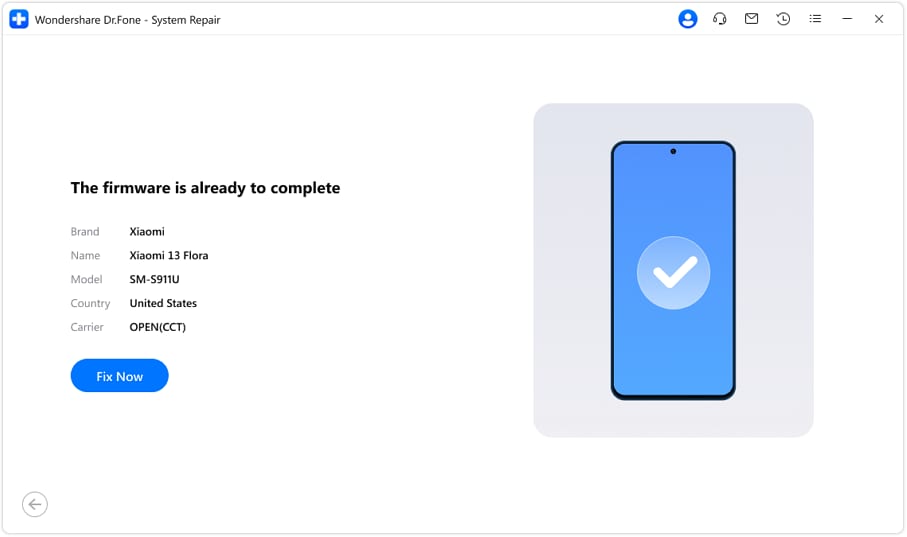
- Step 4. After the firmware download completes, Dr.Fone will display your device's full details—model, Android version, and repair scope. Carefully verify this information matches your physical device, then click Fix Now to begin the system repair process.

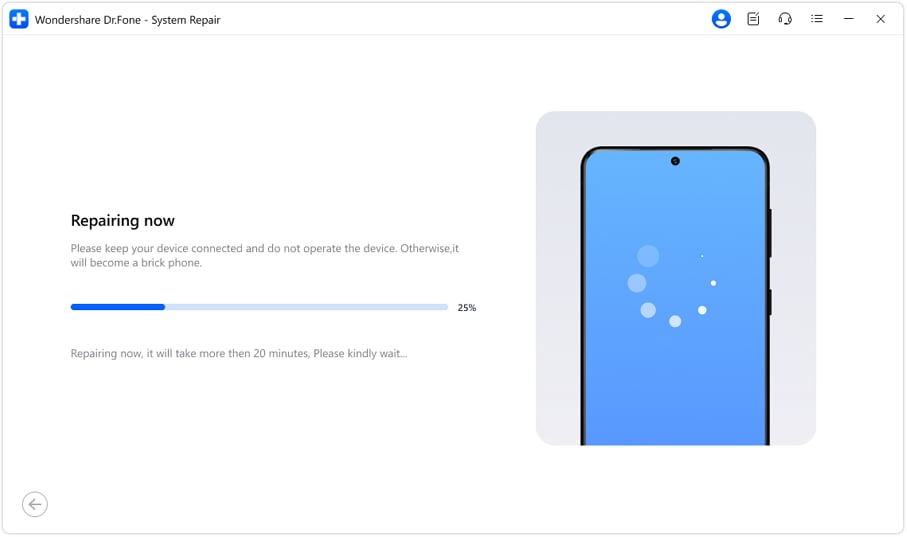
- Step 5. Dr.Fone will execute the system repair and display real-time progress. Do not disconnect your Xiaomi phone, use the device, or close Dr.Fone during this process. Interrupting the repair mid-process can cause additional damage to the system partitions.

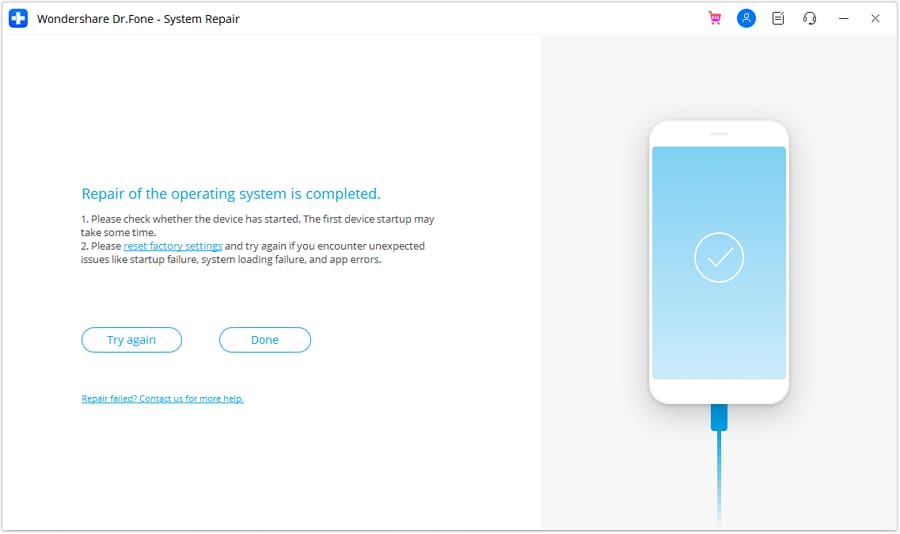
- Step 6. Once the repair is fully complete, Dr.Fone will display a success confirmation screen and your Xiaomi phone will automatically reboot into a repaired, fully functional system. The first boot may take 3–5 minutes—this is expected behavior as the system initializes fresh.

Part 4. Best Practices/Tips Before Unbricking Your Phone
Successfully unbricking a Xiaomi phone requires more than just running a tool—preparation and awareness of common mistakes can mean the difference between a smooth recovery and making a bad situation worse. Follow these best practices before and during the unbricking process to maximize your success rate and protect your data:
- Back Up Your Data First—Every Time. This is the most important rule. Even tools designed to preserve data can fail under certain conditions. Before attempting any unbricking method, back up photos, contacts, messages, and app data to Google Drive, a PC, or an SD card. A 5-minute backup can prevent permanent loss of irreplaceable files.
- Use Only Official and Verified Tools. Only download the Mi Flash Tool (MiFlash) from Xiaomi's official website, and only download Dr.Fone from Wondershare's official page. Third-party redistribution sites sometimes bundle modified or malware-infected versions of Xiaomi phone repair software—using these can make the problem significantly worse. Similarly, only use stock ROMs from official Xiaomi ROM repositories or verified community sources like MIUI.eu.
- Verify Firmware Compatibility Before Flashing. Always double-check that the firmware or ROM you're about to flash exactly matches your device's model number, regional variant, and Android version. A single digit difference in the model number (e.g., Redmi Note 12 vs. Redmi Note 12 Pro) can result in flashing the wrong firmware and causing a hard brick Xiaomi that's far harder to recover from.
- Check Your Battery Level. Both Mi Flash Tool and Dr.Fone require your phone to maintain a stable connection throughout the repair process. Ensure your Xiaomi phone has at least 30–50% battery charge before starting. If the battery is too low, charge it (even via a power bank if the device won't charge normally) before beginning.
- Use a Quality USB Cable and a Direct USB Port. Always use the original Xiaomi data cable or a certified third-party cable. Avoid USB hubs—connect your phone directly to a USB port on your PC to prevent data transfer interruptions that could corrupt the flashing process mid-stream.
- Consult the Xiaomi Community Before Taking Advanced Steps. The Xiaomi community on XDA Developers and the official MIUI forums is one of the most active and knowledgeable mobile communities in the world. Before attempting EDL (Emergency Download) mode recovery or other advanced Xiaomi unbrick tool procedures, search for threads specific to your exact device model. Experienced members often post device-specific guides, known issues, and tested solutions that can save significant time and prevent further damage.
Conclusion
A bricked Xiaomi phone—whether it's a minor soft brick or a severe hard brick—is a frustrating experience, but it's rarely the end of the road for your device. With the right knowledge and the right tools, the vast majority of bricked Xiaomi phones can be fully restored to factory-fresh condition. This guide has walked you through the complete recovery process: from accurately diagnosing your brick type, to using the official Mi Flash Tool (MiFlash Tool) for Fastboot-level firmware restoration, to leveraging Dr.Fone – System Repair as a powerful, user-friendly Xiaomi phone repair software alternative that handles complex cases and protects your data throughout.
The key takeaway: always match your recovery method to your brick type and your technical comfort level. For soft bricks with an unlocked bootloader, Mi Flash Tool is fast and direct. For more complex bricked systems, firmware-level corruption, or when you simply want a guided, safer experience, Dr.Fone System Repair is the trusted choice. Whichever path you take, stay prepared by keeping a backup routine, having verified firmware ready, and bookmarking a reliable Xiaomi unbrick tool before an emergency strikes—because the best time to prepare for a brick is before it happens.
4,624,541 people have downloaded it
FAQs
Xiaomi Topics Series
- Xiaomi Screen & FRP Unlock
- 1. Unlock Xiaomi Bootloader
- 2. Mi Account Unlock Tools
- 3. Redmi Note 8 FRP Unlock Tool
- 4. Redmi Note 9 FRP Bypass Tool
- 5. Redmi 9A FRP Bypass
- 6. Remove FRP on Xiaomi/Redmi
- Xiaomi Repair
- Xiaomi Recover
- Xiaomi Reset
- Xiaomi Tips & News
- 1. Xiaomi HyperOS 3.0
- 2. Screen Mirror Xiaomi to PC
- 3. Run Hardware Tests on Xiaomi
- 4. Conduct battery test on Xiaomi
- 5. How Do I Obtain the Security Code Xiaomi
- 6. DND Mode Xiaomi
- Xiaomi Transfer & Backup
- ● Manage/transfer/recover data
- ● Unlock screen/activate/FRP lock
- ● Fix most iOS and Android issues
- Try for Free Try for Free Try for Free


Daisy Raines
staff Editor
Generally rated4.5(105participated)