Resolve common problems and system crashes on both iPhone and Android devices.


 100% Security Verified | No Subscription Required | No Malware

 :

 ChatGPT
 Perplexity
 Gemini
 Claude
 Grok

My iPhone was working flawlessly until it ran out of charge. Now, when I try to recharge it, it simply won't turn back on. Every time I press a button, it just displays the red battery logo without the lightning cable image. I’ve tried different outlets and cables, but it seems to be stuck in a boot loop. Is there any way to fix this without losing my data?
If your iPhone is stuck on the charging screen, connect it to a working cable, power adapter, and wall outlet, let it charge for 30 minutes, force restart it using the buttons for your model, then charge for another 30 minutes. A red battery icon alone does not tell you whether the battery, connector, or iOS is at fault.
If there is still no improvement, use the symptom checks below: a phone with no reliable power needs charging or hardware diagnosis, while a detected iPhone with a software-related boot problem has a guided repair option. This applies to an iPhone 6 as well as newer models, although the restart buttons differ.
In this article
- Part 1: Why is My iPhone Stuck on the Dead Battery Screen?
- Part 2: How to Fix iPhone Stuck on Charging Screen
- Method 1: Let iPhone Return to a Normal Temperature
- Method 2: Force Restart Your iPhone Using the Correct Buttons
- Method 3: Charge for 30 Minutes, Restart, Then Charge Again
- Method 4: Use Guided iOS System Repair for a Software Freeze
- Method 5: Get the Battery and Charging Hardware Checked
- Method 6: Check Accessories and the PC or Mac Connection
- Method 7: Check Whether DFU Is Relevant Before Restoring
- Method 8: Use Recovery Mode to Update a Detected iPhone
- Method 9: Restore with Finder, Apple Devices, or iTunes (Erases Data)
Part 1: Why is My iPhone Stuck on the Dead Battery Screen?
The iPhone dead battery screen indicates very low charge, but it does not identify a single failed part. These checks help separate a depleted battery, a charging connection problem, a software freeze, and hardware wear.
1. A depleted battery
A fully drained iPhone may need time on a working charger before it starts. Use the timed charging and restart check rather than repeatedly pressing buttons or assuming a specific internal voltage has been reached.
2. A cable, adapter, or port problem
A damaged cable, loose connection, unsuitable power adapter, or debris in the port can interrupt charging. Try a known-good cable suited to your iPhone: Lightning and USB-C use different connectors. A 20W adapter is not a requirement for every iPhone to turn on.
3. A software-related startup problem
An iPhone that starts showing the Apple logo repeatedly, freezes after an update, or reaches a recovery screen may need software troubleshooting. Those symptoms are more useful than assuming every red battery icon means corrupted firmware.
4. Battery or charging hardware wear
A worn battery, damaged charging port, or another internal fault can prevent startup even when the phone is plugged in. Older devices can develop these problems, but age alone is not enough to decide which part to replace.
What does the iPhone charging symbol tell you?
A red battery icon signals very low charge. It does not mean the battery is permanently dead. If your iPhone stays on that screen while plugged in, with or without a cable or lightning bolt, check its response to a timed charge with a known-good power source. The screen design can vary by model and iOS version; the symbol alone cannot tell you how much power is reaching the battery or whether the battery is healthy.
A normal Lock Screen, an Apple logo loop, a Connect to computer screen, and a Charging On Hold message are different states. Use the charging test for a dead battery screen, recovery troubleshooting for a detected startup problem, and temperature checks for Charging On Hold.
Part 2: How to Fix iPhone Stuck on Charging Screen
Choose the method that matches your phone rather than trying all nine in order. For a dry, undamaged phone at normal temperature, start with the timed charging check. If it gets unusually hot, looks swollen, or has liquid in the connector, disconnect it and address that condition before continuing.
Method 1: Let iPhone Return to a Normal Temperature
If your iPhone is very cold or displays Charging On Hold, move it indoors to a dry place at normal room temperature and let it adjust naturally before charging again. iPhone is designed for an ambient range of 32–95°F (0–35°C); both excessive cold and heat can interrupt charging.
Disconnect a hot phone and move it out of direct sunlight. Do not use a hairdryer, heater, oven, or direct heat to force it to start. If you see a liquid-detection alert, unplug the cable and let the connector dry with airflow; do not insert objects or use compressed air.

Method 2: Force Restart Your iPhone Using the Correct Buttons
After the first 30 minutes on a working charger, try one force restart. It does not erase your iPhone. Use the model-specific buttons below and release them when the Apple logo appears; this can take longer than 10 seconds.
1. iPhone 8 or later, including iPhone SE (2nd and 3rd generation)
Press and quickly release Volume Up, press and quickly release Volume Down, then press and hold the Side button until the Apple logo appears.
2. iPhone 7 and iPhone 7 Plus
Press and hold Volume Down and the Side button together until the Apple logo appears.
3. iPhone 6s, iPhone 6, iPhone SE (1st generation), and earlier
Press and hold Home and the Side or Top button together until the Apple logo appears.

If it still shows the red battery screen, leave it charging for another 30 minutes. If it boots, unlock it, check whether the battery level increases, and make a backup. If it repeatedly returns to the Apple logo or a recovery screen, use the software-repair or manual recovery branch.
Method 3: Charge for 30 Minutes, Restart, Then Charge Again
If your iPhone is stuck on the red battery screen, do not deliberately drain it further or wait for all signs of power to disappear. Use this check to see whether it can recover with a reliable power supply.
-
Step 1 Check the supply and charge for 30 minutes
Use an undamaged cable and compatible power adapter plugged into a working wall outlet. Check that the connections are firm, then leave the iPhone connected for 30 minutes.
-
Step 2 Try one model-specific force restart
Keep the phone connected and follow the button combination for your iPhone. Release the buttons at the Apple logo.
-
Step 3 Charge for another 30 minutes and check the result
If it has not started, allow another 30 minutes. A phone that boots and gains charge can be backed up. If it still shows only the battery screen, check accessories and detection and arrange service if there is no improvement.
Already charged overnight? Repeating a five- or six-hour wait does not identify the fault. Confirm the cable, adapter, and outlet with a known-good alternative, then use the connection or service branch. Move to software repair only when the phone has a stable connection and a software-related startup symptom.
Method 4: Use Guided iOS System Repair for a Software Freeze
For an iPhone that is detected by a computer but remains in an Apple logo loop, recovery screen, or software-related freeze after an update, Dr.Fone - System Repair (iOS) brings device detection, firmware preparation, repair-mode guidance, and progress tracking into one workflow. Standard Repair is designed to fix supported iOS system issues while preserving personal data, making it a practical choice when you want guided repair without manually finding firmware.
 Standard Repair is designed to preserve personal data.
- Guided repair for 150+ supported iOS system issues.
- Troubleshoot software-related recovery, Apple logo, and black-screen problems.
- Find compatible firmware without manually searching for a package.
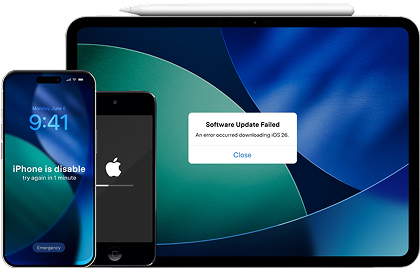
Use this route for software symptoms, not a phone that cannot receive power or has a failed battery or charging port. Back up first if the phone is accessible; the iPhone computer-backup guide explains that separate task. Full system repair requires a paid license. Standard Repair's data-preserving design is not a guarantee of success or data retention.
-
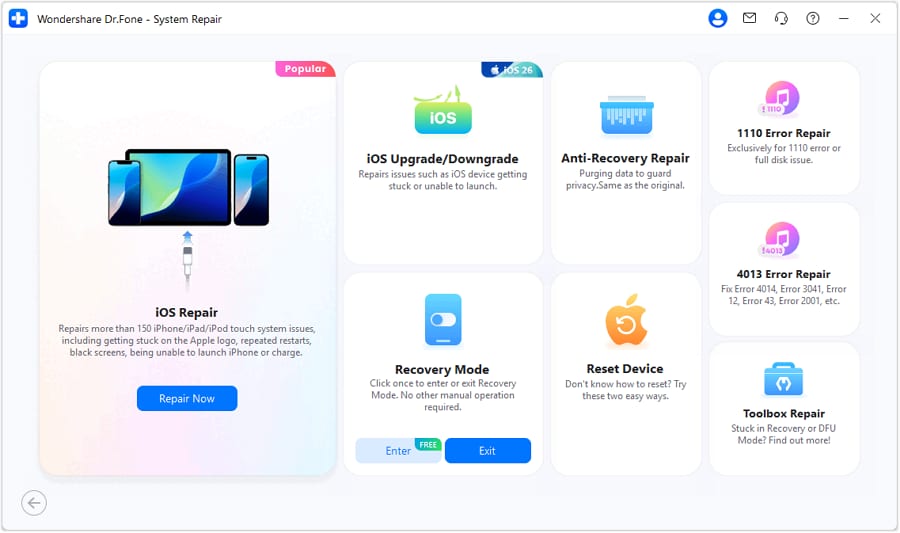
Step 1 Open iOS Repair
On your Windows PC or Mac, open Toolbox > System Repair, connect the iPhone with a reliable USB cable, select iPhone, then iOS Repair. The Mac interface may look different from these Windows screens.
-
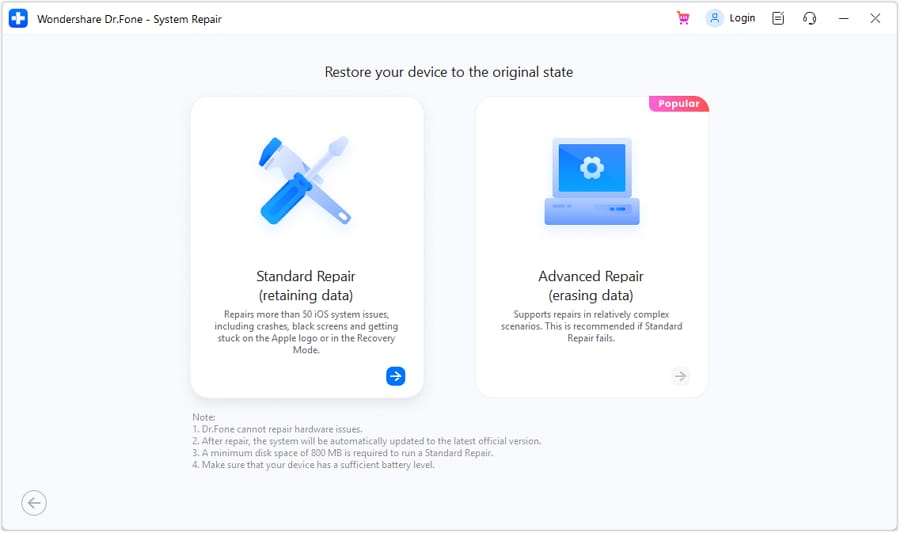
Step 2 Choose Standard Repair
Standard Repair is the data-preserving repair option. Select it for supported software issues. Advanced Repair erases device data; do not select it just because the phone is slow to start.
-
Step 3 Enter recovery and prepare firmware
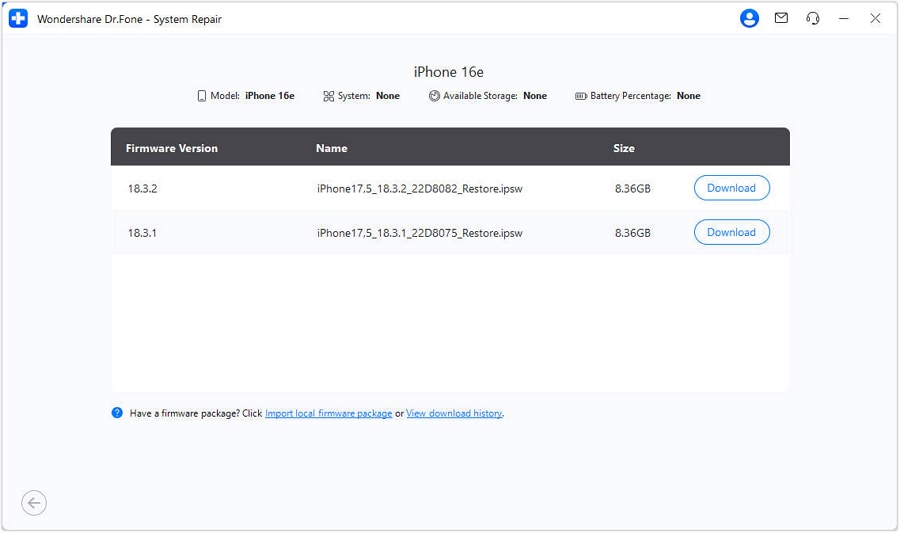
Follow the connected-phone instructions to enter Recovery Mode, using Enter Recovery Mode or Guide for an unresponsive device. Review the detected device and offered firmware, click Download, and let verification finish. Repair can update iOS; a jailbroken device returns to non-jailbroken software, and previously unlocked devices can be re-locked. Confirm these consequences before continuing.
-
Step 4 Start the firmware repair
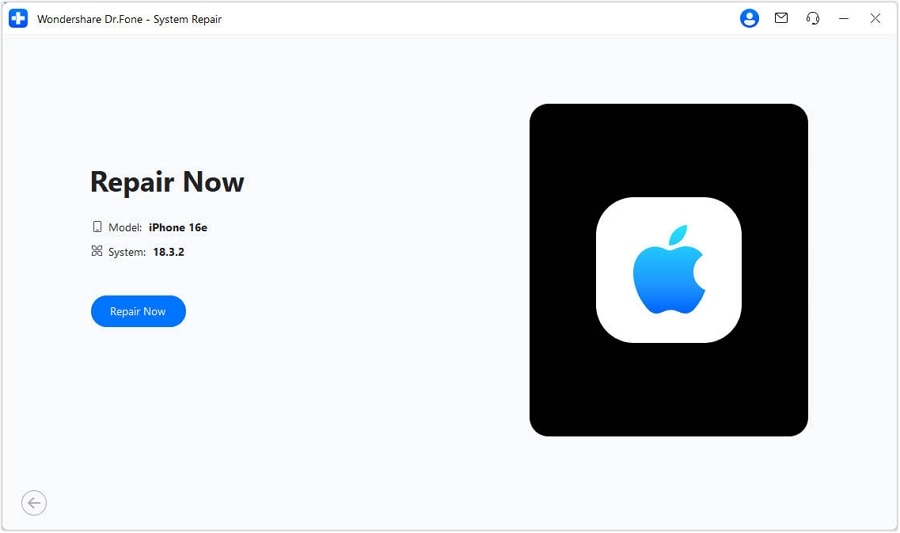
Click Repair Now after the package is verified. Keep the computer powered and the USB cable connected while the repair runs.
-
Step 5 Finish and check charging
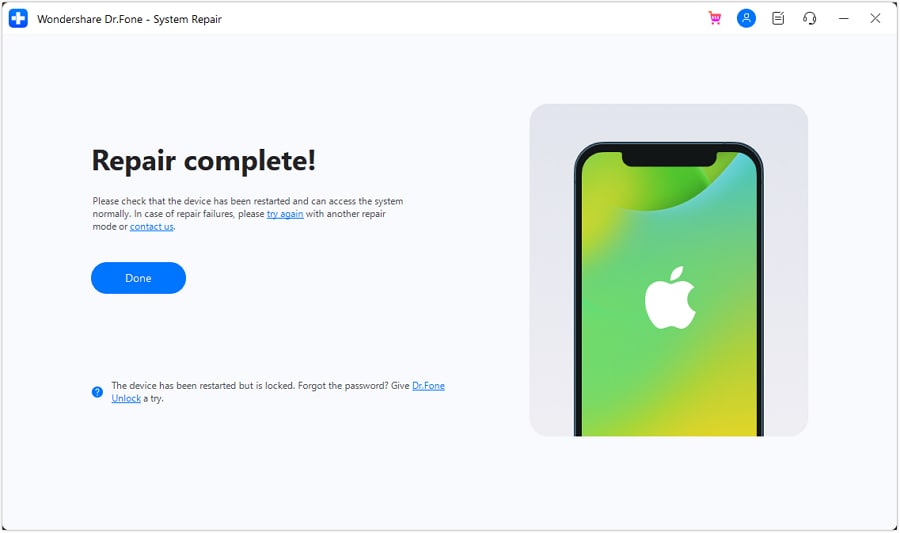
At the completion screen, click Done. Check that the iPhone starts, unlocks, and gains charge on a working charger. A phone that still cannot hold power needs hardware diagnosis rather than repeated firmware repairs.


Method 5: Get the Battery and Charging Hardware Checked
If the iPhone stays on the battery screen after the known-good charging test, loses power again soon after startup, or has visible damage, arrange an assessment with Apple or an Apple Authorized Service Provider. A technician can check the battery and charging path before recommending a replacement. If the battery looks swollen or the phone becomes unusually hot, stop charging it and seek service; do not open or press on it.
- Identifies whether the battery, port, or another component is at fault
- A battery replacement addresses a diagnosed worn or failed battery
- A service assessment gives you the repair options before work starts
- Service may have a cost depending on coverage and diagnosis
- Replacing the battery does not fix every charging or software fault
- Back up an accessible phone before handing it over for service
Method 6: Check Accessories and the PC or Mac Connection
A computer connection is a diagnostic check, not a way to send extra power through USB data pins or bypass a faulty battery. For the charging test, use a known-good wall supply. For device detection, use a cable that supports both charging and data.
- Inspect the cable and adapter for damage and try a working outlet. Swap one accessory at a time so you can identify a failing cable or adapter. Use Lightning or USB-C as required by your model; a 20W fast charger is not mandatory for basic startup.
- Disconnect the cable and inspect the port with a light. If the plug will not seat properly or you see damage or packed debris, arrange cleaning or inspection rather than scraping the pins. If liquid is detected, stop wired charging and let the connector dry.
- Connect directly to a USB port on the computer, avoiding a hub. Open Finder on a current Mac or Apple Devices on Windows. Use iTunes on systems that still use it for device management. Unlock and trust the computer if the iPhone starts and asks.
- If it is not recognized, try a known-good data cable and another USB port or computer. If the phone remains unresponsive after reliable charging and these checks, seek service. If it is recognized but stuck during startup, choose guided iOS repair or the recovery-mode workflow.
Method 7: Check Whether DFU Is Relevant Before Restoring
A black screen alone does not prove that an iPhone is in DFU mode or successfully receiving power. Do not use DFU as a battery-charging test. It is an advanced firmware state, and a restore from it erases the phone rather than repairing a failed battery.
If you accidentally left the phone on a black screen during troubleshooting, try the model-specific force restart and return to the charging check. For a detected startup problem, follow the complete recovery-mode Update path. If you decide to erase and reinstall iOS, read the Restore warning and steps first. If the computer still cannot detect the phone, get a service assessment rather than repeating button sequences.
Method 8: Use Recovery Mode to Update a Detected iPhone
Use this branch when the iPhone has enough power for a stable USB connection but will not finish startup. If it is still only showing a battery screen after the charging test and cannot be detected, return to hardware service rather than assuming an iOS reinstall will fix it.
- Connect the iPhone to a computer and open Finder on a current Mac, Apple Devices on Windows, or iTunes on a system that uses it for device management.
- Keep it connected and enter Recovery Mode using the buttons for your model:
- iPhone 8 or later / SE 2nd generation or later: quickly press and release Volume Up, then Volume Down, then hold Side until the Connect to computer screen appears.
- iPhone 7 / 7 Plus: hold Side and Volume Down until the Connect to computer screen appears.
- iPhone 6s or earlier / SE 1st generation: hold Home and Side or Top until the Connect to computer screen appears.
- Locate the phone on the computer. Choose Update if you want to reinstall iOS without choosing the erase-and-restore option. Keep the cable connected and wait for the process to finish.
- If the download takes more than 15 minutes and the phone leaves Recovery Mode, let the download finish, then repeat the recovery-entry buttons. After a successful startup, check charging and back up your data.
If Update fails, stop and decide whether you can accept erasing with Restore. Broken buttons, repeated update or restore failures, or an unreliable power connection call for service. If you prefer help entering Recovery Mode, Dr.Fone also has a free Enter Recovery Mode utility; it does not perform Apple's Update for you.
Method 9: Restore with Finder, Apple Devices, or iTunes (Erases Data)
Restore erases the iPhone and reinstalls iOS. Use it only when you accept losing unbacked-up local data. Check that you can access your existing backup and Apple Account before proceeding; if the phone is accessible, make a fresh backup first.
- Connect to the computer and enter Recovery Mode using the model-specific steps above. DFU is not required for this recovery-mode Restore path.
- Select the iPhone in Finder, Apple Devices, or iTunes and choose Restore when offered. Confirm only after reviewing the data-erasure warning.
- Keep the iPhone connected while the software downloads and installs. If it leaves Recovery Mode during a long download, finish downloading, then re-enter Recovery Mode.
- After completion, set up the phone and restore an available backup when prompted. Check whether it boots and charges. If Restore fails or it still cannot hold power, arrange service.
Conclusion
An iPhone stuck on the charging screen needs a reliable power check, a model-specific restart, and a clear next step based on its response. Let a cold or hot phone return naturally to room temperature instead of heating it, and do not deliberately drain it. For detected software-related startup problems, Dr.Fone Standard Repair offers guided firmware repair designed to preserve personal data. Persistent power failure or physical damage needs a hardware assessment.
FAQ
1. Why is my iPhone stuck on the red battery logo for hours?
A depleted battery, a faulty charging connection, or a battery or hardware problem can keep the red icon on screen. Use a known-good wall supply for 30 minutes, force restart with the correct buttons, then charge for another 30 minutes. If there is no improvement, check accessories and get a service assessment rather than repeatedly waiting overnight.
2. Can a cold environment really stop my iPhone from charging?
Yes. A very cold iPhone can stop charging. Move it to a dry place at normal room temperature and let it adjust naturally. Do not heat it with a hairdryer or another external heat source.
3. Will Dr.Fone - System Repair delete my photos?
Standard Repair is designed to preserve personal data while fixing supported iOS software issues. Back up first when possible; successful repair and data retention cannot be guaranteed. Advanced Repair and Apple's Restore erase device data, so review the mode before confirming.
4. What is the difference between the red battery logo with and without a cable icon?
Both are low-battery screens, not proof that the battery is permanently dead. A cable or lightning symbol relates to the charging connection, but the display varies by model and iOS version and is not a measurement of charging current or battery health. If the screen does not change while plugged in, check the cable and power source, then use the timed charging and restart test.
 Add Wondershare Dr.Fone as a preferred source on Google