
Guide 2026: How To Run a Hardware Test on Xiaomi

Jun 11, 2026 • Filed to: Device Data Management • Proven solutions
 TL;DR:
You can diagnose failing hardware components on any Xiaomi, Redmi, or POCO device using the hidden CIT (Component Integration Test) menu for a structured evaluation or specific dialer codes for instant checks.
● Launch CIT Engineering Mode on devices running MIUI 12+ or HyperOS by navigating to Settings > All specs and tapping Kernel version 5 to 7 times, ensuring an active internet connection for tests that require network access.
● Dial specific USSD codes like *#*#4636#*#* for a general status overview, *#*#0#*#* for display pixel checks, or *#*#64663#*#* for Redmi sensors, but fallback to the universally supported CIT menu if a code fails to execute on your firmware version.
● Use Wondershare Dr.Fone via a USB connection with Developer Options debugging enabled to view aggregated system metrics like battery health percentage and storage integrity, which native Pass/Fail component tests do not display.
Ask AI for a summary
 ChatGPT
 Perplexity
 Gemini
 Claude
 Grok
Grok
Dr.Fone Basic:
Better Control for Your Phone
Manage, transfer, back up, restore, and mirror your device
Every Xiaomi smartphone—whether a flagship Mi series, a budget Redmi, or a mid-range POCO—contains dozens of hardware components working in concert: the display, touch digitizer, camera sensors, proximity sensor, accelerometer, microphone, speaker, battery, GPS, Wi-Fi module, and more. When any of these components begins to degrade or malfunction, the symptoms can be subtle and easy to misdiagnose. That's exactly why Xiaomi builds a powerful built-in diagnostic system directly into its devices—accessible through a combination of hidden Xiaomi test codes and a dedicated built-in CIT (Component Integration Test) menu reachable via Engineering Mode.
This complete guide teaches you exactly how to run a full hardware test on your Xiaomi device, step by step. You'll learn how to access the Xiaomi test menu via Engineering Mode (CIT) across all major MIUI and HyperOS versions, and how to use specific Xiaomi hardware test codes—including the Xiaomi display test code, Xiaomi touch test code, Xiaomi sensor test code, and the all-in-one Mi test code *#*#4636#*#*—to test individual components directly from the dialer. Whether you're a Xiaomi owner troubleshooting a suspected issue, a mobile retailer grading a second-hand device, or a repair technician diagnosing hardware faults, this guide gives you every tool you need.
You'll also discover how to complement built-in hardware tests with Wondershare Dr.Fone's device health assessment feature—giving you a complete picture of your phone's condition, including battery health, storage integrity, and overall system status, all from a single interface.

- Part 1: Understanding Xiaomi Diagnostic Test and Its Importance
- Part 2: How To Run a Hardware Test on Xiaomi Devices
- Discover Your Phone's Health: Using Dr.Fone To Assess Your Device's Condition

Part 1. Understanding Xiaomi Diagnostic Test and Its Importance
The Xiaomi diagnostic test—also referred to as a Xiaomi hardware test—is a systematic evaluation of every major hardware and software component in your smartphone, including the CPU, GPU, display panel, touch digitizer, audio hardware, camera sensors, connectivity modules, and battery system. This built-in diagnostic capability is embedded directly into Xiaomi's MIUI and HyperOS firmware via the CIT (Component Integration Test) framework, meaning no third-party app download is required. Mobile retailers, phone refurbishers, IT managers, and everyday Xiaomi owners can run these tests at any time, entirely for free.
What Does a Xiaomi Diagnostic Test Check?
The Xiaomi diagnostic test covers a comprehensive range of hardware subsystems. Understanding what gets tested helps you choose the right Xiaomi hardware test code or CIT menu option for your specific concern. Here is a detailed breakdown of the core components evaluated during a full Xiaomi hardware test:
- Display & Screen: The Xiaomi display test code (
*#*#0#*#*) and the CIT display module both check for dead pixels, color accuracy, brightness uniformity, and touch zone coverage. Running a Xiaomi screen test code is essential before buying or selling any used Xiaomi device, as display issues are among the most costly repairs. - Touch Screen: The Xiaomi touch test code (
*#*#2664#*#*) launches a dedicated touch grid test that visualizes every touch input point across the entire screen surface. This test reveals dead zones, drift issues, and multi-touch failure—problems that are invisible during normal use but severely impact the user experience. - Camera System: The CIT camera test verifies both front and rear camera modules, including autofocus accuracy, optical image stabilization (OIS), flash operation, and video recording capability. A malfunctioning camera lens or image signal processor (ISP) will be flagged immediately, helping users determine whether they need a camera module replacement before it affects important shoots.
- Battery Health & Charging: Battery performance degrades naturally over charge cycles. The Xiaomi diagnostic test evaluates battery capacity, current charge level, charging circuit integrity, and thermal behavior. Identifying a degraded battery early—before it causes unexpected shutdowns or swelling—can prevent more serious hardware damage.
- Audio (Speaker & Microphone): The audio test code (
*#*#289#*#*) runs a loopback test on the speaker driver and microphone input. This test confirms whether distorted audio, muffled calls, or voice recording issues are hardware-related (physical damage or speaker failure) or software-related (driver or codec issues). - Sensors Suite: The Xiaomi sensor test code (
*#*#64663#*#*, specifically optimized for Redmi devices) or the CIT sensor menu checks the accelerometer, gyroscope, proximity sensor, ambient light sensor, compass/magnetometer, and barometer. Faulty sensors cause issues with screen auto-rotation, gaming accuracy, and proximity-triggered screen shutoff during calls. - Connectivity Modules: Dedicated Mi test codes for Wi-Fi (
*#*#232339#*#*), Bluetooth (*#*#232331#*#*), and GPS (*#*#1472365#*#*) test each wireless communication module independently, verifying signal detection, pairing capability, and location accuracy—critical for users experiencing connectivity drops or GPS drift.
Why Running Regular Xiaomi Hardware Tests Matters
Regular Xiaomi hardware testing is not just for users who suspect a problem—it's a proactive maintenance practice that delivers measurable benefits across multiple use cases. Here's why running routine diagnostic tests is strongly recommended:
- Pre-purchase and pre-sale device verification. For mobile retailers, phone traders, and secondhand marketplace sellers, a full Xiaomi diagnostic test generates objective, component-level evidence of a device's condition. This eliminates buyer uncertainty and enables fair, transparent pricing based on actual hardware status rather than cosmetic appearance alone.
- Device grading for refurbished inventory. With comprehensive Xiaomi hardware test reports in hand, refurbishers and corporate IT managers can assign standardized condition grades—A+, A, B, or C—to pre-owned Xiaomi, Redmi, and POCO devices. These grades directly correspond to tested functionality, giving buyers data-backed confidence when purchasing used equipment.
- Accurate repair scope assessment. Repair facilities use Xiaomi hardware test codes and the CIT menu to precisely identify which component requires service before opening the device. This allows technicians to source the correct parts in advance, provide accurate repair quotes, and communicate clearly with device owners about repair timelines and costs.
- Early fault detection before escalation. Many hardware issues begin as subtle performance degradations—a slightly unresponsive touch zone, a camera that occasionally fails to focus, a sensor that intermittently misfires. Running a Xiaomi hardware test regularly can detect these early-stage faults before they escalate into complete component failure, reducing repair costs and preventing data loss from sudden device failure.
- Warranty claim documentation. If your Xiaomi device is still under warranty and you suspect a hardware defect, running a Xiaomi diagnostic test and documenting the "Fail" result from the CIT menu provides concrete technical evidence to support your warranty claim at an authorized service center.
🔓 Xiaomi Account Lock Removal & Free Activation Lock Check
Locked out of your Xiaomi phone after a reset? Dr.Fone Unlock Online helps you remove MI Account Lock without password or linked number and check Activation Lock status for free before unlocking. Safe, fast, and works worldwide.
- Bypass Xiaomi Account Lock without password
- 100% removal on all Xiaomi, Redmi & POCO devices
- Supports all systems: HyperOS & MIUI
 Free check • No ads • Professional tech support • Refund guarantee
Part 2. How To Run a Hardware Test on Xiaomi Devices
Xiaomi provides two primary methods to perform a comprehensive hardware test on your device: accessing the built-in CIT (Component Integration Test) menu through Engineering Mode in Settings, or dialing specific Xiaomi hardware test codes directly from the phone app. Both methods are free, require no additional software, and work across the full Xiaomi device family—including Redmi and POCO models. The Engineering Mode approach gives you a structured, menu-driven interface for testing multiple components sequentially, while Xiaomi test codes allow you to launch individual hardware tests instantly for a specific component—ideal for quick spot-checks. Choose the method that best suits your situation, or use both for a thorough diagnostic review.
Method 1: Xiaomi Hardware Test Using Engineering Mode (CIT Menu)
Xiaomi devices include a hidden diagnostic environment called Engineering Mode—also referred to as CIT Mode (Component Integration Test). This mode provides a structured test interface that allows you to sequentially test all major hardware components including the display, touch screen, speakers, sensors, cameras, and connectivity modules, directly on the device without connecting to a PC. The CIT menu is available on all Xiaomi devices running MIUI 12 and above, as well as HyperOS. Make sure your smartphone is connected to the internet before beginning, as some CIT functions require an active network connection.
Here's how to access Engineering Mode and run the Xiaomi hardware test on different MIUI/HyperOS versions:
- Step 1: Navigate to the Kernel version entry in your phone's Settings. The exact path depends on your MIUI or HyperOS version:
- HyperOS / MIUI 14: Go to Settings > My device > All specs, then scroll down to Kernel version.
- MIUI 13: Go to Settings > About phone > All specs, then locate Kernel version.
- MIUI 12: Go to Settings > My device > All specs, then locate Kernel version.
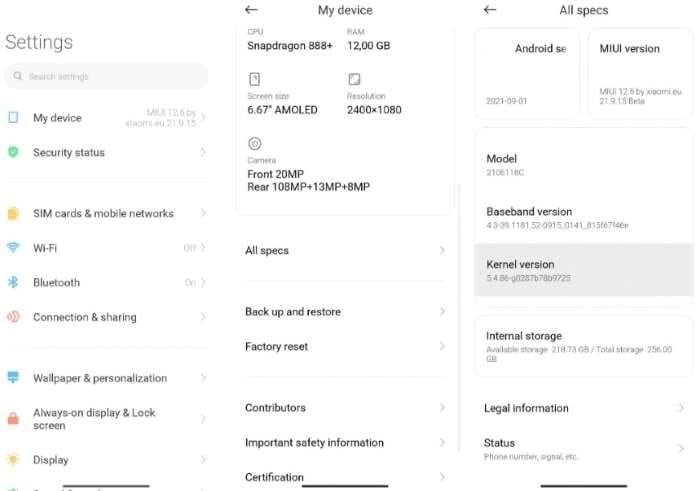
- Step 2: Tap the Kernel version field repeatedly—typically 5 to 7 times in quick succession—until a countdown or notification appears indicating that you are about to enter CIT mode. The exact number of taps required may vary slightly depending on device model and firmware version.
- Step 3: The Xiaomi CIT test menu will launch automatically. This is Xiaomi's built-in hardware test mode, presenting a list of all testable hardware components on your specific device model.
Note: The CIT menu layout and available test options vary by device model and MIUI/HyperOS version. Some models may display additional test categories not shown on others.
Below is an example of the CIT menu as it appears on a Xiaomi device running MIUI 12.6:
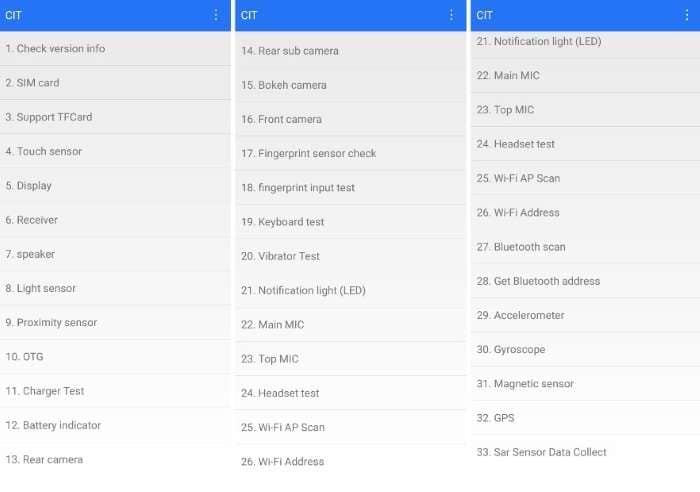
- Step 4: Select the hardware component you want to test from the CIT menu—for example, Display for a Xiaomi display test, Touch Panel for a Xiaomi touch screen test, Proximity Sensor for sensor verification, or Speaker for audio testing. The CIT tool will guide you through each test with on-screen instructions specific to that component.
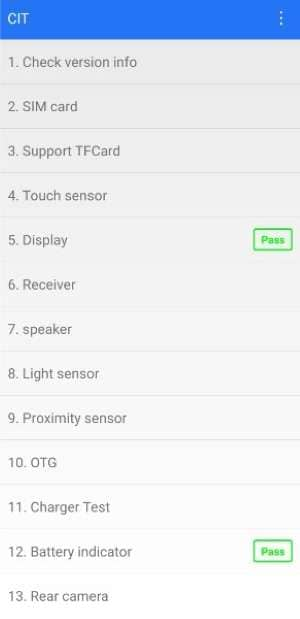
- Step 5: After each test completes, the CIT menu will report either a Pass (component functioning within normal parameters) or Fail (fault detected) result. A Fail result for any component is a reliable indicator that the hardware needs further inspection or professional service.
Method 2: Xiaomi Hardware Test Using Test Codes
The second and often faster method for running a Xiaomi hardware test is by entering dedicated Xiaomi test codes—also known as USSD codes or secret codes—directly into the phone dialer app. These codes instantly launch specific hardware diagnostic tests without navigating through settings menus. This makes them ideal for quickly testing a single component, such as using the Xiaomi display test code to check for screen defects, or the Xiaomi touch test code to visualize touch input performance across the screen.
Each Mi test code below targets a specific hardware module. For Redmi devices, the Redmi hardware test code *#*#64663#*#* provides access to a comprehensive sensor and hardware test suite specifically calibrated for Redmi models. Use the Mi phone code to check all functions simultaneously—dial *#*#4636#*#* for the general Xiaomi test menu, which aggregates phone information, battery status, Wi-Fi data, and usage statistics in one screen.
- Step 1: Open the Phone (dialer) app on your Xiaomi device and enter any of the following Xiaomi hardware test codes. Most codes execute automatically the moment you finish typing—you do not need to press the call button.
| Test Code | Function Description |
| *#*#2664#*#* | Xiaomi touch test code — launches an interactive touch grid test that maps every touch point across the full screen surface. Use this to detect dead zones, multi-touch failure, or screen drift. |
| *#*#289#*#* | Speaker and Microphone test — runs a real-time audio loopback test to verify speaker output quality and microphone recording performance. Reveals distortion, buzzing, or dead audio channels. |
| *#*#232339#*#* | Wi-Fi functionality test — opens the Wireless LAN diagnostic panel, showing signal strength, channel data, and connection capability. Use when experiencing unstable Wi-Fi or poor signal reception. |
| *#*#232331#*#* | Bluetooth test — launches the Bluetooth hardware test and details panel. Useful for diagnosing pairing failures, audio dropout issues, or Bluetooth module malfunctions. |
| *#*#1472365#*#* | Quick GPS test — opens GPS diagnostic details, including satellite lock status and location accuracy. Use to verify GPS hardware function if maps or navigation apps are inaccurate or slow to lock. |
| *#*#1575#*#* | Advanced GPS diagnostic test — provides deeper GPS analysis including signal-to-noise ratio, NMEA data, and satellite constellation view. Recommended for confirming GPS hardware quality on Redmi and POCO models. |
| *#*#0#*#* | Xiaomi display test code / Mi display check code — launches a full-screen color test cycling through red, green, blue, white, and black panels to reveal dead pixels, color bleeding, and backlight uniformity issues. Also functions as the Xiaomi screen test code and mi display test code. |
| *#*#0842#*#* | Vibration and backlight test — activates the vibration motor and screen backlight in test mode. Use to verify that haptic feedback is working correctly and that backlight hardware has no flickering or dimming faults. |
| *#*#7262626#*#* | Field test / RF signal test — opens the mobile field test interface, displaying real-time cellular signal data (RSSI, RSRP, SINR). Useful for diagnosing weak cellular signal, frequent call drops, or SIM card recognition issues. |
| *#*#64663#*#* | Redmi hardware test code / Xiaomi sensor test code — opens a comprehensive hardware and sensor test suite specifically optimized for Redmi and select POCO models. Tests include accelerometer, gyroscope, proximity sensor, ambient light sensor, and compass. |
| *#*#0283#*#* | Audio loopback test — runs a packet loopback diagnostic to test audio channel integrity at the hardware level. Helps differentiate between a physical audio hardware fault and a software/driver issue. |
| *#*#0588#*#* | Proximity sensor test — activates the proximity sensor test mode, displaying real-time sensor distance readings. Use to diagnose issues where the screen does not turn off during calls or where auto-brightness behaves incorrectly. |
| *#0011# | Service mode / general diagnostics — opens the service menu providing access to general network diagnostics, modem status, and hardware parameters. Useful for telecom technicians and advanced users performing deep network-level diagnosis. |
For a single-code solution to check multiple functions at once, dial *#*#4636#*#* to open the Xiaomi Test Menu—the most comprehensive Mi phone code to check all functions in one place. This Xiaomi test mode menu displays your phone's information panel, battery status (charge level, voltage, and temperature), Wi-Fi connection details, and usage statistics. It is particularly useful for quick pre-sale checks or diagnosing intermittent issues that don't manifest during normal use.
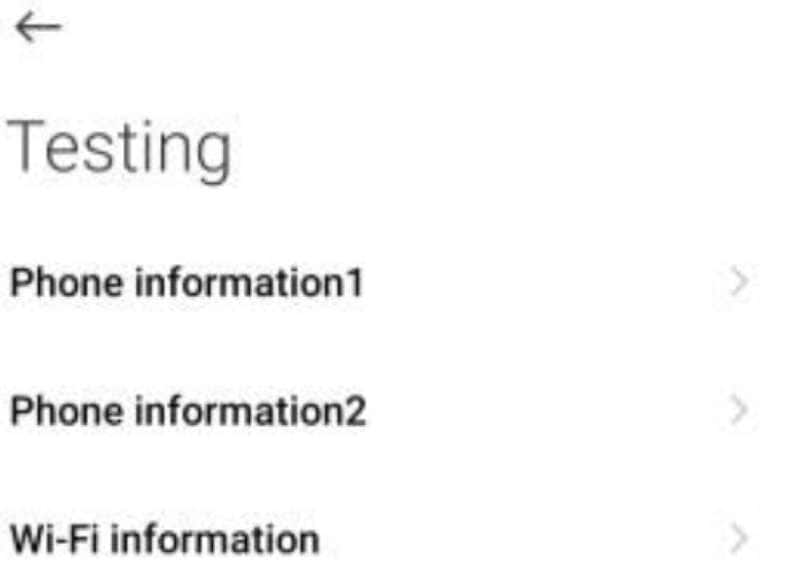
Note: Not all Xiaomi test codes are supported on every device model or MIUI/HyperOS version. If a code does not launch a test on your device, use the CIT Engineering Mode method (Method 1 above) instead, as it is universally supported across all Xiaomi devices.
- Step 2: Allow the entered code to execute. The Xiaomi hardware test interface for that specific component will open automatically within 1–2 seconds of entering the complete code.
- Step 3: Follow the on-screen instructions to complete the specific hardware test on your Xiaomi device. Each test provides real-time feedback—touch grid overlays for the Xiaomi touch screen test code, color panels for the Xiaomi display test code, sensor readout values for the Redmi display check code and sensor tests, and audio playback for the microphone/speaker loopback tests.
Part 3. Discover Your Phone's Health: Using Wondershare Dr.Fone To Assess Your Device's Details
While Xiaomi hardware test codes and the CIT Engineering Mode are powerful tools for testing individual hardware components, they provide results in isolation—a Pass/Fail for the touch screen here, a sensor readout there. What they don't give you is a unified, at-a-glance picture of your phone's overall health across all dimensions simultaneously. That's where Wondershare Dr.Fone's device health and diagnostics feature delivers exceptional value.
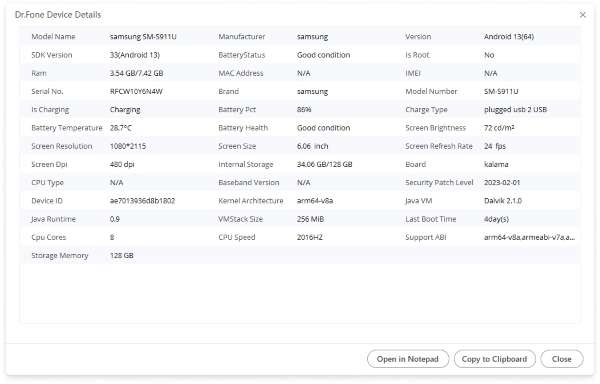
Dr.Fone's My Device module provides a holistic assessment of your Xiaomi smartphone's condition—covering battery health percentage, storage usage and health, RAM status, current system version, and detailed device specifications—all presented in a single, easy-to-read dashboard. For iOS users, Dr.Fone additionally generates a comprehensive Verification Report that documents the device's hardware status in a shareable format, ideal for pre-sale disclosure or warranty documentation. By combining Xiaomi's built-in hardware test mode with Dr.Fone's device overview, you get complete coverage: granular component-level test results from the native CIT tests, plus an aggregated health summary from Dr.Fone that captures system-wide metrics no test code can reveal.
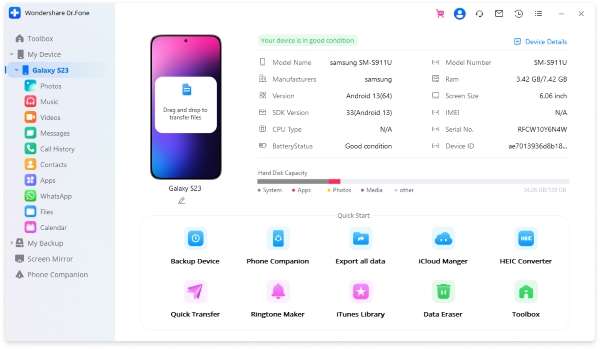
Here is how to use Dr.Fone to assess your Xiaomi phone's overall health condition step by step:
- Step 1: Download and install Wondershare Dr.Fone on your Windows or Mac computer from the official Wondershare website. Launch the application after installation completes.
- Step 2: In the Dr.Fone main interface, select My Device from the left-side navigation menu. This section is dedicated to device health assessment and diagnostics.
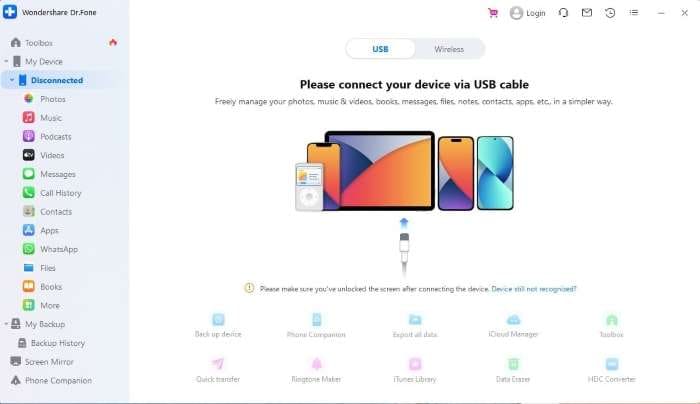
- Step 3: Follow the on-screen prompts to connect your Xiaomi phone to the computer using a USB cable or via wireless connection. If using USB, enable USB debugging on your Xiaomi device if prompted (found in Developer Options). Keep the connection stable throughout the assessment process—Dr.Fone will automatically detect your device and begin the health evaluation.
- Step 4: Once connected, Dr.Fone displays a real-time summary of your device's overall condition. Android users can click Device Details to view a full breakdown of battery health, internal storage status, RAM usage, running processes, and complete hardware specifications. iOS users can additionally access the Verification Report for a comprehensive, exportable health certificate documenting the device's tested condition—particularly valuable for pre-sale transparency or insurance documentation.
4,624,541 people have downloaded it
safe & secureConclusion
Knowing how to run a full Xiaomi hardware test is one of the most practical maintenance skills any Xiaomi, Redmi, or POCO user can develop. As this guide has shown, you have two powerful built-in methods at your disposal: the Xiaomi CIT Engineering Mode for a comprehensive, menu-driven walkthrough of all hardware components, and specific Xiaomi hardware test codes—including the Xiaomi display test code (*#*#0#*#*), the Xiaomi touch test code (*#*#2664#*#*), the Xiaomi sensor test code / Redmi hardware test code (*#*#64663#*#*), and the all-in-one Xiaomi test menu code (*#*#4636#*#*)—for instant, component-specific diagnostics directly from the dialer.
For a complete device health picture that goes beyond individual component tests, Wondershare Dr.Fone's device assessment feature provides the aggregated, system-level data that built-in test codes cannot: battery health percentage, storage integrity, and a full device specification summary—all in one place. Run these tests regularly, document the results, and address issues early to keep your Xiaomi performing at its full potential for years to come.
You might also interested:
FAQs
 Q1. What is the Xiaomi test code to check all phone functions at once?
Q2. What is the Xiaomi display test code to check my screen?
Q3. What is the Redmi hardware test code for sensors and component checks?
Q4. How do I access the Xiaomi test menu or enter Xiaomi test mode?
Q1. What is the Xiaomi test code to check all phone functions at once?
Q2. What is the Xiaomi display test code to check my screen?
Q3. What is the Redmi hardware test code for sensors and component checks?
Q4. How do I access the Xiaomi test menu or enter Xiaomi test mode?
Dr.Fone Basic:
Better Control for Your Phone
Manage, transfer, back up, restore, and mirror your device


Xiaomi Topics Series
- Xiaomi Screen & FRP Unlock
- 1. Unlock Xiaomi Bootloader
- 2. Mi Account Unlock Tools
- 3. Redmi Note 8 FRP Unlock Tool
- 4. Redmi Note 9 FRP Bypass Tool
- 5. Redmi 9A FRP Bypass
- 6. Remove FRP on Xiaomi/Redmi
- Xiaomi Repair
- Xiaomi Recover
- Xiaomi Reset
- Xiaomi Tips & News
- 1. Xiaomi HyperOS 3.0
- 2. Screen Mirror Xiaomi to PC
- 3. Run Hardware Tests on Xiaomi
- 4. Conduct battery test on Xiaomi
- 5. How Do I Obtain the Security Code Xiaomi
- 6. DND Mode Xiaomi
- Xiaomi Transfer & Backup
- ● Manage/transfer/recover data
- ● Unlock screen/activate/FRP lock
- ● Fix most iOS and Android issues
- Free Download Free Download Free Download




James Davis
staff Editor