 Teleport your device anywhere instantly with one click.


 100% Security Verified | No Subscription Required | No Malware


 :

 ChatGPT
 Perplexity
 Gemini
 Claude
 Grok
Can a Xiaomi phone use a mock GPS position to test an app that behaves differently in another area?
Reader question supplied in the source article; original forum attribution not independently verified

To fake GPS on a Xiaomi phone, distinguish permission controls from a mock-location provider. The Location switch allows positioning; it does not let you type a replacement coordinate. A compatible testing tool supplies that coordinate separately. For ordinary privacy, restricting an app's permission is often a more direct first step than simulating a place.
Maps, social apps and delivery services can all use location, but they do not necessarily interpret it in the same way. A successful mock location on Xiaomi does not mean every service accepts it, that a regional restriction disappears, or that your account becomes anonymous. This guide explains the settings, common use cases, the VPN distinction and a controlled Virtual Location workflow on a device you own.

In this article
Part 1. Review Xiaomi Location Access Before Simulating Coordinates
Xiaomi phones can expose different menu labels depending on model, region and installed software. Older MIUI screenshots remain useful illustrations, but a current phone may use a different interface. Xiaomi's official Xiaomi 14T instructions use Settings > Location > Use location and also describe a Control Center location tile.
The device-wide switch and app-specific permission serve different purposes. Enabling location does not automatically grant every app access, and denying one app permission does not require disabling navigation for the entire phone. Inspect the particular app's Location permission when privacy is your main objective.
Enable Location for a Legitimate App or Test
Use the phone's normal positioning controls before troubleshooting a test app. Record the original state so you can restore it afterward.
Step 1 Locate the positioning page
Unlock the phone, enter Settings and find Location. If the label is not where the screenshot shows it, search Settings for 'location' rather than changing an unrelated control.

Step 2 Enable the displayed location switch
Turn on Use location or Location access, depending on the interface. Then check that the intended map or test application has the permission it actually needs.

Normal Android positioning can combine available signals rather than relying only on a satellite fix. Do not interpret 'location on' as proof of a precise reading or as confirmation that a mock provider is active.
Disable Location Access When That Is the Intended Choice
A phone-wide change has wider consequences than restricting one app. Maps, local recommendations and similar functions may become limited. It also does not erase coordinates already uploaded to a service or prevent every form of approximate location inference.
Step 1 Reopen Location settings
Return to Settings > Location. Review whether a per-app permission change would meet your need with fewer effects.

Step 2 Turn off the normal location switch
Disable Location access or Use location. Re-enable it when you need normal positioning, and confirm the result in a map rather than assuming old cached information is current.

Part 2. Common GPS-Simulation Goals and Their Boundaries
A fake GPS position is useful only when the intended application accepts the relevant signal and the activity is permitted. Evaluate each use case separately instead of treating a map change as control over every account, service and region setting.
- Privacy: testing a different reported coordinate is not comprehensive tracking prevention. App permissions, recipients, account access, IP addresses and the content you share can still matter. Use privacy controls directly when the goal is to stop disclosure.
- Location-based games: Pokémon GO, Pikmin Bloom and Jurassic World Alive illustrate why people search for GPS tools, but each game has its own rules and technical behavior. Do not assume rewards, event access or accepted movement. Dr.Fone's Android product section explicitly says Pokémon GO is not supported.
- Regional content: a service may use IP location, account country, payment details, licensing or other eligibility checks. A replacement GPS point alone is not a reliable way to unlock a streaming catalog or a restricted digital service.
- Staged app updates: availability can depend on the account, device, store and rollout criteria. A mock coordinate does not guarantee access to an early version. Use the store's authorized update path and avoid untrusted installation packages.
- Dating-app travel planning: location-dependent discovery in services such as Tinder or Bumble is subject to that service's rules and features. Prefer official travel settings where available and be transparent with people you contact; simulation is not an entitlement to a paid feature.
Do not use a mock point to falsify ride or delivery pickup details, mislead emergency responders, or present a test coordinate as evidence of someone's physical whereabouts.
Part 3. A VPN Changes Network Location, Not Your Physical Position
A VPN routes traffic through a different network endpoint and can change the public-facing IP address seen by websites. A GPS simulator changes a location value supplied to compatible software. Neither physically transports the phone, and the two products should not be marketed as interchangeable privacy tools.
For example, an overseas VPN server can give a connection an IP address associated with another region while the phone's location service still reports the actual area. Conversely, a mock coordinate can move a pin in a test app while the network connection and account country remain unchanged. Some apps combine multiple signals, so avoid an absolute claim that every service uses only GPS.

Choose according to the task. Network protection and IP routing belong to the VPN layer; coordinate simulation belongs to a compatible location-testing workflow. If your purpose is simply to prevent a particular app accessing your position, changing its permission is a third, separate option.
Part 4. Use a Compatible Virtual Location Workflow on Xiaomi
 Set your map route to simulate GPS movement.
- Set your wanted movement speed.
- HD and large map view to check location.
- Fake GPS location to anywhere.

Dr.Fone - Virtual Location offers a map-based workflow for simulated coordinates, routes and movement on supported devices. The desktop version uses a Windows or Mac computer and device-connection steps. Confirm the requirements for your exact Xiaomi model and installed Android version before treating the source screenshots as a current setup guarantee.
The vendor advertises Android location-changing scenarios without root, but the result still depends on device setup and the receiving app. No-root operation does not mean risk-free use, immunity from detection or universal game support. In particular, general Xiaomi GPS testing must not be presented as an Android Pokémon GO solution.
Virtual Location Features Relevant to a Controlled Test
- Teleport Mode: select a destination point to supply simulated GPS coordinates in the supported workflow.
- Route simulation: model a path and choose movement settings for testing, not as proof that an external service will accept the activity.
- GPX handling: use supported import/export functions for repeatable route data where the chosen platform provides them.
- Joystick control: adjust virtual movement from the desktop interface rather than assuming every app exposes the same controls.
- No-root/no-jailbreak positioning workflows: follow the platform's requirements; do not unlock a bootloader or weaken unrelated security settings merely to try a map feature.
Three Steps for a Xiaomi GPS Test with Dr.Fone
Keep this test separate from live navigation, location-sharing commitments and games that prohibit falsified positioning. Allow time to verify both the simulated result and the return to actual coordinates.
Step 1 Connect the phone and complete supported setup
Install the appropriate desktop software, open Virtual Location and connect your own Xiaomi phone by a reliable USB cable. Follow the prompts for device recognition and proceed only after the software recognizes the phone.
If the Android workflow asks for a mock provider, enable Developer options using your phone's documented software/build-version entry, then find Select mock location app and choose the provider indicated by the software. Google's generic Build number instructions and Xiaomi menu labels can differ; use Settings search or the model's help if necessary. Authorize debugging only when required for a computer you trust, and leave unrelated options unchanged.
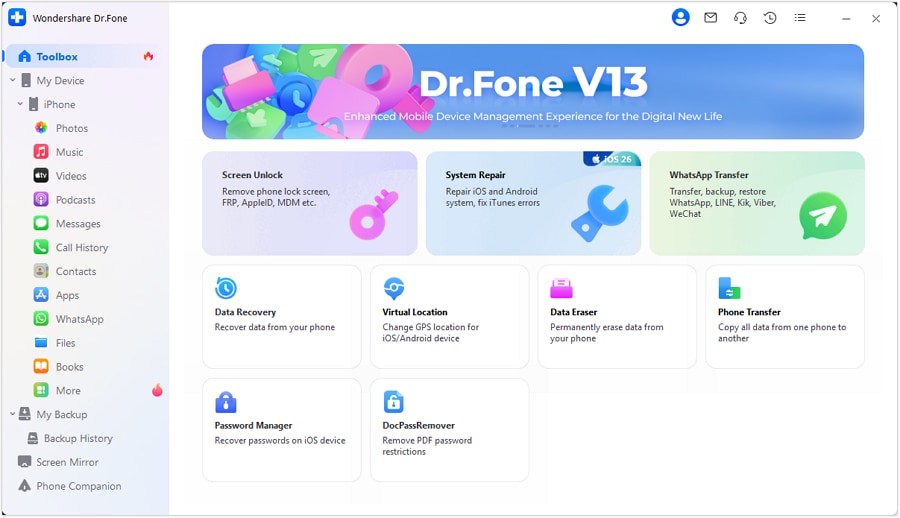
Step 2 Search a point in Teleport Mode
After the map loads, choose the Teleport Mode control by its label or tooltip. The source screenshot's icon position is illustrative rather than a fixed promise. Search a city, address or coordinate and review the returned point.
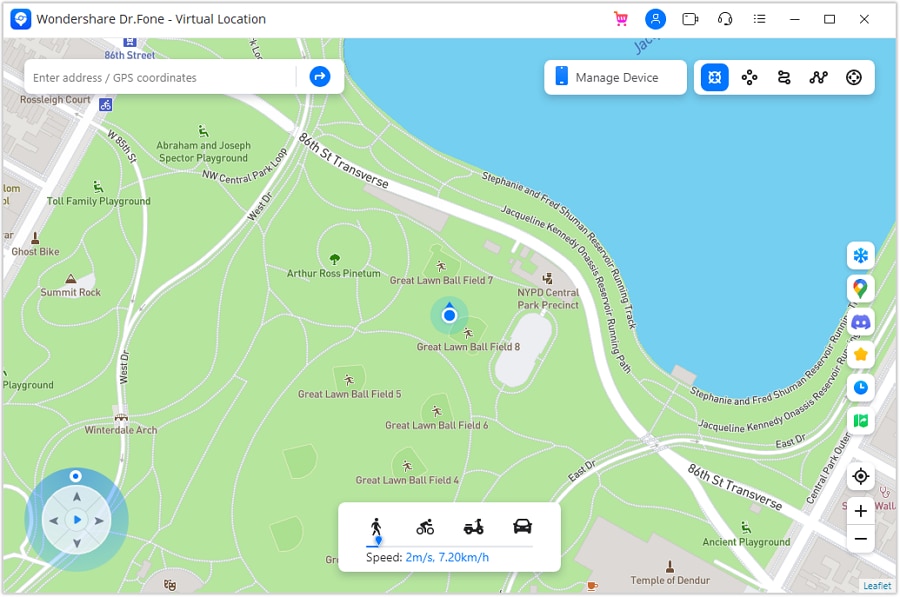
Step 3 Apply, verify and restore
Choose Move Here once the pin is correct. Open a compatible map or test app on the phone and check its actual result. If it does not change, recheck recognition, permission and provider selection rather than assuming a product claim guarantees the outcome.
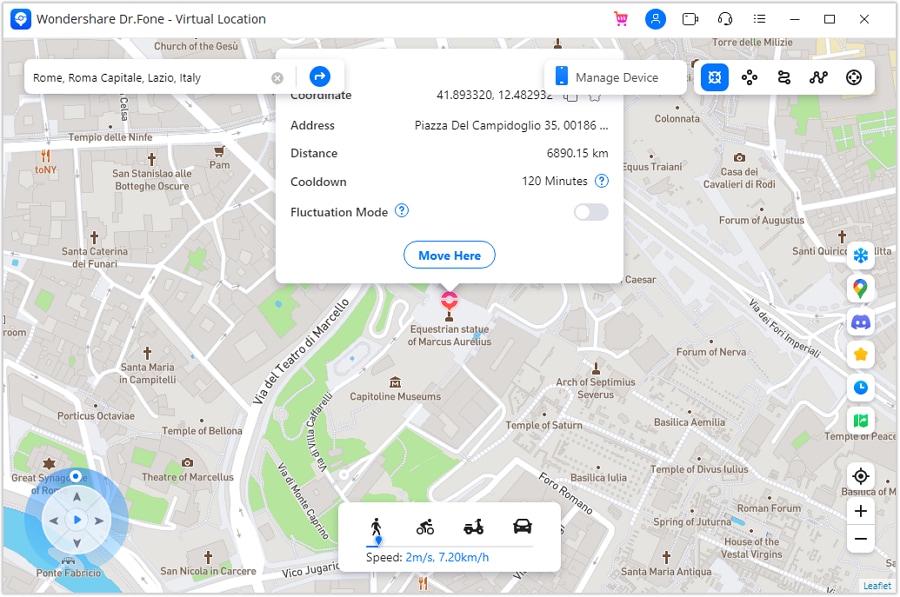
When finished, stop any simulated route, follow the software's restore-location instructions, and remove an active mock provider if the workflow used one. Check that the real point returns in Maps. Revoke temporary debugging access when no longer needed, especially before connecting the phone to another computer.




Conclusion
For Xiaomi users, normal location switches, app permissions, a VPN and GPS simulation solve different problems. Begin with the narrowest setting that meets your need. A mock coordinate is appropriate for a compatible, authorized test, not a promise of anonymity, early updates, regional content or accepted game rewards.
Dr.Fone - Virtual Location provides destination and route controls for supported setups. Check compatibility first, verify the receiving app's behavior, and restore real GPS afterward. Keep the product's Android Pokémon GO limitation and the rules of every service you use in view.
FAQ
1. Is faking GPS on Xiaomi completely safe?
No absolute safety claim is appropriate. Review the software source, device permissions and service rules. A no-root workflow avoids requiring root access but does not remove every privacy, compatibility or account risk.2. Can apps detect a mock location?
Some apps can reject or identify simulated location data. Route variation and joystick controls do not establish protection from detection or penalties, and Android Pokémon GO support should not be inferred.3. Do I need Developer options on Xiaomi?
Android mock-provider workflows normally use Select mock location app in Developer options. Follow the installed tool's instructions and your model's menu labels; not every platform workflow is identical.4. How much battery will GPS simulation use?
The effect depends on screen use, positioning, connection, software and the phone's charging state. No measured 'negligible drain' result is established here. Monitor your device and end the test if it heats up or behaves unexpectedly.
 Add Wondershare Dr.Fone as a preferred source on Google



