
How to Clone a SIM Card for Two Phones: A 2026 Guide (Methods That Work)

Jun 30, 2026 • Filed to: Device Data Management • Proven solutions
 TL;DR:
Traditional hardware cloning of modern 4G and 5G SIM cards is impossible due to advanced encryption, but you can legally use one phone number on two devices simultaneously by activating a carrier-approved Multi-SIM or eSIM service.
● DIY SIM cloning exclusively works on obsolete COMP128v1 cards from the early 2000s using legacy extraction software like MagicSIM; attempting this brute-force process on modern USIMs will fail and permanently lock your original card.
● To legitimately duplicate your number without triggering network fraud alerts, you must contact your carrier to activate add-ons like T-Mobile DIGITS, Verizon Number Share, or AT&T NumberSync, which typically incur a $5–$15 monthly fee and provision a secondary physical SIM or eSIM.
● Because a carrier Multi-SIM only shares your cellular signal and plan, achieving a complete dual-phone setup requires using cross-platform transfer software like Wondershare Dr.Fone to directly merge your contacts, media, and application data to the second device.
Ask AI for a summary
 ChatGPT
 Perplexity
 Gemini
 Claude
 Grok
Grok
Dr.Fone Basic:
Better Control for Your Phone
Manage, transfer, back up, restore, and mirror your device
Can you clone a SIM card to use two phones? It's one of the most searched questions in mobile technology — and the answer is more nuanced than a simple yes or no. If you're a business professional who needs to take calls on both a personal and work device, a frequent traveler managing multiple numbers, or simply someone who wants to use the same number on a smartwatch and a smartphone simultaneously, you've likely wondered whether SIM cloning or a duplicate SIM card is possible. The short answer: for modern SIM cards, traditional hardware cloning is essentially impossible — but there are legitimate, carrier-approved methods that achieve exactly what you're looking for.
In 2026, the "spy movie" style of physically hacking a SIM card and creating a sim copy only applies to ancient COMP128v1 cards from the early 2000s. Every SIM card issued by a major carrier in the past decade uses advanced encryption that makes the authentication key (Ki) unextractable by consumer hardware. However, that doesn't mean you're out of options. Carriers now offer official Multi-SIM and eSIM services that allow you to use the same phone number on two devices simultaneously — legally, reliably, and without any technical risk. If you're asking "can you clone a SIM card to use two phones" today, this is the path that actually works.
This comprehensive guide covers three distinct approaches: the reality of SIM cloning technology and its legal implications, the carrier-approved Multi-SIM and eSIM method for getting duplicate SIM card same number functionality on two devices, and a step-by-step walkthrough of using Wondershare Dr.Fone to clone your phone's data so your second device feels exactly like your first. Whether you're switching phones, adding a second line, or setting up a backup device, this guide has everything you need.
It's also worth clarifying a common point of confusion: can a SIM card be used in another phone simply by moving it? Yes — physically transferring your SIM to a different phone (that uses the same SIM size and isn't carrier-locked) is entirely possible and has nothing to do with "cloning." SIM cloning is specifically about duplicating a SIM's identity so two separate cards can operate simultaneously on the same number. We'll cover both scenarios in this guide.
 safe & secure
Is It Possible (and Legal) to Clone a SIM Card?
Direct answer: You cannot clone a modern 4G or 5G SIM card at home. The only exception is the obsolete COMP128v1 standard — cards no longer issued by any major carrier since the early 2000s. If your goal is to use one phone number on two devices, the legal and practical solution is a carrier Multi-SIM or eSIM service, not hardware cloning.
To truly understand why SIM cloning is effectively impossible today — and why that's actually a feature, not a bug — we need to look at how SIM card security has evolved over the past three decades. A SIM card's primary job is to authenticate your identity to the mobile network. It does this using two critical pieces of data stored securely inside the chip: your IMSI (International Mobile Subscriber Identity, a unique 15-digit number identifying your account) and your Ki (Authentication Key, a 128-bit secret key shared only between your SIM and your carrier's authentication server). The Ki never leaves the SIM under normal operation — it's used in a cryptographic challenge-response process to prove your identity without transmitting the key itself.
- COMP128v1 (1988–early 2000s): The original and now-obsolete authentication algorithm. It contained a cryptographic flaw that allowed attackers to extract the Ki by sending roughly 150,000 challenge queries to the card within a few hours. This is the only version that can be cracked using consumer card readers and software like MagicSIM. No major carrier has issued COMP128v1 SIMs in over 15 years.
- COMP128v2 & v3 (2000s–2010s): Patched versions that closed the Ki-extraction vulnerability. The COMP128v2 algorithm limits the number of authentication queries a card will respond to, neutralizing the brute-force attack. COMP128v3 further strengthened this with additional countermeasures. Both versions are considered uncloneable by standard consumer tools.
- USIM / 4G LTE SIMs (2010–present): A completely redesigned standard using MILENAGE encryption (AES-based). These cards not only prevent Ki extraction but will also permanently lock themselves (self-destruct the authentication credential) if they detect an unusual volume of authentication challenges — making any cloning attempt counterproductive.
- 5G SIMs / eSIMs (2019–present): The most secure generation, using SUCI (Subscription Concealed Identifier) to encrypt even the IMSI during transmission, adding another layer that makes interception and cloning attacks fundamentally unworkable.
The Verdict: If you bought your SIM card any time in the past 10–15 years, it falls into the USIM or 5G category. You cannot extract its Ki, you cannot create a working sim copy, and attempting to do so will likely result in your original SIM being permanently disabled by your carrier's fraud detection system. The only productive question is: how do I legally get the same number active on two devices?
A separate question that often gets confused with SIM cloning is: can I put my SIM card in another phone? The answer is yes — moving a physical SIM card from one phone to another (assuming the destination phone accepts the same SIM form factor and isn't locked to a different carrier) is completely normal, legal, and trivial. This is just swapping your SIM between phones — it's not cloning. Cloning refers specifically to having two SIM cards active on the same number simultaneously.

If you're switching to a new phone as part of this process, managing your contacts, photos, and app data can be a challenge. A tool like Dr.Fone Basic can help you seamlessly transfer contacts, photos, and files between devices — so your new phone feels exactly like the old one from the moment you power it on.
safe & secureMethod 1: Using Carrier Multi-SIM & eSIM (The "Legal" Clone)
If you want to use one number on two phones reliably in 2026, the answer is Carrier Multi-SIM or Number Share — not card readers. This is the only method that works on modern networks, is fully legal, and provides a true "duplicate SIM card same number" experience on two active devices simultaneously.
Most major carriers in the US, UK, Europe, and Asia-Pacific now offer Multi-SIM or Number Share services as a standard add-on. The concept is straightforward: your carrier creates a secondary SIM (or eSIM) that shares the same phone number and — in most cases — the same data plan as your primary SIM. When someone calls your number, both phones ring at the same time. When you receive an SMS, it appears on both devices. This is functionally what most people mean when they search for "how to clone a SIM card to use in 2 phones" — and it's entirely above board.
Major Carrier Multi-SIM Services (US, UK & Europe)
- T-Mobile DIGITS: Allows up to 5 devices to share a single phone number. Supports both physical SIM and eSIM on secondary devices. Available as a paid add-on.
- Verizon Number Share: Extends your number to a second phone, tablet, or smartwatch. Supports eSIM activation for compatible devices.
- AT&T NumberSync: Available for select smartphones, tablets, and wearables. Calls and texts sync across all registered devices.
- Vodafone OneNumber (UK): Pairs a secondary device to your primary number. eSIM activation available for compatible smartwatches and phones.
- EE Multi-Device SIM (UK): Allows up to 4 additional SIMs linked to one number, each capable of making and receiving calls independently.
How to set it up: Step-by-Step
- Step 1: Contact your Carrier: Call your carrier's customer service or visit their website and ask specifically for services like "T-Mobile DIGITS," "Verizon Number Share," "AT&T NumberSync," or "Vodafone OneNumber." Confirm whether a physical secondary SIM or eSIM activation is available for your account.
- Step 2: Request a Secondary SIM or eSIM: Your carrier will either mail you a new physical SIM card or — for the eSIM option — send you a QR code via email or display it in their app. The eSIM path is the modern "clone SIM card to eSIM" workflow: your number gets provisioned to a digital SIM profile on your second device.
- Step 3: Activate the Secondary SIM/eSIM: Insert the physical SIM into your second phone, or on iPhone/Android go to Settings → Mobile/Cellular → Add eSIM and scan the QR code. Once activated, the carrier's network links the unique ID (ICCID) of the new card or eSIM profile to your existing phone number — giving you true duplicate SIM card same number functionality.
Method 2: The Traditional SIM Cloning Process (For Older SIMs)
Understanding the traditional SIM cloning process is valuable for anyone researching mobile security, telecom history, or the technical reasons why modern SIM cloning is no longer viable. The process exploits a cryptographic vulnerability (a flaw in the COMP128v1 algorithm's response to authentication challenges) that was patched in all subsequent SIM standards. If you have a very old COMP128v1 SIM card and want to understand the process, the logic involves three steps: extracting the IMSI (International Mobile Subscriber Identity) and Ki (Authentication Key) from the original card using a USB card reader, calculating the Ki via brute-force challenge queries, and writing both values onto a blank programmable "wafer" SIM card.
What you will need:
- A SIM Card Reader/Writer (available from electronics suppliers online — compatible with ISO 7816 smart card standard).
- A Blank Programmable SIM Card, commonly called a "Wafer" card (must support COMP128v1 algorithm).
- MagicSIM software (a legacy PC application for SIM cloning): https://ssl-download.cnet.com/MagicSIM/3000-2094_4-10601728.html — Note: this software has not been updated since the mid-2000s and is incompatible with modern SIM standards by design.
Step-by-step tutorial to duplicate SIM:
- Step 1: Extract the Key. Remove the SIM from your phone and insert it into the USB Card Reader. Connect it to your PC. Open your MagicSIM software and select "Read from SIM." The software will read the IMSI and begin the process of calculating the Ki.
- Step 2: Crack the SIM. In the software toolbar, select "Crack" > "Strong Mode" > "Start." This begins a cryptographic attack that sends thousands of authentication challenges to the SIM card and analyzes the responses to reverse-engineer the Ki.

Warning: This brute-force attack process sends up to 150,000+ challenge queries to the SIM card and can take many hours to complete. If interrupted or if the card detects abnormal query volume, the SIM may be permanently corrupted or locked. Do not use your primary SIM for this process.
- Step 3: Save the Data. Once the software successfully calculates the Ki code, it will generate a .dat file containing both the IMSI and Ki. Click File > Save As to store this data securely on your computer. Treat this file as strictly confidential — it represents the full identity credentials of the SIM card.
- Step 4: Write to the Blank SIM. Remove your original SIM and insert the Blank Wafer card into the reader. In the software, click "Connect" and then "Write to SIM." Select the .dat file you saved in the previous step.
- Step 5: Finalize. The software will ask for a security code (usually provided with the blank wafer card by the manufacturer). Once entered, the write process completes. The wafer card will now have an identical IMSI and Ki to the original — creating a physical clone.
Crucial Warning — Never Turn Both SIMs On Simultaneously: If you use this method and power on both the original and cloned SIM at the same time, the carrier's Home Location Register (HLR) will detect two devices presenting identical IMSI/Ki credentials within the same authentication window. This instantly triggers a fraud security alert. The carrier's system will deregister both SIM cards from the network, effectively blocking both phones. This is not recoverable through normal customer service channels.
An alternative extraction software option is XSIM: once executed on a connected card reader, XSIM automatically detects the inserted SIM, reads the IMSI, and displays it on the main screen. The Ki extraction process under XSIM is similarly time-intensive — the Ki is a 16-byte (128-bit) secret key, meaning there are 2^128 possible values to brute-force through. Depending on the hardware speed and card response time, a full extraction using either MagicSIM or XSIM on a genuine COMP128v1 card can take anywhere from 2 to 8 hours. Once the Ki is obtained, writing it to a blank wafer card completes the duplication.
To reiterate: this entire process is documented for educational purposes. On any modern 4G/5G SIM (USIM), the Ki extraction step will fail because the MILENAGE algorithm does not have the same cryptographic vulnerability. The card will not respond to the volume of challenge queries needed, and most USIMs will lock themselves permanently after detecting the attempt.
Beyond the Signal - Cloning Your Phone's Data
Getting the same phone number active on two devices is only half the equation. The other half — and the one most users overlook — is making sure your second phone actually has all your data: your contacts, messages, photos, call history, apps, and notes. Without this step, your second phone is just a blank slate with your number on it.
Most people don't just want to clone a SIM card — they want to clone the entire phone experience. Your smartphone is more than its signal; it's your WhatsApp conversation history, your 10,000 photos, your saved passwords, your calendar entries, your banking app setup. When you search for "copy SIM card data" or "how to clone a SIM card to use in 2 phones," what you often really need is a complete phone cloning solution — not just a SIM duplication.
This is where Wondershare Dr.Fone - Phone Transfer becomes essential. While your carrier handles the phone number via Multi-SIM, Dr.Fone handles the digital soul of your device — transferring every piece of data you care about from your primary phone to your second device in a single, streamlined process.
Why Dr.Fone is the perfect companion for dual-phone users:
Dr.Fone Phone Transfer is purpose-built for the exact scenario dual-phone users face: you have one fully configured primary device and you need a second phone to mirror it as closely as possible. Here's why it stands out:
- True Cross-Platform Cloning: Moving from iPhone to Android, Android to Android, or Android to iPhone? Dr.Fone handles all four cross-platform combinations — a critical feature when your two phones run different operating systems.
- Comprehensive Data Transfer in 1 Click: It's not just contacts. Dr.Fone transfers photos, videos, call logs, SMS messages, calendar events, WhatsApp data, and apps in a single automated process — far more than the "copy SIM card data" (contacts only) option in your Settings app.
- Direct Device-to-Device Security: Unlike cloud backups (which store your data on third-party servers and can be vulnerable to breaches), Dr.Fone transfers data directly from device to device over a local encrypted connection. Your data never touches an external server.
- Intelligent Merge — No Overwriting: If your second phone already has some data, Dr.Fone intelligently merges the transferred data with existing content — so you don't lose anything already on the destination device.
- Supports 8000+ Devices: From the latest iPhone 16 and Samsung Galaxy S25 to budget Android models, Dr.Fone's compatibility list covers virtually every modern smartphone on the market.
Dr.Fone - Phone Transfer
1-Click Phone-to-Phone Transfer
- Easy, fast, and safe.
- Move data between devices with different operating systems, i.e., iOS to Android.
- Supports iOS devices that run the latest iOS version

- Transfer photos, text messages, contacts, notes, and many other file types.
- Supports over 8000+ Android devices. Works for all models of iPhone, iPad, and iPod.
Step-by-Step: How to Clone Phone Data with Dr.Fone
Ready to make your second phone a true duplicate of your first? This process typically takes under 10 minutes for most users. Follow these steps:
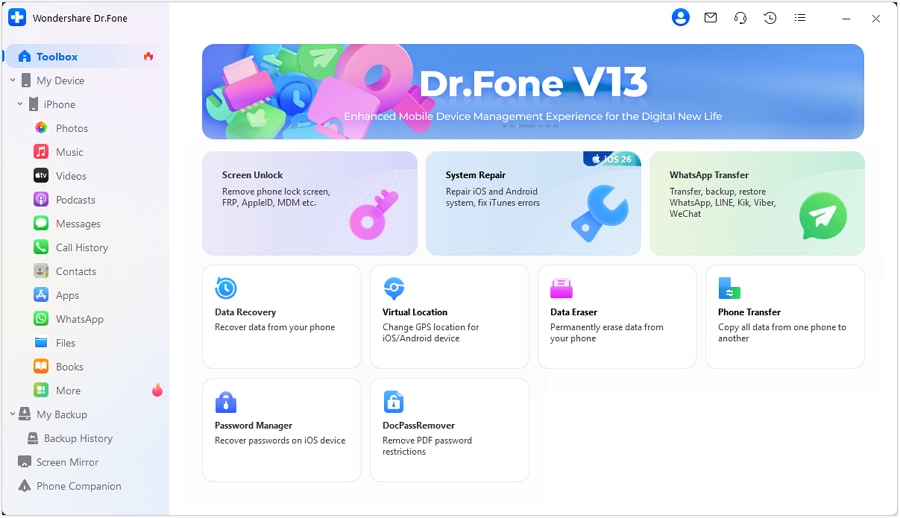
- Step 1: Launch Dr.Fone.
Download and install Dr.Fone on your Windows PC or Mac. Open the application and select "Toolbox" > "Phone Transfer" from the main dashboard.
- Step 2: Connect Both Devices.
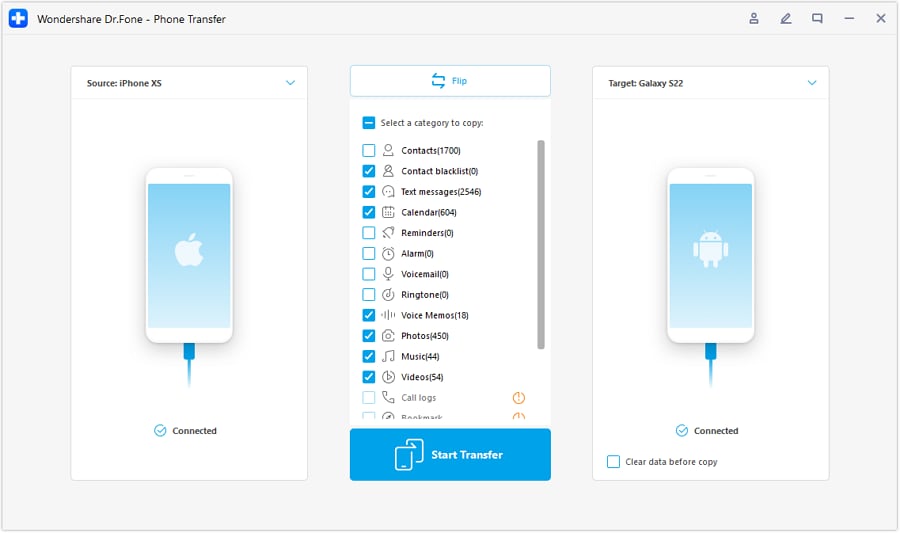
Connect both your "Source" phone (the original phone) and your "Destination" phone (the second device) to the PC via USB cables. Dr.Fone will automatically detect both devices and display them in a Source → Destination layout.
Note: Click the "Flip" button if the Source and Destination assignments are reversed.
- Step 3: Select Files to Clone.
Check the boxes for each data category you want to copy — Contacts, Messages, Photos, Videos, Call History, Calendar Events, and more. This is your comprehensive "copy SIM card data" step, extended to cover your entire phone content. - Step 4: Start Transfer.
Click "Start Transfer" and keep both phones connected to the PC throughout the process. Dr.Fone will display a real-time progress bar. Within minutes, your second phone will contain all the essential data from your main device — contacts, photos, messages, and more.
4,624,541 people have downloaded it
 safe & secure
Comparison: Which "Cloning" Method is Right for You?
With three distinct methods covered in this guide — carrier Multi-SIM, DIY SIM cloning, and Dr.Fone data transfer — choosing the right approach depends entirely on what you actually need. The table below provides a clear, side-by-side comparison to help you make the right decision based on your goal, technical comfort level, and device compatibility.
| Feature | Carrier Multi-SIM (Method 1) | DIY SIM Hacking (Method 2) | Dr.Fone Data Transfer (Method 3) |
|---|---|---|---|
| Primary Goal | Same Number on 2 Phones | Duplicate SIM Identity | Clone Data & Content |
| Success Rate | 100% (Guaranteed) | < 5% (Only works on ancient SIMs) | 100% (Works on all phones) |
| Difficulty | Easy (Call Carrier) | Expert (Requires Hardware) | Easy (1-Click Software) |
| Legal/Safe? | ✅ Yes, Fully Approved | ❌ Risky (Can block SIM) | ✅ Yes, 100% Safe |
| Best For... | Business & Smartwatches | Educational Research Only | Setting up a second phone |
For the vast majority of users, the recommended combination is Method 1 + Method 3: set up a carrier Multi-SIM/eSIM to handle the phone number side, and use Dr.Fone Phone Transfer to clone all your data to the second device. This gives you a complete dual-phone setup — same number, same contacts, same photos, same history — without any technical risk or legal concerns.
Conclusion
In 2026, the concept of "SIM cloning" has been effectively redefined. The era of using a $30 card reader to extract a Ki key and create a physical duplicate SIM card is over — modern USIM and 5G SIM cards use encryption that renders DIY cloning tools obsolete. If your goal is to use one number on two phones, the only path that actually works today is contacting your carrier for a Multi-SIM or Number Share service, or activating an eSIM profile on your second device for the modern "clone SIM card to eSIM" experience.
However, getting the number active on two devices is only one half of the puzzle. The other half is making sure your second phone has all the data and content that makes your primary phone feel like yours. This is precisely what Dr.Fone - Phone Transfer solves — it bridges the gap between your two devices, transferring contacts, photos, messages, call history, and more in a single process. By combining a carrier Multi-SIM plan with Dr.Fone's comprehensive data transfer, you get the perfect clone SIM card use two phones setup: same number, same data, zero technical headaches.
Whether you're a business professional who needs to stay reachable on two devices, a traveler who wants a backup phone ready to go, or someone exploring the technical realities of SIM security, this guide has covered every angle — from the legitimate carrier-approved methods to the educational history of traditional SIM cloning.
4,624,541 people have downloaded it
safe & secureDr.Fone App - Phone to Phone
Wireless Transfer: Cross-Platform Transmission Between iOS and Android Devices
- Supports photos, videos, music, files, and contacts.
- Rapid transfer with visual data display.
- One connection for multiple transfers.
- No mobile data or cables needed.



FAQs
 Q1. Is it illegal to clone a SIM card?Q2. Can you clone a modern 4G or 5G SIM card?Q3. What are the risks of using a cloned SIM card?Q4. eSIM vs. Multi-SIM: Which one is better for me?Q5. Can you clone a SIM card to use two phones at the same time?Q6. Can you get a duplicate SIM card with the same number?Q7. Can I just put my SIM card in another phone to use it?Q8. How do I copy SIM card data (contacts) to a new phone?
Dr.Fone Basic:
Better Control for Your Phone
Manage, transfer, back up, restore, and mirror your device


iPhone Transfer
- Data Transfer
- 1. Video from iPhone to External Drive
- 2. Transfer MP4 to iPhone
- 3. Put Wallpapers on iPhone
- 4. Move Photos to SD Card
- 5. Best Apps to Transfer from iPhone to Android
- iPhone to PC
- 1. Transfer Pictures From iPhone to PC
- 2. Transfer From iPhone to Computer
- 3. Transfer Album from iPhone to PC
- 4. Transfer Data from iPhone to PC
- 5. Copy Voice Memo from iPhone to PC
- 6. Apple 'MFi Certified'
- 7. Podcasts from iPhone to Computer
- 8. Transfer Notes from iPhone
- 9. Techniques Used in Mobile Phone Forensics
- 10. Facing Please Unlock iPhone Photos Error
- iPhone to Mac
- 1. Voice memos from iPhone to Mac
- 2. Synce Notes from iPhone to Mac
- 3. Export iBooks to PC and Mac
- 4. Transfer Photos from iPhone to Mac
- 5. Transfer Music from iPhone to Mac
- Computer to iPhone
- 1. AirDrop From Mac to iPhone
- 2. Use AirDrop from Mac to iPhone
- 3. Transfer Data from PC to iPhone
- 4. Transfer Videos from PC to iPhone
- 5. Unsync iPhone from Computer
- 6. Sync iPhone with Multiple Computers
- Transfer to iPhone
- 1. Switch Cards Between iPhones
- 2. Facetime for Android to iPhone
- 3. Transfer Data from Motorola to iPhone
- 4. Samsung to iPhone Transfer
- 5. Transfer iPhone Apps to iPhone
- 6. Clone iPhone/iPad to iPhone
- Transfer from iPhone
- 1. Transfer Video from iPhone to Laptop
- 2. Transfer Data from iPhone to Laptop
- 3. Transfer Notes from iPhone to iPad
- 4. Transfer Data from iPhone to Android
- 5. Switch from iPhone to Google Pixel
- 6. Switch from iPhone to Samsung S10
- 7. Switch from iPhone to Samsung
- 8. Transfer from iPhone to Samsung S20
- iPhone Transfer Tips
- 1. Ford Sync iPhone
- 2. Free Music Download Sites
- 3. Where Do AirDrop Photos and Files Go
- 4. iPhone Transfer Software
- 5. Get a Free iPhone Government Phone
- WhatsApp Transfer
- 1. WhatsApp from iPhone to iPhone
- 2. WhatsApp from iPhone to Android
- 3. WhatsApp from iPhone to Samsung S10
- 4. WhatsApp Messages to iPhone
- 5. WhatsApp from iPhone to Samsung S9
- iTunes Transfer
- ● Manage/transfer/recover data
- ● Unlock screen/activate/FRP lock
- ● Fix most iOS and Android issues
- Free Download Free Download Free Download


 > How-to > Device Data Management > How to Clone a SIM Card for Two Phones: A 2026 Guide (Methods That Work)
James Davis
staff Editor