
How to Exit iPhone Recovery Mode: Safe Methods by iPhone Model

Oct 23, 2026 • Filed to: Phone Repair Solutions • Proven solutions
 TL;DR:
- Identify your iPhone model and try its force-restart button combination until the Apple logo appears.
- If the cable-and-computer screen remains, use Finder on Mac or Apple Devices on PC.
- Choose Update before Restore when the recovery prompt offers both options.
- Restore erases all data on the iPhone; use it only after accepting that risk or confirming an appropriate backup.
- If the iPhone keeps returning to Recovery Mode, check the cable, port, computer, software, and buttons, then seek support.
Ask AI for a summary
 ChatGPT
 Perplexity
 Gemini
 Claude
 Grok
Grok
If your iPhone shows the cable-and-computer screen, first identify its model and try the correct force restart. This is the quickest initial attempt to exit iPhone Recovery Mode without a computer or Restore. If the phone remains stuck, connect it to Finder on a newer Mac or iTunes on supported systems and choose Update before considering Restore.
A force restart does not guarantee recovery when iOS or the hardware has a deeper problem. The steps below explain what to try, what may erase your data, and how to handle an iPhone that repeatedly returns to Recovery Mode.
How to Exit iPhone Recovery Mode
Recovery Mode is a built-in iPhone troubleshooting state. It temporarily prevents the usual iOS startup and displays a cable and computer symbol so Finder or iTunes can communicate with the device. It may appear after a failed update, interrupted restore, software problem, or an intentional troubleshooting step.

Recovery Mode is different from iPhone DFU Mode. DFU Mode is a deeper device-firmware state and is not the first step for simply trying to exit Recovery Mode.
Try the force-restart combination for your model below and continue holding the buttons until the Apple logo appears. If the iPhone returns to the cable screen, use the Finder or iTunes method in Part 4.
Choose your iPhone model
| iPhone model | Force restart to try first | What to look for |
|---|---|---|
| iPhone 8 or later, including iPhone SE (2nd generation or later) | Press and quickly release Volume Up, press and quickly release Volume Down, then hold the Side button. | Keep holding until the Apple logo appears. |
| iPhone 7 or iPhone 7 Plus | Hold the Side button and Volume Down button together. | Release when the Apple logo appears. |
| iPhone 6s or earlier, including iPhone 4 and iPhone 4S | Hold the Home button and Top or Side button together. | Keep holding until the Apple logo appears. |
These button combinations are also used when entering Recovery Mode, but the goal here is different: continue holding until the iPhone starts normally rather than stopping at the cable-and-computer screen. Timing and button condition can affect the result.
How to Enter or Re-enter iPhone Recovery Mode
If a force restart does not work, you may need to re-enter Recovery Mode while connected to a computer so Finder or iTunes can offer an Update or Restore. Use the group that matches your iPhone.
Step 1: Connect your iPhone to your computer with a USB cable. Open Finder on a newer Mac or iTunes on supported Windows and Mac systems.
Step 2: iPhone 8 or later, including iPhone SE (2nd generation):
- Press and quickly release the Volume Up button.
- Press and quickly release the Volume Down button.
- Hold the Side button until the Recovery Mode screen appears.

For iPhone 7 and iPhone 7 Plus:
- Hold the Side button and Volume Down button together.
- Continue holding until the Recovery Mode screen appears.

For iPhone 6s or earlier, including iPhone 4 and iPhone 4S:
- Hold the Home button and the Top or Side button together.
- Continue holding until the Recovery Mode screen appears.

Step 3: Select your iPhone in Finder or iTunes. When the recovery prompt appears, continue with Update before Restore.
Get an iPhone Out of Recovery Mode Using Dr.Fone
If the model-specific force restart and the Finder or iTunes Update option do not resolve the problem, Dr.Fone - System Repair (iOS) may be considered as an optional third-party troubleshooting path. It should not replace Apple-supported steps, and available features, compatibility, repair modes, and results can vary by device and iOS version.
Back up your iPhone whenever it is accessible. Do not assume that any repair method will preserve data in every situation, especially if the device cannot boot or requires an advanced repair.

Dr.Fone - System Repair (iOS)
An optional system-repair path for an iPhone that remains stuck.
- Follow the current product prompts for the detected iPhone and iOS version.
- Review the repair mode and any data-loss notice before starting.
- Use the official product guidance to confirm supported devices and features.
- For related symptoms, see iPhone stuck in Recovery Mode, white Apple logo, and black screen troubleshooting.


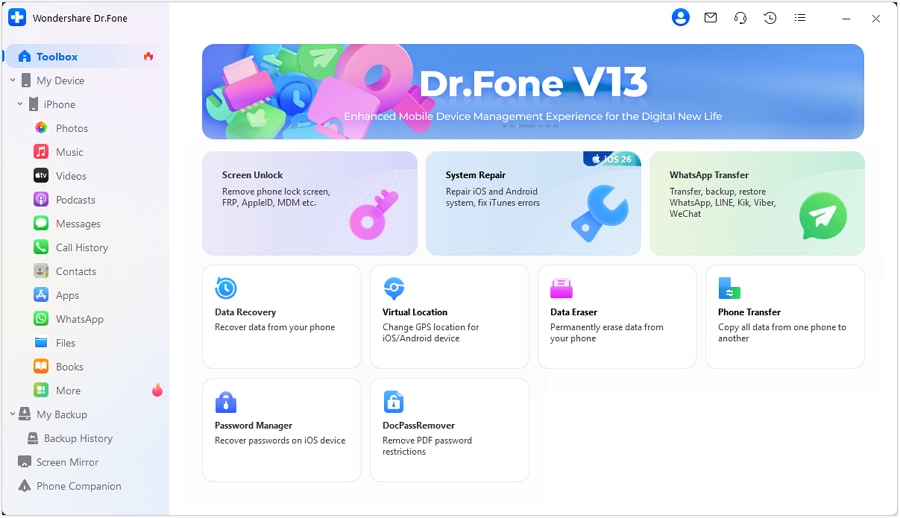
Step 1: After installing Dr.Fone on your desktop, launch it. Go to the "Toolbox" and select "System Repair" from the list.
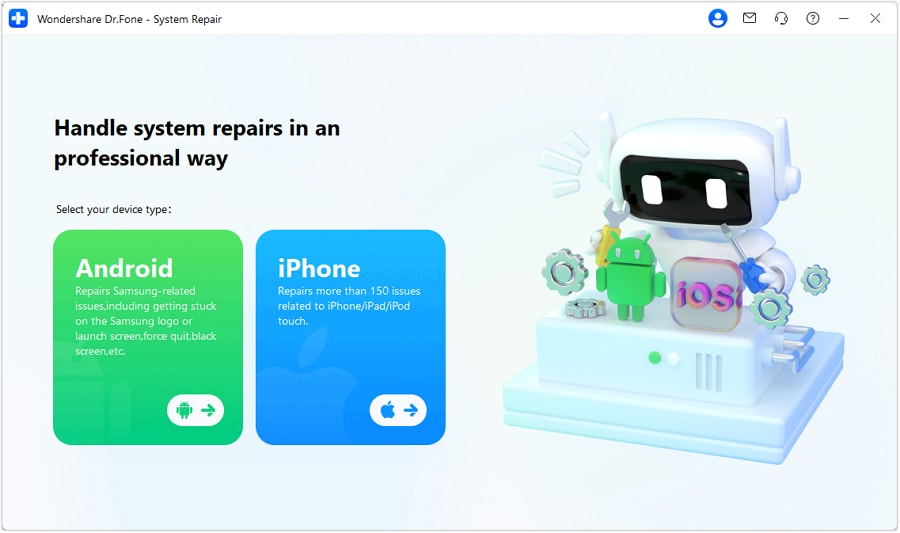
Step 2: Now, connect your iOS device to your PC/laptop via a USB cable. A new window will appear. Select "iPhone" from the options and proceed.
Step 3: After selecting your device type, you will prompted to the next window. Select "Exit Recovery Mode" from the options for exiting recovery mode.
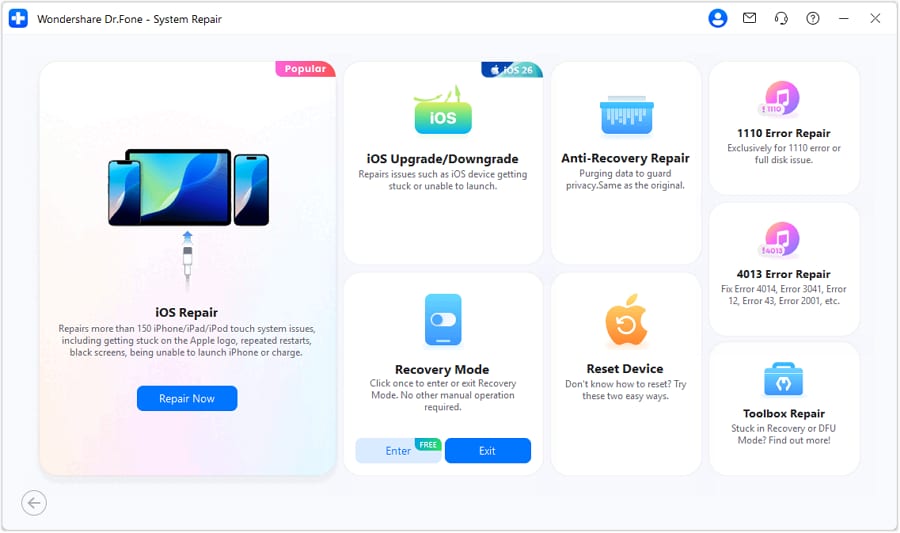
Step 4: Then, your iphone will be out of the recovery mode instantly.
 safe & secure
4,624,541 people have downloaded it
Use Finder or iTunes: Update Before Restore
When an iPhone remains in Recovery Mode, Finder or iTunes can reinstall iOS. If the computer offers both Update and Restore, try Update first. Update attempts to reinstall iOS without intentionally erasing personal data, although no software process can guarantee data preservation in every failure state.
Step 1: Connect the iPhone to your computer with a reliable USB cable. Open Finder on a newer Mac or iTunes on a supported system.
Step 2: If necessary, use the instructions in Part 2 to place the iPhone in Recovery Mode.
Step 3: Select the iPhone when it appears and choose Update when the recovery prompt offers that option.

Step 4: If you choose Restore, read the prompt carefully and confirm only when you understand the data-loss risk.
Step 5: Keep the iPhone connected until the process finishes. If it restarts normally, complete setup and restore your data from a backup if needed.
For more troubleshooting, see iPhone Recovery Mode not working or the guide to exit an iPhone Recovery Mode loop.
If Your iPhone Keeps Returning to Recovery Mode
An iPhone that repeatedly returns to Recovery Mode may have an interrupted update, damaged iOS installation, connection problem, or hardware fault. Work through these checks in order:
- Repeat the correct force restart for your model in Part 1.
- Inspect the USB cable and connector. Try another reliable cable and a different USB port.
- Restart the computer and make sure Finder or iTunes is current.
- Reconnect the iPhone and choose Update before considering Restore.
- Use Restore only after reviewing the warning that it erases device data.
- If the loop continues, contact Apple Support or a qualified repair professional. Avoid obsolete utilities, jailbreak tools, or unverified commands.
If you need a broader repair route, visit Phone Repair Solutions. A third-party tool should remain optional and should be used only after checking its current instructions and device support.
Conclusion
To exit iPhone Recovery Mode, start with the button combination for your model and wait for the Apple logo. If the phone remains stuck, connect it to Finder or iTunes and try Update before Restore.
Restore can return an iPhone to working order, but it erases the device. Back up whenever possible, read each prompt carefully, and seek qualified support if the iPhone continues to loop. Dr.Fone - System Repair (iOS) may be considered as an optional third-party troubleshooting path when the current product instructions support your device.
safe & secure4,624,541 people have downloaded it
FAQs
 Q1. Can I exit iPhone Recovery Mode without a computer?Q2. What if force restart does not exit Recovery Mode?Q3. Does Restore erase data from an iPhone?Q4. How do I get an iPhone 4 out of Recovery Mode?Q5. Why does my iPhone keep returning to Recovery Mode?Q6. Why did my iPhone leave the recovery screen while the software was downloading?Q7. What if an iPhone button is broken or stuck?
You Might Also Like

iPhone Reset
- iPhone Recovery Mode
- 1. Exit iPhone Recovery Mode Loop
- 2. iPhone in Recovery Mode
- 3. iPhone Recovery Mode
- 5. Get Data from iPhone in Recover Mode
- 6. Put iPhone in Recovery Mode
- 7. Recuva Data Recovery Review
- 8. DFU Mode vs Recovery Mode
- iPhone DFU Mode
- 1. Put iPhone in DFU Mode
- 2. Enter and Exit DFU Mode
- 3. Get Data from iPhone in DFU Mode
- 4. Tools for iPhone to Enter DFU mode
- 5. Enter/Exit DFU Mode on iPhone X
- 6. Enter/Exit DFU Mode on iPhone SE
- 7. DFU Mode Works on iPhones
- 8. Enter DFU Mode on iPod Touch
- iPhone Factory Reset
- 1. Factory Reset iPhone
- 2. Factory Reset iPhone without iTunes
- 3. Reset iPhone without Passcode
- 4. Reset iPhone Without Apple ID
- iPhone Hard Reset
- 1. Hard Reset Without Computer
- 2. Force Restart iPhone
- 3. Restart or Force Restart iPhone
- 4. Hard/Soft/Factory Reset iPhone 8
- iPhone Reset Tips
- 1. Soft Reset iPhone
- 2. Restart or Reboot iPhone
- 3. iPhone Reset All Settings
- 4. Reset iPhone Battery
- 5. Reset iPhone without Apple ID
- 6. Reset Jaibroken iPhone
- 7. Reset Network Settings On iPhone
- 8. Reset Restriction Passcode iPhone
- 9. Restart iPhone Without Power Button
- 10. Turn Off iPhone Without Home Button
- 9. Turn off iPhone without Screen
- 10. Reset Disabled iPhone
- ● Manage/transfer/recover data
- ● Unlock screen/activate/FRP lock
- ● Fix most iOS and Android issues
- Free Download Free Download Free Download




Alice MJ
staff Editor
Generally rated4.5(105participated)