Move contacts, messages, photos, videos, app data, and more between iOS and Android.

 100% Security Verified | No Subscription Required | No Malware

 :
: 
 ChatGPT
 Perplexity
 Gemini
 Claude
 Grok
Grok
Among the vast array of iOS devices, the iPhone and iPad stand out as ultimate companions for capturing and storing your most precious moments. Because of their shared ecosystem, you would think that moving files between them is instantaneous. However, navigating the precise process of learning how to transfer photos from iPhone to iPad can sometimes feel daunting for users new to Apple devices or dealing with large galleries.
Fortunately, as we head further into 2026, the Apple ecosystem and third-party software markets have evolved significantly, turning this into a highly straightforward task. This comprehensive guide is designed to effortlessly help you transfer photos from iPhone to iPad. From tapping into built-in features like iCloud and AirDrop to exploring third-party desktop applications for bulk actions, we will cover complete, step-by-step instructions to suit your specific needs.

In this article
- Part 1: How To Transfer Photos From iPhone to iPad Using AirDrop
- Part 2: How To Transfer Photos From iPhone to iPad Using iCloud Sync
- Part 3: One-Click Innovative Solution To Transfer Photos From iPhone to iPad
- Part 4: How To Transfer Photos From iPhone to iPad Using iTunes/Finder
- Part 5: How To Transfer Photos From iPhone to iPad Using Social Media Apps
- Part 6: How To Transfer Photos From iPhone to iPad Using Email
Part 1: How To Transfer Photos From iPhone to iPad Using AirDrop
AirDrop stands out as one of the most convenient, fast, and straightforward methods natively available on Apple devices. It is explicitly designed to transfer photos, documents, and videos between iOS devices wirelessly. This robust functionality leverages both Bluetooth and Wi-Fi to establish a direct, secure link between your smartphone and tablet. This peer-to-peer connection enables smooth sharing without requiring extra lightning cables or even an active internet connection. Here is a detailed guide outlining the process on how to transfer photos from iPhone to iPad utilizing AirDrop:
-
Step 1 Configure AirDrop Settings on Both Devices
Begin by unlocking both your iPhone and iPad. Swipe down from the top right corner of the screen to open the Control Center. Tap and firmly hold the connectivity panel. Within that expanded menu, press and hold the network connectivity box that features the AirDrop icon. Choose either "Contacts Only" or "Everyone for 10 Minutes" to enable AirDrop visibility across both platforms.

-
Step 2 Select and Share Your Desired Photos
Next, access the default Photos app on your iPhone and deliberately pick the images you'd like to transfer over to your iPad. After highlighting them, tap the "Share" icon (a square with an upward arrow) located at the bottom left. From the available sharing options, opt for "AirDrop." Wait a moment, look for your iPad's specific name in the populated AirDrop radar panel, and tap on it to kickstart the transfer.

-
Step 3 Accept the Transfer on Your iPad
When your iPad screen lights up with a notification prompting you to accept the incoming media payload from the iPhone, simply tap "Accept." Depending on the file size, the selected images will be beamed over and automatically saved into your iPad's Photos app gallery.

Part 2: How To Transfer Photos From iPhone to iPad Using iCloud Sync
iCloud provides an exceptionally seamless way to heavily synchronize your extensive photo library across all registered Apple devices. It guarantees that your photo collections remain constantly up-to-date without requiring active manual intervention. Enabling the iCloud Photos feature securely and automatically uploads your snapshots to cloud storage, allowing immediate access from any device linked to the same Apple ID. Here's exactly how to transfer photos from iPhone to iPad automatically via the iCloud network:
-
Step 1 Activate iCloud Photos on the Source iPhone
Start the process by accessing your iPhone's core Settings app. Tap your Apple ID profile name located at the very top. On the subsequent screen, choose "iCloud," followed by navigating to "Photos." Inside this menu, ensure that the toggle switch for "Sync this iPhone" is turned firmly on.

-
Step 2 Match the Settings on the Destination iPad
Now, shift your attention to the iPad and verify that you are successfully logged in using the exact same Apple ID. Navigate through "Settings," tap your profile name, press "iCloud," and then tap on "Photos." Here, you must also toggle on the "Sync this iPad" switch. Afterward, connect to a strong Wi-Fi network and wait for the syncing engine to populate your gallery. Note that the overall speed of this synchronization largely depends on your home internet connection bandwidth and the total volume of photos being downloaded.


Part 3: One-Click Innovative Solution To Transfer Photos From iPhone to iPad
If you are grappling with limited iCloud storage space or inconsistent AirDrop connections, relying on a robust desktop tool can be a game changer. Wondershare Dr.Fone presents a highly innovative, stable, and user-friendly architecture. It provides a comprehensive ecosystem for learning how to get photos from iPhone to iPad smoothly and safely. This particular software bypasses traditional boundaries, allowing you to transfer photos selectively or clone an entire library with zero data loss. Let's delve into the specific step-by-step methods below:
3.1 Transfer Selective Photos from iPhone to iPad
The Wondershare Dr.Fone toolkit acts as a highly intelligent iOS data management solution. It is purposefully engineered to streamline all forms of data handling. With its wide array of integrated functions, you can meticulously manage your data through importing, exporting, viewing, and deletion processes. Most notably, this utility offers the unparalleled convenience of lightning-fast file transfers by simply dragging and dropping chosen media. Follow these instructions to selectively add photos from iPhone to iPad:
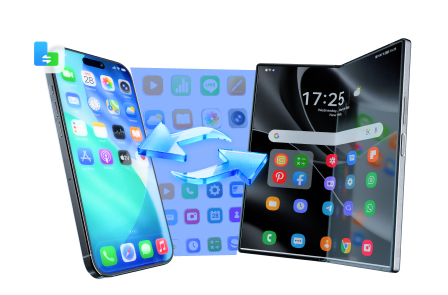
 Move data between iOS to Android and vice versa.
- Transfer contacts, SMS, photos, videos, music, and more types.
- Available with all phones with Android and iOS versions.
- Simple, click-through process.
-
Step 1 Install and Launch Wondershare Dr.Fone
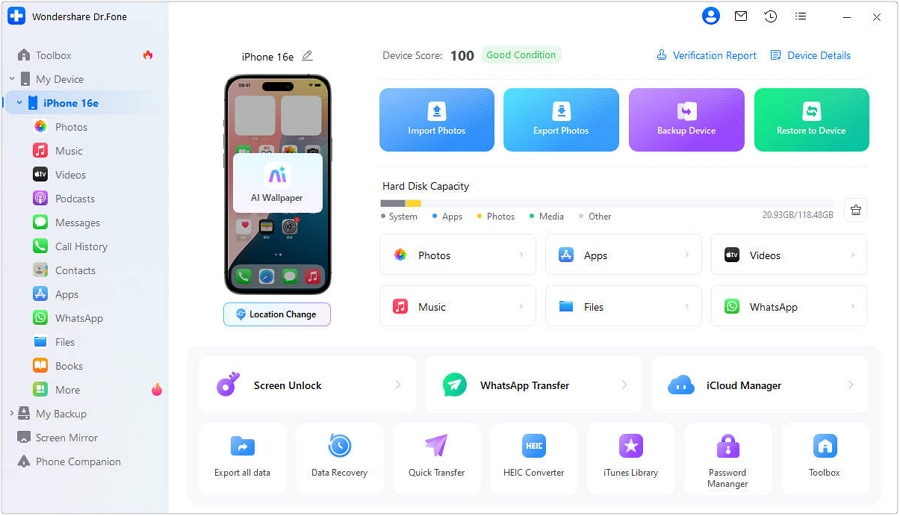
Kickstart your journey by safely downloading and installing the latest official version of Wondershare Dr.Fone to your Mac or Windows PC. Once correctly installed, launch the application. Next, connect both the iPhone and the iPad to the computer using certified USB or Lightning cables. Wait a few moments; once the internal devices are detected by the Dr.Fone interface, click on your "iPhone" name situated in the left-side navigation panel to expand its storage categories.
-
Step 2 Select and Push the Photos to the iPad
From the newly expanded data options under your iPhone, choose the "Photos" tab to gain full access to your iPhone's visual gallery. Here, carefully select the specific picture files you heavily desire to transfer, and then click the top menu option labeled "To Device." In the resulting dropdown, deliberately choose your connected "iPad." The selected photos will be pushed across immediately. This tool enables you to send as many files as you like without running into Wi-Fi drops or storage constraints.

3.2 Transfer All Photos From iPhone to iPad
For scenarios demanding bulk migration—such as upgrading to a new tablet—Wondershare Dr.Fone Phone Transfer mode has you comprehensively covered. It acts as an aggressive, high-speed phone transfer feature fully capable of transferring over 18 major types of data from one portable device to another. Dr.Fone simplifies the traditionally messy process of cloning device storage into just one unified click. Follow these streamlined steps if you want to cleanly transfer photos from iPhone to iPad entirely:
-
Step 1 Access the Dedicated Phone Transfer Tool
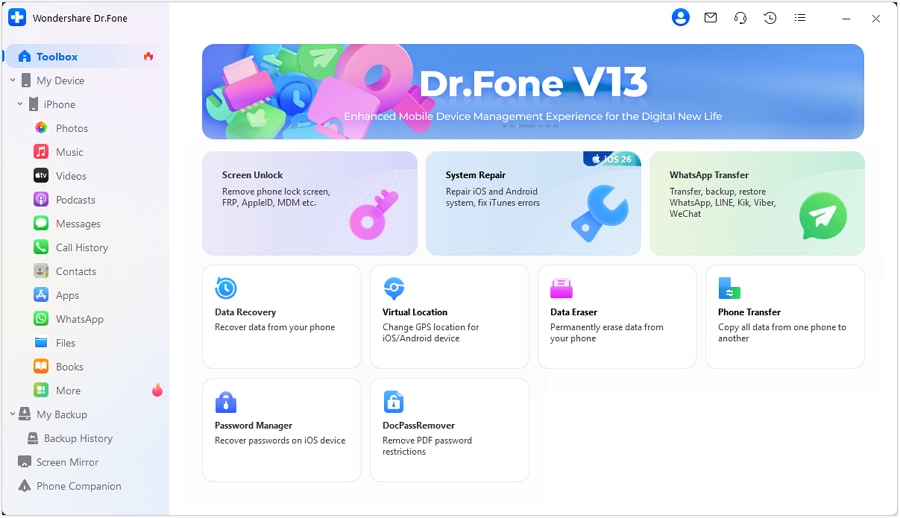
With Wondershare Dr.Fone actively running, ensure both your iPhone and your target iPad are tethered firmly to the computer. In the main software dashboard, click on the "Toolbox" tab on the left-side menu, and then select the "Phone Transfer" module from the provided grid of utilities. A new window will prompt you to organize your device positioning.
-
Step 2 Execute the Full Photo Transfer Operation
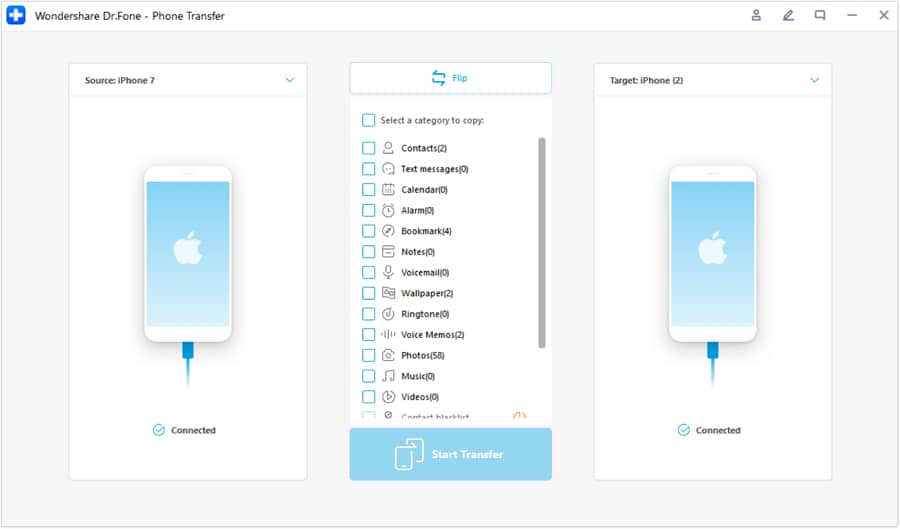
Pay close attention to the designated locations on your screen. The iPhone must legally be recognized as the "Source" device (usually on the left), and the iPad must explicitly act as the "Destination" device (on the right). If they are swapped, utilize the centralized "Flip" button to correct their places. Once aligned properly, select the "Photos" checkbox from the listed data types in the middle column. Finally, click the "Start Transfer" button. Sit back and relax while the software handles the complete data shift.




Part 4: How To Transfer Photos From iPhone to iPad Using iTunes/Finder
If you prefer native desktop architecture, iTunes (on Windows or older Macs) and Finder (on macOS Catalina and newer) provide a traditional, wired alternative to wirelessly transferring media. As the official Apple client for music, media, and heavy backup management, iTunes/Finder operates brilliantly for users needing to manually dictate photo sync behavior. Keep in mind that this is a two-step process requiring local storage buffers. The necessary steps to transfer photos from iPhone to iPad automatically via sync are detailed below:
-
Step 1 Import the Photos to Your Computer Environment
First, physically connect your iPhone to the PC or Mac using a robust USB cable. If utilizing a Windows machine or older Mac, open the native "Photos" app. Inside the desktop Photos application interface, click on "Import," highlight your recognized iPhone, and wait patiently as the computer loads your device's photo gallery thumbnails. Once visible, choose to securely transfer the targeted images directly into a local computer folder.

-
Step 2 Sync the Folder Through iTunes or Finder
After confirming that the photos reside safely on your computer's hard drive, carefully unplug the iPhone and plug in your iPad. Launch the latest supported version of iTunes (or Finder if on modern macOS). Click the small device icon representing your connected iPad. In the left-hand navigation pane, select "Photos." Check the prominent box indicating "Sync Photos."

-
Step 3 Apply the Configuration and Synchronize
Under the sync settings, click the dropdown menu and point it precisely to the specific folder where you previously imported the iPhone photos. To finalize, smash the "Apply" or "Sync" button located in the lower right corner. The desktop client will mirror those images directly to the iPad's internal storage.

Part 5: How To Transfer Photos From iPhone to iPad Using Social Media Apps
While often viewed solely as communication tools, popular social media platforms can double as highly convenient workarounds for moving media cross-device. Applications like WhatsApp natively support file sharing. By leveraging its web or companion application functions, WhatsApp enables individuals to bounce images around easily, solving the query of how to get photos from iPhone to iPad with tools you likely already use. Let us walk through this clever WhatsApp workaround:
-
Step 1 Transmit Photos via WhatsApp Chat
Guarantee that you have active WhatsApp access on the iPhone. Open a chat conversation—ideally, a personal "message yourself" chat or a trusted contact account that is also logged in on the iPad's web client. Tap the "+" icon near the text box, select "Gallery" or "Photos," and highlight the desired images. Tap the blue "Send" arrow to propel them into the chat timeline.

-
Step 2 Retrieve the Media from the iPad Browser
Migrate over to your iPad and launch Safari. Navigate directly to "WhatsApp Web" and scan the authentication code if prompted. Once inside the active messaging interface, click into the chat containing the sent photos. You can then download and save those received images directly to your iPad's local camera roll.

Part 6: How To Transfer Photos From iPhone to iPad Using Email
Using classic email provides a direct, low-tech methodology for shifting visual files between an iPhone and an iPad. However, it is crucial to recognize that standard email providers cap attachment file sizes (typically around 20MB to 25MB). Consequently, this route is rarely suitable for enormous batches or high-resolution RAW files. Yet, for a quick handful of JPEGs, it remains highly effective. Here is how to utilize email:
-
Step 1 Attach and Send from the iPhone
Open your preferred "Mail" application (such as Apple Mail, Gmail, or Outlook) directly on the iPhone and compose a fresh message. Enter your own email address into the recipient "To:" field. Tap the "Attachment" paperclip icon or photo gallery symbol to select the specific snapshot files. Once attached, hit the "Send" button to blast them to your inbox.

-
Step 2 Access and Download on the iPad
Pick up your iPad, verify its internet connection, and launch your Mail application there. Allow the "Inbox" a moment to refresh and look for the newly arrived self-addressed email. Open the message, tap on the image attachments, and utilize the native sharing sheet to effectively save them directly onto your iPad's local storage.

Conclusion
Ultimately, learning precisely how to transfer photos from iPhone to iPad is a foundational skill necessary to extract the maximum potential from your iOS devices. Throughout this comprehensive 2026 guide, we explored various capable methods ranging from Apple's native AirDrop, iCloud synchronization, and legacy iTunes/Finder modules to more unconventional yet functional strategies like social media forwarding and self-emailing.
While every method has distinctive strengths tied to different scenarios, balancing total convenience, operational speed, and bulk processing capabilities points to a superior solution. Wondershare Dr.Fone consistently rises above native constraints as a highly versatile and intuitive remedy. Through its sophisticated desktop interface, you are empowered to navigate both selective photo pushing and wholesale full-device transfers completely hassle-free, preserving your digital memories with zero compromises.
FAQ
-
1. Does AirDrop reduce or compress the quality of my transferred photos?
No. When you use AirDrop to transfer photos from an iPhone to an iPad, the files are typically sent in their original format and full resolution. Unlike some social media apps, AirDrop preserves your image metadata and visual fidelity intact. -
2. Why are my photos not syncing automatically between my iPhone and iPad via iCloud?
This often occurs due to insufficient iCloud storage space (as Apple only provides 5GB free), being logged into completely different Apple IDs on the two devices, or having the "Sync this iPad/iPhone" setting accidentally disabled under the iCloud Photos menu. Connecting to a stable Wi-Fi network and having sufficient battery power is also required. -
3. How to get photos from iPhone to iPad without an active Wi-Fi connection?
If you lack Wi-Fi, you can still securely transfer your data using Wondershare Dr.Fone via a physical USB-to-computer connection. Alternatively, AirDrop establishes a localized peer-to-peer connection that requires the Wi-Fi and Bluetooth toggles to be physically "on", but doesn't require actual internet router connectivity. -
4. Will transferring or syncing photos delete them from my original iPhone?
No. Methods like AirDrop, Dr.Fone transfers, iTunes importing, and Email act strictly as copy-and-paste mechanisms. Your photos will remain on your original iPhone unless you specifically choose to delete them afterward to free up local space.
 Add Wondershare Dr.Fone as a preferred source on Google