Resolve common problems and system crashes on both iPhone and Android devices.

 100% Security Verified | No Subscription Required | No Malware

 :
: 
 ChatGPT
 Perplexity
 Gemini
 Claude
 Grok
Grok
Since the introduction of the Android operating system, smartphones have practically eliminated the strict need for computers when managing emails through Gmail. For working professionals and casual users alike, the platform remains an essential tool for daily communication. However, technology is never flawless. You might be experiencing a day where Gmail is crashing on Android, or you find that the app is simply completely unresponsive. It can be incredibly frustrating when important work relies on timely email access.
If you find that your Gmail has stopped or Gmail keeps stopping every time you try to launch it, there is no need to panic. In this comprehensive 2026 guide, we will explore some of the most prominent Gmail not working Android issues and provide detailed, actionable fixes. By the end of this article, you will have the knowledge to troubleshoot and resolve these annoying problems efficiently.
1. Resolving App Crashes and Sync Issues
When Gmail keeps crashing or fails to sync, the most effective immediate steps include clearing the application cache, freeing up local storage space on your device, and verifying your manual sync settings.
2. Fixing Network and Loading Problems
If emails are stuck in the outbox or the app won't load, checking your active internet connection, disabling conflicting browser extensions, and removing then re-adding your Google account often restores full functionality.
In this article
- Part 1. Problem 1: Gmail App Not Responding or Keeps Crashing
- Part 2. Problem 2: Gmail Won't Sync Between All Ends
- Part 3. Problem 3: Gmail Won't Load in Your Web Browser
- Part 4. Problem 4: Gmail Can't Send or Receive Emails
- Part 5. Problem 5: Emails Stuck in the "Sending" Outbox
- Part 6. Problem 6: Experiencing the "Account Not Synced" Error
- Part 7. Problem 7: The Gmail App is Running Extremely Slow
Part 1. Problem 1: Gmail App Not Responding or Keeps Crashing
First and foremost, the most frequently reported situation users encounter is when their Gmail keeps crashing. Alternatively, the app may open but simply refuses to respond to any touch inputs. You might launch the application, find it frozen for a few agonizing seconds, and then be forced to close it entirely. If your Gmail not responding issue is preventing you from working properly, here are the most effective solutions to implement.
1-1. Clear the App Cache
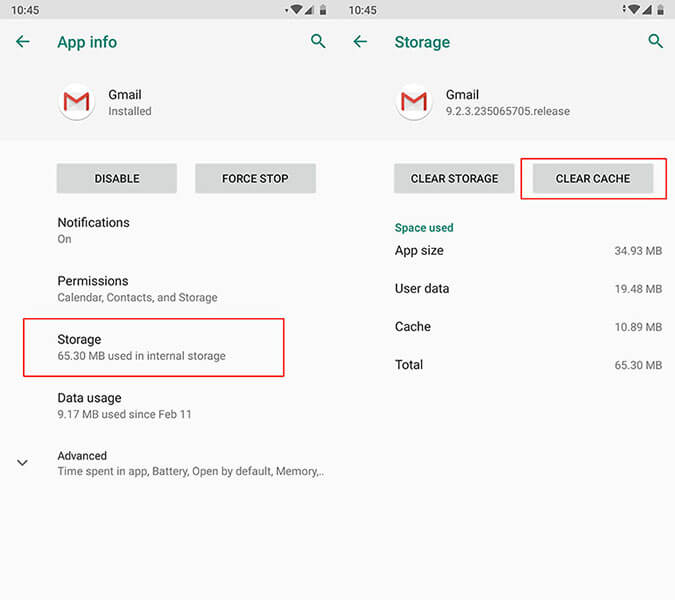
The very first troubleshooting step to resolve a frozen or crashing Gmail app is to clear the application's temporary cache. This method has a high success rate as it removes corrupted temporary files that often cause instability.
-
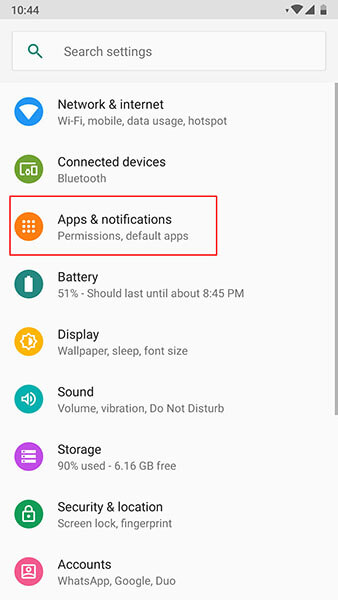
Step 1 Navigate to App Settings
Go to your Android device's "Settings" menu and look for "Apps & Notifications." Keep in mind that depending on your phone's manufacturer (like Samsung, Google, or Xiaomi), this might be labeled as "Applications" or "App Manager."
-
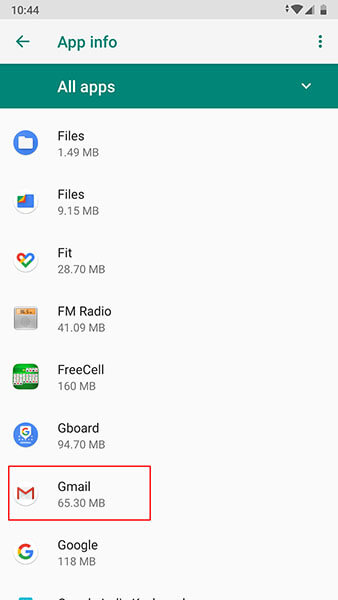
Step 2 Locate Gmail
Scroll through your comprehensive list of installed applications, search for "Gmail," and tap on it to open its specific app info page.
-
Step 3 Clear the Cache Data
Tap on the "Storage" or "Storage & cache" option, followed by selecting "Clear Cache." Do not tap "Clear Data" unless you are prepared to reconfigure your app settings.
1-2. Restart the Android Device
Restarting the hardware is a classic but highly effective method for resolving minor software glitches, especially when Gmail keeps stopping unexpectedly. Simply long-press the physical power button on your smartphone and select the "Restart" option. Once the device boots up, check if the Gmail application functions normally.
1-3. Perform a Factory Reset
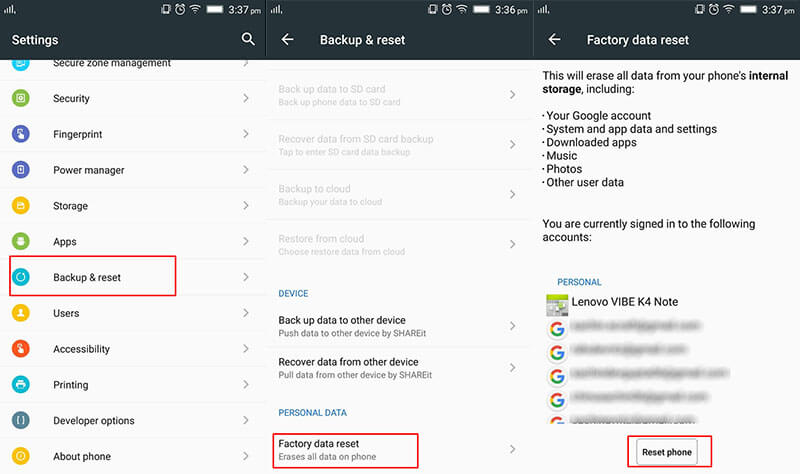
If the above methods fail, your next viable option is resetting your Android device. Warning: This procedure will lead to total data loss on the internal storage. We strongly suggest you create a comprehensive backup of your important files, contacts, and photos before proceeding with this extreme method.
-
Step 1 Find Reset Options
Open "Settings" and search for the "System" or "General Management" menu to find the "Backup & Reset" option.
-
Step 2 Erase Everything
Tap on "Factory data reset" or "Erase all data" (the exact nomenclature will vary). Follow the on-screen prompts to confirm the deletion.
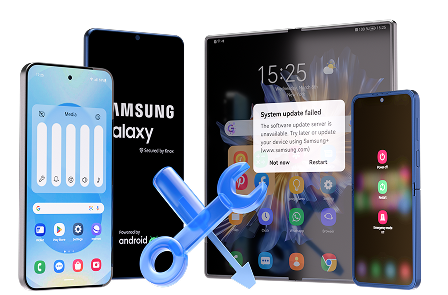
If unfortunately, all the basic manual solutions fail, there may be a deeper system corruption requiring you to flash the stock Android ROM. Before you worry about the complexities of such a task, there is a professional one-click software tool that can assist you: Dr.Fone - System Repair (Android). This robust utility takes special care of your Android phone, fixing almost every severe system issue with remarkable ease. It demands absolutely no special technical skills and performs its system recovery efficiently.
 Fix Android instantly – no skills needed.
- Solve boot loop, black screen, won’t turn on, etc.
- High success rate for all system issues.
- User-friendly interface with easy-to-follow steps.
Part 2. Problem 2: Gmail Won't Sync Between All Ends
The next prevalent obstacle that completely stalls productivity is when Gmail simply refuses to synchronize your emails across your mobile and desktop platforms. Here are the tried-and-true solutions for this particular synchronization failure.
2-1. Make Space in the Phone
When Gmail stops syncing, one of the primary culprits is often a critically low amount of internal storage. If the operating system cannot allocate space to download new email data, the syncing mechanism will not work at all. We highly suggest removing unused or unwanted applications to clear storage space, or deleting large downloaded media files. You can also back up important files by transferring them to your personal computer, rendering enough vacant space for Gmail to resume normal operations.
2-2. Check Gmail Sync Settings
If you have adequate storage but the gmail not working android synchronization issue persists, you must manually inspect the Gmail sync configurations. Follow these precise steps:
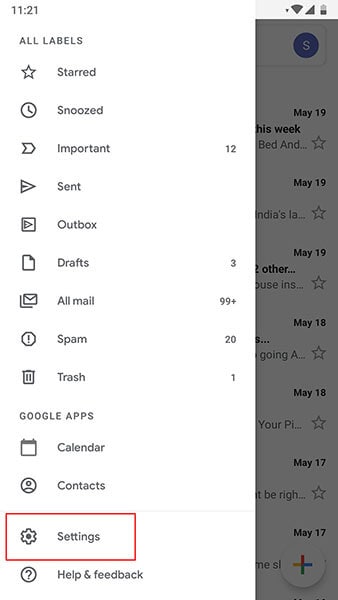
- Launch the Gmail application on your Android phone and tap on the hamburger menu icon (three horizontal lines located in the top-left corner).
- Scroll down to the bottom, tap on "Settings," and then choose the specific Google account that is experiencing issues.
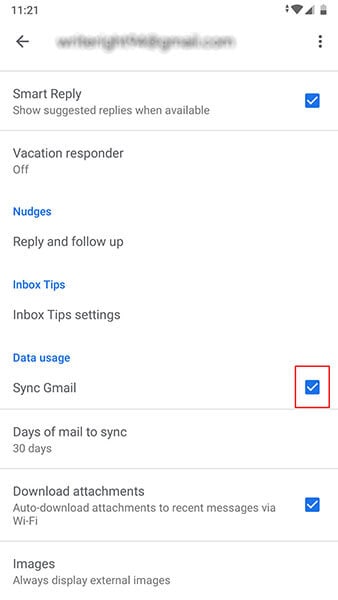
- Scroll to the "Data usage" section and ensure that the checkbox next to "Sync Gmail" is actively checked. If it was disabled, checking it should instantly trigger a background refresh.
2-3. Restart the Device
Once again, restarting the entire phone can act as a powerful catalyst for re-establishing broken background connections. Reboot the device and carefully observe if your Gmail account begins fetching new messages.
Part 3. Problem 3: Gmail Won't Load in Your Web Browser
In cases where you are accessing Gmail through a mobile web browser rather than the dedicated app, and the loading bar endlessly tests your patience, we have compiled the best solutions to accelerate the process.
3-1. Ensure You Use a Gmail-Supported Browser
First of all, you must guarantee that the specific browser application you are using is officially compatible with Google's web infrastructure. Gmail is optimized to perform seamlessly on Google Chrome, Mozilla Firefox, Apple Safari, Internet Explorer, and Microsoft Edge. Furthermore, these browsers must be fully updated. Make absolutely sure they are running on their latest available versions in the Google Play Store. Moreover, if you happen to use a Chromebook alongside your phone, never neglect to update the Chrome OS to maintain robust Gmail support.
3-2. Clear the Cache of Your Web Browser
If switching or updating the browser proved to be futile, you should clear the accumulated cache and cookies within that specific web browser. Please be aware that doing so will typically remove your active login sessions and wipe out your short-term browsing history. Consequently, the automatic login records for websites you frequently visit will be temporarily lost until you sign in again.
3-3. Check Browser Extensions or Add-ons
If the aforementioned cache-clearing strategy didn't help, examine any active browser extensions or mobile add-ons. It is quite common for aggressive ad-blockers or privacy plug-ins to interfere with Gmail's complex JavaScript loading scripts. Due to this software conflict, Gmail simply won't load. You can try turning off all extensions and plug-ins temporarily to identify the culprit, or use the browser's "Incognito Mode" (which generally disables add-ons by default) to see if Gmail loads successfully.
Part 4. Problem 4: Gmail Can't Send or Receive Emails
Another major obstacle occurs when Gmail seemingly functions, but entirely blocks you from dispatching outgoing messages or receiving incoming emails. To systematically troubleshoot this communication breakdown, follow the solutions below.
4-1. Check for the Latest Version of Gmail
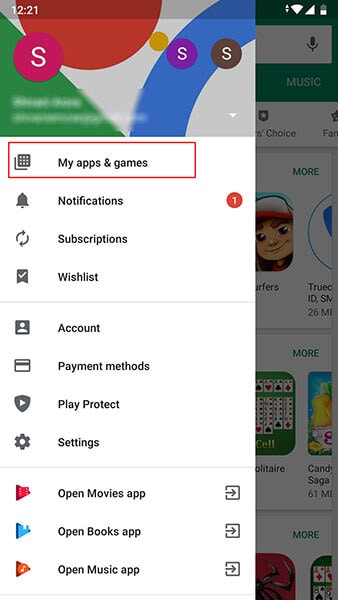
This distinct communication issue is highly likely to emerge if you are operating an outdated iteration of the Gmail application. Therefore, our primary recommendation is to verify if a pending Gmail update exists. Navigate to the Google Play Store, access your profile, and select "Manage apps & device" (formerly "My apps & games"). From there, you can easily determine if the Gmail client requires an urgent update.
4-2. Verify Your Internet Connection
Another critical variable that dictates whether you can send or receive emails is the stability of your internet connection. Naturally, if the device lacks active internet access, Gmail not responding errors are guaranteed. We advise you to manually turn off your Wi-Fi toggle from the quick settings menu and enable it again after a few seconds. If you rely on mobile cellular data, check if your carrier signal is strong. Sometimes, abruptly switching from cellular data to a stable Wi-Fi network resolves unexpected data-hampering protocols that prevent email transmission.
4-3. Remove Your Account and Add It Again
If Gmail keeps stopping you from moving forward despite a strong network connection, performing a manual sign-out and re-authentication is highly effective.
-
Step 1 Access Account Management
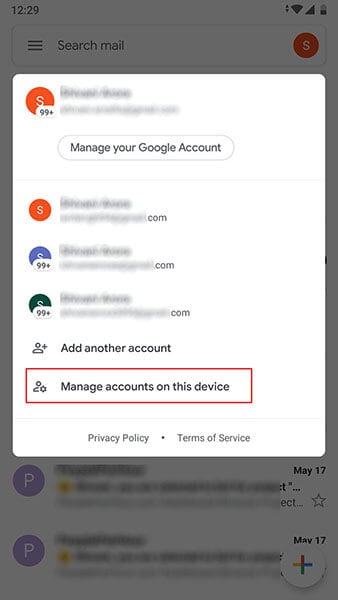
Open your device's global "Settings," locate the "Accounts" or "Users & accounts" section, and select the Google account associated with your problematic Gmail.
-
Step 2 Remove the Account
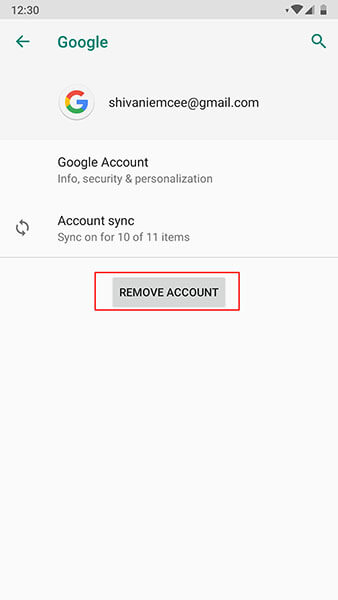
Tap on the specific email address you are struggling with, then press the prominent "REMOVE ACCOUNT" button. Confirm your choice. Once completely removed, restart the app, add the account credentials again, and check if normal operations have resumed.
Part 5. Problem 5: Emails Stuck in the "Sending" Outbox
One of the most irritating glitches that disrupts Gmail on Android is when a drafted email gets permanently trapped in the "Sending" state within your outbox. If your critical business proposal or personal message is stuck in digital limbo, the subsequent solutions should force it through.
5-1. Try an Alternative Gmail Address
Initially, if Gmail's progress halts strictly due to a "stuck in sending" loop on one specific profile, we advise switching to an alternate Gmail address (if you have multiple accounts logged in) to send the exact same mail. If it transmits successfully, the issue is account-specific rather than app-wide.
5-2. Check Your Network Connection Thoroughly
As previously emphasized, an active and uninterrupted internet connection is mandatory. When you operate on an unstable network, packet loss often leads to messages getting stuck, which can subsequently cause Gmail crashing on Android. You can stabilize your connection via these three methods:
- Prioritize a reliable Wi-Fi network over cellular data, as Wi-Fi provides better sustained bandwidth for uploading outbound data.
- Toggle your device's Wi-Fi off and wait approximately five seconds before turning it back on. If you have physical access to the network router, unplug it for 30 seconds and plug it back in to flush its temporary cache.
- Activate "Airplane mode" from the notification shade, wait a few moments to sever all radio connections, and disable it to force your phone to establish fresh network handshakes.
After executing these steps, manually pull down on your outbox to retry sending the queued mail.
5-3. Check Your Email Attachments Size
Excessively large media attachments are a notorious trigger for outbox freezing. We strongly suggest you review the files attached to the pending email. Gmail enforces strict file size limits (usually around 25MB). If the attachments aren't strictly necessary, delete them and attempt to send the text alone. If the files are mandatory, consider compressing them into a ZIP archive or uploading them to Google Drive and sharing a hyperlink instead.
Part 6. Problem 6: Experiencing the "Account Not Synced" Error
Frequently, Android users are greeted with an annoying overlay error stating "Account not synced" when they attempt to navigate their inbox. This represents the sixth major anomaly in our guide. The strategies detailed below will help you eliminate this persistent warning.
6-1. Make Space in the Phone
When Gmail interrupts your workflow by aggressively prompting an "Account not synced" error dialog, you must ensure that your Android internal drive isn't completely maxed out. If the storage is full, create room immediately. As detailed in earlier sections, you can either uninstall applications you no longer launch or migrate substantial media files (like 4K videos or high-res photos) to a desktop PC. Adopt this storage management tip and monitor if the sync warning disappears.
6-2. Review Gmail Sync Settings Again
As an alternative fix, verifying your master sync configuration is crucial.
-
Step 1 Open the Main Menu
Simply open the Gmail interface and tap the three horizontal lines (hamburger menu) positioned on the upper-left corner.
-
Step 2 Select Your Account
Scroll downward to "Settings" and tap on the specific email address that is displaying the sync error.
-
Step 3 Enable the Sync Checkbox
Locate the tiny square checkbox designated "Sync Gmail." If it is currently unchecked, tap to activate it. This should theoretically force the server to push new data to your client.
6-3. Reboot the Device
If toggling the settings proved ineffective, standard procedure dictates that you should reboot your handset. Utilize the physical Power button on the side of your device. Long-press it and select "Restart" from the power menu. This basic action flushes the system RAM and often forces Google Play Services to restart the sync engine gracefully.
Part 7. Problem 7: The Gmail App is Running Extremely Slow
The final significant problem you might endure is a heavily sluggish and unresponsive Gmail application. You might notice intense lag while scrolling, or delayed typing responses when composing a new message. To rejuvenate the app's performance, the following solutions are highly recommended.
7-1. Restart the Phone to Clear RAM
Rebooting is widely recognized as a universal remedy for rectifying minor Android memory leaks. We recommend restarting your Android phone first whenever you observe that Gmail has stopped behaving snappily and exhibits noticeably sluggish transitions.
7-2. Clear Storage of Device
Historically, all mobile applications suffer massive performance degradation when the host device approaches maximum storage capacity. Since complex apps require ample free cache space to cache images and execute background processes efficiently, running on minimal free space guarantees a poor user experience. Make sure to aggressively wipe out cached data, obsolete downloads, and unused apps to carve out enough breathing room. This ensures Gmail responds promptly and stops dragging its feet.
7-3. Update the Gmail App
Our final piece of practical advice is to ensure the Gmail app is running its absolute latest build. Until you authorize pending updates, an outdated framework might suffer from known bugs that cause memory leaks, resulting in intense frustration. Therefore, visit the Google Play Store, search for Gmail, and hit "Update" if the button is visible. Welcoming the newest version often serves as a permanent farewell to a slow-running inbox.

As we mentioned earlier, we highly recommend utilizing a premium one-click solution to seamlessly repair the Android firmware. Dr.Fone - System Repair (Android) is explicitly engineered to help you achieve this with zero data loss. This robust desktop utility boasts an exceptionally high success rate and is highly praised for its straightforward interface and impenetrable security. It is specifically designed to tackle a vast array of Android system catastrophes. So, regardless of whether your Gmail keeps crashing, refusing to load, or continuously stalling, this software acts as the ultimate safety net.
- Fix Android instantly – no skills needed.
- Solve boot loop, black screen, won’t turn on, etc.
- High success rate for all system issues.
- User-friendly interface with easy-to-follow steps.
Conclusion
To sum up, managing your digital life requires a reliable email client, and encountering scenarios where Gmail has stopped can severely impact your daily productivity. Whether you are dealing with an app that keeps crashing, synchronization failures, or a painfully slow interface, the manual fixes provided—such as clearing the cache, freeing up internal storage, re-adding your Google account, and checking your network—are designed to resolve the majority of standard glitches in 2026. However, if standard troubleshooting proves insufficient due to deep-seated OS damage, relying on dedicated software like Dr.Fone - System Repair (Android) provides a foolproof, permanent resolution to ensure your Android ecosystem remains flawless.
FAQ
-
1. Why does my Gmail app keep crashing on my Samsung device?
This often happens due to a corrupted app cache or outdated software. Go to Settings > Apps > Gmail > Storage, and tap "Clear Cache". Also, ensure you have the latest app version from the Play Store. -
2. How do I fix Gmail not syncing in the background?
Check your device's power-saving mode, as it frequently restricts background data. Ensure that the "Sync Gmail" option is checked in your Gmail app settings, and verify that your internal storage isn't completely full. -
3. Will clearing Gmail data delete my actual emails?
No, clearing the app data or cache only removes temporary files and local app settings. Your emails are securely stored on Google's cloud servers and will immediately re-sync once you log in again. -
4. What should I do if my emails are stuck in the Outbox?
A stuck outbox is usually caused by network drops or oversized attachments (exceeding 25MB). Connect to a stable Wi-Fi network, remove large files, and manually refresh the Outbox to force the pending messages to send.
 Add Wondershare Dr.Fone as a preferred source on Google