
Play Store Stuck on Downloading? 7 Ways to Resolve

Nov 02, 2026 • Filed to: Phone Repair Solutions • Proven solutions
 TL;DR:
- Pending or waiting: check other downloads and the Wi-Fi-only preference, then retry one app.
- 99%, 100% or Installing: check free storage, restart and clear Play Store cache; the percentage alone does not prove that the file is complete.
- Only one app fails: check its availability for your device and compare it with a small app. Do not jump straight to system repair.
- Several apps fail and the phone also freezes or crashes: guided Android firmware repair is a separate option for supported devices, with workflow-specific data consequences.
Ask AI for a summary
 ChatGPT
 Perplexity
 Gemini
 Claude
 Grok
If your Play Store is stuck on downloading, check whether it says Pending, shows a frozen percentage, or has reached Installing. Close and reopen Google Play Store, restart the phone, then retry one app. If it is still stuck, check the download queue, connection and free storage before resetting app settings.
A Google Play download stuck at 99% or an app stuck at 100% is not enough to identify a specific fault. The checks below help separate a queued download, a network problem, a single-app restriction and a broader Android software issue.

Part 1: Symptoms when “Play Store Stuck on Downloading”
A Play Store download can remain pending, stop at 99%, or reach 100% without the app becoming ready to open. These are different visible states, not a diagnosis of corrupted firmware or a failed verification step.
First note the exact label and whether the problem affects one app or several. If a download is still making progress, let it continue; do not repeatedly cancel a large download just because it briefly pauses.
- Stuck at 99% or 100%: check storage and retry after restarting. If it remains stuck, use Play Store cache troubleshooting.
- Waiting for download: check the queue and download network preference.
- Stops halfway on Wi-Fi: compare another trusted connection using the same app.
- The same app retries but never installs: check that app's device availability.
- Several downloads remain pending: try one app at a time, then follow the Store-level checks below.
Part 2: Causes of why “Play Store Stuck on Downloading”
Connection trouble, low storage and Play Store settings can all interfere with downloads. A percentage does not reveal which one applies. Use the checks below to narrow the problem rather than assuming every stalled download needs a system reset.
- Incorrect date or time: open Settings > System > Date & time and enable automatic time and time zone where available. Wait a few minutes and retry. Menu names vary by phone.
- Connection or download preference: an unavailable network, a sign-in page or a Wi-Fi-only setting can prevent a download from starting or progressing.
- Play Store cache or settings: clearing its cache is a supported troubleshooting step. Clearing Store data has a different effect from clearing Google Play services data; choose the appropriate reset.
- Store or Android update trouble: check the current Play Store update control and available Android system updates. This does not establish that an update caused your problem.
- Low storage or app-storage trouble: check internal free space. An SD card used as internal storage is different from a portable card used for files.
- Account sign-in problems: resolve any visible sign-in prompt. Compare an already-added account before removing an account from the device.
Part 3: 7 fixes for Play Store stuck on downloading
The seven methods cover different causes. For an ordinary stalled download, work through storage, connection and queue, Store cache, updates and account checks, testing one app after each change. Use the single-app check if other apps install normally; choose the system-repair route when the symptoms fit a broader software fault.
3.1 Check SD card and phone storage space
Open Settings > Storage. On some Samsung phones this is under Battery and device care > Storage. Google flags less than 1 GB available as a sign of low space; more than 1 GB is not a guarantee that a large app has enough room.
- Review unused apps and large downloads. Back up files you want to keep before deleting them.
- Free space on the phone, then retry the same app once. Check whether it installs rather than watching only the percentage.
- If you use an SD card, check whether Settings identifies it as portable or internal/adopted storage. Portable cards store files but do not support app installation; internal cards can hold apps.
Do not format an SD card to fix a download: formatting deletes its data. Do not remove an adopted/internal card containing apps as a casual test. If the phone reports card errors, back up accessible data and use the manufacturer's storage guidance before changing the card.
3.2 Check Wi-Fi or cellular data connection
If the download works on mobile data but not Wi-Fi, that is a useful network-specific clue, not proof of a broken router or healthy phone hardware.
- In Play Store, tap your profile icon > Manage apps & device. Review downloads or updates in progress; the Manage tab can show pending items. Let an active update finish, or cancel unwanted queued items with their cancel control, then retry just the app you need.
- Open profile icon > Settings > Network preferences > App download preference. If it is set to Wi-Fi only, connect to working Wi-Fi. Alternatively, select Over any network for a mobile-data test only if you accept your carrier's data charges; restore your preferred setting afterward.
- Open a website to check connectivity and complete any legitimate Wi-Fi sign-in page. Compare another trusted Wi-Fi network or mobile data. Restart your own router if its connection is failing.
- If you configured a personal VPN, proxy or custom DNS, compare a permitted alternate network or briefly test your own configuration, then restore it. Do not disable employer-managed security controls or bypass network policy; ask the administrator instead.
Retry the same app after each change. If every app still stalls on both connections, continue with Play Store cache. If only one app fails, go to the app-specific check.
3.3 Use guided repair for a broader Android software fault
For a supported phone with persistent Play Store failures alongside repeated crashes, freezing or boot problems, Dr.Fone - System Repair (Android) provides guided firmware repair on Windows. Device identification, compatible firmware preparation and repair progress are brought into one workflow, reducing the manual work involved in a firmware repair.
This route addresses supported system software faults, not a Wi-Fi restriction, an unavailable app or physical hardware damage. A stalled percentage by itself is not evidence that firmware repair is needed. A factory reset removes phone data and apps; it is not the same operation as this guided firmware preparation and installation. Choose between them based on the fault and supported repair path, not an assumption that firmware repair is always better or keeps Samsung data.

Dr.Fone - System Repair (Android)
Guided firmware repair for supported Android system issues
- Repair supported Android software problems such as repeated crashes, boot loops and frozen screens in one guided workflow.
- Match and prepare compatible firmware without manually searching for packages or using a separate flashing tool.
- Choose the appropriate repair path for supported Samsung, Xiaomi, Redmi and POCO devices.
- Use the eligible Xiaomi, Redmi and POCO workflow without root, with its data-preserving repair design.
- Follow device details, firmware preparation and repair progress on screen, with 24/7 technical support available for guidance.


Samsung repair walkthrough
Before starting: this Samsung workflow erases device data. Back up accessible Android data to a computer and verify that the files you need are saved. Continue only if you accept the erasure and your exact model and firmware are supported. Full firmware repair requires a paid license; downloading the installer is not a free repair.
Xiaomi, Redmi and POCO use a separate eligible no-root, data-preserving workflow, not the Samsung steps below. If you have one of those devices, use the Xiaomi-family repair instructions.
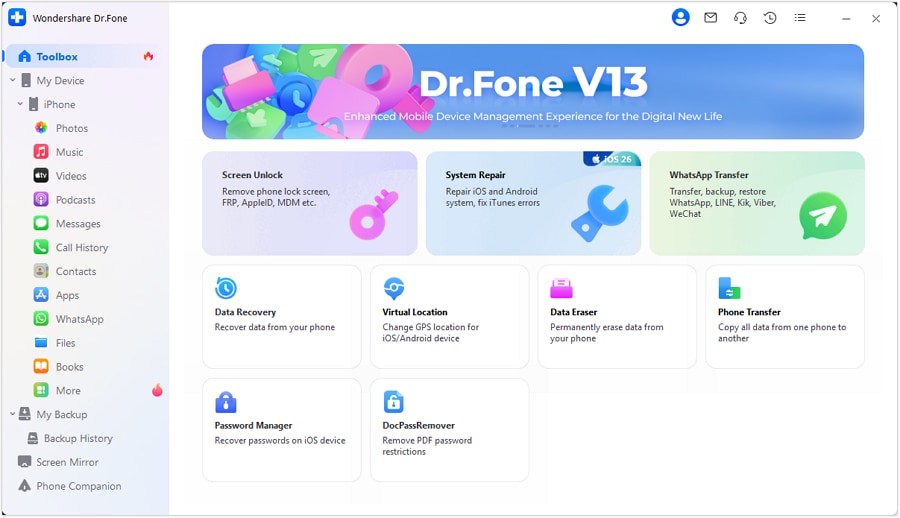
Step 1: Connect your Samsung and open System Repair. Launch Dr.Fone on Windows, connect the phone or tablet by USB and choose Toolbox > System Repair.
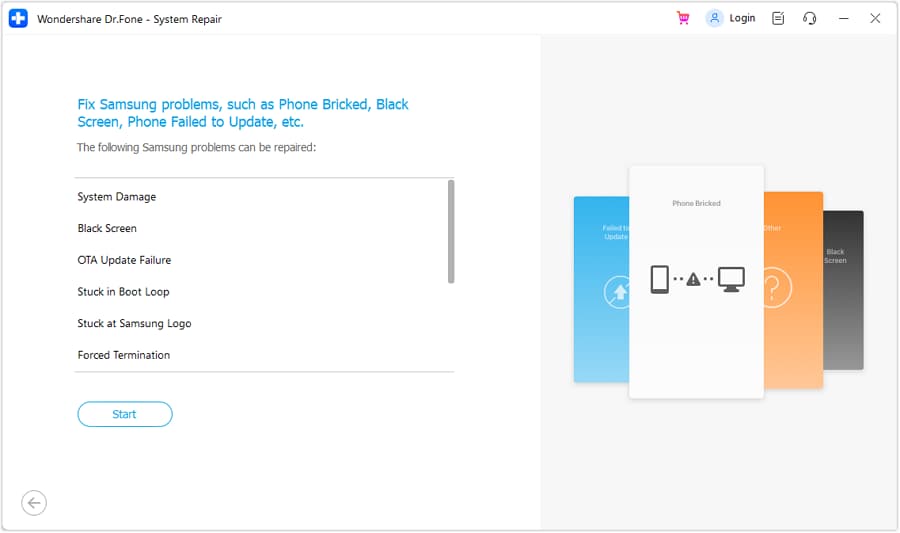
Step 2: Choose the Samsung repair path. Select Android > Android Repair > Repair Now, choose Samsung and continue with Start on the repair screen.
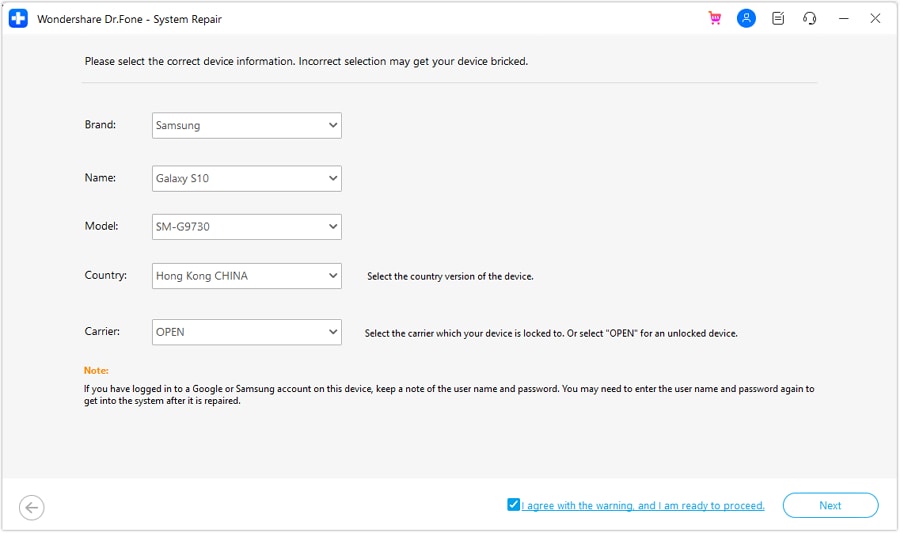
Step 3: Confirm the device details. Select the correct Name, Model, Country and Carrier. Use OPEN in the Carrier field if the device is unlocked. Read the warning, select the agreement checkbox and click Next; do not proceed with mismatched details.
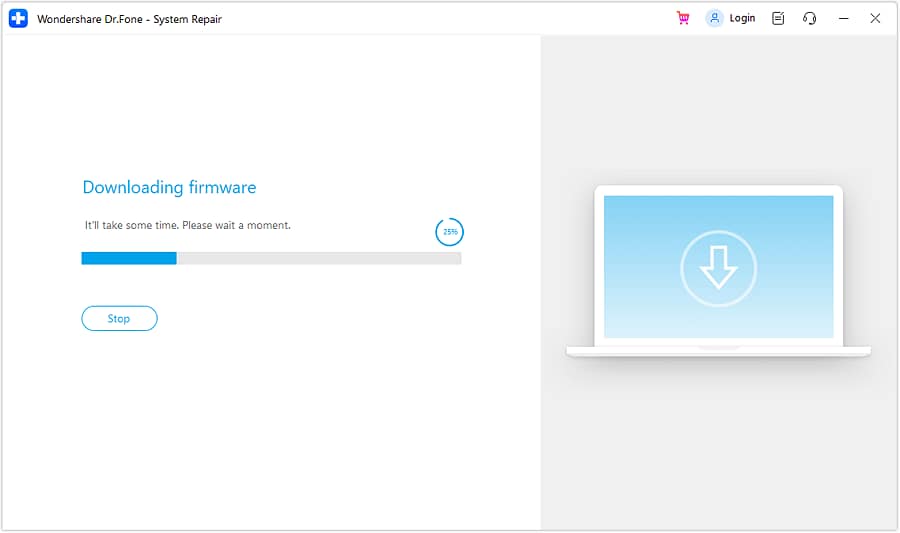
Step 4: Enter Download Mode and prepare the firmware. For a connected, unlocked device, use the offered Enter Download Mode control. Otherwise follow the on-screen instructions for your exact button layout; Home-button, Bixby and volume-button models do not use one universal combination. Once the device enters Download Mode, Dr.Fone downloads and verifies the firmware. Wait for preparation to complete.
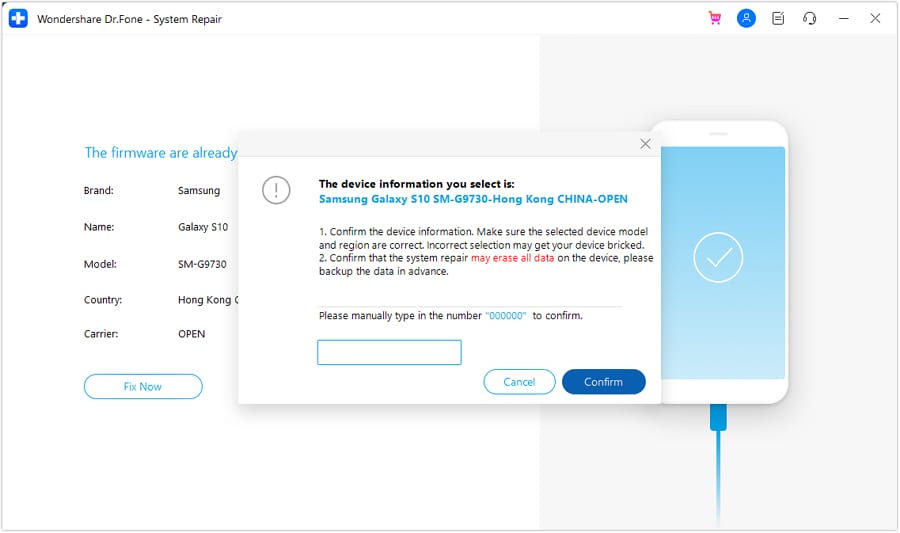
Step 5: Confirm the erasing repair. Review the verified firmware details and choose Fix Now. At the data-erasure prompt, type 000000 and choose Confirm only if you are ready to erase the device and install the firmware. Keep the USB connection in place during repair.
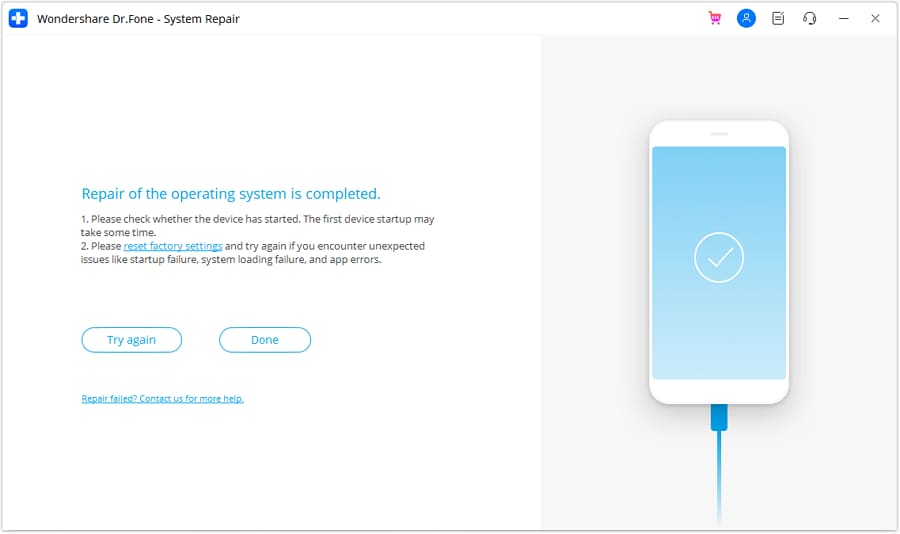
Step 6: Check the result. When repair completes, check whether the device starts, then choose Done. Reopen Google Play Store and test one app. If it does not start, the tool offers Try Again; do not assume repair succeeded merely because firmware finished downloading.
3.4 Clear data and cache of Play Store and download again
Clear Google Play Store cache first. It removes temporary files and is different from resetting Store data or Google Play services storage.
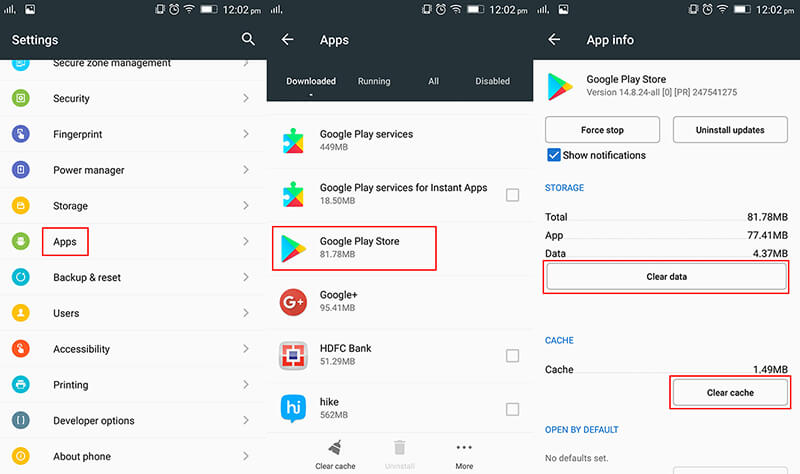
- Close Play Store, then open Settings > Apps > Google Play Store. You may need See all apps or Application manager.
- Open Storage & cache or Storage, then tap Clear cache.
- Reopen Play Store and try the same app. If the Store remains unresponsive, return to its App info, choose Force stop, then reopen it or restart the phone.
- If downloads still fail, return to that storage screen and choose Clear storage or Clear data. This resets Store preferences, including parental controls and purchase password protection; review and restore those settings afterward. You may need to accept the Store terms again.
- Retry one download. If it remains stuck, continue with Store updates rather than repeatedly clearing everything.
Google Play services is not the Play Store. Google recommends clearing its data only after other troubleshooting options. It can remove saved passwords, transit cards and virtual payment cards, and require payment reauthentication and Google Account sign-in again. Do not clear it casually or treat it as the same low-impact step as Store cache.
If you have tried the other checks and accept those consequences, open Settings > Apps > Google Play services > Storage & cache. Tap Clear cache first. The separate higher-impact reset is Clear storage > Clear all data > Delete; some phones label the storage controls differently. Reauthenticate as prompted, review password protection and parental controls, and retest. Clearing Download Manager data is not a required part of this routine.
3.5 Update Play Store to the latest version
Use the Play Store's own update control; it is separate from installing an Android system update.
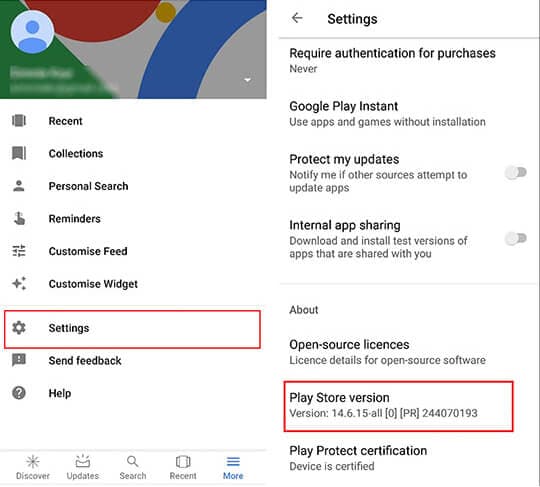
- Open Play Store and tap your profile picture > Settings > About.
- Tap Update Play Store. If an update is available, it downloads and installs automatically; otherwise the Store reports that it is up to date.
- Reopen the Store and retry the download.
If the problem persists, try reinstalling Play Store updates: long-press its app icon, choose App info, open the top-right menu and select Uninstall updates if offered. Review the confirmation before accepting, then reopen Play Store and use the update path above. This removes Store updates, not the apps you downloaded.
Also check Settings > System > Software update for an available Android update; Samsung may use Settings > Software update > Download and install. Back up important data and follow the device's update prompts. Retest before trying another change.
3.6 Try another Google account
Check for a Google sign-in error first. If another Google Account is already on your phone, tap your Play Store profile picture, open the account selector and switch to it. Try a free app available to both accounts. Purchases, region settings and managed-account restrictions can differ, so a different result is a clue, not proof of hardware health.
Before removing an account, verify that important data is synced or backed up and that you know the password and can complete two-step verification. Removal deletes that account's associated email, contacts and settings from this device. Do not remove a work or school account without your administrator's approval.
- Open Settings > Passwords & accounts. Some phones use Users & accounts, Manage accounts or Accounts and backup > Manage accounts.
- Select the affected Google Account, choose Remove account and review the confirmation.
- Return to the accounts screen, choose Add account > Google and sign in to the same account.
- Let the account sync, reopen Play Store and retry one app. Restore any necessary account settings.
3.7 Test one small app and separate single-app failures
You do not need to avoid large apps permanently. Try one small app you trust from Google Play as a diagnostic comparison after checking the queue.
- Small app installs, large app stalls: recheck available storage and use a stable connection before retrying the large app. This points to a size-related difference; it does not identify a specific failed component.
- Only one app fails: open its Play Store listing and check whether it is available for your device. If it is unavailable, resetting the whole phone will not change that listing's eligibility.
- An installed app will not update: back up or sync its local data before considering uninstall/reinstall. Uninstalling can delete that app's local data. If you can restore what you need, use Profile > Manage apps & device > Manage > app > Uninstall, then reopen its listing and choose Install.
- Several unrelated apps fail: return to the Store-level checks. If failures persist, record the error text, device model and Android version for Google Play support; for a single-app issue, contact the developer from that app's listing.
For an app stuck at 100% or Installing, use the same single-app comparison after a restart and storage check. Do not assume the displayed percentage proves successful installation, and do not factory-reset just to clear that label.
Conclusion
A Play Store stuck on downloading problem needs a stage-based check: pending downloads need a queue and connection check; 99% or 100% needs a storage, restart and Store-cache check; a single failing app needs its own availability and data precautions. Retry one app after each change so you can tell what helped.
When a supported device also has broader software failures, Dr.Fone's guided Android repair provides a firmware-repair route with device-specific steps. Choose it for that system-level job, not to bypass a network restriction or an unavailable app.
 safe & secure
FAQs
1. Why is my Google Play Store stuck at 99% when downloading an app?
The percentage alone cannot tell you whether the file is complete or why progress stopped. Restart, check phone storage and clear Play Store cache if it remains stuck. If just one app fails, check its listing; if downloads work only on another network, investigate that connection. Use the symptom checks to choose the next step.
2. What should I do if Google Play Store says waiting for download?
Open Profile > Manage apps & device and let other updates finish or cancel unwanted pending items. Check Settings > Network preferences > App download preference for a Wi-Fi-only restriction, then retry one app on a working connection. Follow the queue and network steps before resetting account or services data.
3. Why do Play Store downloads stop halfway on Wi-Fi but work on mobile data?
That is a network-specific clue, but it does not identify a router, DNS or VPN fault by itself. Compare another trusted Wi-Fi network, complete any legitimate sign-in page and restart your own router if needed. Mobile-data tests can incur charges; restore your preferred download setting afterward. Do not bypass managed network controls.
4. How do I fix an app stuck at 100% in Play Store?
Restart the phone, check free storage and retry. If it stays at 100% or Installing, clear Play Store cache and compare one small app. When only the original app fails, check device availability or follow the data-aware reinstall steps; when many apps fail, use Store-level troubleshooting. See the single-app versus all-app check.


Android Stopped
- Apps Keep Stopping
- 1. Make Instagram Work Properly
- 2. Fix App Has Stopped Error
- 3. Fixe Gmail Not Working on Android
- 4. Fixe Spotify Keeps Crashing
- 5. Fix Chrome Crashes on Android
- 6. Fix TouchWiz has stopped
- 7. Fix WhatsApp has stopped
- 8. Solve YouTube App Crashing
- 9. Fix Apps Keep Crashing on Android
- 10.Fix Android App Not Installed
- 11.Fix WhatsApp issues on Android
- 12.Fix App Won't Open on Android
- Google Services Crash
- 1. Uninstall Google Play Service
- 2. Fix Google Maps Not Working
- 3. Fix Google Services Has Stopped
- 4. Fix Google Services Won't Update
- 5. Fix Google Play Store Not Working
- 6. Fix Play Store Stuck on Downloading
- Android Services Fail
- 1. Fix Phone Keep Disconnecting
- 2. Fix Android SystemUI Has Stopped
- 3. Fix Process Acore Has Stopped
- 4. Fix Process Media Has Stopped
- 5. the .com.android.phone Has Stopped
- 6. Fix Android Not Receiving Texts
- 7. Fix Bluetooth Not Working
- 8. Fix Home Button Not Working
- 9. Fix SIM not provisioned MM#2 Error
- 10.Fix Phone Has Stopped on Samsung
- 11.Fix Settings Has Stopped on Android
- 12.Fix Video Not Playing on Android
- 13.Fix Wi-Fi Not Working on Android
- 14.Fix Contacts Has Stopped Error
- 15.Fix Android System Crash Issue
- 16.Fix Process System Isn't Responding
- 17.Fix GPS Signal Not Found
- ● Manage/transfer/recover data
- ● Unlock screen/activate/FRP lock
- ● Fix most iOS and Android issues
- Free Download Free Download Free Download



Alice MJ
staff Editor
Generally rated4.5(105participated)