 Teleport your device anywhere instantly with one click.


 100% Security Verified | No Subscription Required | No Malware


 :

 ChatGPT
 Perplexity
 Gemini
 Claude
 Grok
To change weather location on an iPad, search for another city in Weather or edit the location assigned to its Home Screen widget. These are separate settings: the city you open in the app does not necessarily replace the city selected for an existing widget. You do not need to travel to a destination, or simulate GPS, simply to read its forecast.
First identify what is wrong. If you see the wrong saved city, select or add the correct one. If My Location is inaccurate, review the iPad's location permissions and connection. If only the widget shows the wrong place, edit that widget. This 2026 guide preserves both practical methods while explaining the forecast features that make correct location selection useful.
In this article
Part 1. Useful Features of iPad's Weather App
Weather combines current conditions with forecasts for the place you have selected. That selection is crucial: a perfectly valid forecast for another city will still be irrelevant to the activity you are planning. Check the location name before interpreting the temperature, rain predictions or warning information.
The app's hourly view and longer-range modules answer different questions. Use near-term information when deciding what to wear or whether to bring an umbrella, and use the longer forecast as a planning aid. Updated data can change the outlook; choosing a city does not make the underlying forecast certain.
Ten-Day Forecast

The ten-day view summarizes expected conditions, temperatures and precipitation over the coming days. It is useful for comparing possible dates for an outdoor activity or preparing for a trip, especially when you keep both your home city and destination in the saved list.
Read it as an evolving estimate rather than a fixed schedule. Conditions farther ahead can change, so revisit the forecast as the event approaches and check the hourly detail closer to departure. Apple says the ten-day forecast is available for most countries and regions, not that every other Weather feature has the same coverage.
Severe Weather Alerts

Where supported, Weather can show severe-weather information and send notifications for enabled locations. Such alerts can help you notice an official warning without repeatedly checking the app, but availability depends on the country or region and the relevant weather-information service.
Confirm the location and notification settings before relying on alerts. A searched forecast and a notification subscription are not identical, and a disabled permission may affect current-location features. During hazardous conditions, consult the responsible local authority as well; no app should be treated as a guarantee that every danger will generate an immediate warning.
Maps

Map layers place weather information in geographic context instead of limiting you to a single number for a city. Depending on availability, you can inspect temperature, precipitation, wind or air-quality patterns. This is helpful when conditions vary across the area you intend to visit.
Look at the selected layer, its time range and its legend before drawing conclusions. A precipitation map for one time window does not describe the entire day, and an unavailable air-quality layer is not evidence that the air is clean. Select the destination you actually need to evaluate.
Air Quality

Air-quality information is available only in supported countries and regions. When it appears, review both the index and its accompanying description rather than interpreting the number without context. It can help you compare conditions before spending time outdoors, particularly if air quality is relevant to your plans.
Saving a destination makes checking its available information more convenient. It does not create data for an unsupported region or replace personal medical advice. Follow local public-health guidance when conditions are poor, and avoid assuming that an empty module means there is no pollution.
Wondershare Dr.Fone: keep GPS testing separate from weather selection
 Set your map route to simulate GPS movement.
- Set your wanted movement speed.
- HD and large map view to check location.
- Fake GPS location to anywhere.

The original toolkit recommendation groups together phone-management tasks such as file transfer, mirroring, recovery, repair and unlocking. Those are distinct from the location module. Dr.Fone - Virtual Location is relevant when you specifically need a supported-device GPS simulation, with map-based position selection and route-movement controls.
It is not necessary for either of the normal Weather methods below, and it does not improve meteorological data or enable regionally unavailable alerts. Treat it as a separate location-testing option, not a way to make safety-critical weather notifications more reliable. Verify exact device and system support before using it with an iPad.
-
Step 1 Connect a compatible device
Open the desktop program's Virtual Location module and follow its connection and authorization prompts. Stop if your specific device or system version is not supported.
-
Step 2 Choose a simulated position
Activate Teleport Mode, search for the intended place and review the map result. Confirm with Move Here only after checking the pin.

-
Step 3 Verify the location test
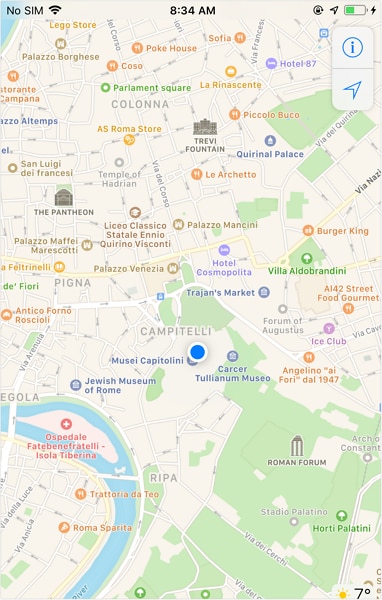
Use the device's maps app to inspect the reported position. Do not assume that a Weather widget will change, since it may be configured to a saved city rather than My Location.
-
Step 4 Restore the actual location
End the test using the program's restoration instructions. The official guide describes restarting the connected device to restore its real position; verify the result afterward.
Keep real-location reporting restored when using navigation, sharing your whereabouts or relying on local warnings. For an ordinary forecast in another city, use Weather's built-in search instead.




Part 2. How to Change Weather Location on iPad?
Choose the method that matches the screen you want to change. Method 1 manages the locations inside Weather; Method 2 changes the location used by a particular widget. Neither operation moves your device's physical position or corrects a forecast model's uncertainty.
Method 1: Search for and save a location in Weather
Weather can display conditions for places you are not currently visiting. Add a city when planning a trip or following conditions elsewhere, then select that saved entry whenever you need it.
-
Step 1 Open Weather
Find Weather on the iPad and launch it. Apple's Weather app is available on iPadOS 16 and later. If it is missing, check the installed iPadOS version and whether the app was removed before assuming a location setting is the problem.
-
Step 2 Reveal the location list
Tap the sidebar or menu control near the upper-left corner when the list is hidden. In a wider layout, the location list may already be visible.

-
Step 3 Search for the destination
Type the city or other supported place into the search field. Select the appropriate result, checking the region when several places share a name.

-
Step 4 Add the city and organize the list
Tap Add to save the location. To rearrange saved entries, use the list's More control and Edit List where shown, then drag the entries into your preferred order. Select a saved city to open its forecast; reordering the list does not change the device's GPS location.

Method 2: Edit the Weather widget's location
A Weather widget may be pinned to a named city even while the app shows somewhere else. Edit the widget itself if the Home Screen is the only place displaying the unwanted location.
-
Step 1 Open the widget's menu
Touch and hold the Weather widget on the Home Screen until its quick-action menu appears. If it is in a stack, make sure Weather is the widget you are editing.
-
Step 2 Choose the editing control
Tap Edit Weather or Edit Widget, depending on the iPadOS layout and widget. The original screenshot illustrates the Edit Weather label.

-
Step 3 Select Location
Tap the location field, search for the city you want and select the correct result. Choose the current-location option only if you want the widget to follow the device and have granted the required access.

-
Step 4 Close editing and check the result
Tap outside the editing panel and allow the widget to refresh. If the menu is missing or the widget remains stale, check the widget type, network access and available iPadOS updates. Avoid assuming that the app is newly released or that every update uses identical controls.
Part 3. Is the Weather App on iPad Really Helpful?
Weather is useful because it brings several practical checks together: a quick look at today's conditions, a longer view for planning and, where available, warnings and air-quality information. You do not need to open it constantly to benefit from it. A correctly configured widget can provide a useful glance before leaving home.

For example, compare the ten-day outlook before choosing an outdoor event date, then revisit the hourly forecast nearer the time. Before a journey, check both the starting point and destination rather than assuming conditions are the same. During severe weather, use the app alongside official local guidance and your own surroundings.
There is no need to speculate about future iPad features to justify using Weather. Its present value is the information it can actually display for your selected location. Keep the saved list and widget configuration accurate, and remember that useful forecasts remain estimates rather than instructions that eliminate risk.
Conclusion
Use Weather's search and Add controls to view another city's forecast, then edit the widget separately if the Home Screen should show that city too. If My Location is wrong, review device permission and connectivity instead of repeatedly adding unrelated places. GPS simulation is a different task and is unnecessary for normal weather browsing.
Check regional feature availability, keep the app and device current where supported, and revisit forecasts before important plans. Correct location selection makes the information relevant; it does not guarantee precise predictions or uninterrupted alerts.
FAQ
-
1. Can I view another city's weather without changing GPS?
Yes. Search for the destination in Weather, select the correct result and tap Add if you want to save it. This changes the forecast you view, not your physical location. -
2. Why does the Weather widget show a different city from the app?
The widget can have its own selected location. Touch and hold it, choose Edit Weather or Edit Widget, and change its Location field. -
3. Why are severe-weather or air-quality details missing?
Some features are available only in particular countries and regions. Also review location and notification permissions for current-location alerts; adding a city does not guarantee every information layer. -
4. What should I check if Weather is missing from my iPad?
Check the installed iPadOS version and whether Weather was removed. The native app is available on iPadOS 16 and later, subject to the device's supported software.
 Add Wondershare Dr.Fone as a preferred source on Google



