 Teleport your device anywhere instantly with one click.


 100% Security Verified | No Subscription Required | No Malware


 :

 ChatGPT
 Perplexity
 Gemini
 Claude
 Grok
When iTools Virtual Location is not working, identify the failing stage before reinstalling anything. A phone that is not recognized, a map that stays blank and an app that ignores a selected position are three different problems. Start by noting your phone model, exact iOS release, computer system, iTools version and the full error message.
The original iTools Virtual Location reference is the appropriate vendor starting point, but an available product page does not certify every device/build combination. This 2026 troubleshooting checklist preserves the source's five symptom categories and suggested checks while separating reasonable diagnostics from unsupported promises about compatibility or permanent fixes.
In this article
Part 1. Identify Why iTools Virtual Location Is Failing
First reproduce the issue once and record where progress stops. Does the program detect the unlocked phone? Does the map load before you choose a destination? Does the desktop marker move while the phone app remains unchanged? Those observations help distinguish a connection problem from a map-service issue or an application that does not accept simulated coordinates.
The categories below are troubleshooting hypotheses, not evidence that every iTools installation suffers from the same defect. Avoid changing several settings simultaneously: if a later attempt works, you need to know which change actually affected the result.
1-1. The Developer Mode Stage Does Not Complete
A screen mentioning Developer Mode can refer to a required device permission, an incomplete pairing step or an operation that the installed software cannot complete on that build. Copy the exact wording. Do not treat every loading indicator as proof that the iPhone's Developer Mode switch is simply off.
Apple's Developer Mode instructions describe the Privacy & Security setting, a restart and an on-device confirmation. Apple also explains that the option's appearance depends on pairing state. Those are platform instructions, not a guarantee that a third-party location utility supports your iOS version.
1-2. The Map Is Blank, Loading Indefinitely or Crashing
If the phone is recognized but the map never draws, inspect the map stage separately. A working browser connection does not prove that the program can reach every map service it uses. Network filtering, a remote service issue or a problem in the application's map component are possibilities to investigate, not confirmed causes.
Record whether the application stays open, displays an error or exits entirely. A blank map and a full process crash need different support evidence. Do not delete device data or alter iOS merely because a computer-side map is not rendering.
1-3. Check iOS 17 and Later Against the Exact iTools Build
The source names iOS 17 and newer releases, but that is not enough to conclude that all such versions are incompatible. Compatibility belongs to a specific combination of phone hardware, operating-system build, computer software and connection workflow. A claim about one old release cannot be expanded to every later device.
Consult the vendor's current support information and release notes for your exact setup. If support is not confirmed, record the uncertainty instead of repeatedly applying patches intended for a different version. Do not describe an unverified update as a proven cure or assume that a competing tool automatically supports the same phone.
1-4. The Desktop Location Changes but the App Does Not
A new map pin in iTools establishes what you selected in the desktop interface, not necessarily what another app received. Check that the intended phone remains connected, that the target app has the relevant location permission and that you are inspecting a live location view rather than a saved address or account-region setting.
Apps can use more than GPS: cached data, network signals and service-side rules may affect the result. Some deliberately identify mock locations. Avoid assuming that a phone restart will force every service to accept the simulated coordinate; it can also end a temporary override.
1-5. Downloads, Freezes and Image-Loading Messages
- The installer fails: distinguish an interrupted download from an operating-system security warning or an unsupported installer. Check the source and exact message before granting additional privileges.
- The program stops responding: note the last action, whether a phone was connected and whether the rest of the computer remains responsive. One frozen window is not proof of a phone fault.
- 'Image load failed' appears: retain the complete error text and its screen location. 'Image' may describe different resources in different workflows; it should not automatically be interpreted as a missing map picture.
These details make a vendor support request actionable. A screenshot of the message, software version and reproducible sequence is more useful than repeatedly stating that location spoofing is not working.
Part 2. Troubleshoot iTools in a Controlled Sequence
Try the relevant check, repeat the same observation and stop once the result is clear. The following six checks correspond to the source's suggested fixes, but none guarantees success on an unsupported configuration.
Check 1 Confirm software, pairing and required device permissions
Verify the installed version through the vendor's own update channel and confirm support for your exact iOS release. Unlock your phone and complete any legitimate trust prompt. Apple's Trust This Computer guidance explains that trusting a computer grants data access, so approve only a computer you control. If Developer Mode is actually required by the documented workflow, complete its restart and confirmation sequence. Recheck device recognition before proceeding.
Check 2 Isolate map loading from phone recognition
Confirm connectivity and inspect the application's own map settings. The original guide suggests switching Google Maps to Mapbox; try an alternate provider only if your installed edition actually offers that option. No current vendor confirmation of a universal provider-switch menu was established here. Do not invent a setting, hard-code a replacement API key or assume the provider is at fault. If maps still fail, record the error and contact support.
Check 3 Restart a frozen session, then reconnect cleanly
Save unrelated work, close the location session and restart the program. If needed, reboot the computer and phone, then reconnect the unlocked device and check recognition again. Use a suitable data cable rather than a charging-only connection. A restart is a diagnostic reset of the session, not evidence that the underlying compatibility issue has been fixed permanently.
Check 4 Treat unsupported iOS builds as a support question
If the vendor does not support your exact release, wait for documented support or evaluate another tool against the same requirements. Do not make an iOS downgrade the routine next step. A restore can erase data, older software may not be installable through Apple's current process, and a downgrade is not a guaranteed fix for a third-party utility. Obtain appropriate support before considering destructive device changes.
Check 5 Compare the reported location in a suitable test app
Use your own allowed test app to determine whether the phone's reading changed, then compare it with the original target app. Reopen the relevant location view and check permissions. If one app accepts the test position while another rejects it, document that app-specific limitation. Do not keep changing destinations or claim that a reboot must 'sync' every app to a false position.
Check 6 Verify installer integrity and clarify resource errors
For an incomplete download, obtain the appropriate installer again from the genuine vendor and compare its platform requirements. Follow legitimate installation prompts, but do not disable protections or run unidentified packages as administrator to bypass a warning. For 'Image load failed', send the exact message and stage to support; reinstalling is not a confirmed solution for every resource or device-support error.
If the same failure remains after a clean supported setup, preserve the observations and ask the vendor about that specific build. Avoid buying repeated licenses or applying unrelated system changes before knowing whether the configuration is supported.
Part 3. Evaluate Dr.Fone - Virtual Location as a Separate GPS Workflow
 Set your map route to simulate GPS movement.
- Set your wanted movement speed.
- HD and large map view to check location.
- Fake GPS location to anywhere.

Dr.Fone - Virtual Location offers a desktop map workflow with teleport-style destination selection, route simulation, configurable speeds and directional controls. It can be a relevant alternative for an authorized location test when the exact phone and computer configuration is supported.
That is not a claim that it fixes iTools itself, is more stable in an independently measured comparison or works with every app. Confirm current requirements and available trial functions before paying. General iOS/Android support does not certify the particular service you want to test; the developer explicitly excludes Pokémon GO from Android support.
Features to assess against your actual task
- Destination selection: choose a reported coordinate for a permitted map demonstration; this does not change all location signals used by an app.
- Route simulation: define one or several stops and observe movement at a configured speed. Simulated travel is not a guarantee that a service will credit distance.
- Joystick control: steer the virtual position to reproduce directional changes during a supported test.
- Automatic movement: replay a selected path and adjust direction where the chosen mode permits, without confusing a moving desktop marker with universal app acceptance.
- App-specific checks: the inherited tutorials for Pokemon Go, Snapchat and Instagram are references, not proof of flawless current compatibility, hidden activity or a changed account region.
Complete the alternative workflow before judging the result
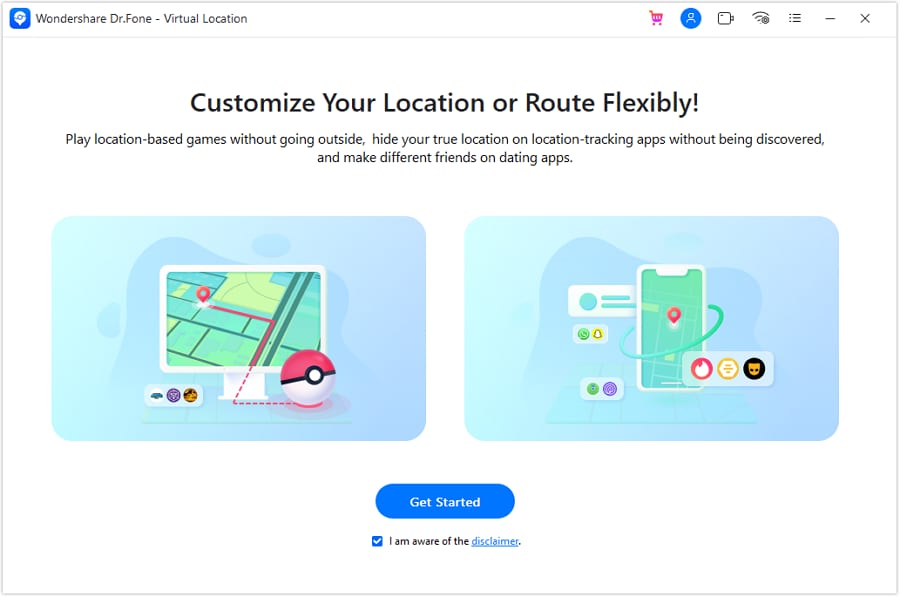
Step 1 Establish a supported device connection
Open Virtual Location on your computer, connect your own unlocked phone and complete the documented trust or permission prompts. Confirm recognition of the intended device. If the connection fails, resolve that before selecting a destination; changing tools does not remove a faulty cable or uncompleted pairing requirement.
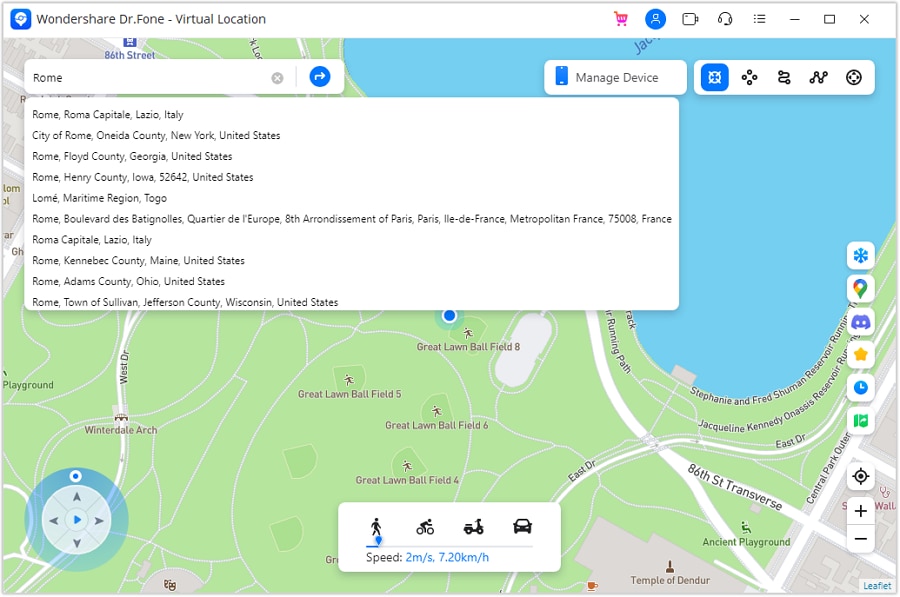
Step 2 Choose a point or route for an allowed test
Select the mode suited to the demonstration, search for your intended destination and inspect the pin or path. Apply the change only after verifying the selection. Controls and requirements may differ by device or version, so follow the installed interface rather than assuming an old screenshot is exact.
Step 3 Check the result and restore genuine positioning
Observe the reported position in your supported test app and note any mismatch. When finished, stop the simulation and confirm your actual location before using directions, emergency-related functions or live sharing. A successful test does not guarantee that another service accepts mock data or that it permits the activity.
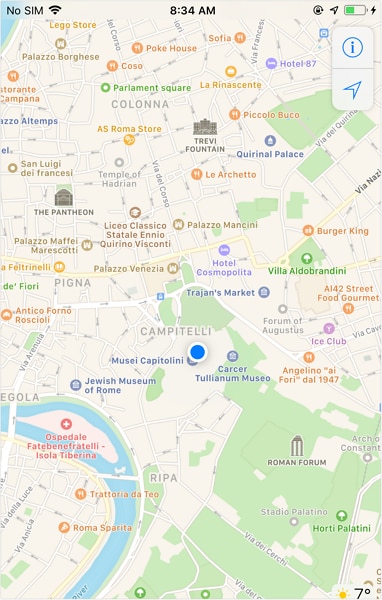
The alternative guide ends after connection, selection, observation and restoration. For privacy, use built-in location-sharing controls first; a GPS utility does not provide VPN encryption or guarantee invisible changes in a tracking service.




For games, technical acceptance and account rules are separate. Pokémon GO's official fairness policy treats GPS falsification as cheating, so no successful map test establishes immunity from penalties.
Conclusion
An effective iTools diagnosis starts with the failing stage and the exact supported configuration, not an assumption that all newer iPhones are incompatible. Check trust, required permissions, map loading and app behavior independently; avoid routine downgrades and universal fixes. Dr.Fone is a separate GPS workflow worth evaluating for an authorized supported task, not a guaranteed cure for iTools crashes or every location-aware app. Keep the error evidence and stop making system changes once the remaining issue needs vendor confirmation.
FAQ
1. Why does the iTools map crash or stay blank?
The symptom alone does not identify a cause. Separate phone recognition from map rendering, check the exact software build and record any network or application error. Use another map provider only if your installed edition actually exposes that setting.2. Does a virtual location tool guarantee privacy or account safety?
No. GPS simulation is not VPN encryption, guaranteed hidden location sharing or game-policy approval. Use built-in privacy controls and check the target service's rules independently.3. What should I check for an iTools Developer Mode error?
Record the exact message, verify build support, complete legitimate pairing and trust prompts, and follow Apple's restart/confirmation sequence if the workflow requires Developer Mode. Missing or stuck controls can require vendor guidance rather than repeated toggling.4. When is Dr.Fone a sensible alternative to evaluate?
When its current requirements match your device and you need an allowed destination, route or joystick test. It is not proven universally more stable, and the official Android support excludes Pokémon GO.
 Add Wondershare Dr.Fone as a preferred source on Google



