 Teleport your device anywhere instantly with one click.


 100% Security Verified | No Subscription Required | No Malware


 :

 ChatGPT
 Perplexity
 Gemini
 Claude
 Grok
Minecraft Earth is no longer an officially playable live service. If you are searching for a Minecraft Earth gameplay download in 2026, do not mistake an old tutorial or APK listing for a working official release. Mojang's service-closure announcement explains that downloads, gameplay, and service support ended. A GPS changer cannot restart those discontinued servers.
What remains worth exploring is the game's design: nearby Tappables supplied resources, buildplates turned those resources into augmented-reality creations, and Adventures and Challenges added objectives and rewards. The sections below preserve that gameplay journey as a historical guide, compare it with other Minecraft editions, and separate the former indoor-play idea from what location software can actually do today.
In this article
Explore the original Minecraft Earth gameplay loop
Minecraft Earth adapted familiar block collection and construction to a mobile map and camera-based AR view. Players gathered resources within reach of their map position, then used those materials in building and crafting activities. The design was not simply Java or Bedrock Edition running behind a camera: its inventory, progression, encounters, and interaction rules were specific to Earth.
Three elements explain most of that experience. Adventures provided combat and resource encounters; buildplates offered spaces for constructing and displaying creations; and Challenges attached goals to activities players were already performing. Understanding their different roles makes archived footage easier to follow, even though a new player cannot join the former official service now.
Adventures: encounters beyond collecting Tappables

Adventures were survival-style AR encounters for one or more nearby players. They combined mining, combat, and rewards that ordinary Tappables did not always provide. Rather than merely walking past a map icon, a player entered an encounter, prepared useful tools, and placed its AR scene in a suitable physical space.
Creature variety helped distinguish Earth from the standard editions. Bouldering Zombies and Bone Spiders were hostile examples, while a Mossy Sheep was an animal variant rather than another enemy to classify indiscriminately as a threat. Tools and food mattered because taking damage and losing an Adventure could cost the items brought into or collected during that encounter.
The often-repeated seven-minute detail needs context: map Adventures commonly remained available at a location for roughly that period. It should not be treated as an identical guaranteed duration for every encounter. Players inspected the remaining availability and objectives rather than assuming unlimited time to fight, mine, and collect rewards.
Buildplates: create and display AR structures

A buildplate was the foundation for a player's construction. An initial 8-by-8 plate introduced the building process, while progression and the former store offered other layouts and sizes. Players could arrange blocks, refine a design, and view a creation through the AR interface rather than only as a conventional on-screen world.
Placement depended on the camera recognizing an appropriate surface and on having enough safe room for the intended scale. Tabletop editing and life-size display were different situations; not every construction task required wandering outdoors. A clear, flat surface was useful, but a road, shoreline, or unfamiliar facade was not automatically a safe or permitted place to play. Public parks and open areas still required attention to access rules and other people.
The original catalog examples included Witch's Mansion, Colorful Cottage, Sleepy Village, and Chill Spot. They are historical buildplate names, not products available for a new Earth purchase now. Rubies were associated with Earth's economy; do not assume an old store screenshot represents a current transaction or that those offers transfer to another edition.
Challenges: objectives, progress, and rewards

Challenges turned routine actions into explicit goals. The original guide grouped them as Daily, Career, and Tappable-related tasks, with rewards such as experience or Rubies depending on the objective. Their purpose was to give collecting, crafting, and exploration a more directed progression path.
A requirement to collect ten Tappables or reach level three illustrates the difference between simply playing and completing a tracked objective. Likewise, the original sheep-collection example offered 30 experience points. Treat such numbers as examples from the former challenge set, not as a reward schedule active in 2026.
Difficulty depended on the requested resource, deadline, and access to suitable encounters. Familiarity made routine tasks easier, but it did not mean every challenge could be finished instantly. Checking the actual requirement before consuming materials or starting an Adventure was the more useful strategy.
How Minecraft Earth differed from other Minecraft editions
Earth retained the series' vocabulary of blocks, mobs, tools, crafting, and exploration, but rebuilt the experience around a phone's location and AR tracking. Other editions let a player move through a digital world using their controls. In Earth, real surroundings affected how the player could view and interact with a placed scene.

- Physical movement and elevation: building upward or mining downward did not mean a player could freely fly through the AR scene. Changing viewpoint depended on actual movement and device tracking. A safe real-world structure could change viewing height, but reaching a virtual object never justified unsafe climbing.
- Lighting and time: the presentation did not reproduce the ordinary survival edition's day-and-night loop in the same way. AR camera conditions and buildplate presentation needed to be considered separately from a desktop world's time cycle.
- Inventory and collecting: the main collection supported far more expansive storage than a normal survival inventory, including collected mobs and associated records. Adventure hotbar and backpack behavior were separate, so 'unlimited inventory' did not mean that death carried no risk for encounter items.
- Timed production and available recipes: crafting and smelting used a dedicated interface, timers, and preset recipes rather than the standard inventory crafting grid. They could continue after leaving that interface; the old claim that no other activity was possible during production was incorrect. Earth did not expose every normal-edition recipe: utility blocks such as workstations, chests, anvils, brewing stands, crafting tables, and enchanting tables were not a reason to assume the full desktop crafting system existed, and usable armor was absent.
- Tool reach: weapons and tools had a longer practical reach across an AR encounter than in ordinary Minecraft. That supported interaction with distant parts of a small scene, but 'boundless range' overstates the mechanic and should not be understood as unlimited interaction across the map.
- Health and food: Earth emphasized a health indicator instead of the familiar separate survival hunger-management loop. Eating food restored lost health after attacks; it was not accurately described as decreasing a second Hunger meter.
- Food during encounters: prepared food could be used during or after an Adventure. Crafting and smelting were separate management activities, so preparing supplies beforehand mattered rather than expecting to operate a cooking interface mid-fight.
- Iron resources: iron ore could be smelted into ingots, but locating the ore was the limiting step. Adventure mining and particular drops mattered more than assuming plentiful ordinary Tappables. Carrying the appropriate tool was part of preparing for that resource hunt.
- Obsidian and fluid expectations: the regular obtainable block and recipe selection was not identical to Java or Bedrock. Obsidian-related assets or mentions should not be confused with a normally available Earth resource. The original lava-and-water example referred to cobblestone; it is not a universal rule for all Minecraft editions or all fluid configurations.
- Mini boosts: the associated scan-based boosts belonged to Earth's own progression system. They were not transferable upgrades that could be scanned into every other Minecraft edition, and they do not supply a way to restore the retired service.
These distinctions explain why an old Earth strategy cannot automatically be applied to a current Bedrock or Java world. The names may be familiar, but the control model, recipe set, resource sources, and service availability differ. Consult the documentation for the edition you are actually playing.
How players originally approached Minecraft Earth
The former beginner sequence moved from identity and exploration to building, then to more directed encounters. It is retained here to explain archived gameplay, not as a current installation checklist. A downloaded package or copied set of screenshots does not recreate the account services and map systems that supported these actions.
Design a character for the Earth experience

Character customization let players personalize appearance, including facial details, skin tone, and other visual choices. Cosmetic items and the Character Creator connected this activity with the wider Minecraft identity experience. Minecoins and Earth's Rubies should not be treated as interchangeable currencies simply because both appeared in discussions of customization and purchasing.
The useful historical lesson is to separate appearance from capability: a cosmetic choice did not replace resource gathering, tools, or challenge progress. For current character purchases, use the store and entitlement information for a supported edition rather than an old Earth checkout page.
Explore the map and collect resources

Outdoor movement brought different Tappables within collection range. Stone, plants, chests, and mobs could contribute to the stock of materials used elsewhere in the game. Resource variety was more meaningful than simply maximizing distance or keeping an allegedly 'full' inventory, especially given the collection's expansive storage.
Safe play meant stopping before interacting with the screen, respecting private property, and avoiding traffic or difficult terrain. Covering more ground was not a guaranteed progression formula. The resources encountered and the objectives a player chose mattered as much as the route taken.
Practice constructing sandbox creations

Once materials were available, players could experiment with layouts on a buildplate, inspect the result from different viewpoints, and revise it. Starting with a small, understandable structure made the AR controls easier to learn than immediately attempting an elaborate design.
Creative progress came from testing how blocks, scale, and available materials worked together. Crafting several components and adjusting a design was more useful than assuming quantity alone improved skill. That general building habit remains relevant to supported Minecraft editions, even though the Earth-specific buildplate service is gone.
Prepare for Adventures and pursue Challenges

Adventures offered resources and encounter rewards beyond casual map collecting, while Challenges gave those activities explicit goals. A sensible sequence was to inspect an objective, prepare tools and food, choose an appropriate encounter, and watch health and remaining availability while playing.
Entering without preparation could put carried and newly collected items at risk. These activities complemented building rather than replacing it: encounter resources fed later construction, and task rewards supported progression. None of the archived rewards should be interpreted as currently claimable through a fresh install.
Can Minecraft Earth be played indoors now?
No official live Earth session can be started indoors or outdoors now that the service has ended. Historically, indoor AR building and later adjustments made parts of the experience more accessible without extended outdoor movement. Those possibilities depended on an operating game service; changing a GPS coordinate cannot supply missing servers or recreate Tappables.
 Set your map route to simulate GPS movement.
- Set your wanted movement speed.
- HD and large map view to check location.
- Fake GPS location to anywhere.

Dr.Fone - Virtual Location offers GPS destination and route simulation on supported iOS and Android devices. Its desktop map, speed controls, and route repetition can be useful for permitted location demonstrations. This is a separate capability from running Minecraft Earth, not a way to download, unlock, or revive the discontinued game.
The six-stage workflow below preserves the original one-stop-route demonstration as a general GPS test. Use your own device, check compatibility, and choose an app or testing environment that permits simulation. Other active games may reject mock locations or impose penalties; the product banner is not a guarantee of immunity from enforcement.
Step 1 Install the desktop application
Obtain the appropriate installer from Dr.Fone - Virtual Location and complete installation on a compatible computer. This installs the location utility, not Minecraft Earth.
Step 2 Connect the supported phone
Open the application, attach the smartphone with a data-capable USB cable, and follow legitimate pairing or trust prompts. Keep the connection stable while the module recognizes the phone.
Step 3 Open Virtual Location from the Toolbox
Select Toolbox and then Virtual Location. If the official application requests additional module resources, let that process finish. Download time depends on the connection rather than a fixed promise of a few minutes.
Step 4 Choose a one-stop route
In the location window, select One-Stop Route from the top-right controls. Review the current starting point; use Teleport Mode first if your permitted test needs a different origin. Select the destination on the map or search for it and choose the correct result.
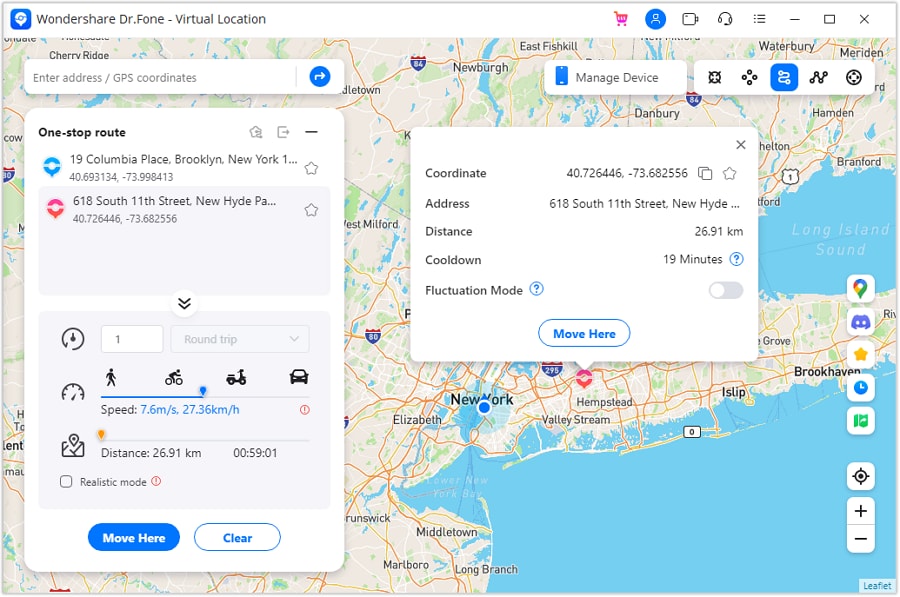
Step 5 Set repetition and movement speed
Choose the number of repetitions and the offered trip type, such as a round or loop trip. Adjust the speed slider, inspect the route, and select Move Here to start. Use Clear if you need to discard the current route settings.
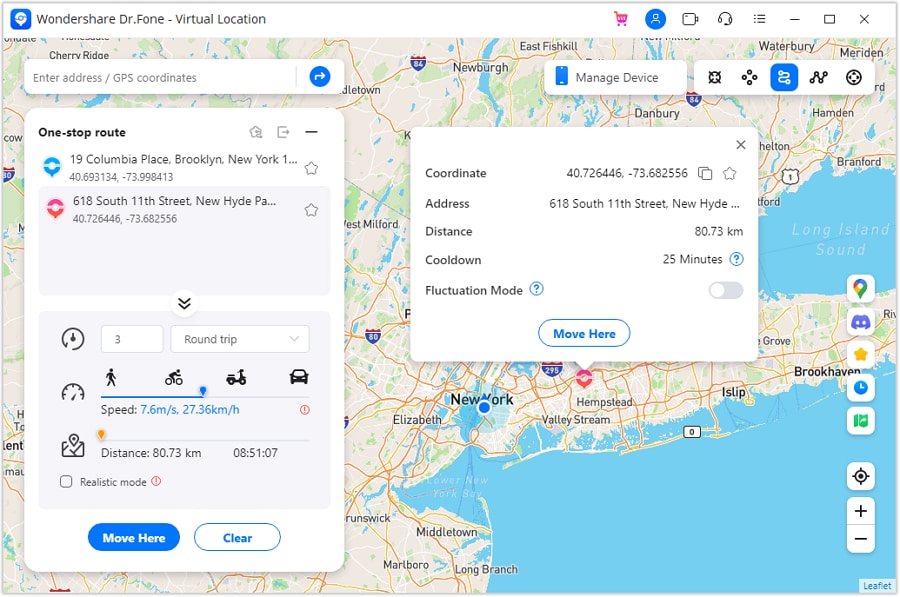
Step 6 Monitor and finish the simulation
Watch the reported position move along the desktop map. Select Pause to suspend movement, or Clear to stop and reset the route. Restore normal device location reporting after the test, following any restart prompt from the software.
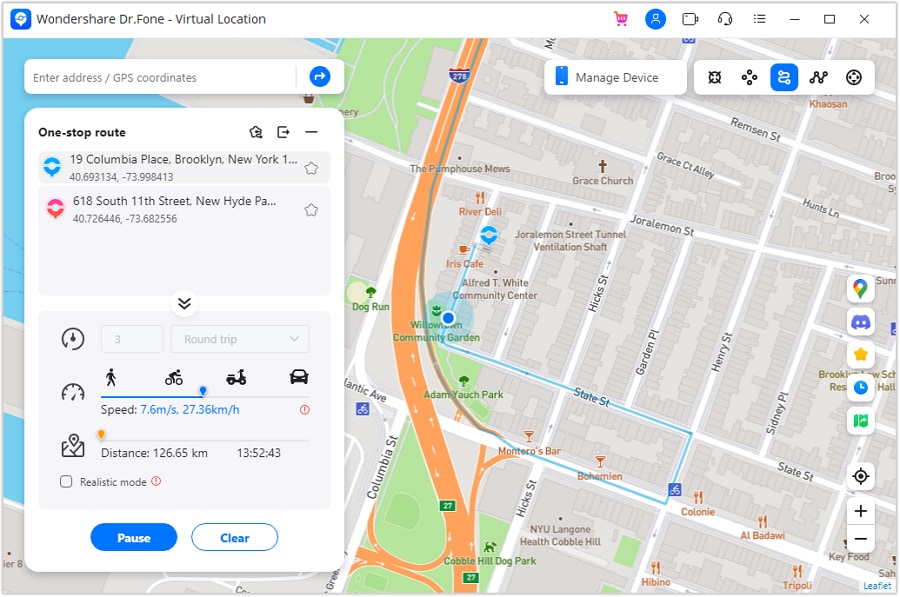
This completes a general route simulation only. It produces no Earth Tappables, server access, buildplate entitlement, or restored player progress. Do not buy location software on the assumption that it will make a retired online game playable again.




Conclusion
Minecraft Earth combined real-world collection, AR construction, resource encounters, and goal-based progression in a distinct adaptation of Minecraft. Its Adventures, buildplates, Challenges, and beginner sequence remain useful historical context, but they are not current instructions for joining an official live game.
Dr.Fone - Virtual Location can demonstrate supported GPS movement separately. It cannot reverse the game's closure. For present-day play, choose a supported Minecraft edition and learn that edition's own movement, crafting, inventory, and multiplayer rules.
FAQ
1. Can I officially download and play Minecraft Earth in 2026?
No. The original service and official gameplay have ended. An old installer, tutorial, or screenshot does not establish a working official release. Be cautious of sites claiming that a simple download restores access.2. What were Tappables and buildplates?
Tappables were nearby map objects that supplied resources and collectible content. Buildplates provided spaces for arranging those materials into AR creations. They belonged to Earth's own gameplay systems rather than being ordinary Java or Bedrock world saves.3. Was every Adventure exactly seven minutes long?
No universal duration should be assumed. The common seven-minute reference described an Adventure's availability on the map. Players checked its remaining time and encounter information before entering, rather than treating every session as an identical timer.4. Can a GPS route simulator bring Minecraft Earth back?
No. GPS simulation changes reported coordinates on a supported device. It cannot restore a retired game's servers, accounts, rewards, or map content. Use route simulation only for a separate, permitted location-testing purpose.
 Add Wondershare Dr.Fone as a preferred source on Google



