 Teleport your device anywhere instantly with one click.


 100% Security Verified | No Subscription Required | No Malware


 :

 ChatGPT
 Perplexity
 Gemini
 Claude
 Grok
To change the coordinates supplied by your phone, you need a GPS-location tool, not simply a VPN connection. That distinction matters when researching fake GPS Mobile Legends: a different map position is not the same thing as a different game server, a higher rank, or an approved Street ranking location.
Mobile Legends: Bang Bang is a team-based MOBA, and players may investigate location settings for local rankings or playing alongside friends. The methods below retain the original iPhone and Android walkthroughs while explaining their boundaries. No destination is a verified shortcut to badges, and no location changer can promise that the game will accept simulated coordinates or leave an account unrestricted.
In this article
Part 1: Why Players Investigate Fake GPS in ML
Local leaderboards are one reason players look for ways to change location in ML. The original article connects Street rankings with the handset's position. However, the coordinates a phone reports are only one possible input to an online game's systems. A virtual destination should not be confused with permission to register for a different area or with control over matchmaking.

The earlier examples named Kuwait and Ireland as potentially less competitive locations. Those examples are not evidence of current player numbers, badge thresholds, or eligibility. There is therefore no confirmed best location for fake GPS ML in this guide. Rankings depend on the game's rules and actual competition, rather than a location tool awarding achievements.
Playing with friends is another motivation, but identical GPS coordinates do not themselves create a party, move an account to another server, or improve latency. Use the game's legitimate invitation and account settings first. For privacy, review the game's permissions and profile visibility instead of assuming that a spoofed point prevents all location inference or tracking.
Part 2: Changing the iPhone's GPS Position for ML Testing
 Set your map route to simulate GPS movement.
- Set your wanted movement speed.
- HD and large map view to check location.
- Fake GPS location to anywhere.

Dr.Fone - Virtual Location provides a computer-based map interface for selecting a simulated position on supported iOS and Android devices. Its Teleport Mode changes the location supplied through the supported device workflow; route tools can also simulate movement and let you choose a travel speed.
That is a GPS function, not an assurance of compatibility with every game. The original article made contradictory blanket claims about Android games and universal iOS support. Treat the current phone, operating-system version, software build, and the receiving app as separate compatibility requirements. Check those requirements before connecting your main device, and do not infer jailbreak requirements or account safety from an older screenshot.
Step-by-Step: Set and Verify a Virtual GPS Position
Start by closing navigation or other apps that must use your genuine position. Connect only a phone you own or are authorized to manage. The following four stages preserve the original setup, map check, teleport selection, and verification sequence without promising an in-game result.
Step 1 Open the module and connect the iPhone
Install the appropriate desktop edition, launch Dr.Fone, and choose Virtual Location. Attach the iPhone with a suitable USB cable, complete any on-device trust or connection prompts, then proceed with Get Started when that option appears. Keep the handset available so you can approve legitimate prompts rather than bypassing them.
Step 2 Inspect the starting position
Wait for the map to load and compare its marker with the phone's expected position. The older interface calls its recenter control Center On; newer builds may label a similar control Current Virtual Location. Recentring changes the map view, so do not treat it alone as proof that the phone is reporting its real coordinates.
Step 3 Select a destination in Teleport Mode
Activate Teleport Mode, enter a place or coordinates in the search field, and run the search using the displayed control or Enter. Inspect the proposed point before selecting Move Here. Confirming a specific pin is more useful than choosing a country name and assuming every app will interpret it identically.
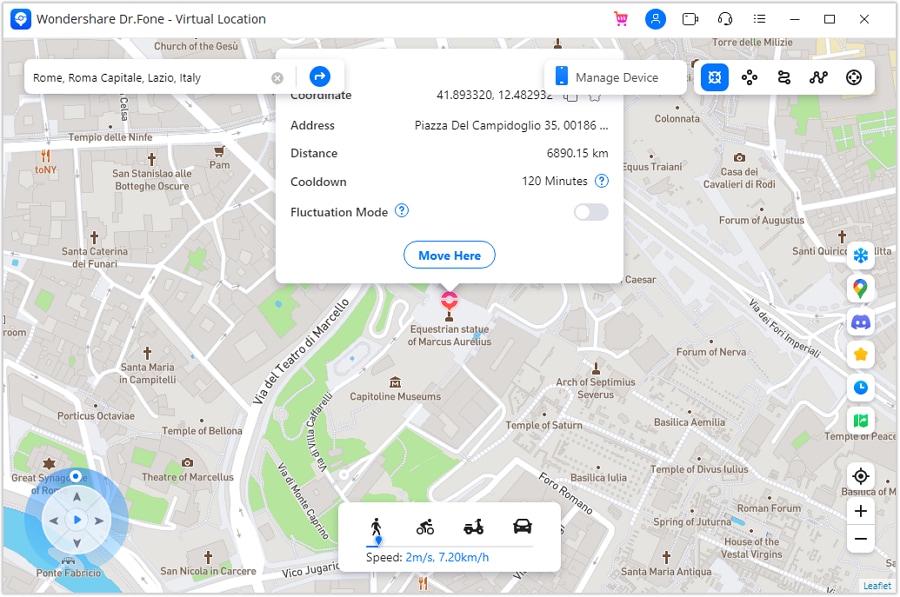
Step 4 Verify the phone before checking the game
Compare the selected point with the phone's map app. Only then inspect any location-dependent feature in Mobile Legends, if testing is permitted under its current rules. A successful map change is not proof of a server switch, badge eligibility, or game support. When finished, follow the software's restore prompt; the official guide describes restarting the device to return to the actual position.
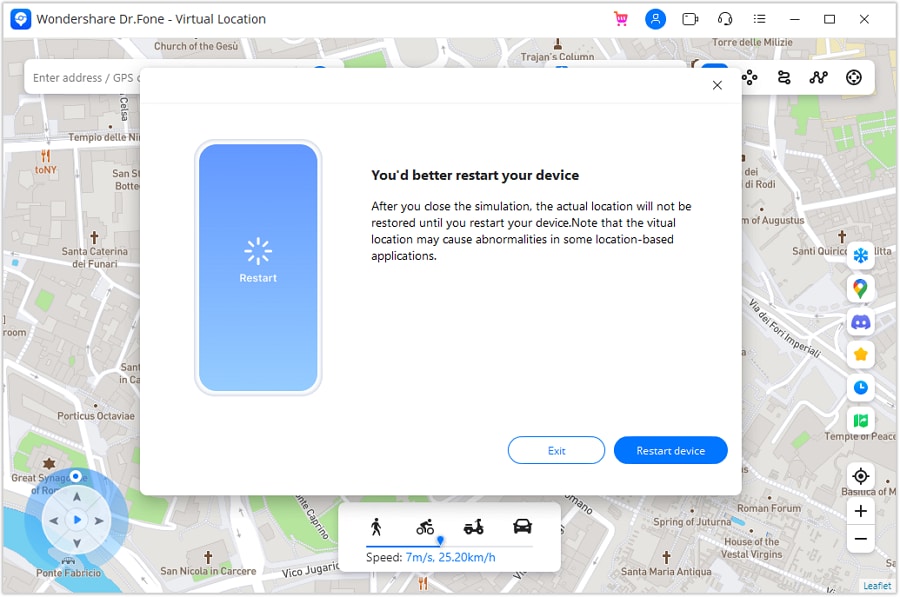
Complete the device-map verification and restore check before relying on normal location services again. If the game rejects the position, stop testing rather than repeatedly changing coordinates in an attempt to force acceptance.




Dr.Fone - Virtual Location: Movement Features and Limits
- Set your map route to simulate GPS movement.
- Set your wanted movement speed.
- HD and large map view to check location.
- Fake GPS location to anywhere.
The desktop product can represent a chosen point or simulate travel along a map route, with speed and stops controlled through the available interface. These features are useful when evaluating location-aware behavior on a supported device. They do not make a user anonymous, replace an encrypted network connection, or compel another app to trust the supplied coordinates.
For a permitted desktop route simulation on a supported connected device, select Multi-Stop Route, choose the route points on the map, set the trip count and speed, and click Start Moving. Use Pause or Clear when needed.
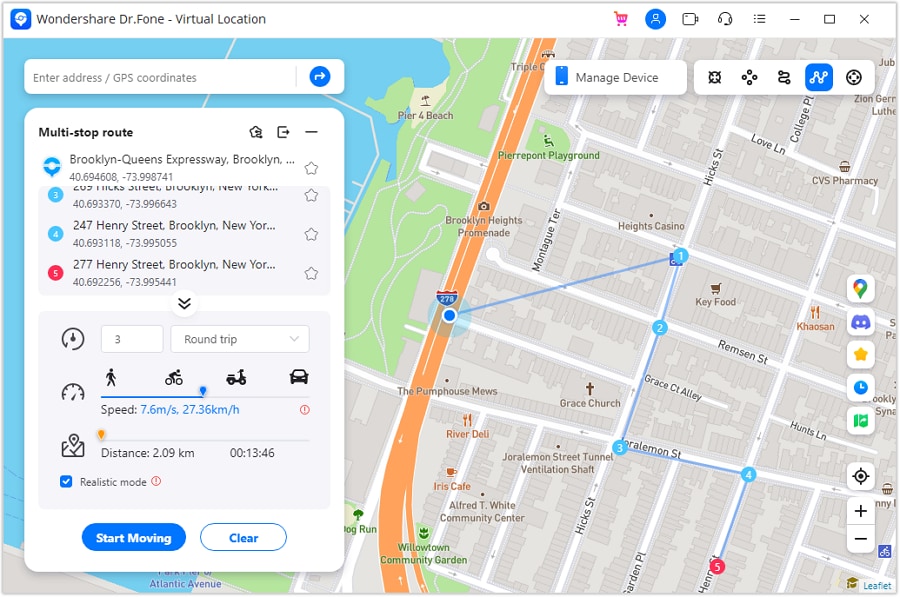
The original related guides discuss Pokemon Go, Snapchat, Instagram, and Facebook. Those references concern different apps and should not be read as a shared guarantee of compatibility or permission. Avoid using location simulation to mislead other people about safety-critical whereabouts.
Dr.Fone App - Change Location on Android
A separate mobile option appears in the source: Dr.Fone App - Change Location (Android). Its location-changing workflow is presented as an on-phone alternative to using a computer. Keep this Android app distinct from the desktop module when checking features, prerequisites, and which installation you actually need.
The original description mentions saved destinations and use with social or dating services such as Twitter, Facebook, Instagram, Hinge, and Meetme. Those examples describe potential location-based uses, not proof that the app hides an account's identity, prevents tracking, or works in Mobile Legends. Confirm the current app listing and device support, and use each service's own privacy controls for privacy decisions.
Part 3: Android Options and What They Actually Change
Android offers system location permissions as well as tools for providing a test location. Those are different choices: revoking permission limits an app's access, while a mock-location tool supplies a replacement point. Neither action alone removes account information, network-location clues, or the game's own eligibility checks.
1. Fake GPS Location by Lexa
Lexa's Fake GPS Location is the Android option identified in the original article. Its appeal is a map-based location selector, with remembered or saved locations making repeat tests less repetitive. Verify the developer identity and current listing before installation; a similarly named app may not be the same product.
Where the installed version requires it, enable Developer options and select the app under Select mock location app. Choose a test pin, start the simulation, and inspect the resulting position in a map app. Saved destinations and any start-on-boot option should be checked in that specific version rather than assumed. Afterwards, stop the simulation and clear the mock-location selection when appropriate. Games may reject mock data even if Maps displays it successfully.

2. Hola VPN: Network Region Is Not a GPS Pin
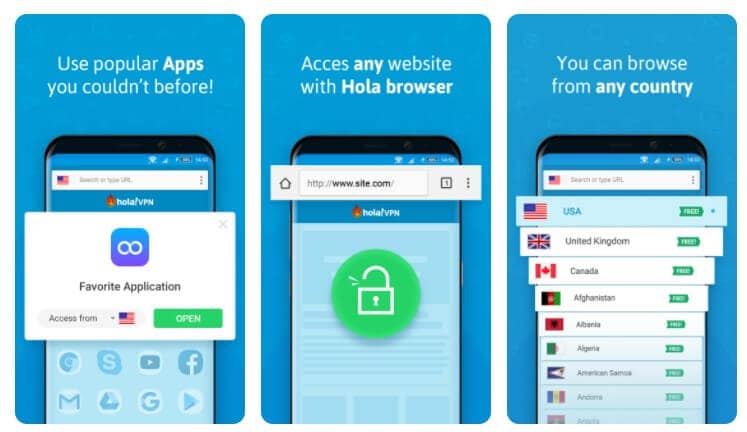
Hola is relevant to the comparison because it changes how supported traffic is routed, rather than because a VPN inherently rewrites the phone's GPS data. A website may infer a different region from an exit IP address while an app with location permission still receives the handset's coordinates. That makes Hola VPN a different category of tool from a mock-location provider.
The original Samsung/Huawei-only availability statement is not current universal guidance: Hola's own FAQ lists browser extensions and apps on multiple platforms. It also distinguishes free and Premium offerings, peer-resource participation, and platform-specific encryption or split tunneling. Check the exact edition and policy rather than assuming every connection is anonymous, every site will open, or game latency will improve.
Part 4: Comparing the Three Approaches
Choose according to the signal you need to test. The table separates device coordinates, route simulation, and network routing instead of treating all three products as interchangeable ways to change an ML location.
| Method | Setup and platform | Specific GPS point | Route or keyboard movement | Main limitation |
|---|---|---|---|---|
| Dr.Fone - Virtual Location | Computer-assisted workflow for supported iOS/Android devices | Teleport Mode selects a map destination | Movement controls are available in supported modes/builds | Device support and the receiving game's behavior must be checked separately |
| Fake GPS Location App | Android; mock-location setup may be needed | Provides a selected test point | Do not assume the desktop product's route or keyboard controls | Apps can reject mock coordinates; saved-location behavior varies by version |
| Hola VPN Service | Availability and routing depend on edition/platform | VPN routing does not itself select a GPS pin | Not a GPS route or joystick tool | IP-region changes do not guarantee a game-region change or anonymity |
Conclusion
For fake GPS in Mobile Legends, begin by separating the handset's reported location from account region, matchmaking, and rank. Dr.Fone - Virtual Location provides a guided way to test a GPS destination on supported devices; Lexa is an Android mock-location option, while Hola addresses network routing. None establishes a guaranteed badge destination or immunity from game restrictions. Restore the genuine position after testing and follow the game's current rules.
FAQ
1. What is the best location for fake GPS ML?
No location is verified here as the best. Examples such as Kuwait or Ireland are not current evidence of low competition, title thresholds, or account eligibility.2. Does a VPN change Mobile Legends GPS coordinates?
Not by itself. A VPN changes routing or an apparent IP region; a GPS tool changes a different location signal. Neither guarantees how the game will classify the account.3. Can an iPhone map change prove that ML accepted the location?
No. The map verifies the device-level result, while the game can use other checks or reject the supplied position. Test only where its current rules permit it.4. How should I stop using a simulated position?
End the location-changing session and follow the software's restore instructions. Dr.Fone's official guide describes restarting the connected device; verify the real position before using navigation again.
 Add Wondershare Dr.Fone as a preferred source on Google



