Teleport your device anywhere instantly with one click.


 100% Security Verified | No Subscription Required | No Malware

 :

 ChatGPT
 Perplexity
 Gemini
 Claude
 Grok
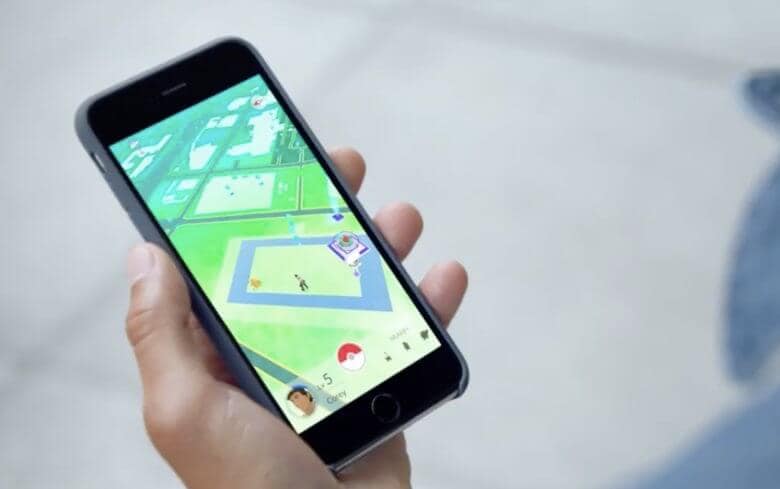
Can an iPhone report a different location to Pokemon GO without physically travelling there?
Searching for fake GPS Pokemon GO iOS usually leads to four very different suggestions: desktop movement simulators, VPNs, iTools, and modified game clients. They are not interchangeable. A VPN changes network routing rather than the iPhone's GPS coordinates, while a modified game client introduces security and account risks of its own.
This 2026 comparison keeps those four approaches separate and explains what their controls actually do. GPS falsification violates Pokemon GO's fair-play rules; no tool, subscription, realistic-looking route, or waiting period guarantees protection from restrictions or account termination. Use location simulation only where you have permission, and do not treat a successful map demonstration as proof of game compatibility.
In this article
Solution 1: Understand iPhone GPS simulation with a movement simulator
Desktop location software works at a different layer from a VPN: it attempts to alter the location reported by a connected device. On iPhone, the available workflow depends on the installed iOS release, desktop software, connection permissions, and the receiving app. An anecdote about one person's Android phone does not establish support for another person's iPhone.
 Set your map route to simulate GPS movement.
- Set your wanted movement speed.
- HD and large map view to check location.
- Fake GPS location to anywhere.
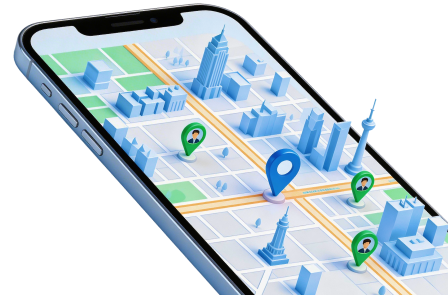
Dr.Fone - Virtual Location provides a desktop map for choosing a simulated destination and creating movement routes. Its location controls include teleporting to a selected point and simulating travel between two or more points. These are GPS simulation features, not a way to make the game authorize remote play.
Check the current device requirements before connecting your phone. The product's Android support information explicitly excludes Pokemon GO; general Android GPS support must not be interpreted as Android game support. For iOS, verify the exact combination of phone, system release, and software version rather than assuming every current device works.
Step 1 Install the desktop application and connect the iPhone
Choose the appropriate Windows or Mac installer, complete installation, and attach your unlocked iPhone to the computer. Review any trust or connection prompts on the phone. Keep the device connected while establishing the simulation; a download alone does not change location.
Verify that you obtained the installer through the approved product channel rather than an unrelated game-mod download site.
Step 2 Open the location workspace
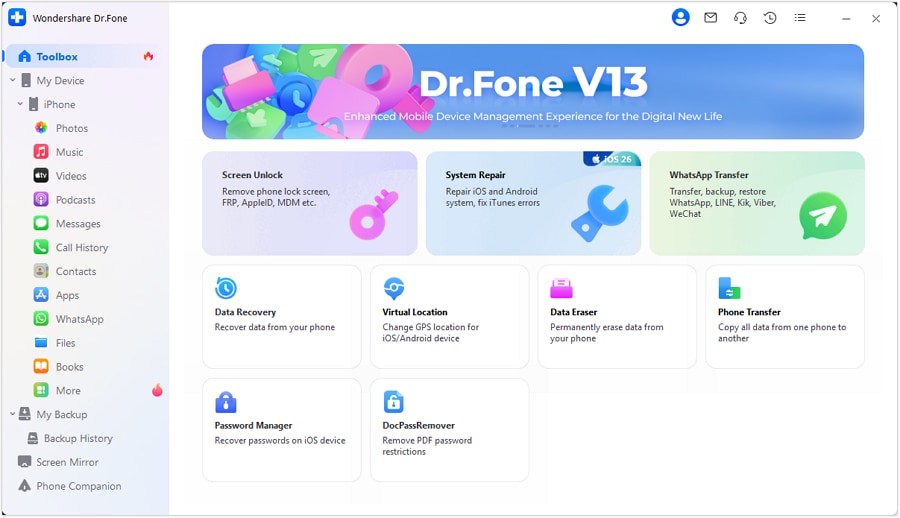
Launch the application and choose Virtual Location. Wait until it recognizes the connected phone, then continue into its map. The original interface screenshot below is a visual reference; menu placement can differ between releases.
Step 3 Search for a destination in Teleport Mode
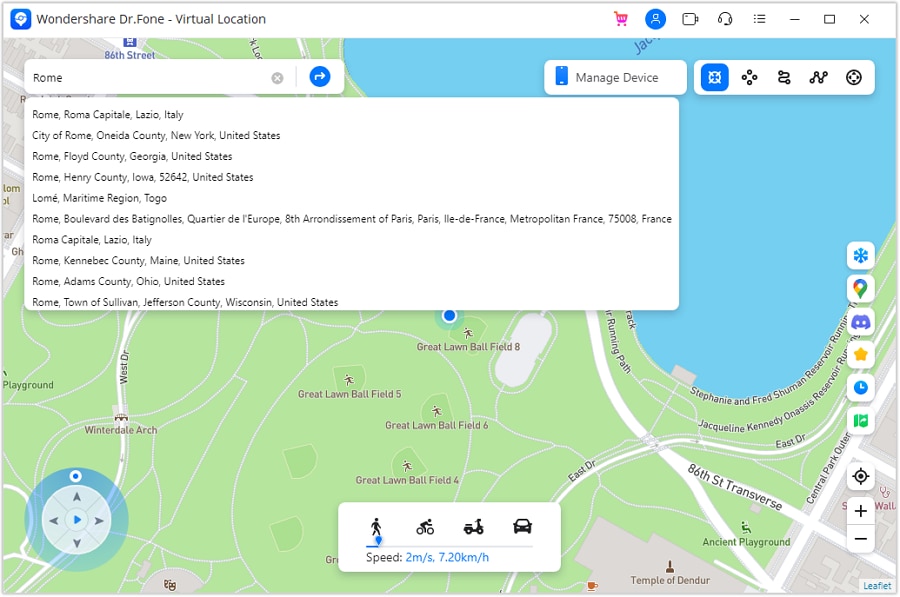
Activate Teleport Mode, enter an address or place in the search field, and inspect the resulting map marker. Select the intended result and confirm with Move Here when available. Choose the mode by its label rather than relying on an outdated instruction that calls it the third icon.
Step 4 Verify the reported position and finish the session
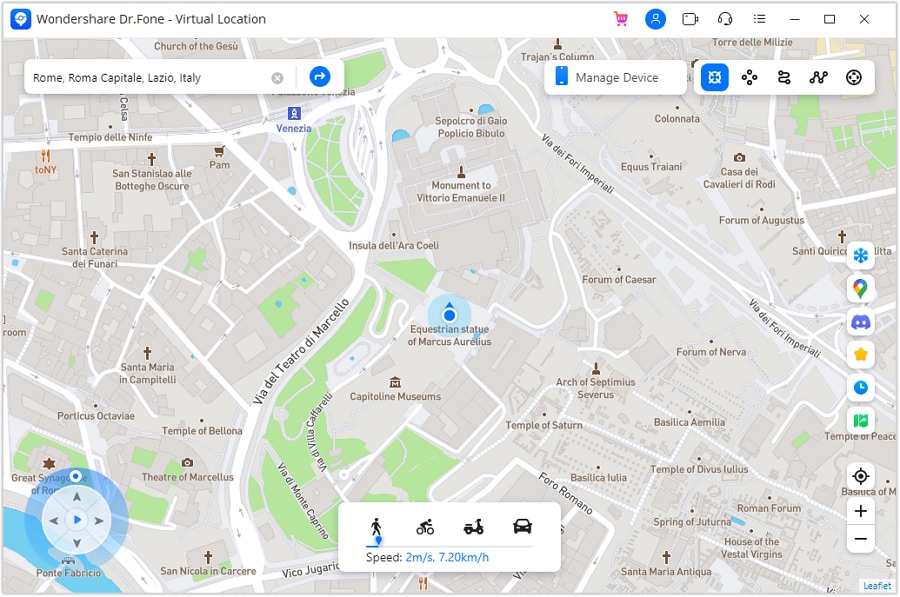
Compare the selected point in the desktop workspace with the phone's Maps application. If they disagree, check the device connection and destination instead of repeatedly changing game settings. When finished, follow the application's restoration prompt; the official guide describes restarting the device to restore its actual position.
For a permitted route simulation, select either the two-point movement option or a multi-point route and review the speed and endpoints before starting. The first connects a start and destination; the second follows several selected locations. Neither creates real walking activity or guarantees that a game will accept the reported movement.
The retained demonstration video illustrates the location interface, not independent evidence that a particular game build accepts it or that enforcement can be avoided.




Solution 2: Why an iPhone VPN is not a Pokemon GO GPS changer
A virtual private network sends internet traffic through a VPN server, so a website may see the server's IP address rather than your ordinary public IP. That network-level change is not the same as replacing the coordinates supplied by iPhone Location Services. Connecting to a server in another country therefore does not, by itself, move your Pokemon GO character there.
The original article named NordVPN, ExpressVPN, IPVanish, PureVPN, and Hola. Treat them as examples of network services, not verified GPS spoofers or equivalent security recommendations. Compare provider practices, server coverage, subscription terms, and trial conditions for your actual networking needs. A paid plan is not evidence of protection against game penalties.
Step 1 Obtain a VPN for a networking purpose
If you need a VPN independently of the game, obtain the provider's authentic iPhone app from its supported distribution channel. Closing Pokemon GO while setting up a network connection does not convert the VPN into a location simulator.
Step 2 Sign in and select a server
Open the VPN application, sign in or register, and choose a listed server. Approve only the connection permissions needed for the VPN service. The map below represents server selection, not a new GPS destination on your phone.

Step 3 Distinguish the server list from location settings
You can also choose a server from the provider's country or city list. Confirm the network connection in the VPN application, then separately examine Maps if you want to understand the difference: the phone can retain its actual GPS position while using a foreign network endpoint.

Pros: A conventional VPN does not require jailbreaking and may serve legitimate network privacy needs, depending on the provider.
Cons: Subscription charges may apply, and a VPN alone does not supply the fake GPS function sought here. Claims that it prevents Pokemon GO account suspension or makes spoofing undetectable are not supported.
Solution 3: Evaluate iTools as a separate desktop location option
iTools by ThinkSky is another desktop utility associated with an iPhone Virtual Location feature. Do not confuse desktop device detection, a management function, and reliable location simulation: each may have different requirements. A phone appearing in the device panel does not prove that the location feature supports its system release.
The source's fixed iOS 12 ceiling, three-use trial, and monthly price should not be carried forward as verified current terms. Check the exact edition's official requirements and purchase screen before spending money. Equally, a no-jailbreak workflow does not establish that Pokemon GO cannot detect location falsification.
Step 1 Check the correct iTools edition
Use ThinkSky's official information to identify the desktop edition and its Virtual Location support. Review the current trial limit and licence terms rather than assuming a third-party download has the same feature set.
Step 2 Connect a supported phone
Install the appropriate desktop release and connect the unlocked iPhone with a working cable. If the device or system version is unsupported, stop here rather than installing an unrelated profile or modifying the phone to match an old screenshot.
Step 3 Locate Virtual Location
After the device is recognized, open its Virtual Location control if included. Confirm the computer trust request on the phone only when you recognize the computer and application requesting access.
Step 4 Review the selected map point
In the illustrated workflow, searching the map or placing a marker prepares a destination, and Move Here applies it. Check the place carefully before confirming. Do not assume disconnecting the cable will preserve a simulated position on every release.

Step 5 End the simulation deliberately
For an authorized location test, inspect the result in Maps, return to the desktop interface, and use Stop Simulation when done. Reconnect if the software requires it. Confirm the real position afterward; retaining a false point unintentionally can affect other location-based applications.

Pros: The illustrated desktop workflow offers map-based point selection without requiring a modified game client.
Cons: A computer, supported software/device pairing, and potentially a paid licence are required. Game penalties remain possible. Neither the old compatibility statement nor a low advertised price should substitute for checking current feature-specific support.
Solution 4: Recognize the risks of Pokemon GO++ and modified clients
Pokemon GO++ refers to an unofficial modified client, not an enhanced edition approved by the game's operator. The original guide associated it with jailbreak-era installers such as Cydia and Tutu App. Those references are retained for context, but they do not establish that a maintained, trustworthy installation exists for your current iPhone.
Unlike a separate map simulator, a modified client can change the software into which you enter game credentials. That adds account-access and software-integrity concerns to the location-rule violation. Do not jailbreak a phone, remove security protections, or grant an unknown signing profile access merely because a screenshot shows a working-looking menu.
Step 1 Identify the unofficial installer stage
The old sequence began by preparing a jailbroken device and obtaining Tutu App. This describes the source's installation dependency, not a recommendation to weaken a current iPhone's protections. If you cannot establish an authentic supported publisher, stop rather than continuing through anonymous mirrors.
Step 2 Understand the replacement-client requirement
The next illustrated stage searched for Pokemon GO++ and removed the official game. Replacing the official app is a material change, not an ordinary settings adjustment. Keeping the genuine client avoids introducing a substitute application whose integrity you have not verified.

Step 3 Review the installation-permission warning
The source then showed an installation screen and permission prompts. A successful install prompt cannot establish that the package is safe, authorized, or compatible with the live service. Do not approve unknown profiles or permissions on the strength of the displayed app name.

Step 4 Distinguish a menu from legitimate access
The pictured client exposed a Fake Location switch and map/radar controls after sign-in. These controls describe the altered interface only; they are not proof that the service permits the change. Avoid entering credentials into an unverified client, and use the official app for normal play.

Pros: The source screenshots show location controls integrated into one interface, which explains the appeal of this approach.
Cons: The software is unofficial, installation may depend on unsupported or security-reducing procedures, and account restrictions can follow. A simple interface does not cancel those drawbacks.
The game's published fairness policy specifically includes GPS spoofing and unauthorized third-party access within cheating. Its three-strike framework is not permission to experiment: the policy explicitly allows some violations to result in immediate termination without earlier warnings.
Conclusion
The four suggestions answer different technical questions. A VPN changes networking, desktop tools attempt device-location simulation, and Pokemon GO++ replaces the client itself. None should be described as a guaranteed safe way to play remotely. Dr.Fone - Virtual Location offers map-based GPS controls for supported, permitted uses, but platform compatibility and game authorization must be evaluated separately. For ordinary Pokemon GO play, the official client and genuine physical location remain the appropriate baseline.
FAQ
1. Can a VPN alone change Pokemon GO GPS on an iPhone?
No. Choosing a VPN server changes the network endpoint; it does not by itself replace the coordinates reported by iPhone Location Services.2. Does avoiding a jailbreak guarantee account safety?
No. Installation method and gameplay rules are separate matters. GPS falsification can violate the rules even when the phone has not been jailbroken.3. Should I follow old iTools compatibility and price claims?
Check the exact edition's current official requirements and licence terms. Old version ceilings, trial counts, and subscription amounts are not dependable current specifications.4. Are three warnings guaranteed before a ban?
No. The published fairness policy says some misconduct may cause immediate account termination without prior warning.
 Add Wondershare Dr.Fone as a preferred source on Google