Teleport your device anywhere instantly with one click.


 100% Security Verified | No Subscription Required | No Malware


 :

 ChatGPT
 Perplexity
 Gemini
 Claude
 Grok
FGL Pro is an Android GPS-mocking utility, but its older Pokemon Go setup is not a verified working method for current devices. In particular, instructions that ask you to downgrade Google Play services to 12.6.85 should not be treated as routine preparation in 2026. A mock position appearing on a map does not prove that the game will accept it.
Pokemon Go uses real-world exploration as part of its gameplay. Its current player guidelines classify falsifying location as cheating and allow account penalties. The sections below explain FGL Pro's advertised capabilities, the practical drawbacks and every stage of the original setup, while clearly identifying obsolete security-reducing steps. Use GPS simulation for authorized testing rather than assuming it provides safe remote gameplay.
In this article
Part 1: What FGL Pro does on Android
FGL Pro lets a user choose a different position through Android's mock-location facility. The source associates it with Pokemon Go, but that association is not a compatibility certification. Android can expose simulated coordinates for development while individual apps decide whether to accept, reject or flag them.

The original description lists several functions. These explain why people investigate FGL Pro, not why a game account would be protected:
- Map-based position selection: choose coordinates away from the phone's physical position for a test session.
- Location sharing: a location-sharing app may use the simulated coordinates, but that is neither a guarantee across services nor a way to hide every location signal.
- On-device control: the Android interface avoids operating a separate desktop map, provided the utility and Android version work together.
- Route and speed options: the source describes walking, driving and speed adjustments. These are simulation controls, not evidence that movement will be undetectable.
The source called the app free and referred to Google Play and downloadable APKs. Check whether a legitimate listing is currently available for your device; this revision has not established present-day distribution, pricing or maintenance. Do not install an unverified APK simply because it uses the FGL Pro name, and do not accept the claim that one utility includes every feature of all competing paid products.
Part 2: Is FGL Pro a suitable choice for Pokemon Go?
Separate three questions before installing anything: can the app run on the phone, can Android report the selected coordinates, and does the target service permit that use? A positive answer to the first two does not settle the third. The following trade-offs retain the original advantages-and-limitations comparison without claiming a successful gameplay test.
2.1 Reasons users consider FGL Pro
- Low initial cost: the original article described a free download. That can appeal to people exploring Android mock-location testing, although current listing terms must be checked rather than inferred.
- A visible map workflow: selecting a point and starting a simulation is easier to understand than manually feeding coordinates to a test application. Initial simplicity does not remove OS compatibility requirements.
- Potential use beyond one app: the source mentions social and dating applications as well as a game. Results vary because each service uses its own permissions, account settings and detection logic.
None of those points supports a promise of catching Pokemon from home. A simulated location cannot authorize prohibited gameplay or guarantee access to encounters. If the goal is ordinary play, the official client and genuine location remain the appropriate baseline.
2.2 Drawbacks and reasons to avoid the legacy setup
- Outdated dependency changes: the old guide requires a Google Play services rollback. Google now advises keeping that component up to date; it supports functions such as Google Sign In and Maps.
- Advertisements: the source reports an ad-supported experience and no monthly ad-removal option. Treat those as the source's observations, not a verified description of the current release.
- Unreliable target-app behavior: the earlier account describes login failures and unsuccessful interactions. Those symptoms do not establish that another APK, route speed or system rollback will fix the problem.
- Lengthy preparation: changing administrators, package updates and developer settings creates more failure points than simply installing an app.
- Game enforcement: the current official player guidelines prohibit location falsification. No FGL Pro setting establishes immunity from warnings, suspension or termination.
For a daily-use phone, preserving updates and device-finding protection is more important than reproducing an obsolete tutorial. Stop if the process requires disabling security features or installing a system component from an uncertain source.
Part 3: Reviewing the original FGL Pro setup, step by step
The seven stages below preserve the original sequence so readers can recognize the screens they encountered elsewhere. They are an annotated review of the legacy workflow, not a recommendation to downgrade or disable current Android services. The old screenshots remain unchanged and may not resemble your present settings.
Step 1 Identify the old Play services requirement
The earlier procedure began with Google Play services 12.6.85 or an older build. That version number is an old software dependency, not a current compatibility recommendation. Google Play services supports account and map functions, and Google recommends updating it when troubleshooting. Do not replace the current package with an arbitrary old APK to follow this guide.

Step 2 Verify the FGL Pro download source
The original instructions next searched Google Play for FGL Pro. If you investigate the app for permitted testing, verify the publisher, listing availability, permissions and device requirements first. A search result or reuploaded APK is not proof of authenticity, and no new download address is supplied here.
Step 3 Recognize the device-finding change
The old tutorial opened Settings, Security and Device Administrators to turn off Find My Device. Menu names vary, and disabling a device-finding safeguard is not necessary to understand Android's supported mock-location option. Leave protection enabled on a personal phone rather than reproducing this obsolete prerequisite.

Step 4 Understand the uninstall-updates screen
The earlier sequence then opened the system-app list, selected Google Play services and used Uninstall updates. This is included to explain the retained image, not as a current remedy. Removing updates can disrupt services that other apps depend on; a Pokemon Go location error is not sufficient justification for this change.

Step 5 Recognize the downloaded system-APK installation
The source next located the downloaded package in the Downloads folder and opened its installer. Do not repeat that action with an unverified Google Play services APK. System-package compatibility depends on more than a familiar version number, and this article does not verify a suitable old package for your phone.

Step 6 Avoid disabling the Play Store
The old workflow disabled Google Play Store from the system-app settings, attempting to preserve the rollback. That prevents normal store use and is not a suitable long-term setup. Keep the store available and use Google's supported update or troubleshooting instructions if previous changes have caused problems.
Step 7 Understand Android's mock-location selection
For legitimate testing, Android documents Developer options and Select mock location app. Enable Developer options through your device's Build number setting, then choose a trusted installed mock-location app if the control is available. The retained image shows FGL Pro being selected; it does not demonstrate current game compatibility.

The original FGL Pro interface then selected a map point and used Play to start simulation. Verify results in a permitted test or mapping app, not by assuming an in-game action will succeed. When finished, stop the simulation and clear the mock-location selection as appropriate.

If you already followed the obsolete stages, prioritize restoring supported updates and device protection. Do not continue cycling through old APK versions because an account cannot sign in or a game rejects coordinates. The setup cannot establish permission to spoof a game location.
Dr.Fone - Virtual Location for a controlled GPS test
 Set your map route to simulate GPS movement.
- Set your wanted movement speed.
- HD and large map view to check location.
- Fake GPS location to anywhere.

Dr.Fone - Virtual Location provides a computer interface for changing the reported GPS position of a supported connected phone. Its map, teleport and route controls are useful for understanding location-dependent app behavior in an authorized test. Device and OS support must be checked before use.
This is not a promise that Pokemon Go will accept simulated coordinates or that a route will avoid enforcement. The fixed product panel describes the supplied product features; no claim in this guide makes its marketing safety language an account-protection guarantee.
Step 1 Prepare the supported connection
Launch the desktop program, open Virtual Location and follow the device connection, trust and permission prompts. Read any model-specific requirements before continuing.
Step 2 Set a test destination
Select Teleport Mode, search for a place or coordinates and verify the map pin. Confirm with Move Here when the selected point is correct.
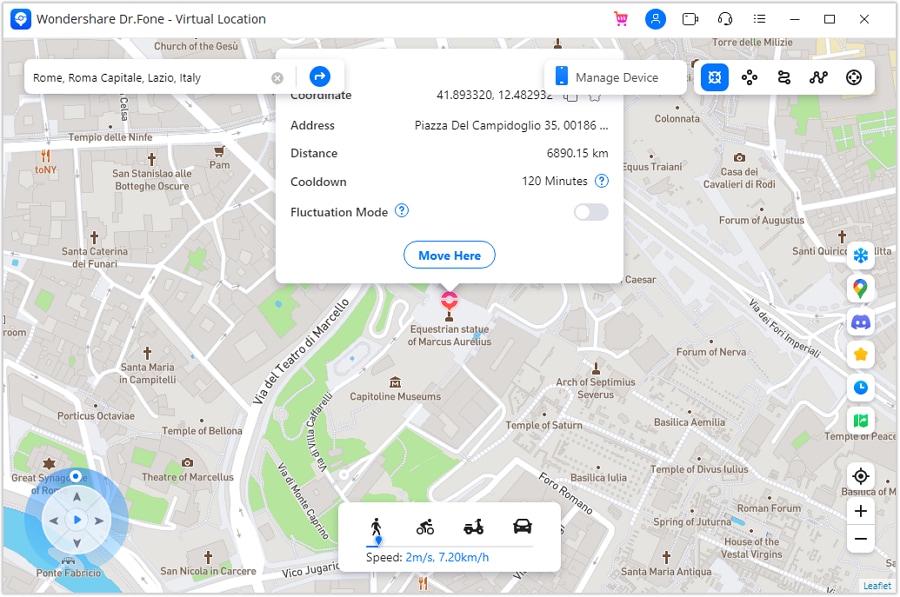
Step 3 Check and end the test
Open Maps on the phone to inspect the reported coordinates. End the simulation when finished and use the restart-device restoration option described in the official guide, then recheck the actual position.
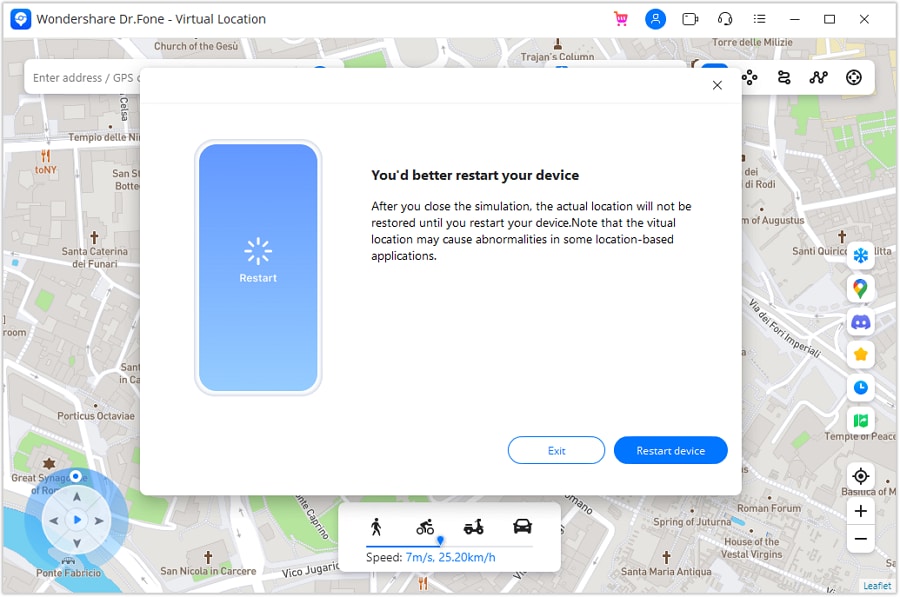
A successful map test establishes only that the phone reports the selected position in that test. It does not certify third-party game compatibility or remove account risk.




Conclusion
FGL Pro illustrates Android location simulation, but the original downgrade-heavy process is not a dependable present-day Pokemon Go guide. Keep the distinction between an OS test feature and permitted game behavior clear. Retain normal system updates and follow the game's location rules. For a separate, desktop-controlled GPS test on a supported device, Dr.Fone - Virtual Location offers the map workflow described above, without establishing game approval.
FAQ
1. Is FGL Pro guaranteed to work with Pokemon Go in 2026?
No. The original screenshots and setup do not verify current compatibility, and the game can reject or penalize simulated locations.2. Should I install Google Play services 12.6.85?
Not as a current recommendation from this guide. That is the legacy procedure's dependency; Google advises keeping Play services updated.3. Does selecting a mock-location app require root?
Android provides a developer setting for selecting a mock-location app without rooting as the general test workflow. App-specific compatibility and permissions still apply.4. Can a GPS route make spoofing safe for my game account?
No. A movement control does not override player guidelines. The official rules prohibit falsifying location and permit account penalties.
 Add Wondershare Dr.Fone as a preferred source on Google