 Teleport your device anywhere instantly with one click.


 100% Security Verified | No Subscription Required | No Malware


 :

 ChatGPT
 Perplexity
 Gemini
 Claude
 Grok
Ingress Prime location tools: what to know before comparing six options
No GPS tool listed here guarantees permitted or penalty-free Ingress Prime spoofing. Ingress is designed around real locations; falsifying those locations can violate its rules. You do not need to spoof your phone to play the game normally, contrary to the original article's opening claim.
This comparison retains the source's iOS utilities, Android apps and emulator workflow, then explains the separate desktop-controlled GPS option in the closing product section. Together these make six tools to understand, not six verified ways to bypass game restrictions. Older OS ranges and screenshots are retained as source context rather than proof of compatibility in 2026.
In this article
Part 1: Understanding Ingress and Ingress Prime
Ingress is a location-based game that places science-fiction objectives around real public art and landmarks. Players use the Scanner to find portals and participate in faction competition. Its appeal comes from exploration, coordination and an evolving narrative, not from a requirement to falsify the device's position.
Niantic's launch announcement identifies November 2012 as the original Ingress release. That corrects the source's later starting year. Ingress Prime launched on November 5, 2018, rebuilding the experience with revised onboarding and presentation while keeping the portal-based game world.
Both Android and iOS are part of the game's platform history. The original article described worldwide popularity and millions of users, but this revision does not turn an old audience estimate into a current active-player count. The practical point is that the game connects the phone's location with nearby objectives, so coordinate falsification can affect other players.
Searching for an Ingress GPS spoofing method does not establish that one is approved or currently works. The official Ingress discipline policy identifies GPS location spoofing as cheating and says some violations can cause immediate account termination. Avoid the assumption that a simulation becomes safe because it uses a familiar app, a slow route or an older operating system.
The original article's relative age statement and repeated outdated search-year phrases have therefore been replaced with clear current guidance, while real launch history remains historical. Before testing any location utility, check device support, installation provenance and the target service's rules separately.
Part 2: Reviewing the two legacy iOS location utilities
The iOS tools below belong to the older-device workflow described in the source. Their listed version ranges are not evidence of compatibility with a modern iPhone or current Ingress build. Do not install an untrusted profile, package or modified game simply to reproduce an old screenshot.
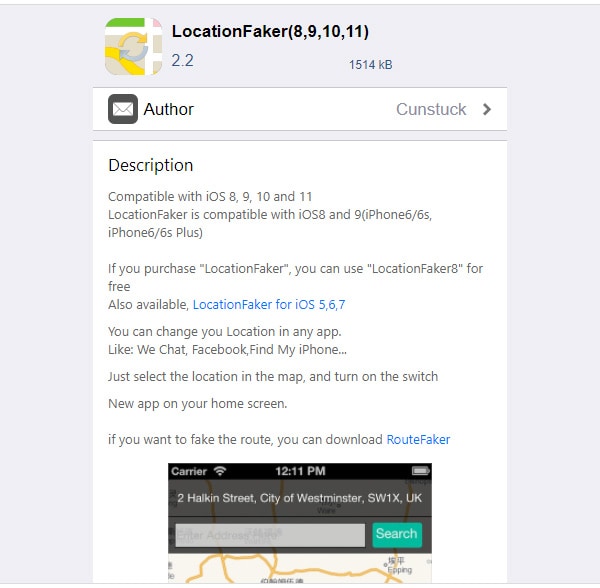
1. Location Faker App
The source lists Location Faker for iOS 8, 9, 10 and 11, with examples including iPhone 6/6s and their Plus variants. Preserve those limits when evaluating the claim: a utility described for that range should not be assumed to support every later iOS version. This revision has not verified a current publisher listing or a working Ingress configuration.
Its original workflow is map-based: choose the point you want the device to report and activate the utility's location function. Before doing so in a legitimate test, confirm that you have the authentic product and understand its device-modification requirements. The source does not establish a universal, standard App Store installation route.
The earlier description named WeChat, Facebook, Find My iPhone and Ingress Prime as possible targets. That is not proof that all those apps accept the result. In particular, changing reported GPS does not guarantee that Find My stops showing other location information or that a game considers the position valid.
2. Location Handle
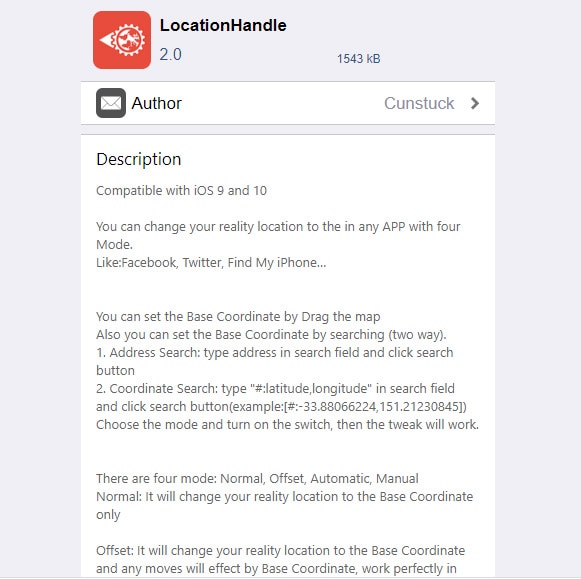
Location Handle is presented in the source as an iOS 9 and 10 utility. Treat that as the original compatibility claim, not a recommendation for current devices. Its stated location workflow uses a base coordinate, selected by dragging a marker or searching for a place.
-
Step 1 Check the base coordinate
In a compatible, authorized test environment, locate the map pin or search field described by the utility. Confirm the selected point before applying it.
-
Step 2 Review the available mode
The original interface lists Normal, Offset, Automatic and Manual. Choose only a mode whose behavior you understand from the actual product instructions; their names alone do not prove how every app will respond.
-
Step 3 Activate and verify the test
The source then turns on the location switch. Check the effect in a permitted map or test application and restore normal location afterward. Do not assume that one successful marker change certifies Ingress compatibility.
Neither old iOS utility is established here as a safe way to operate a live game account. If installation requires unsupported device changes, the appropriate response is to stop, not to assume that the source's enthusiastic description removes the risk.
Part 3: Understanding the Android and emulator options
Android provides a developer mock-location mechanism, but individual apps may reject simulated data. An emulator adds another compatibility layer because its virtual Android environment is not the same as a supported physical phone. The three source options below should be evaluated on those terms.
3. Hola Fake GPS
The source describes Hola Fake GPS as a free Android utility for selecting a different reported position. Its current distribution, price and maintenance have not been verified for this revision, so the old description is not a present-day download recommendation.
If investigating an authentic compatible build for permitted testing, review the publisher and requested permissions before installation. Android's supported test approach selects the installed utility under Developer options and Select mock location app. A position chosen in such an app does not guarantee that Ingress permits or accepts it.

4. Fake GPS by Lexa
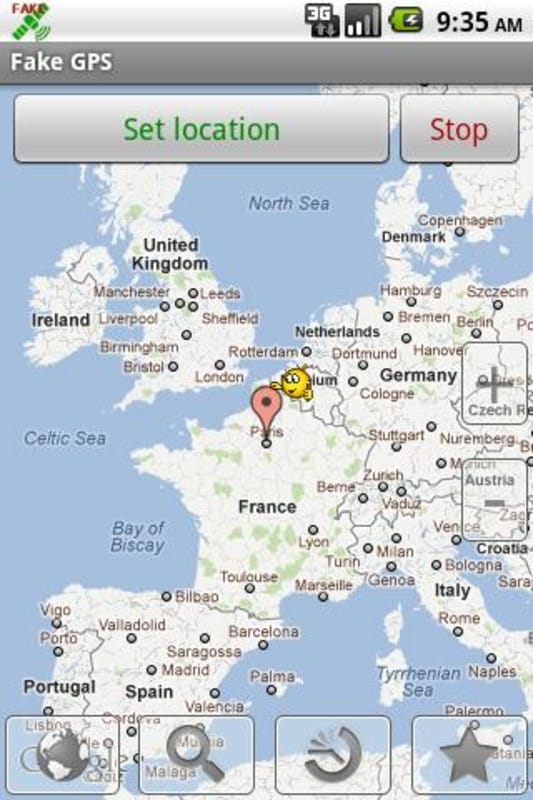
Fake GPS by Lexa is another on-device map utility in the original comparison. The source describes selecting a destination with a small number of taps, but the result is still subject to Android settings, app permissions and the target application's handling of mock data.
For an authorized test, install a trusted compatible version, enable Developer options if required and select the intended mock-location provider. Choose a map point, start the simulation with the app's current control and inspect a permitted test app. Stop the simulation and clear the mock-provider selection when finished.
The original statement that every app automatically detects and uses the fake position is too broad. Some apps reject mock locations, consult additional inputs or retain account-region settings. No universal location replacement or guaranteed remote Ingress play is established.
5. BlueStacks Emulator
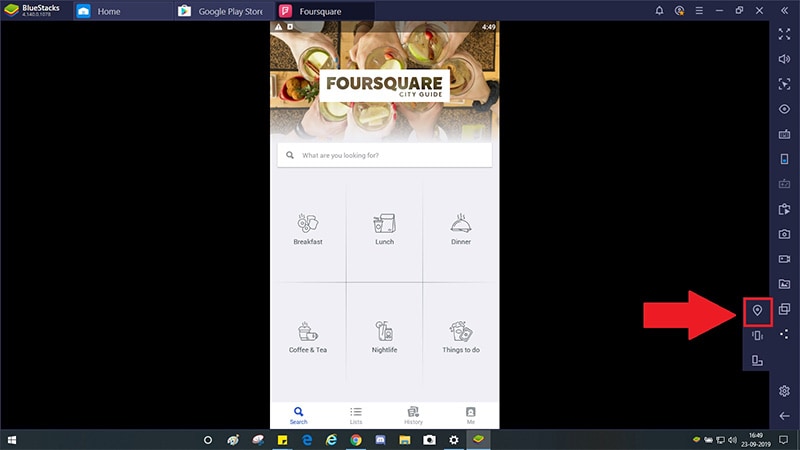
BlueStacks exposes a location-setting tool for its Android environment. That changes the emulator's selected position, not a separate physical iPhone or Android phone. Current BlueStacks support describes a map, address search, Set location and Reset controls; the retained screenshots show an earlier interface.
Check that an app is supported in the emulator before testing location behavior. The following four stages explain the original location-provider sequence without promising that Ingress installation, login or live play will work.
-
Step 1 Find the emulator's location control
Launch BlueStacks and locate its location tool. The source shows it along the lower edge; newer releases may place it in a side toolbar. For location testing, start with an app workflow you are permitted to test rather than assuming a live game account is suitable.
-
Step 2 Open the map and search
Select the location button to open the emulator's map. Use the search function to identify a destination, and follow any mock-location preparation required by the actual emulator version rather than assuming a physical phone has also changed.
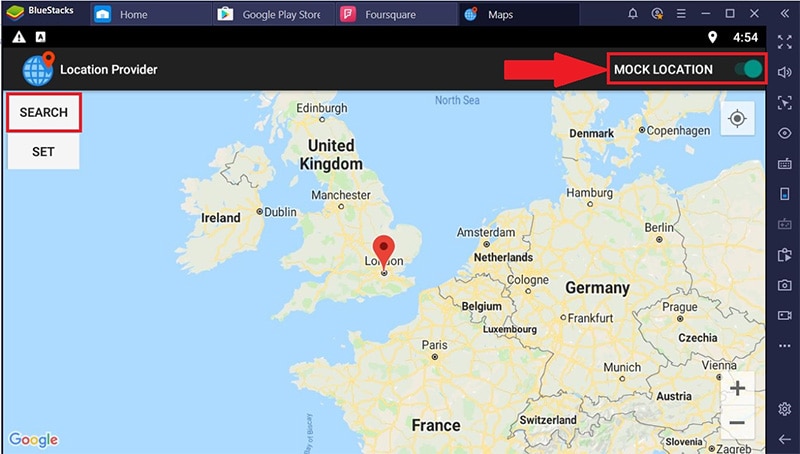
-
Step 3 Confirm the search result
Enter the intended address or place, run the search and inspect the returned location. Similar names can identify different cities, so verify the map pin before applying the selection.
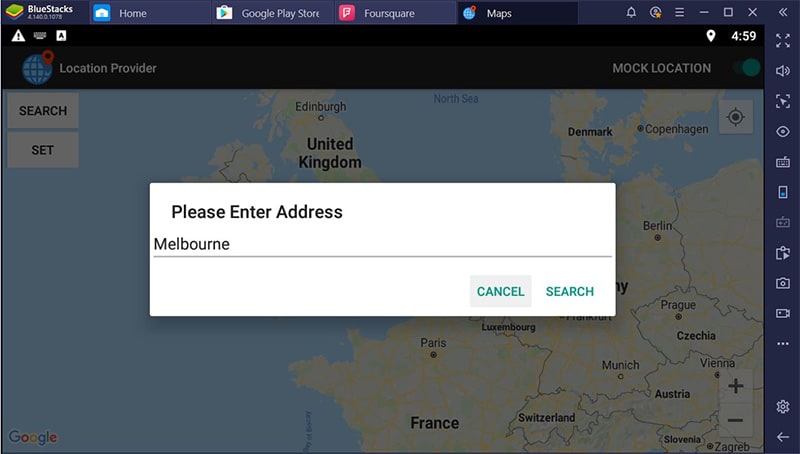
-
Step 4 Apply and later reset the position
The source uses SET; current documentation calls the control Set location. Confirm it, inspect the result in a permitted app, and use Reset when finished if available in your version. Searching alone is not the same as applying the new location.
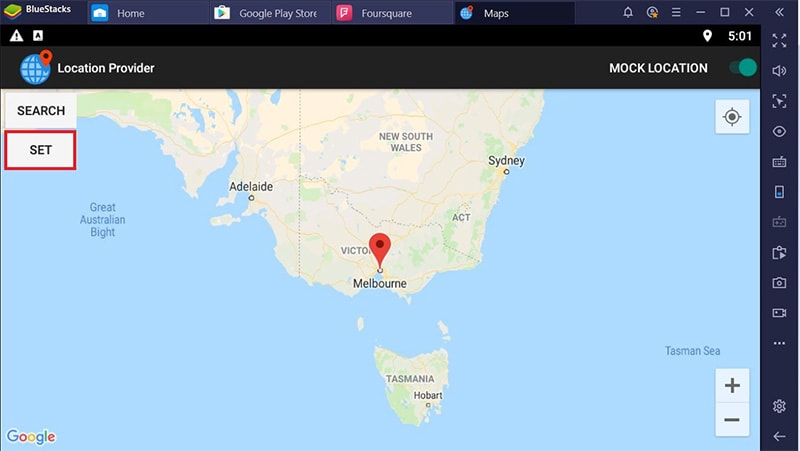
A successful emulator map setting proves only that the test environment reports that selected position. It does not prove that the game's supported-device checks or rules permit its use. Avoid modified clients or an attempt to circumvent an account penalty if compatibility fails.
6. Dr.Fone - Virtual Location for a supported connected phone
 Set your map route to simulate GPS movement.
- Set your wanted movement speed.
- HD and large map view to check location.
- Fake GPS location to anywhere.

Dr.Fone - Virtual Location uses a computer map to select a reported GPS position and simulate movement on a supported phone. Unlike the emulator's map setting, it is intended for the connected device. Check the current device and OS requirements before choosing this workflow.
The product's teleport, map-route and speed controls can support authorized location testing. They do not make a game account undetectable, replace service permissions or guarantee acceptance by Ingress. The supplied fixed panel is retained verbatim; its marketing language should not be interpreted as a game-enforcement guarantee.
-
Step 1 Open Virtual Location and connect
Launch the desktop program and follow its instructions to connect a supported phone. Complete any trust, connection or permission prompts shown for that device.
-
Step 2 Select a map destination
Choose Teleport Mode and search for the address or coordinates you need to test. Review the destination on the map before selecting Move Here.
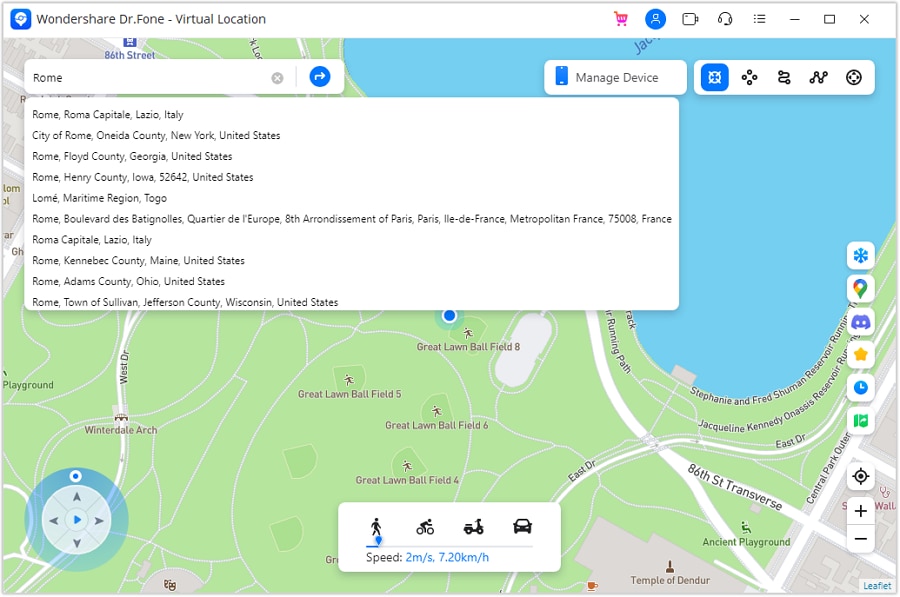
-
Step 3 Inspect the reported position
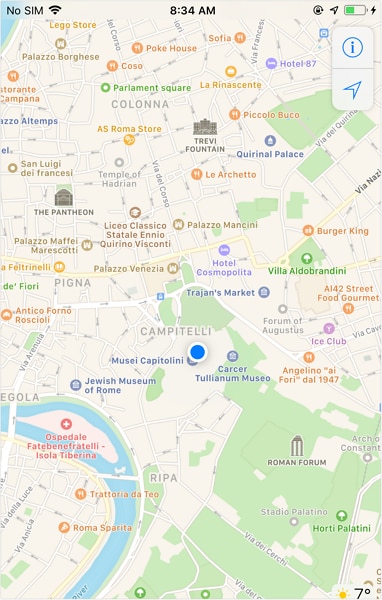
Open Maps on the phone and compare its location with the chosen point. This verifies the map test, not whether a separate game authorizes simulated coordinates.
-
Step 4 End the test and restore
Use the program's restoration instructions or restart-device prompt to return the phone to normal location reporting. Verify the actual position again before relying on navigation.
Keep this GPS workflow separate from live Ingress actions. No tool in the comparison removes the requirement to follow the game's supported-device and fair-play policies.




Conclusion
The source's iOS and Android tools illustrate several ways to influence reported location, but none guarantees safe Ingress Prime spoofing. Old iOS compatibility ranges, Android mock providers and emulator map controls describe different environments. Keep installation safety and game rules separate from whether a pin moves. For the sixth option, Dr.Fone - Virtual Location provides a desktop-controlled phone GPS test, explained above without a promise of approved remote gameplay.
FAQ
-
1. Must I spoof location to play Ingress Prime?
No. The game is designed for real-world exploration using genuine location. Spoofing is not a required setup step. -
2. Do Location Faker and Location Handle support every current iPhone?
No such compatibility is established. The source lists older iOS ranges, which must not be extended to later releases without current evidence. -
3. Does Lexa's selected location automatically work in all apps?
No. A target app may reject mock data, use additional signals or keep a separate account-region setting. -
4. Does setting a BlueStacks location also change my phone?
No. The emulator's map setting applies to its virtual Android environment. A physical phone is a separate device with its own location reporting.
 Add Wondershare Dr.Fone as a preferred source on Google



