 Teleport your device anywhere instantly with one click.


 100% Security Verified | No Subscription Required | No Malware


 :

 ChatGPT
 Perplexity
 Gemini
 Claude
 Grok
To fake GPS on a compatible Huawei phone, you need a mock-location tool and the relevant developer setting; a VPN alone does not change GPS coordinates. The correct setup depends on the software running on the phone. Do not assume that instructions written for an Android-based Huawei device apply unchanged to every Huawei operating-system version.
Also separate location testing from privacy. If you simply do not want an app to read your whereabouts, review its location permission first. A simulated position does not make an account anonymous or stop every other location signal. This 2026 guide explains the original mock-location procedure and VPN workflow while making their different purposes clear.
In this article
Part 1: How to Mock Location to Fake Location on Huawei
Android's mock-location setting is intended for testing how an app behaves in different places. It authorizes a selected application to provide a simulated location. Enabling Developer options by itself does not move a map pin, and selecting a tool does not prove that every app will accept the result.
Before starting, check the exact Huawei model and operating-system version in Settings. The procedure below applies to devices that expose the Android-style Select Mock Location App option and support the chosen tool. Huawei's current guidance describes different developer-mode entry methods for different software versions, so a missing menu should not be treated as a reason to install random packages or change unrelated settings.
Step 1 Open Developer options
On the original Android-style layout, open Settings > System > About Phone, find Build Number and tap it seven times. Some versions place About Phone directly in Settings or use System & updates for system controls. Enter your own device's unlock credential if requested, and stop if your software's official instructions use a different procedure.

Huawei warns that developer settings are intended for debugging and incorrect changes can cause problems. Its current documentation also distinguishes owner mode from restricted user environments. If a managed or restricted device does not allow access, obtain the owner's or administrator's permission instead of trying to bypass the restriction.
Step 2 Select the installed mock-location tool
Install a compatible, trusted test application before selecting it. Return to the system settings, open Developer Options and choose Select Mock Location App where available. Select the intended tool from the list. An empty list can mean that no suitable application is installed; the setting is not itself a built-in map editor.

Next, open the selected tool and follow its own instructions to set a test position. Check the result in a map or in the application you are authorized to test. Services can reject mock locations or use additional signals, so a successful test in one place does not guarantee success everywhere.
When finished, stop the simulation, clear the selected mock-location app where the device offers that option, and confirm that maps reports the real position again. Turn off unnecessary developer settings after the test. Do not depend on simulated positioning for navigation, emergency information or telling another person where you actually are.
Part 2: Can VPN Apps Fake GPS Location on Huawei?
No: a VPN changes the public IP address used by routed traffic, not the phone's GPS coordinates. This distinction matters whenever an app checks the device itself rather than the network connection. An app with location permission may still obtain the physical location from the device even while a VPN server is in another region.
The original example is ExpressVPN. It provides a VPN connection and server-selection workflow on supported Android devices. Its own documentation explicitly says that it does not change Android GPS, nearby Wi-Fi or cellular location signals, or the region already saved in an online account.
Use a VPN for the network function it actually provides, subject to local law and service terms. A streaming catalog may depend on licensing, account region and other checks, so connecting to a different server is not a guarantee of accessing a particular show. GPS simulation alone does not provide VPN encryption either.
Step 1 Install and sign in on supported software
Obtain the application through the provider's official distribution route for your device. If Google Play is unavailable, the provider documents an official Android APK route, but you must still confirm that the phone's operating system supports that app. Open it and sign in, or review any trial offer actually displayed. The original screenshot's seven-day-trial wording should not be treated as a universal current entitlement.

Step 2 Choose a server and establish the connection
Select the intended VPN server location and tap the connection control. Review and approve the operating system's VPN connection request if you intend to proceed. Wait for the app's connected or protected status before checking the IP-based result. Menu labels can differ from the original screenshot.

Verify the VPN result with an IP-based check, not by assuming that a GPS map must move. Google Maps or another location-enabled app can still show your real location without indicating that the VPN has failed. Disconnect through the VPN app when you want to stop routing traffic through it.
Pros
- A possible trial route: if an eligible offer is presented, it can let you evaluate the service. Check current availability, renewal terms and cancellation conditions rather than assuming every new account receives seven free days.
- App-by-app routing choices: supported split tunneling lets you decide which apps use the VPN and which use the ordinary connection. This is a network-routing choice, not separate GPS positions for each app.
- Configurable automatic connection: ExpressVPN documents an auto-connect option for networks not marked trusted. It requires configuration and the permissions described by the provider; do not assume the feature is already enabled.
Cons
- A changing or unexpected IP region can be confusing: inspect the selected server, reconnection state and the service's own stored location if a website reports somewhere unexpected. That observation alone does not prove the phone's GPS changed.
- Speed and latency can vary: server distance, congestion, protocol and the underlying network affect performance. A VPN connection can be slower, so compare conditions rather than expecting identical speeds on every server.
- It is not a replacement for GPS mocking: an app that uses device location may still know the real position. Neither tool guarantees regional eligibility, account safety or unrestricted content access.
Wondershare Dr.Fone: distinguish the toolkit from Virtual Location
 Set your map route to simulate GPS movement.
- Set your wanted movement speed.
- HD and large map view to check location.
- Fake GPS location to anywhere.

The wider toolkit includes separate phone-management, transfer, mirroring, recovery, repair and unlocking functions. Virtual Location is the dedicated location-simulation module, offering a map for position selection and route-movement controls where supported. It does not automatically include all the other toolkit functions or change a Huawei phone's supported operating-system features.
Before connecting, check support for your exact Huawei model and software version. Do not assume that all phones carrying the Huawei name accept the same Android tools. Use simulation only for permitted testing, keep normal location-sharing permissions under your control, and avoid using test coordinates to misrepresent a real-world meeting or journey.
Step 1 Connect the supported phone
Open the desktop program's Virtual Location module and follow its device-connection and authorization prompts. If your device is not supported, do not proceed on the assumption that an APK or a VPN will make it compatible.
Step 2 Select a test location
Choose Teleport Mode, search for the intended place and check the map pin. Confirm with Move Here to apply the selected simulation.
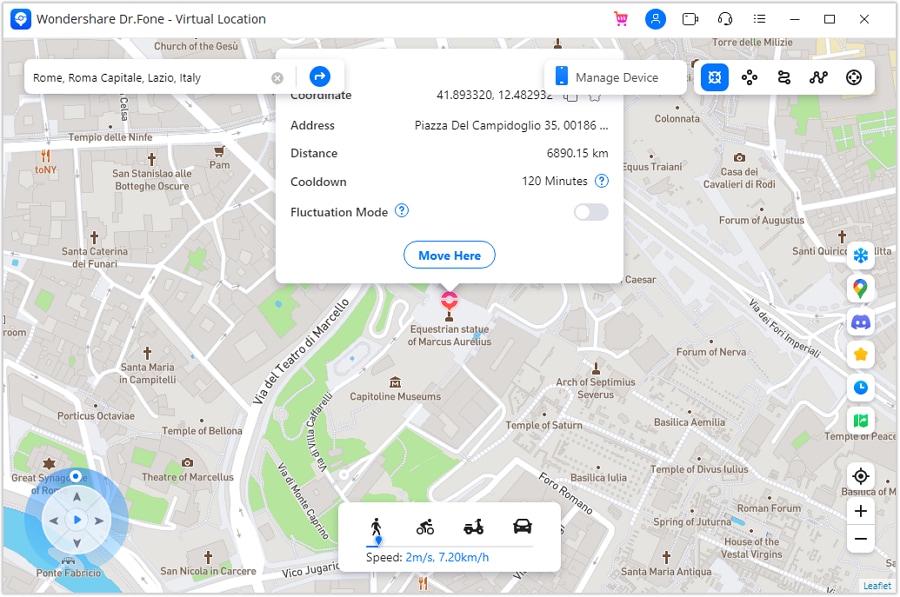
Step 3 Verify and restore the location
Check the phone's reported position in its maps app, then test only the app you are authorized to evaluate. End the simulation using the program's restoration instructions; its official guide describes restarting the device to restore the actual location. Confirm that the real position has returned.
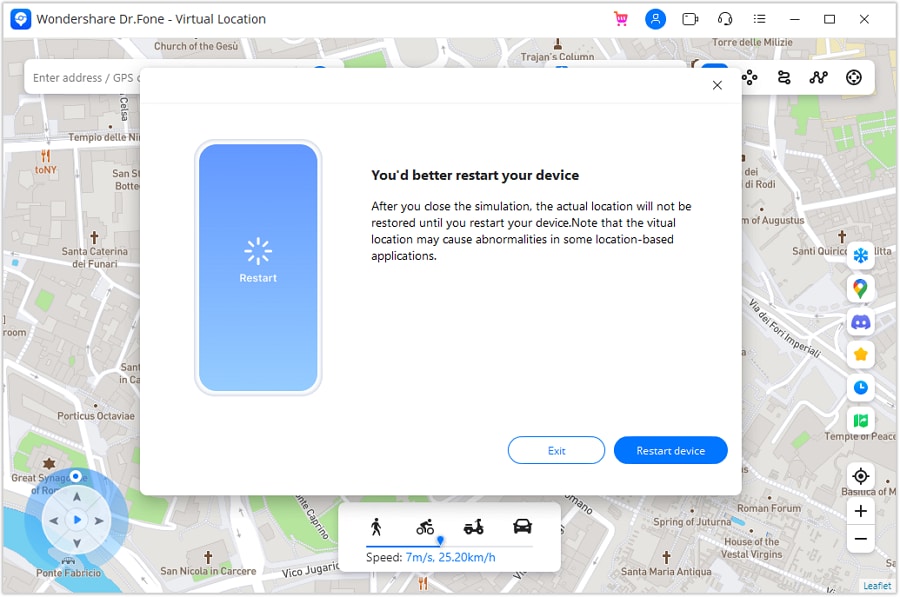
A GPS simulation and a VPN solve different technical problems. Restore the actual location before using navigation or live location sharing, and do not assume either method overrides another app's terms or eligibility checks.




Conclusion
Choose the tool by the signal you need to test. An Android-style mock-location setup can supply simulated coordinates on a compatible Huawei device; a VPN changes the IP-based view of routed traffic. Neither should be described as a universal privacy shield or a guaranteed way to unlock region-restricted services.
For a separate supported-device GPS test, Dr.Fone - Virtual Location is the relevant product rather than a generic phone-management download. Confirm compatibility before using the workflow above.
FAQ
1. Does a VPN change GPS coordinates on Huawei?
No. A VPN changes the public IP address used by routed traffic. Apps with device-location permission may still receive the phone's physical position.2. Why is Select Mock Location App empty or missing?
An empty list can mean no suitable app is installed. A missing setting may reflect the operating system, device policy or a different menu layout. Check your exact software version and official instructions instead of assuming every Huawei device follows Android steps.3. Does enabling Developer options immediately fake my location?
No. On supported Android-style software, you must select a compatible installed mock-location app and start its simulation. Enabling the menu alone does not change coordinates.4. How do I return to my real location after a test?
Stop the simulation and follow the tool's restoration instructions. Clear the mock-app selection where offered and verify the actual position in maps before relying on location-dependent services.
 Add Wondershare Dr.Fone as a preferred source on Google



