
iPhone 13 SIM Failure: 13 Proven Ways to Fix 'No SIM Card' (2026)

Sep 30, 2026 • Filed to: Phone Repair Solutions • Proven solutions
 TL;DR:
iPhone 13 SIM failure and missing SIM alerts are primarily triggered by eSIM provisioning errors, outdated carrier configurations, or iOS software glitches, which can usually be fixed by refreshing network connections or updating system settings.
● Before initiating device resets, physically inspect the nano-SIM tray if your specific regional iPhone 13 model supports one, and contact your provider to verify that the eSIM profile or cellular plan is actively provisioned without account-level suspensions.
● Resolve software-based network conflicts sequentially by toggling Airplane Mode, installing available carrier settings updates, and executing a Reset Network Settings command to clear saved cellular and APN data without erasing personal files.
● If the connection issue stems from a carrier network restriction, iPhone 13 users must submit an IMEI request through the cloud-based Dr.Fone SIM Unlock Online service, as the desktop Dr.Fone Screen Unlock software strictly limits carrier unlocking to iPhone 5S through iPhone X models running iOS 12.0 to 14.8.1.
Ask AI for a summary
 ChatGPT
 Perplexity
 Gemini
 Claude
 Grok
Grok
"I am a fairly new user to iPhone 13 pro, I got this phone in January of this year. All of a sudden today I began getting a message that says “SIM card failure”. I reached out to Verizon who directed me to reset my network settings to factory settings, this fixed the problem, however, I’ve now had to do this THREE times since today and the last time it did not fix the problem. My phone does not have a physical SIM card and I cannot figure out what is suddenly causing this issue. I haven’t dropped or damaged my phone at all. Any ideas? "---from Apple Discussions Community

If you are seeing SIM Failure, No SIM Card, or No SIM Available on an iPhone 13, iPhone 13 Pro, or iPhone 13 Pro Max, the issue is usually caused by an eSIM activation glitch, outdated carrier settings, weak network coverage, an inactive plan, or a temporary iOS system error. In many cases, the problem can be fixed without replacing your phone or visiting a repair store.
Many users search for answers like why does my iPhone 13 keep saying no SIM available, iphone 13 no sim issue, or iphone 13 pro max sim not working. The good news is that most SIM-related problems on iPhone 13 models are software, carrier, or configuration issues rather than permanent hardware failure. This guide explains the causes first and then walks you through the most effective fixes in the right order.
It is also important to know that does iPhone 13 have a SIM card depends on your region and model. Some iPhone 13 devices support a physical nano-SIM and eSIM together, while others rely more heavily on eSIM. That is why does iPhone 13 have physical SIM and no sim card iPhone 13 are common questions when the phone suddenly loses cellular service.
Part 1: What Causes SIM Failure on iPhone 13?
The most common causes of SIM failure iPhone 13 errors are a poorly seated physical SIM, eSIM activation problems, carrier setting conflicts, iOS glitches, weak signal, or an inactive cellular plan. If your iPhone 13 says No SIM Card or No SIM Available, identifying the cause first helps you choose the right fix faster.
In simple terms, your iPhone must successfully communicate with either a physical SIM card or an eSIM profile, then connect that line to your carrier account and current network. If any part of that chain breaks, you may see SIM failure on iPhone 13, iPhone 13 Pro sim failure, or iPhone 13 Pro Max SIM not working messages.
1. SIM Card Tray
If your iPhone 13 model uses a physical SIM, a loose tray or misaligned card is one of the fastest explanations for a sudden SIM failure on iPhone 13. Even a slight shift can interrupt contact and trigger repeated no-SIM alerts, dropped service, or activation warnings.
2. Damaged SIM Card
A worn, scratched, or aging SIM card may no longer be read consistently. This often leads to random errors such as no sim card iPhone 13, intermittent signal loss, or service that returns briefly after reinserting the card. Testing the SIM in another compatible phone can quickly confirm whether the card itself is failing.
3. Malfunctioning of System
Not every SIM problem is caused by the SIM. Temporary iOS communication errors can stop your iPhone from recognizing the line properly, especially after crashes, system freezes, or abnormal restarts. In those cases, the phone may show No SIM Available on iPhone 13 even when the SIM or eSIM is still active.
4. Problematic Software Update
A buggy or incomplete iOS update can affect modem communication, carrier settings recognition, or eSIM activation. This is why some users notice SIM failure iPhone 13 Pro or SIM failure iPhone 13 Pro Max right after installing a new iOS version.
5. Active Plan
Your iPhone also needs an active carrier plan to complete normal cellular registration. If the account is suspended, the eSIM profile is not fully activated, or the line has provisioning issues, your device may behave like there is no SIM at all even though the hardware is fine. This is especially common in carrier-specific cases such as Verizon SIM failure iPhone 13.
Tips: Looking for an all-in-one mobile management software? Look no further than Dr.Fone App - the ultimate choice for all your needs:
- For iOS Users: Free up space with Smart Clean, remove any restriction including screen lock, iCloud activation lock, MDM, or Apple ID, and transfer data easily between devices with our all-in-one iOS solution.
- For Android Users: Bypass screen locks and FRP with our Android unlocker, change your location with one click, and repair damaged Samsung devices with ease.
Discover more possibilities for mobile management solutions with Dr.Fone App (iOS) and Dr.Fone App (Android). Don't miss out, try it now and revolutionize your smartphone experience.



Part 2: What to Do If Your iPhone 13 Says No SIM Card?
If your iPhone 13 says No SIM Card, No SIM Available, or SIM Failure, start with the simplest fixes first: check whether the SIM or eSIM is active, toggle Airplane Mode, restart the device, update carrier settings, and reset network settings. These steps solve many iphone 13 no sim issue cases without data loss.
The best way to troubleshoot is to move from basic connection checks to deeper system fixes. That matters because some issues are caused by network registration or carrier provisioning, while others come from iOS or eSIM setup problems. Follow the solutions below in order for the fastest results.
1. Check if SIM Malfunctions
A failing SIM card can trigger recurring errors even when your phone is working normally. If your iPhone 13 keeps saying there is no SIM, test the physical SIM in another compatible phone or ask your carrier to verify the eSIM profile. This is one of the fastest ways to distinguish a line problem from a device problem.
2. Check your Activation Error
If your device or line was recently activated, the issue may be related to delayed carrier provisioning. In that case, the message may look like a SIM problem, but the actual cause is incomplete activation. This is common when users ask, why does my iPhone 13 keep saying no SIM available right after setup or after switching carriers.
3. Reset the SIM Card
If your model uses a physical SIM, remove the SIM tray, inspect the card, wipe it gently with a dry microfiber cloth, and insert it again carefully. This simple reset helps restore proper contact and can resolve SIM failure iPhone 13 messages caused by dust, poor alignment, or temporary read errors.
📱 iPhone Frozen? Fix It in 3 Steps – No Data Loss!
Struggling with a frozen iPhone screen? 🤔 Our guide covers 6 common causes, step-by-step fixes for all models (iPhone 6s to iPhone 17), and safe data recovery. 98.6% success rate! ✨
4. Play with Airplane Mode Settings
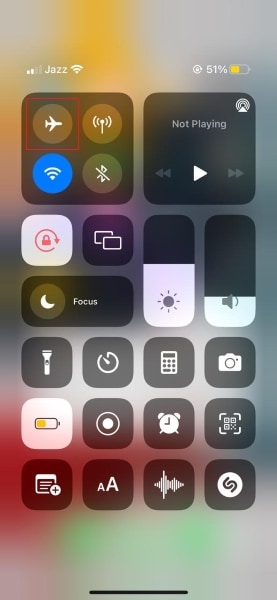
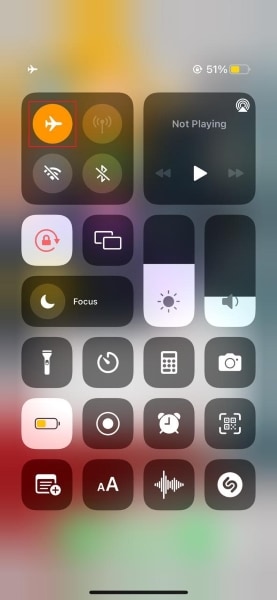
Toggling Airplane Mode forces your iPhone to disconnect from and reconnect to the cellular network. This can refresh network registration and clear brief carrier communication problems that look like a SIM fault.
- Step 1: To enable the Airplane mode, you need to access the "Control Centre". For that, from the top right corner of the screen, swipe down. From the Control Centre, locate the "Airplane Mode" icon and click on it to enable it.
- Step 2: After a few seconds of enabling it, you can now disable it in the same way.
5. Reinsert SIM
If you use a physical SIM, reinserting it is worth trying even if the card already looks normal. A proper re-seat helps the phone detect the card again and is especially useful when iPhone 13 Pro Max SIM not working appears after travel, a restart, or a carrier change.
6. Restart your iPhone 13
A restart clears temporary software glitches, resets carrier communication, and often resolves random No SIM Available on iPhone 13 alerts. It is one of the safest first-line fixes because it does not erase your data or settings.
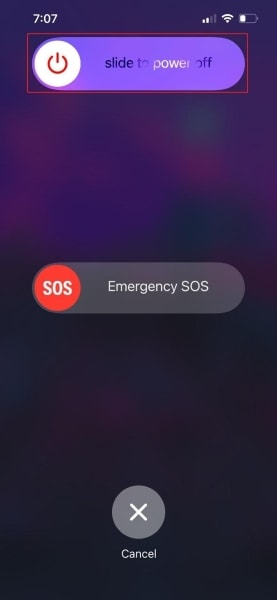
- Step 1: To restart your iPhone, firstly press and hold either of the Volume buttons with the Side button simultaneously.
- Step 2: By doing this, a slider will appear on the screen saying 'Slide to Power Off.’ Move this slider to the right side to turn off your mobile device. Now, press and hold the ‘Power’ key; this will turn on your mobile again.
7. Check the Network Coverage
Weak signal can mimic a SIM problem. If your network bars drop, flicker, or disappear in certain places, the issue may be poor coverage rather than SIM damage. This is why some users mistake local signal instability for SIM failure iPhone 13 Pro Max or constant SIM failure on iPhone.
8. Factory Reset your iPhone 13
A factory reset is a deeper troubleshooting step that can fix persistent configuration or system issues, but it should only be used after basic methods fail because it erases your data. Back up your iPhone first if you decide to continue.
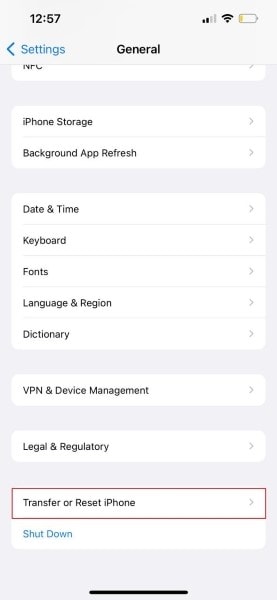
- Step 1: To factory reset your phone, start by launching the 'Settings' app. Then from the menu list, locate and select the 'General' option. Scroll down in the ‘General’ tab and click on 'Transfer or Reset iPhone'.
- Step 2: A new screen will show up from where you have to select the option of ‘Erase All Content and Settings'.
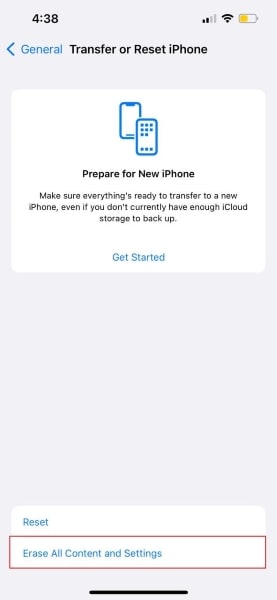
- Step 3: A prompt message will appear asking you to confirm your identity either with a passcode or face identity. Do that and select the "Erase iPhone" option.

9. Look for iOS Update
Keeping iOS updated helps fix modem bugs, carrier compatibility issues, and activation-related glitches. If your problem started after instability or strange system behavior, installing the latest iOS version may restore normal SIM or eSIM detection.
- Step 1: To check for iOS updates, first open the "Settings" app and then select the "General" option. In the General tab, look for the option of "Software Update" and click on it.
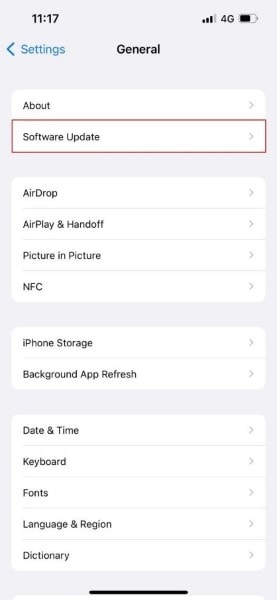
- Step 2: In case there is any update available, just "Download and Install" it.
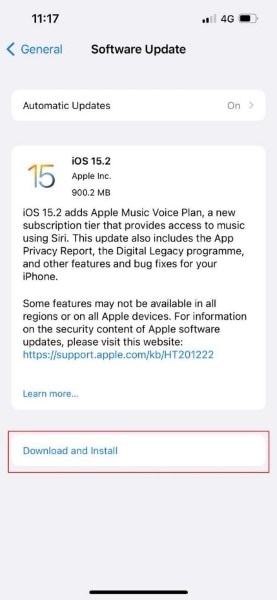
10. Reset Network Settings
Resetting network settings removes saved cellular, Wi-Fi, VPN, and APN-related conflicts that may block normal carrier connection. It is one of the most effective fixes when your iPhone 13 keeps saying no SIM available or when cellular service fails after switching lines or carriers.
- Step 1: Start by launching the "Settings" app on your iPhone and moving to the "General" tab.
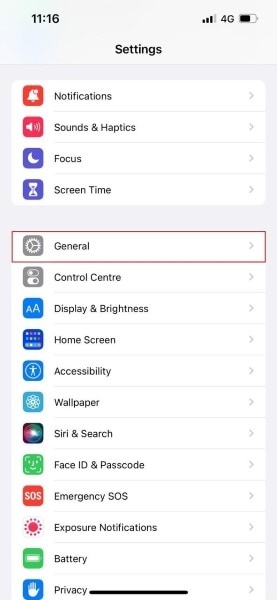
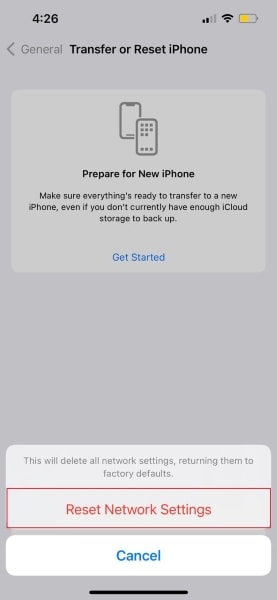
- Step 2: Then, scroll a little and look for "Transfer or Reset iPhone". A new screen will show up, move to the end and select the "Reset" option. There, just click on "Reset Network Settings" and enter your security lock, if asked.
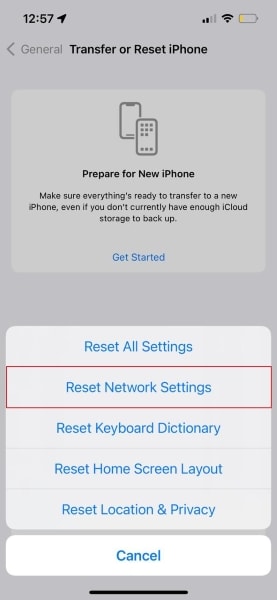
- Step 3: Lastly, confirm your reset network by selecting the option of "Reset Network Settings".
11. Check your Plan
An inactive or incorrectly provisioned plan can make it look like your SIM has failed. Before assuming hardware damage, confirm with your carrier that your line is active, your eSIM is properly assigned, and there are no account-level restrictions affecting service.
12. Update Carrier Settings
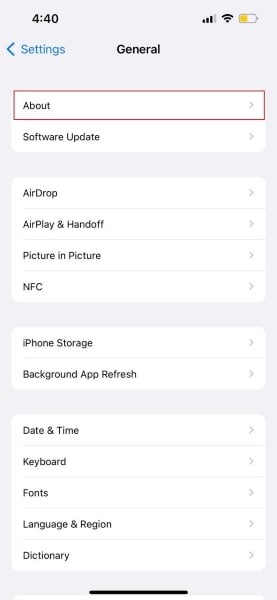
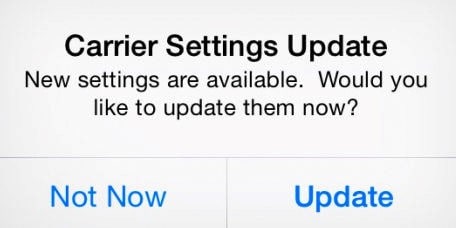
Carrier settings updates help your iPhone communicate correctly with your mobile network. If these settings are outdated, you may see connection problems, activation errors, or repeated SIM alerts, especially in region- or carrier-specific situations such as Verizon SIM failure iPhone 13.
- Step 1: To update Carrier Settings, first open the "General" tab from the "Settings" app. From there, open the "About" section and locate the "Carrier" option.
- Step 2: In case a new version is available, you will be asked to update.
13. Contact Apple
If none of the methods above works, the issue may involve hardware, deeper modem faults, or a carrier activation conflict that requires official support. Contact Apple Support or your carrier if the SIM or eSIM still cannot be recognized after you complete all troubleshooting steps.
Bonus Part - Doctor for iPhone Problems
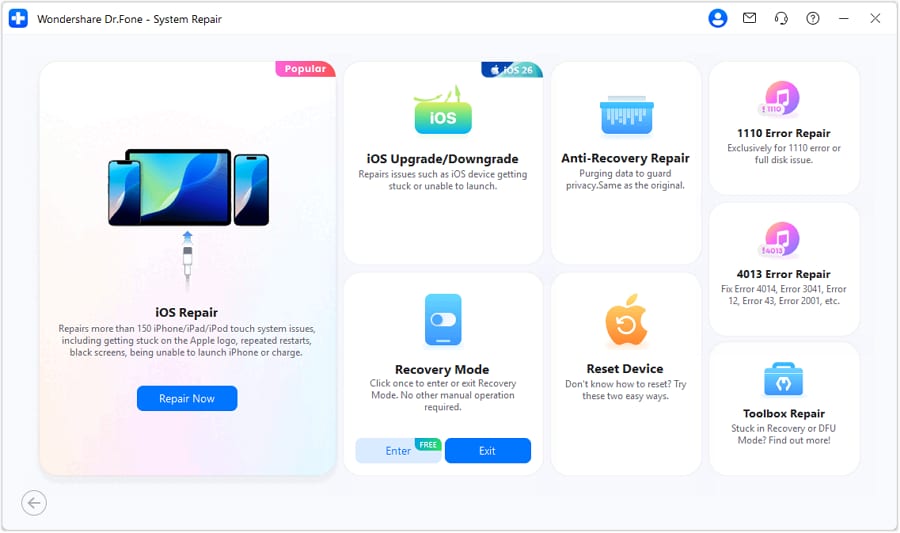
Dr.Fone – System Repair (iOS) is a practical option when your SIM problem appears to be linked to iOS instability rather than the carrier line itself. If your iPhone shows SIM failure iPhone 13, freezes, loops, or keeps losing service after common fixes, this tool can repair many system-level issues without data loss and help restore normal device behavior.
Dr.Fone - System Repair (iOS)
Repair iOS System Errors Without data loss.
- Only fix your iOS to normal, no data loss at all.
- Fix various iOS system issues stuck in recovery mode, white Apple logo, black screen, looping on start, etc.
- Downgrade iOS without iTunes at all.
- Works for all models of iPhone, iPad, and iPod touch.
- Fully compatible with the latest iOS Version.

And you could watch this YouTube video for an in-depth tutorial.
 safe & secure
Part 3: How to Fix SIM Failure or SIM Card Lock via Dr.Fone - Screen Unlock?
Before using this method, it is important to understand the difference between SIM failure and SIM lock. A SIM failure or no-SIM issue means the iPhone cannot properly detect or connect to the line. A SIM lock issue means the phone is restricted to a specific carrier. If your device is carrier-locked and you need to switch networks, Dr.Fone - Screen Unlock (iOS) can help remove those restrictions.
This section is especially relevant when users think they have SIM failure iPhone 13, but the real issue is that the device is still limited to the original network provider. In those cases, unlocking the carrier restriction can restore normal SIM usage on another supported network.
Dr.Fone - Screen Unlock (iOS)
Remove SIM Lock Without Hassle.
- Simple, click-through, process.
- Unlock screen passwords from all iPhones and iPad and Unlock iPhones without any carrier restrictions.
- No tech knowledge is required, everybody can handle it.
- Support all models of iPhone, iPad, and iPod touch
Note: For SIM unlock, the supported device is iPhone 5S to iPhone X running iOS 12.0 to iOS 14.8.1.
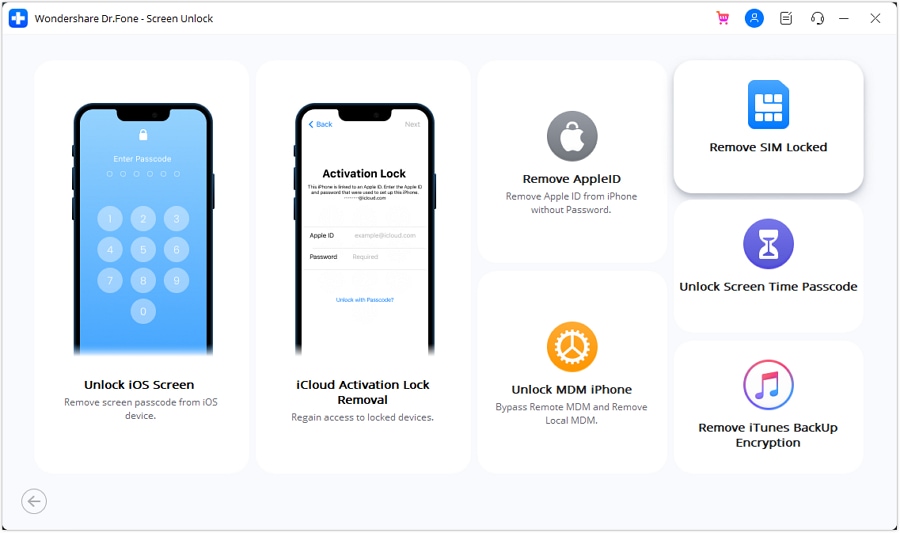
- Step 1: Turn to the homepage of Dr.Fone - Screen Unlock and then choose "Remove SIM Locked".
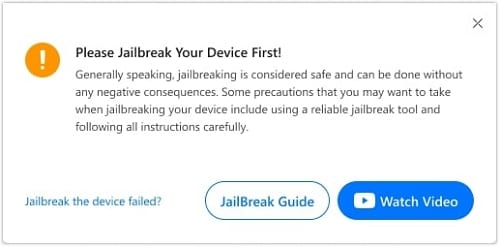
- Step 2: Make sure your iPhone has connected to your computer. After confirming all device information, click on "Unlock Now" to continue. Then follow the Jailbreak Guide to jailbreak your iPhone for Sim unlock.
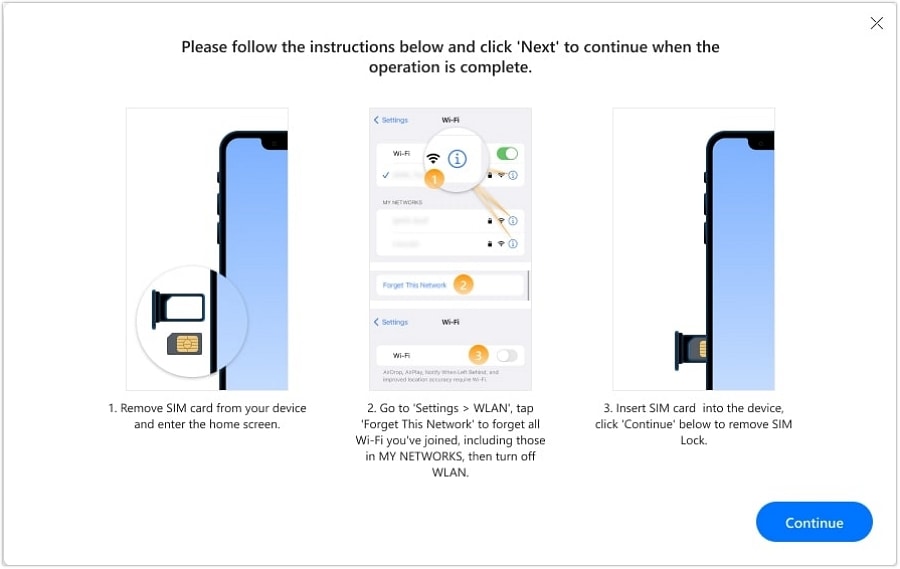
- Step 3: Follow the on-screen instructions to reinsert the SIM card and click "Continue".
- Step 4: You will see the program is removing the Sim lock, wait patiently and keep your device connected.
- Step 5: Now, the sim lock is removed successfully!
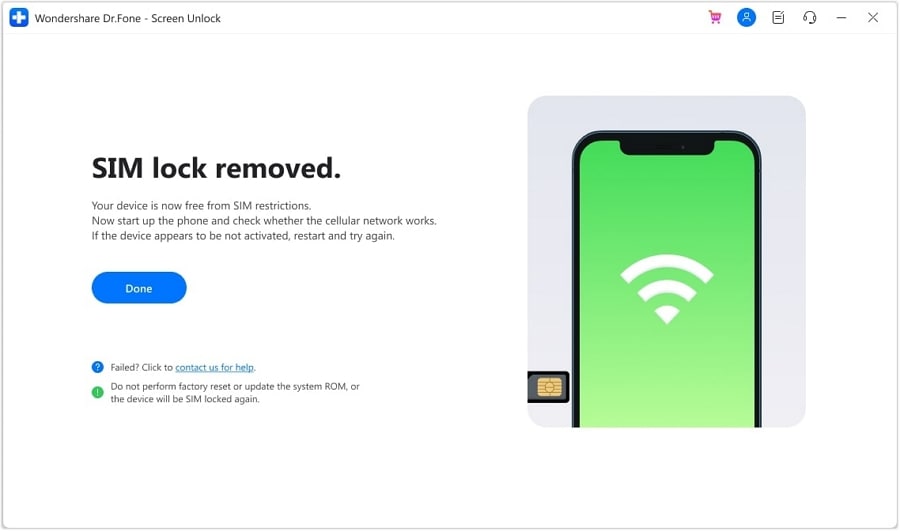
All you need to do is obey the guides. If you want to know more about our service, welcome to visit the iPhone SIM Unlock guide.
 safe & secure
Part 4: How to Check Carrier Restriction and Remove SIM Lock Online
If your iPhone 13 still shows SIM-related problems after basic troubleshooting, there is one more thing worth checking: whether the device is still restricted to its original carrier. This matters most when you recently switched networks, inserted another SIM, or restored service but still cannot use a different carrier line normally.
Dr.Fone SIM Unlock offers an online way to review your carrier lock status and submit a SIM unlock request without installing desktop software. It is a practical option when the issue is not a damaged SIM or eSIM glitch, but a carrier restriction that prevents your phone from accepting another network.
The process is simple: prepare your IMEI, confirm the right country and carrier, and follow the online request flow. This keeps the section aligned with users searching for carrier unlock, network unlock, SIM restriction removal, or a way to switch carriers more smoothly.
Before you start: This method is best for carrier lock or network restriction scenarios. If your iPhone has no service because of a damaged SIM, failed eSIM activation, or an inactive carrier plan, fix those issues first.
What you need: Your device IMEI number, the correct country, and the original carrier information linked to the phone.
Support scope: Online SIM unlock availability depends on the selected carrier and service route shown on the page when you submit your details.
Go to the official Dr.Fone SIM Unlock page in your browser. This is the online entry where you can start the carrier unlock request directly.
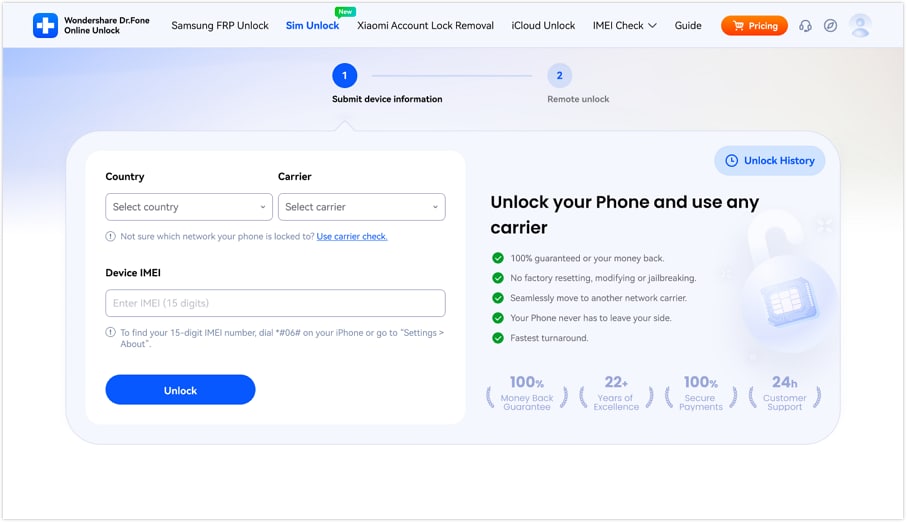
Choose the correct Country and Carrier from the drop-down lists, then enter your device IMEI. Accurate details are important because the unlock request is matched to the device and carrier information you provide.
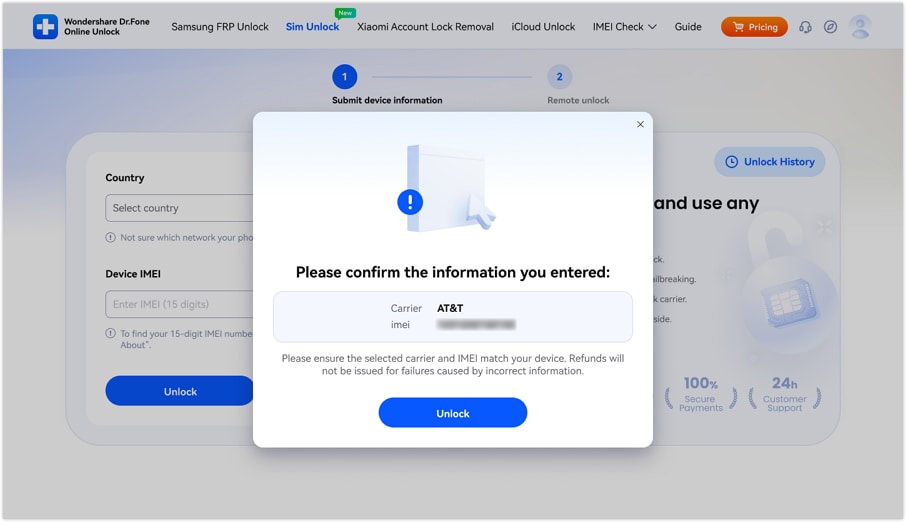
Before you continue, double-check the carrier name and IMEI shown on the confirmation screen. This helps avoid delays caused by a wrong network selection, an incorrect IMEI, or a mismatch between the phone and the original carrier account.
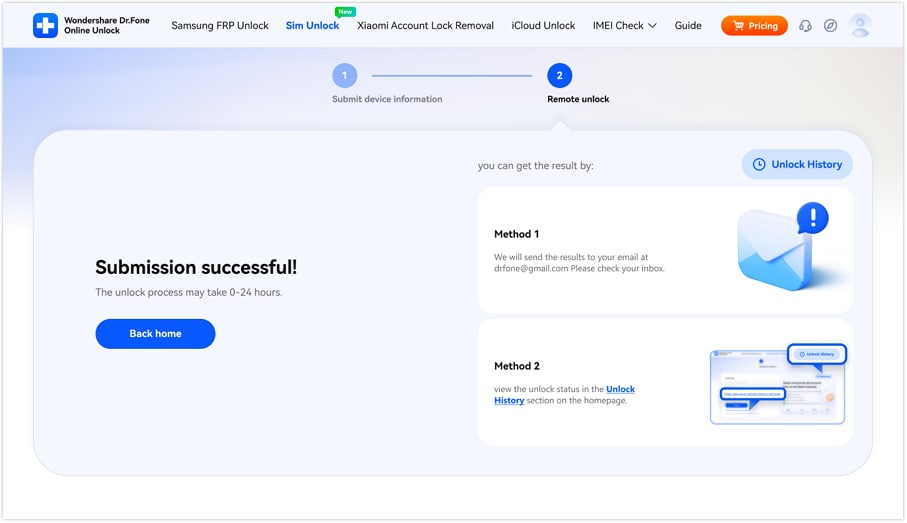
Once everything looks correct, submit the request online. The service will process your SIM unlock request in the cloud, so you do not need to connect the phone to a computer for this step.
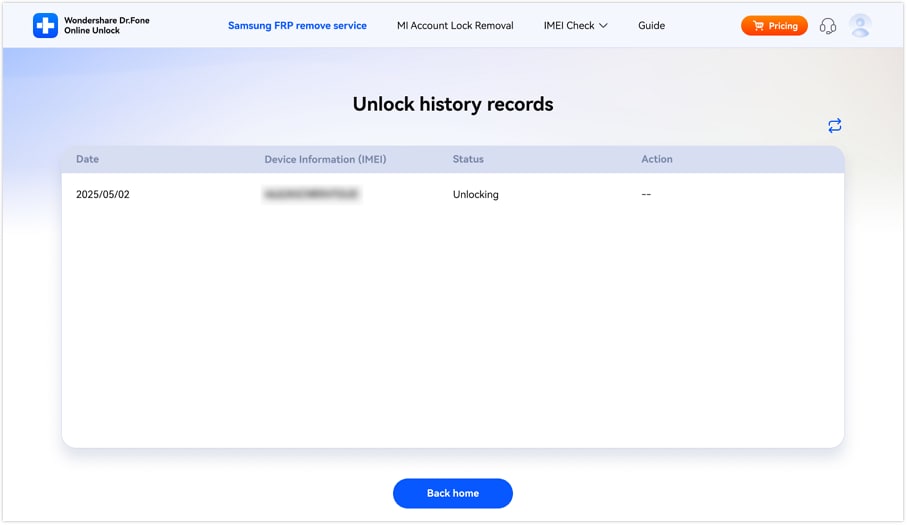
After processing is complete, check the result through the email address used for the request or through the unlock history page if available. If the phone was carrier-restricted, this is the stage where you can confirm whether it is ready to work with another supported SIM.
Tip: If you are unsure whether the problem is a real SIM failure or a carrier lock, check the carrier status first before spending time on repeated resets.
Important: A successful SIM unlock request does not repair hardware faults, damaged SIM cards, or carrier account suspension. It is designed for carrier restriction removal.
For users dealing with switching carriers, network lock limits, or SIM restriction messages after all basic fixes, this online route is a much better fit than sending them into an unrelated desktop unlock flow.
Concluding Thoughts
If you are dealing with SIM failure iPhone 13, iPhone 13 Pro SIM failure, or iPhone 13 Pro Max SIM not working, the most effective approach is to check the SIM or eSIM status first, then move through carrier, network, and system fixes in order. Problems such as No SIM Card or No SIM Available on iPhone 13 are often caused by activation, settings, or software issues rather than permanent hardware damage.
However, if these methods don't resolve the issue, we recommend using Dr.Fone - Screen Unlock (iOS). This tool is effective in managing a variety of iOS issues, potentially providing the fix your device needs.
safe & secureFAQs
 Q1. Does iPhone 13 have a SIM card or only eSIM?Q2. Why does my iPhone 13 keep saying No SIM Available?Q3. What should I do if I see No SIM Card on iPhone 13?Q4. How can I fix Verizon SIM failure on iPhone 13?


iPhone 13 Issues
- Apps Keeps Stopping
- 1. iPhone 13 Safari Not Working
- 2. iPhone 13 Apps Keep Crashing
- 3. iPhone 13 Apps Stuck on Loading
- 4. iPhone 13 WhatsApp Calls Don't Work
- 5. iPhone 13 Won't Download Apps
- 6. iPhone 13 Apps Not Opening
- 7. iPhone 13 Apps Won't Update
- 8. iPhone 13 Safari Freezes
- 9. iPhone 13 Safari Not Loading Pages
- iPhone 13 Charging Issues
- 1. iPhone 13 Battery Draining Fast
- 2. iPhone 13 Overheating
- 3. iPhone 13 Overheats While Charging
- 4. iPhone 13 Won't Charge
- iPhone 13 Not Working
- 1. iPhone 13 Overheating And Won't On
- 2. iPhone 11/12/13 Won't Turn On
- 3. iPhone 13 Restarts
- 4. iPhone 13 Problems
- iPhone 13 Screen Issues
- 1. iPhone 13 Touch Screen Not Working
- 2. iPhone 13 Stuck on White Screen
- 3. iPhone 13 Frozen Screen
- 4. iPhone 13 Black Screen
- 5. iPhone 13 Camera Black Screen
- 6. iPhone 13 Goes Black During Call
- iPhone 13 Services Fail
- 1. iPhone 13 Face ID Not Working
- 2. iPhone 13 Not Ringing
- 3. iPhone 13 Call Failed
- 4. iPhone 13 Poor Call Quality
- 5. iPhone 13 iMessage Not Working
- 6. iPhone 13 Dropping Calls
- 7. iPhone 13 No Service Problem
- 8. iPhone 13 Not Receiving Calls
- 9. iPhone 13 SIM Failure/No SIM Card
- 10. iPhone 13 iMessage Not Syncing
- 11. iPhone 13 Hotspot Not Working
- iPhone 13 Tips
- ● Manage/transfer/recover data
- ● Unlock screen/activate/FRP lock
- ● Fix most iOS and Android issues
- Free Download Free Download Free Download

 > How-to > Phone Repair Solutions > iPhone 13 SIM Failure: 13 Proven Ways to Fix 'No SIM Card' (2026)
Daisy Raines
staff Editor
Generally rated4.5(105participated)