Recover photos, messages, WhatsApp, and more — no backup
needed.
Recover photos, messages, WhatsApp, and more — no backup
needed.

 100% Security Verified | No Subscription Required | No Malware

 :
: 
 ChatGPT
 Perplexity
 Gemini
 Claude
 Grok
Grok
Deleted an important Android video? Stop recording, downloading, updating, or installing apps on the affected phone until you check for another copy. It may still be in the Gallery Trash, Google Photos Trash, or a cloud backup. If it was permanently deleted from modern encrypted internal storage, recovery may not be possible, especially after a factory reset.
Follow this step-by-step guide on how to recover deleted videos from Android on Samsung, Google Pixel, OnePlus, and other devices. First check the Gallery Trash, Google Photos, and other backups in Part 3; only if those fail, assess the conditional computer scan in Part 2. Menu paths, supported files, and permissions vary with your Android version, manufacturer, and storage type.
In this article
Part 1. What Happens to Videos When You Delete Them on Android?
A deleted video may first move to a Gallery or Google Photos Trash rather than disappear immediately. If there is no Trash or backup copy, whether a file can be accessed depends on where it was stored. Encryption and storage cleanup on modern Android phones can make permanently deleted internal-storage files unrecoverable even when a recovery app can scan the phone.
Act promptly, but do not assume a deleted file remains intact until a new file overwrites it. Stop taking photos, installing apps, and saving files to the affected storage. If the lost video was on a removable microSD card, stop using that card; a card-reader scan on a computer is a different option from scanning encrypted internal phone storage.
Many Gallery or file-manager apps have a "Trash," "Bin," or "Recently Deleted" folder, but its name, location, and retention period vary by manufacturer and version. Google Photos has a separate Trash tied to your Google account. Check both: deleting a video in one app does not guarantee another app holds a second copy.
Part 2. If Trash and Backups Fail: Assess a Desktop Scan
Only after checking Part 3, consider a desktop scan if the video is still missing. Wondershare Dr.Fone - Data Recovery (Android) offers recovery workflows for supported Android devices, but no scan guarantees a video permanently deleted from internal storage is recoverable. Check your exact device and version, required access, file type, and fees before making changes to the phone.
Dr.Fone advertises support for 6,000+ Android models, with scanning and preview before a possible recovery. That model count is not a success rate or proof that your exact configuration is supported. Phone-storage scanning may require permissions or root for some approaches; the product's "No Root Needed" language specifically describes Google Drive or supported broken-phone routes, not every direct scan. Free scanning or preview need not include free export.
Key Capabilities of Wondershare Dr.Fone:
- Offers direct phone-data scans on compatible Android devices; deleted internal files may still be inaccessible.
- Offers separate Google Drive and supported broken-phone routes; check your precise model and feature compatibility.
- Lists videos alongside photos, WhatsApp chats, contacts, and other supported types; results vary by source.
- Offers scans and previews before recovery; verify whether exporting any found file requires a paid license.
A Step-by-Step Guide to Recovering Videos with Dr.Fone
If no copy is available in Trash or a backup and the phone can connect, use these computer steps to check for available files—not as a promise to recover data deleted from encrypted storage. Screenshots illustrate one desktop interface; controls may differ by version.
-
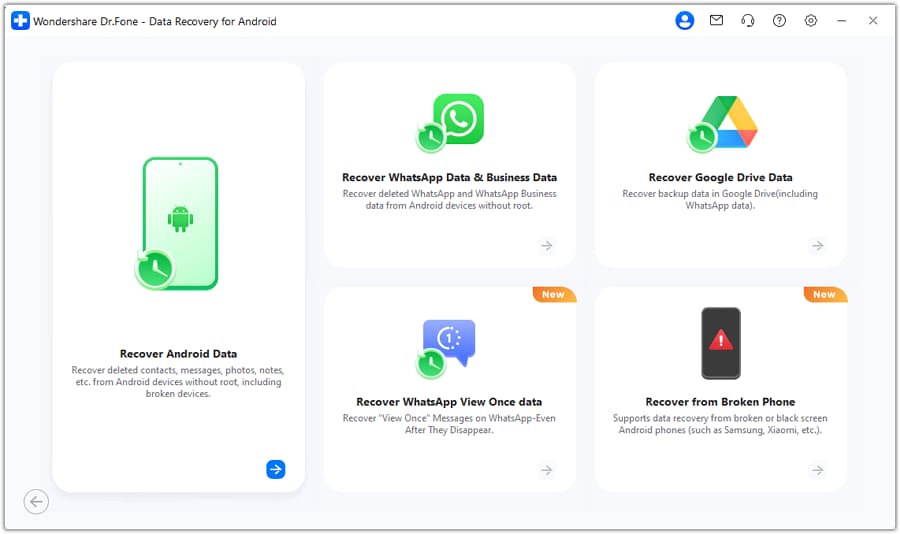
Step 1 Launch Dr.Fone and Select Data Recovery
Install Wondershare Dr.Fone on your computer, not the affected phone. Open "Toolbox" > "Data Recovery" > "Android" > "Recover Android Data," as described in the official recovery guide. Connect the phone with a USB cable, allow only the access required by this workflow, and confirm it is recognized. If it is locked or not detected, do not factory-reset or root it solely to run a scan.
-
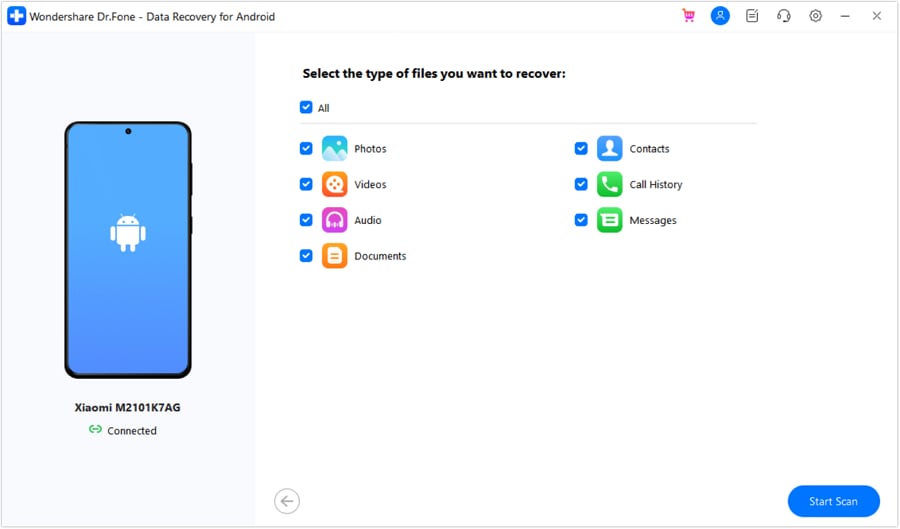
Step 2 Choose File Types and Start Scanning
Once Dr.Fone recognizes the phone, review the offered file types and select "Videos" if available; select any other needed types as well. Click "Start Scan" and wait for it to finish before inspecting the results. A video category on screen does not prove that your original deleted video still exists; encryption, access permissions, and storage cleanup can limit the scan.
-
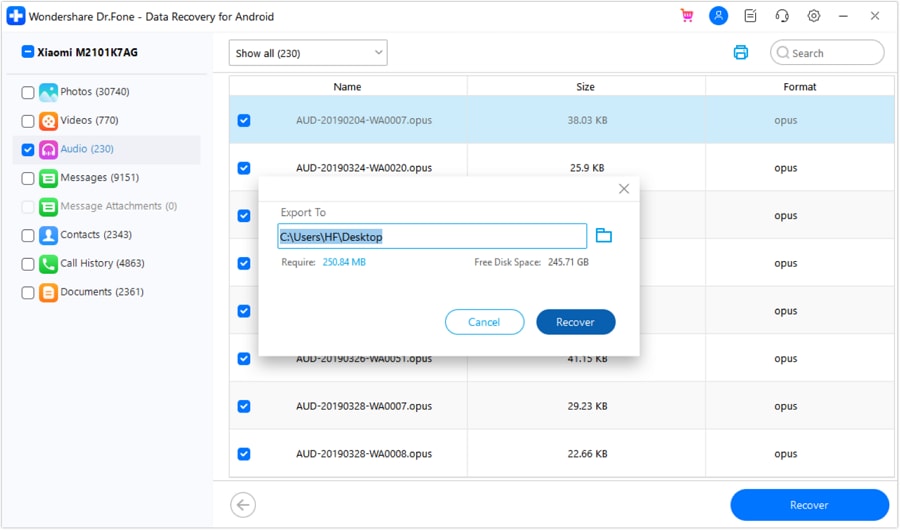
Step 3 Preview and Restore Your Videos
Review the files actually shown, using filters and a preview if available to identify the right video. A thumbnail does not guarantee the full file will play. If you locate it, select it, click "Recover," and choose a folder on your computer or another storage device in the pop-up before confirming. Never save results to the storage being scanned. Confirm any paid export requirement, and verify the recovered video's duration and playback.
 Scan Android phones and tablets directly.
- Preview and recover only what you want.
- Supports WhatsApp, photos, videos, contacts, and more.
- Works with 6000+ Android devices.
Product-box clarification: "Without Backup" and the model count above describe offered features, not a guarantee that permanently deleted videos can be recovered on this phone. Try Trash and backups below first; a factory reset usually removes the keys needed to access earlier encrypted internal files.
Part 3. First: Restore from Trash or an Existing Backup
Start with these three built-in or backed-up methods, even though their section appears after the conditional desktop procedure. They avoid installing an app on the affected phone and can retrieve a copy that still exists. Confirm the original account for each service; different apps have separate Trash folders.
Method 1: Check the 'Recently Deleted' or 'Trash' Folder
Some Android Gallery apps temporarily retain deleted videos in Trash or Recently Deleted. To recover deleted videos on Samsung and other Android phones, adapt the steps below to your manufacturer's Gallery version. Retention periods, menu labels, and whether the feature exists vary; a Google Photos deletion may not be in your manufacturer's Gallery Trash.
-
Step 1 Access Your Gallery's Trash
Open the Gallery app. Look in its Menu, Albums, or Settings for "Trash," "Bin," or "Recently Deleted"; the menu may be marked with three dots or lines. If you cannot find it, consult help for your exact device and Gallery version. The screenshot below shows one example, not a universal route.

-
Step 2 Select and Restore Videos
If the missing video is still in Trash, long-press it and select any other needed videos, then tap "Restore." Find the restored item in the Gallery and check that it plays; its location depends on the app. If nothing appears, check Google Photos separately before concluding the file was permanently erased.

Method 2: Restore Videos from Google Photos Backup
Check the correct Google account's library and Google Photos Trash. Google's current Android help says Trash items are permanently deleted after 30 days and can only be restored while still in Trash. Older advice distinguished 60 days for backed-up items and 30 for unbacked-up items; the current help no longer makes that distinction. Backup still determines whether an additional cloud copy exists. Check promptly.
-
Step 1 Open the Google Photos Bin
Open Google Photos and verify the Google account that originally held the video. At the bottom, tap Collections > Trash (called "Bin" in some regions). Older app versions and the screenshot below may show "Library" rather than "Collections." Also search the main Google Photos library in case a backup still exists there.

-
Step 2 Restore the Deleted Videos
If the video is in Google Photos Trash, touch and hold it, select any others, and tap "Restore" at the bottom. Google says the restored item returns to your Photos library and previous albums, and may reappear in the phone's Gallery. Open it to verify playback. If it is absent from or permanently deleted from Trash, Google's in-app Restore cannot retrieve it.

Method 3: Re-Download from Your Cloud Storage Service
If you previously uploaded a separate copy to Google Drive, Dropbox, OneDrive, or a manufacturer's cloud account, check that service independently. A Google Photos backup does not necessarily create a separate Google Drive copy. Each provider maintains its own Trash and retention rules; this route works only when the missing video was saved there.
-
Step 1 Log into Your Cloud Account
Use the cloud provider's phone app or website on another device and sign in to the account that held the video. Inspect the original folder and any upload or backup locations. Avoid enabling a new sync that might change an existing copy before confirming what is stored there.

-
Step 2 Check the Trash and Download
If the video is not in its folder, look for that provider's "Trash" or "Bin." Restore it there if needed, then choose "Download" or "Save to device" to make another copy. If the only copy was on a removable SD card, remove and preserve the card; a computer card reader and compatible recovery software may be an option for an unencrypted card. Save any result elsewhere, not back onto that card.

Part 4. No PC? Check On-Phone Options and Risks
Without a computer, check Gallery Trash, Google Photos, and previously made cloud backups on your phone first. The Wondershare Dr.Fone mobile app offers Android data-management and recovery functions, but installing any new app onto the affected phone writes data and may reduce the chance of finding a deleted file. Do not install an app solely to scan that same internal storage when there is no Trash or backup copy.

Mobile features such as a Recycle Bin are preventive: if enabled beforehand they may protect future deletions, but cannot recreate a video deleted before installation. Check current supported file types, requested permissions, and any charges on the official app page. The original desktop and mobile download buttons below remain as published; they should not be taken as advice to write new data to a phone whose missing file you are preserving.




Conclusion
To recover deleted videos from Android, stop writing to the affected storage and check Gallery Trash, the correct Google Photos account and Trash, and any separate cloud or SD-card backup. Restore a found copy and confirm that it plays. These low-risk checks should precede installing or paying for recovery software.
If there is no copy, a compatible desktop scan such as Dr.Fone's may help determine whether an accessible file remains; free preview does not necessarily mean free export. No program can promise recovery of permanently deleted videos from encrypted internal storage. A removable SD card has a different computer/card-reader route. After a factory reset, look for a backup rather than counting on a scan.
FAQ
-
1. Can I recover videos after a factory reset on my Android?
Usually only from a pre-existing backup or another copy. A modern Android factory reset removes the encryption keys for previous internal-storage data, so recovery software should not be presented as a way to retrieve the old video. Check Google Photos, other cloud services, computer backups, and any SD card that was not erased. Do not reset the phone again in hopes of recovery. -
2. How long do deleted videos stay in the Trash or Bin folder?
Check immediately: Gallery retention varies by manufacturer, app, and version. Google's current Android help says Google Photos Trash items are deleted after 30 days, whether or not they were backed up; older 60-day advice for backed-up files may be outdated. Once you empty Trash or permanently delete an item there, Google Photos cannot restore it. Verify other providers' policies separately. -
3. Will the quality of the recovered videos be the same?
An intact original restored from Trash or a backup retains the quality of that saved version; a cloud upload may have a different resolution. A scan result can be incomplete or unplayable, so preview it if possible and verify the exported video's duration and playback before discarding any remaining copy. -
4. Is it safe to use third-party video recovery software?
No tool is risk-free. Download desktop software from its official site, review USB permissions and privacy terms, and save any recovered file to other storage. Installing an app on the affected phone or granting root may write data or affect security. Check Trash and backups first; verify exact device support and any export charges before proceeding. -
5. Can I recover a video deleted from a removable microSD card?
Possibly, if the card was not encrypted and can be read as a drive through a computer card reader. Stop using it and save any found video to the computer—not onto the original card. An adopted or encrypted card may remain tied to its phone, and no scan guarantees the file still exists. -
6. Can I restore a permanently deleted video without a backup or root?
Check Gallery Trash and Google Photos Trash first; neither needs root. If the only copy has been permanently deleted from encrypted internal storage, no-root apps cannot guarantee recovery. Some scans require device-specific access or root, with attendant risks. Dr.Fone's no-root claims for Google Drive or supported broken-device routes do not imply that every phone-storage scan works without root.
 Add Wondershare Dr.Fone as a preferred source on Google