Resolve common problems and system crashes on both iPhone and Android devices.

 100% Security Verified | No Subscription Required | No Malware

 :
: 
 ChatGPT
 Perplexity
 Gemini
 Claude
 Grok
Grok

My iPhone shows an SOS icon next to the battery, and I can't get rid of it. I have Wi-Fi at home and can browse the internet, but I can't make calls, send texts, or use WhatsApp. I've completely lost communication.
A Concerned iPhone User
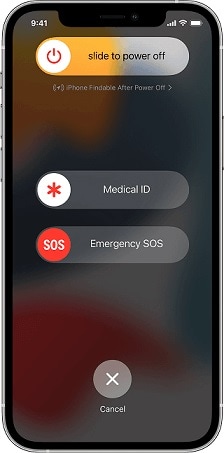
The Emergency SOS feature on your iPhone is a crucial safety tool designed to help you quickly contact emergency services and alert your emergency contacts with your location. However, this life-saving feature can become a major headache when your device gets stuck on the SOS screen, leaving you unable to make calls, send messages, or use any other apps.
When your iPhone is stuck in SOS mode, it can be incredibly frustrating, especially if you need to use your phone urgently. Fortunately, this is a common issue with several effective solutions. This guide will walk you through the primary causes of this problem and provide five reliable methods to get your iPhone back to normal functionality. We'll cover everything from simple restarts to more advanced system repair tools.
In this article
Part 1. Why Is My iPhone Stuck on the Emergency SOS Screen?
Before diving into the solutions, understanding the root cause can help prevent the issue from recurring. It's often due to either a user error or a software-related glitch. Here are the most common reasons your iPhone gets stuck on the SOS screen.
1-1. Accidental Button Combination
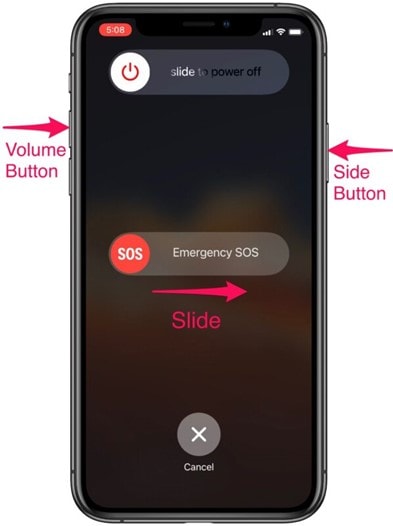
One of the most frequent causes is unintentionally pressing the specific button combination that activates Emergency SOS. On modern iPhones, this combination is similar to taking a screenshot (holding the side button and one of the volume buttons). If you press and hold these buttons for too long, you might inadvertently trigger the SOS countdown, and a software bug could cause it to freeze on that screen.
1-2. Failed Jailbreak Attempt
While less common today, jailbreaking your iPhone to remove software restrictions can lead to system instability. A failed or incomplete jailbreaking process can corrupt essential system files, causing your device to boot into a non-functional state, such as being stuck in Emergency SOS mode, as a protective measure.
1-3. iOS System Crash or Software Bug
Even though iOS is known for its stability, it's not immune to bugs or crashes. A critical software glitch, often occurring after an iOS update or due to a conflict with a third-party app, can cause the operating system to behave unexpectedly. This can lead to your iPhone getting stuck on the SOS screen without any direct action on your part.
Part 2. 5 Effective Methods to Fix an iPhone Stuck in SOS Mode
Now that you know the possible causes, let's explore the solutions. Start with the simplest method and work your way down to the more advanced ones.
Method 1: Use a Professional iOS System Repair Tool (No Data Loss)
If you're looking for a quick and reliable solution that won't erase your data, using a specialized tool like Dr.Fone - System Repair (iOS) is highly recommended. This software is designed to fix over 150 iOS system issues, including an iPhone stuck on the SOS screen, without requiring technical expertise.
-
Step 1 Launch Dr.Fone and Select System Repair
Download and install Dr.Fone on your computer. Launch the application and navigate to the "System Repair" module from the main toolbox.
-
Step 2 Choose iOS and Repair Type
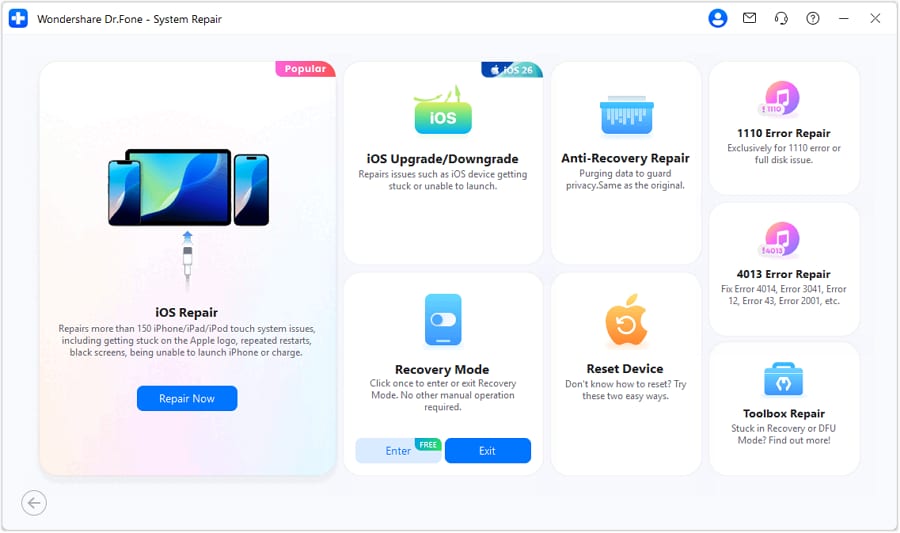
Connect your iPhone to the computer using a USB cable. On the next screen, select "iOS" as your device type. Then, choose "iOS Repair" to proceed with fixing system-related problems.
-
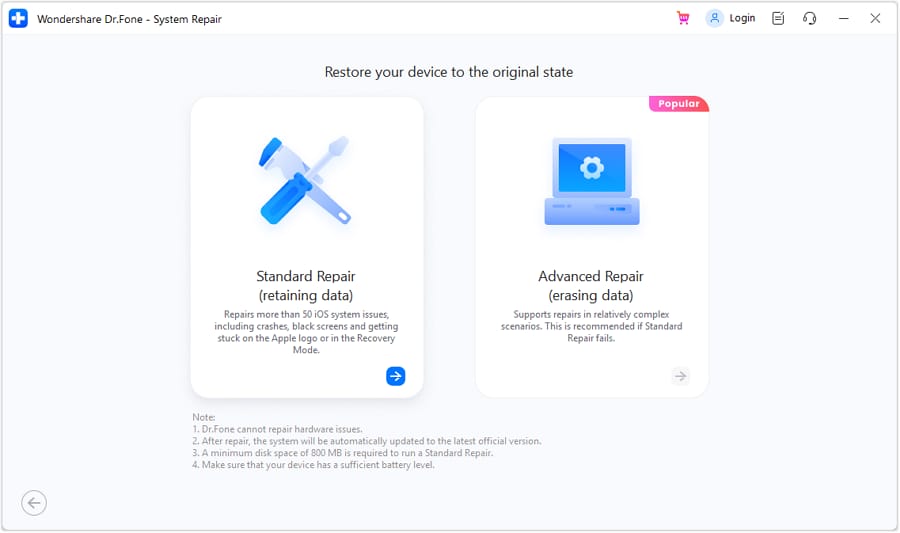
Step 3 Select Standard Repair Mode
You will be presented with two repair options. Select "Standard Repair," as this mode can resolve most iOS issues without causing any data loss. It is the ideal choice for fixing an iPhone stuck in SOS mode.
-
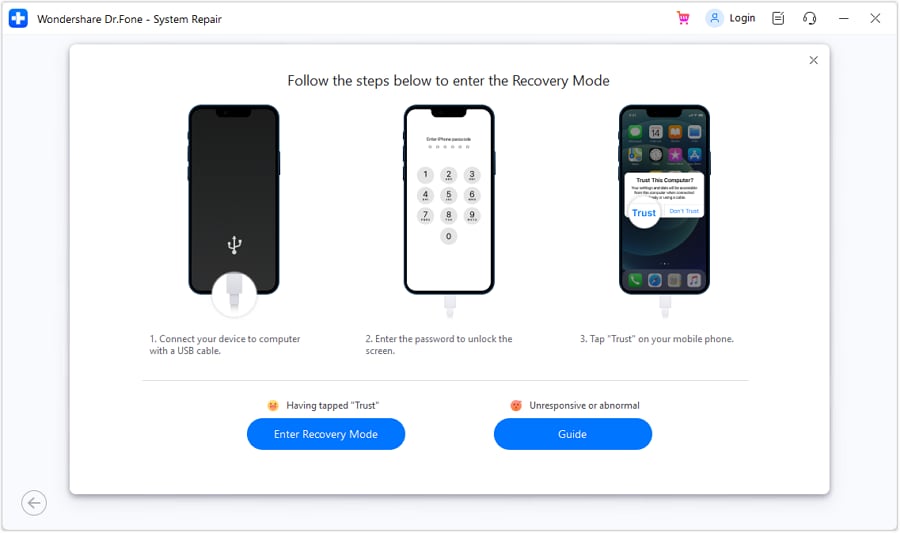
Step 4 Enter Recovery Mode
The software will require you to put your iPhone into Recovery Mode. Follow the on-screen instructions specific to your iPhone model to do this. Once the device is in Recovery Mode, Dr.Fone will automatically detect it.
-
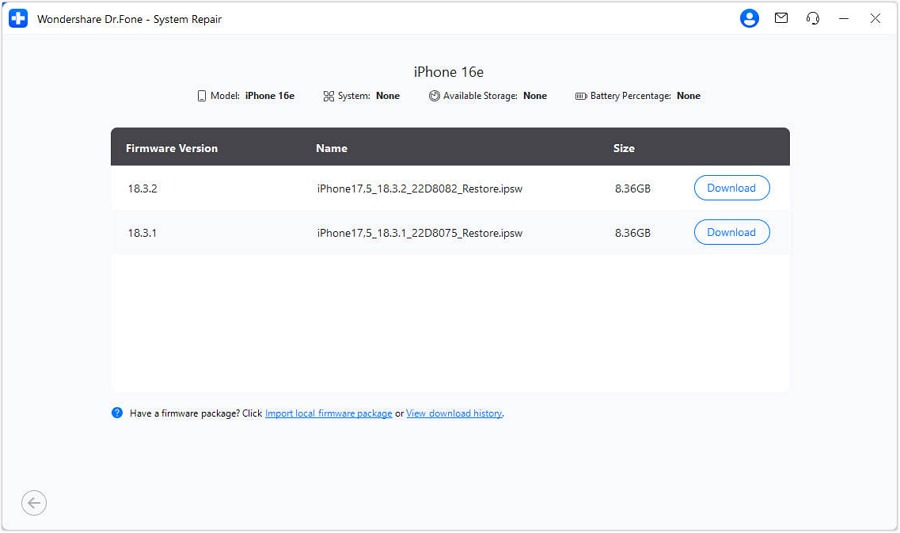
Step 5 Download the Correct iOS Firmware
Dr.Fone will identify your iPhone model and display the available iOS firmware versions. Select the appropriate version and click "Download" to begin downloading the firmware package.
-
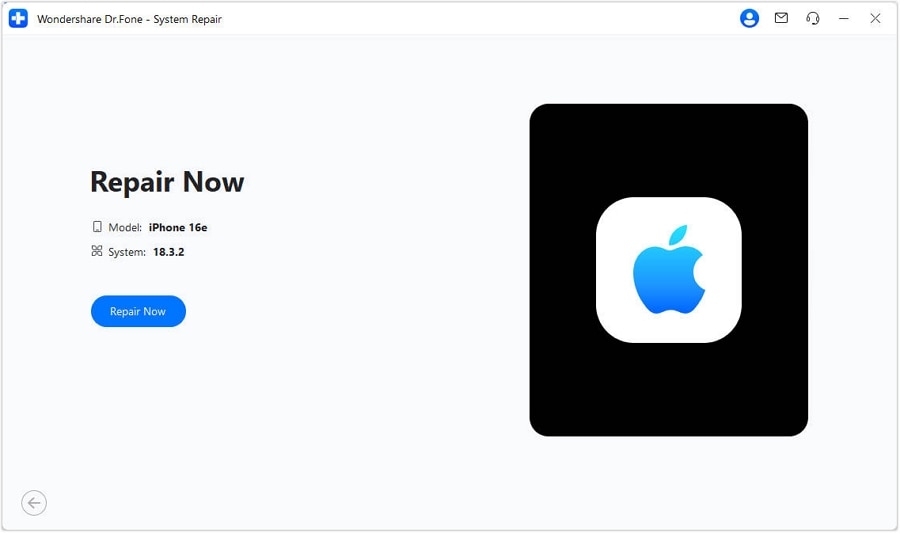
Step 6 Start the Repair Process
After the firmware is downloaded and verified, the screen will show that it's ready to repair your device. Click the "Repair Now" button to initiate the system repair process.
-
Step 7 Complete the Repair
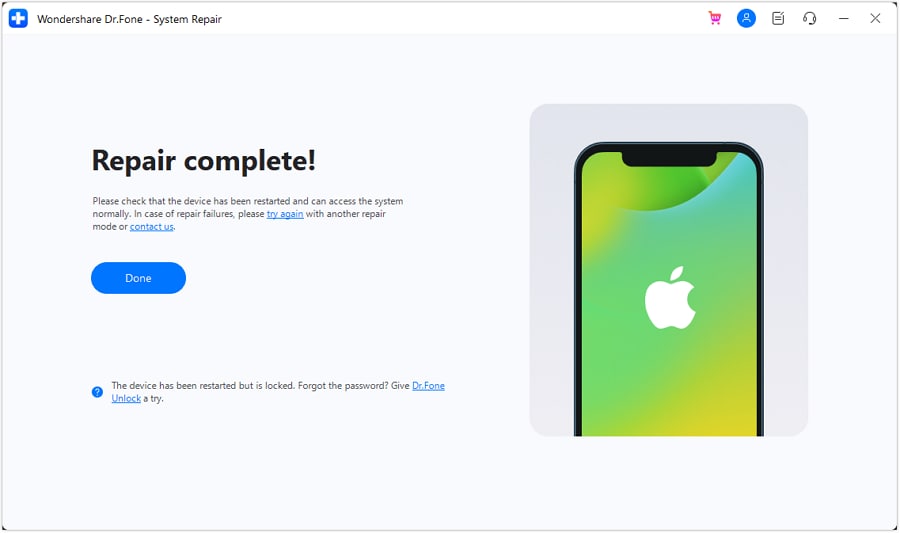
The repair process will take a few minutes. Keep your iPhone connected throughout. Once it's finished, a confirmation window will appear. Click "Done." Your iPhone will restart and should be out of the Emergency SOS mode.
 Fix iOS issues, no data loss.
- One-click repair for all iOS problems.
- Solve recovery mode, Apple logo, black screen, etc.
- Upgrade or downgrade iOS without iTunes
Method 2: Force Restart Your iPhone
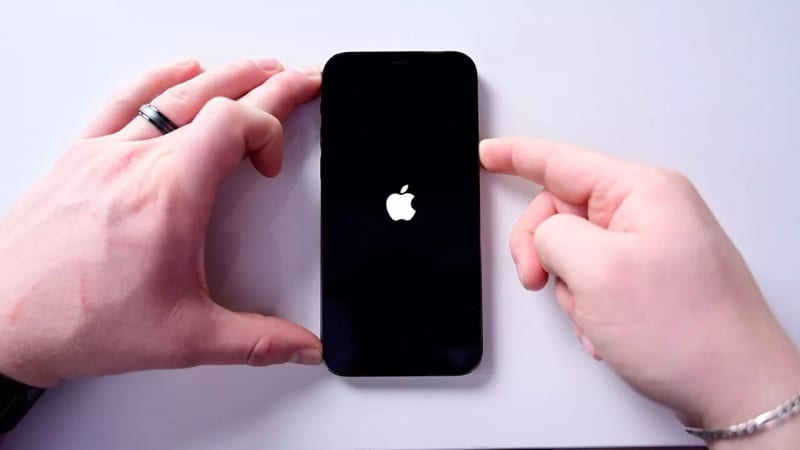
A force restart is often the simplest and quickest way to resolve minor software glitches. It won't delete any of your data and can effectively get your iPhone out of the SOS screen. The procedure varies depending on your iPhone model.
- For iPhone 8, X, 11, 12, 13, 14, 15 & SE (2nd gen or later): Quickly press and release the Volume Up button. Immediately press and release the Volume Down button. Then, press and hold the Side (Power) button until the Apple logo appears.
- For iPhone 7 and 7 Plus: Press and hold both the Side (Power) button and the Volume Down button simultaneously. Keep holding them until you see the Apple logo.
- For iPhone 6s, SE (1st gen) & Earlier: Press and hold both the Home button and the Top (or Side) Power button at the same time. Continue to hold them until the Apple logo appears on the screen.
Method 3: Update or Restore Your iPhone in Recovery Mode
If a force restart doesn't work, placing your iPhone into Recovery Mode and connecting it to a computer is the next logical step. This allows iTunes (on older macOS/Windows) or Finder (on macOS Catalina and later) to fix the software.
- Connect your iPhone to your computer using a lightning cable and open iTunes or Finder.
- Follow the specific button sequence for your model to enter Recovery Mode. It's similar to a force restart, but you must keep holding the buttons even after the Apple logo appears, until you see the Recovery Mode screen (a computer and cable icon).
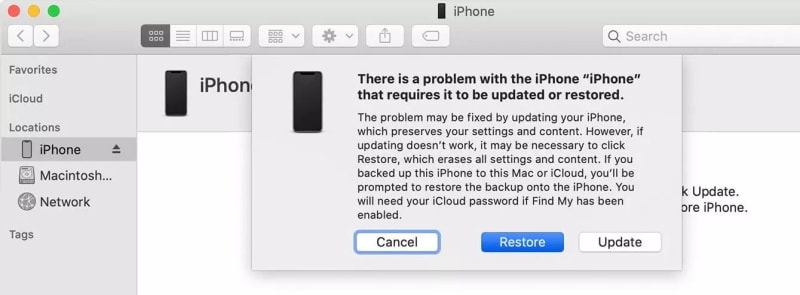
- Once your computer detects the iPhone in Recovery Mode, a pop-up window will appear, giving you the option to Update or Restore.
- First, choose Update. This will attempt to reinstall iOS without erasing your data. If the update process fails or doesn't solve the problem, you may need to repeat the steps and choose Restore, which will erase all your data and install a fresh version of iOS.
Method 4: Perform a Factory Reset via iCloud
This method should only be used as a last resort, as it will completely erase all data on your iPhone. It requires that you have the "Find My" feature enabled on the stuck device and know your Apple ID credentials.
- Step 1. On another device, open a web browser and go to iCloud.com. Sign in with your Apple ID and password.
- Step 2. Click on the "Find My" icon.
- Step 3. From the "All Devices" dropdown menu at the top, select your stuck iPhone.
- Step 4. Three options will appear. Click on "Erase iPhone" and confirm your choice. This will remotely wipe your device and should resolve the iPhone stuck on SOS screen issue. You can then restore your data from a recent backup.
Method 5: Contact Apple Support for Professional Help
If you've tried all the methods above and your iPhone is still unresponsive, there might be a more severe software issue or even a hardware problem. In this case, your best option is to contact Apple Support directly.

You can schedule a call, start an online chat session, or book an appointment at a nearby Apple Store or Authorized Service Provider. Their technicians have the diagnostic tools to identify the exact cause and perform the necessary repairs.
Part 3. How to Prevent Accidental Activation of Emergency SOS
If you find that you are accidentally triggering the Emergency SOS feature, you can adjust its settings to make it less sensitive. While we don't recommend disabling this safety feature entirely, you can turn off the simpler activation methods.
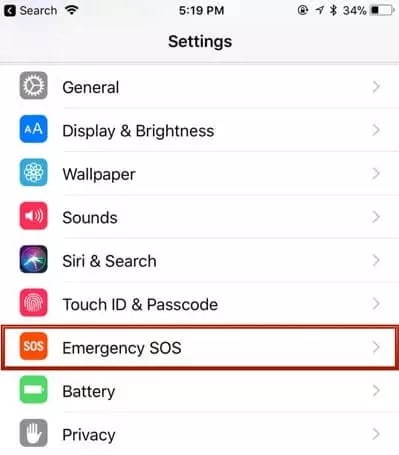
- Step 1. Open the Settings app on your iPhone.
- Step 2. Scroll down and tap on Emergency SOS.
- Step 3. Here, you can toggle off "Call with Hold and Release" (or "Call with Side Button" on older models). This prevents the SOS sequence from starting just by holding the side and volume buttons. You can still access the SOS slider by rapidly pressing the side button five times.
Conclusion
Having your iPhone stuck on the Emergency SOS screen is a disruptive experience, but it's almost always fixable. We recommend starting with the simplest solutions like a force restart before moving to more technical steps like Recovery Mode. However, for a guaranteed fix that is both safe and easy and protects your personal data, using a dedicated tool like Dr.Fone - System Repair (iOS) is the most efficient and stress-free option. It handles the complexities for you, getting your device back to perfect working order in just a few clicks.
FAQ
-
1. What does the Emergency SOS mode on an iPhone do?
Emergency SOS is a safety feature that allows you to quickly and easily call for help and alert your emergency contacts. When activated, it automatically calls local emergency services and sends a text message with your current location to your designated emergency contacts. -
2. Will force restarting my iPhone delete my data?
No, a force restart is a safe procedure that does not affect your data. It is equivalent to rebooting your computer and is used to shut down and restart the device when it's unresponsive, clearing out temporary memory and minor software glitches. -
3. Is it safe to use a third-party tool like Dr.Fone to fix my iPhone?
Yes, reputable system repair tools like Dr.Fone are specifically designed to be safe and secure. The Standard Repair mode fixes iOS system issues without accessing or deleting your personal data, making it a much safer option than a factory reset. -
4. What is the difference between 'Update' and 'Restore' in Recovery Mode?
When using Recovery Mode, selecting 'Update' instructs your computer to reinstall the iOS operating system while preserving your data and settings. 'Restore,' on the other hand, will completely erase your device and install a fresh copy of iOS, returning it to its factory state. Always try 'Update' first.
 Add Wondershare Dr.Fone as a preferred source on Google