Recover photos, messages, WhatsApp, and more — no backup
needed.
Recover photos, messages, WhatsApp, and more — no backup
needed.

 100% Security Verified | No Subscription Required | No Malware

 :
: 
 ChatGPT
 Perplexity
 Gemini
 Claude
 Grok
Grok
I accidentally deleted my important videos. What is the best video recovery app for Android that doesn't require me to root my phone?
Android User

When dealing with Android data loss and searching for the best video recovery app for Android, you will frequently encounter a complex technical requirement: rooting your Android device. Rooting is widely discussed, but many users wonder what it actually entails. Is it safe? Should you root your device just to get your precious files back? Most importantly, are there reliable video recovery apps for Android without root available in 2026?
We understand the panic that sets in when precious memories or important work files disappear. This guide compares five Android video recovery apps by root requirement, free-use limits, supported storage, preview options, and practical recovery limits. No app can guarantee recovery: results depend on where the video was stored, whether a backup or Trash copy exists, how much the device has been used since deletion, and what access the current Android version allows.
In this article
Part 1. What Is Rooting and Why Is It Used?
Any profound discussion around the Android operating system is essentially incomplete without addressing the term 'root' and the associated process called rooting. For the uninitiated, the concept can seem daunting. Simply put, rooting provides unhindered, administrative access to the entire Android operating system hierarchy.
In its normal state, your Android operating system functions within a secure sandbox environment. Specific critical areas of the OS are locked down to protect user privacy and ensure that the core system cannot be damaged or "bricked" by accidental user errors or malicious applications. By denying access to system files, the manufacturer ensures stability.
Rooting breaks down these barriers, providing unrestricted access to all segments of the operating system. This allows you to modify the OS in ways otherwise impossible. Rooting can affect warranty or support eligibility, depending on the manufacturer, device, and local consumer law. Check the manufacturer's current policy before you root your device. This is because users could inadvertently install incompatible software or a heavily modified, unofficial ROM that breaks the hardware integration.
Part 2. Should We Root Our Android Device?
This reality begs a perennial question for Android smartphone users: should we or should we not proceed with rooting our devices, especially when trying to utilize a deleted video recovery app?
The answer heavily depends on your technical expertise, comfort level with software modifications, and outright necessity. Sometimes, the urgency to recover a deeply deleted, irreplaceable video pushes users toward rooting to allow recovery software deeper access to the internal storage sectors. On current Android versions, storage sandboxing also limits what a non-root app can inspect, so available recovery paths vary by device, storage source, and backup status.
- Unlocks the full potential of your device hardware capabilities.
- Grants apps unrestricted access to all parts of the OS, aiding deep file recovery.
- Enables removal of manufacturer bloatware and pre-installed unwanted apps.
- Allows installation of custom operating systems (ROMs) to upgrade outdated Android versions.
- May affect warranty or manufacturer support, depending on the device and policy.
- High risk of "bricking" or completely killing your device if done incorrectly.
- Exposes the phone to malware, viruses, and severe security vulnerabilities.
- Breaks compatibility with essential banking and payment applications.
Root access is not required for every recovery path. Start with Trash, cloud backups, app-specific backups, and tools that clearly document what they can access without root. Deeper access does not guarantee that an overwritten video can be restored.
Before You Try a Video Recovery App
If a video was deleted recently, minimize use of the affected storage. Avoid recording new videos, downloading large files, or installing multiple recovery apps on the same phone, because new writes can reduce the chance of recovering deleted data. First check Google Photos, the Gallery or Files Trash, cloud backups, and the media folder or backup of the app that created the video.
Choose a Recovery Path Based on the Actual Problem
| Your question | What to check | Important limit |
|---|---|---|
| What is the best video recovery app for Android? | Root requirement, supported storage, video preview, file filters, current device support, and recovery destination | A high ranking or scan result is not a recovery guarantee |
| Is there a free video recovery app? | Whether “free” covers scanning, preview, and saving recovered files—not just installation | Free editions may cap file size, quantity, scan depth, or export |
| Can I recover videos without root? | Trash, backups, accessible folders, Google Drive, and documented no-root modes | Non-root apps cannot freely read every protected folder or raw storage area |
| Can I recover an old or permanently deleted video? | Backup history, original storage location, and device use since deletion | Once the relevant storage is overwritten, software cannot reconstruct the original video |
| Should I install the recovery app on the same phone? | Use built-in Trash and backups first; consider a documented computer workflow before adding new data | Installing or saving files to the affected storage creates new writes |
What “Without Root” Actually Means
“Without root” describes how a tool accesses data; it does not promise a particular recovery rate. A non-root scan may find accessible originals, cached copies, thumbnails, Trash items, or backup data, but Android sandboxing can block protected locations. Before paying, verify the exact Android version, device model, storage source, supported file types, what the free scan can preview, and where recovered files will be saved.
Part 3. Top 5 Video Recovery Apps For Android Without Root
The apps below represent different recovery and prevention approaches. Compare their current store listings, free-use limits, root requirements, and supported storage before choosing one. Features, pricing, and Android compatibility can change, and no app can recover data that has already been overwritten.
No. 1: Dr.Fone: Photo & Data Recovery
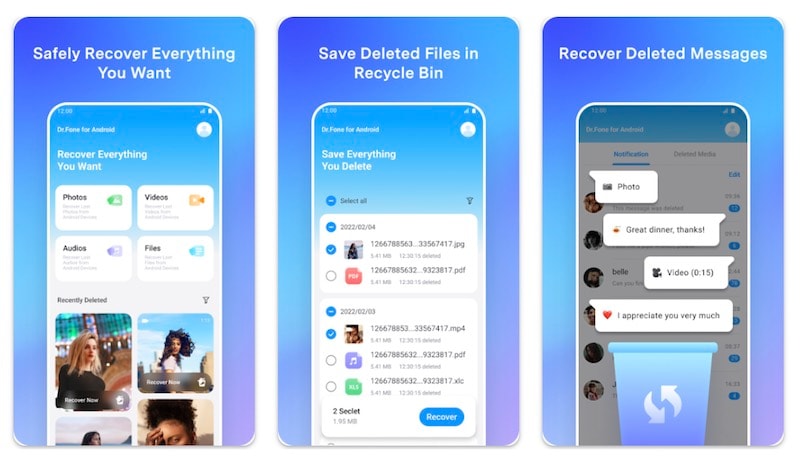
Dr.Fone: Photo & Data Recovery combines Android data recovery with backup and restore tools. Check its current app-store listing for the recovery sources, file types, free-use limits, and Android versions supported on your device; a no-root scan cannot guarantee access to deleted data in protected or overwritten storage.
Key Features:
- Supports robust photo and high-resolution video recovery natively.
- Includes dedicated audio, contact, and file document recovery functionalities.
- Features a powerful recycle bin for recently deleted files.
- Recovers media sent or received through major social apps (WhatsApp, Telegram, LINE, Instagram).
- Offers an encrypted Secret Space to safeguard your most private media.
- Built-in AI image enhancement to fix blurry recovered photos.
- Compatible with over 6000 Android devices across all manufacturers.
- Highly effective recovery without demanding root privileges.
- Advanced encryption keeps your recovered data secure.
- Fast scanning engine that parses internal and external memory.
- Premium features require a paid subscription model.
- Some heavily fragmented videos might only be partially recovered without desktop support.


No. 2: EaseUS MobiSaver
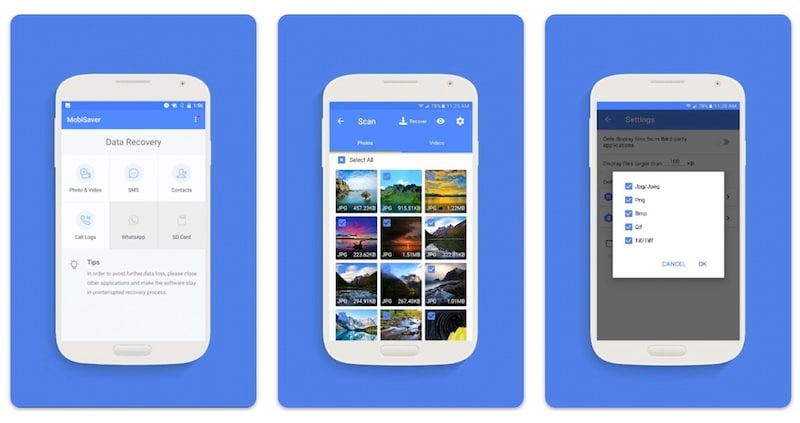
EaseUS MobiSaver is positioned as one of the most straightforward recovery tools available directly from the Google Play Store, boasting over 5 million downloads. It is an excellent video recovery app for Android tailored to users who need a simplified interface without navigating complex technical settings.
Key Features:
- Fast initial scanning of media folders.
- Visual preview feature allows you to examine videos before attempting full recovery.
- Built-in file filtering to refine search results by size and format.
- Completely operational without rooting the Android device.
- Very user-friendly layout suitable for beginners.
- Displays thumbnails effectively.
- The free version is extremely limited.
- Deep scans tend to be quite slow on older devices.
- Lacks advanced sector scanning for power users.
No. 3: Disk Video Recovery Pro
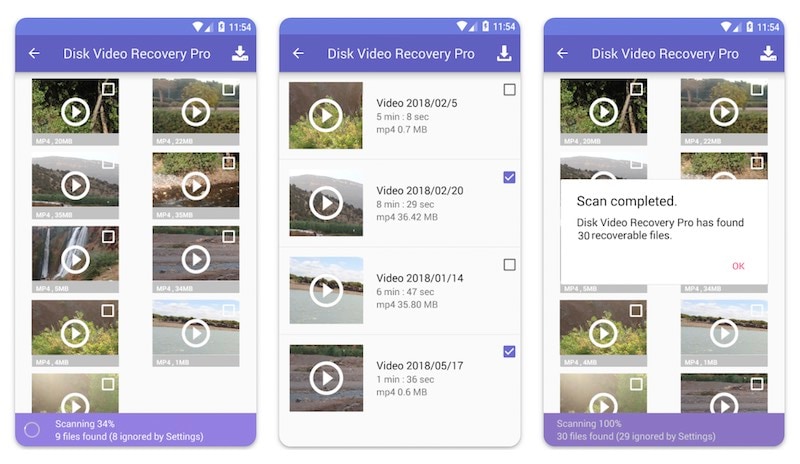
Disk Video Recovery Pro brings a specialized focus to media retrieval. This software is designed with an intuitive framework, making it accessible while delivering strong results for finding lost video fragments in hidden directories.
Key Features:
- Dual support for retrieving data from both SD cards and internal device storage seamlessly.
- Does not obligate you to root your device for baseline file discovery.
- Recognizes and supports a vast array of niche video formats.
- Incredibly simple to navigate interface.
- Free tier offers functional recovery without paywalls blocking results immediately.
- Falls short on providing advanced diagnostics for deeply deleted videos.
- Cannot recover data lost due to factory resets.
No. 4: Dumpster Android Video Recovery
Dumpster operates slightly differently than traditional forensic scanners, acting more as a proactive shield. It is easily one of the most heavily downloaded video recovery apps for Android without root because it creates an overarching recycle bin environment on your smartphone.

Key Features:
- Utilizes robust algorithms for background monitoring and instant recovery.
- Provides comprehensive backup capabilities alongside local file restoration.
- Features direct-to-cloud backup options.
- Extensive visual customization and locking features for privacy.
- Completely free from any root requirements.
- Capable of safeguarding app files and system data.
- Cloud synchronization ensures dual-layered protection.
- It is not a true post-deletion recovery app; it must be installed before the videos are lost to be fully effective.
- Constant background processing may slightly impact battery life on older phones.
No. 5: Video Recovery
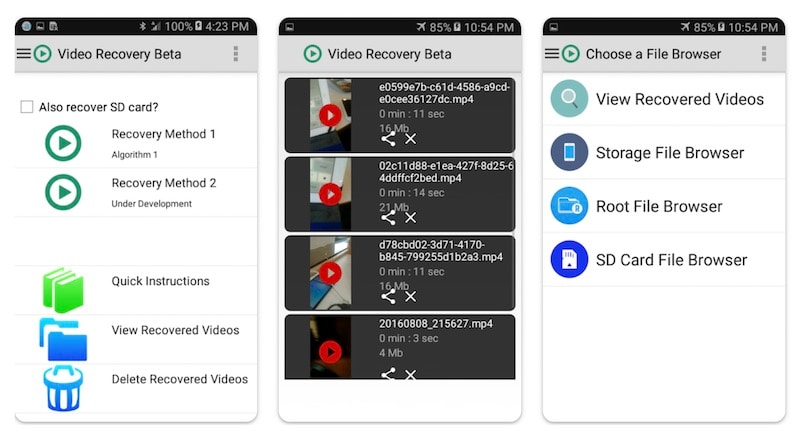
True to its straightforward name, Video Recovery is a lightweight, strictly focused photo and video recovery app for Android. It promises to locate recently erased multimedia files effectively without entangling the user in unnecessary premium features or mandatory system configurations.
Key Features:
- Operates smoothly without root permissions for standard scanning.
- Capable of identifying and recovering diverse photo and video extensions from local and external directories.
- If you choose to root eventually, it can switch to a deep-scan forensic mode.
- Completely free to use with no hidden subscription costs.
- Significantly lacks the customer support available with premium apps.
- Heavily populated with intrusive advertisements that disrupt the workflow.
When a Desktop Android Recovery Workflow Makes More Sense
 Scan Android phones and tablets directly.
- Preview and recover only what you want.
- Supports WhatsApp, photos, videos, contacts, and more.
- Works with 6000+ Android devices.
A computer-based workflow can be preferable when you want to avoid installing another app on the affected phone, preview recoverable items on a larger screen, or save selected files to a different storage device. It still cannot guarantee recovery, and direct phone scans may have device, permission, or connection requirements.
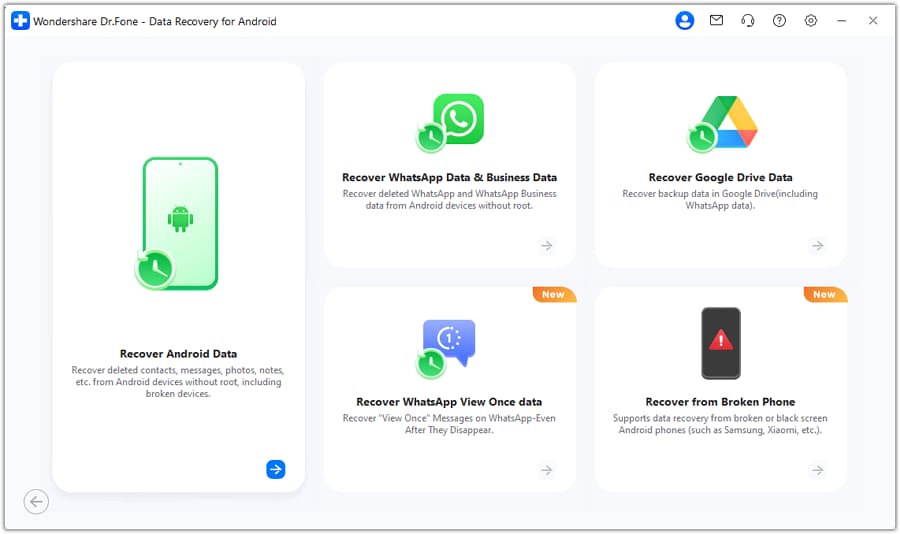
According to the current official product page, Dr.Fone - Data Recovery (Android) can scan and preview before purchase, recover selected files to a computer, and work with phone storage, Google Drive, or supported broken phones. Its published no-root claim specifically names Google Drive and supported broken-phone recovery; verify the requirements for direct phone-storage recovery before purchase.
- Preview scan results before deciding what to recover.
- Choose individual files and save recovered data to the computer.
- Supports photos, videos, contacts, messages, and other published file types.
- Supports 6,000+ models according to the current official product page.
- Includes Google Drive and supported broken-phone recovery paths.
- Device, Android version, source, and connection requirements still apply.


Conclusion
Start with the least invasive recovery source: Trash, Google Photos, cloud backups, and app-specific backups. If the video is not there, minimize new writes to the affected storage and compare recovery tools by supported source, preview capability, free-use limits, and current device compatibility.
A no-root tool can be the right first choice, but “no root” is not the same as guaranteed recovery. Keep recovered files on different storage, verify product requirements before paying, and treat regular backups as the most reliable protection against future video loss.
FAQ
1. Can I recover deleted videos on Android without rooting?
Sometimes. First check Trash, Google Photos, cloud backups, and the app that created the video. Non-root tools may recover accessible copies or supported backup data, but Android permissions and overwritten storage can prevent recovery.2. What is the best video recovery app for Android?
The best choice is the one that supports your Android version, device, storage source, and video format; previews the relevant files; explains its free and paid limits; and saves recovered files away from the affected storage. No single app is best for every deletion scenario.3. Is there a truly free Android video recovery app?
Some apps are free to install or scan, but recovery, large files, deep scans, or export may require payment. Check whether “free” includes preview and saving recovered videos rather than only the initial scan.4. What should I do immediately after deleting an important video?
Stop recording videos and downloading large files, check Trash and backups, and avoid installing several apps on the affected storage. If you recover a file, save it to a computer, SD card, or other separate storage.5. Can I recover an old or permanently deleted Android video?
Age alone does not decide recovery. The key questions are whether a backup or Trash copy exists and whether the original storage blocks have been overwritten. Continued phone use makes recovery less likely.6. Should I install a recovery app on the same Android phone?
Use built-in Trash and backups first. Installing an app writes new data to the phone, so consider a documented computer workflow before adding more data to the affected storage. A desktop tool still has compatibility and access limits.7. Why do some recovery tools ask for root access?
Android isolates apps and protects parts of storage. Root access can remove some restrictions, but it adds security, stability, and support risks and does not restore data that has already been overwritten.8. Can Dumpster recover a video deleted before it was installed?
Do not rely on it for that scenario. Recycle-bin apps are primarily preventive: they can retain supported files after installation and setup, but they are not a guarantee for files deleted beforehand.
 Add Wondershare Dr.Fone as a preferred source on Google