Recover photos, messages, WhatsApp, and more — no backup
needed.
Recover photos, messages, WhatsApp, and more — no backup
needed.

 100% Security Verified | No Subscription Required | No Malware

 :
: 
 ChatGPT
 Perplexity
 Gemini
 Claude
 Grok
Grok
A cracked display does not always mean your files are lost. First determine whether the phone still powers on, whether the display shows an image, whether touch works, and whether you can unlock it. These details determine whether you can copy files to a computer or must rely on an existing backup. A black screen is different from a phone that will not power on.
This guide compares free backup and OTG options with Dr.Fone recovery, screen mirroring, and export workflows for Android and, where relevant, iPhone. Start with the least invasive option and verify an existing backup before making changes to the device. No cable or app can guarantee access to a locked, encrypted, unsupported, or non-booting phone.
In this article
Part 1: Free Ways to Access my Broken Phone Screen on My Computer
Before trying a desktop recovery tool, check what still works and whether a recent backup already contains the files. These free options depend on the device booting, its display and touch condition, the account used for backup, and whether the phone can be unlocked. Do not reset, flash, or repeatedly restart the phone just to test a recovery claim.
| Phone condition | First safe check | PC access limit |
|---|---|---|
| Display visible, touch fails | Try a compatible OTG mouse; unlock and back up first. | USB file transfer may still require an on-device MTP choice. |
| Black display, phone powers on | Check existing cloud backups; consider video output only if the exact model supports USB-C DisplayPort Alt Mode or an OEM display adapter and you know the passcode. | OTG alone gives no visual feedback; Dr.Fone black-screen extraction is limited to certain older Samsung models. |
| Boot loop or phone will not power on | Look for cloud/local backups; seek a repair service that prioritizes preserving data. | Normal mirroring and USB export need an operating device; software extraction is not assured. |
For details on why a new computer cannot silently authorize ADB, see Android Developers on USB debugging and the on-device RSA approval. This requirement is separate from normal USB file transfer and from any model-specific recovery mode.
Method 1: Accessing Broken Smartphone via OTG
If your Android display still shows the lock screen but touch has failed, a compatible USB On-The-Go (OTG) adapter and mouse may let you navigate on the phone. Check the phone supports USB host/OTG and use the correct USB-C or other connector. OTG is an input method, not a method for defeating a PIN or decrypting storage.
Connect the mouse through the OTG adapter and check whether a cursor appears on the phone display; this is not PC remote control. If you know the passcode, unlock the phone and immediately copy or back up important files. Connecting the phone to a PC afterward may require disconnecting the OTG mouse, selecting File transfer (MTP) on the handset, and using a data-capable cable. A USB hub can help on some devices, but compatibility is not universal.
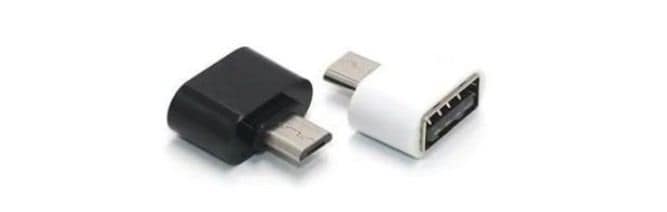
- Uses the phone display and a compatible mouse without installing desktop recovery software.
- May let you unlock a visible screen with your own passcode and start a normal backup.
- Requires purchasing a specific physical OTG cable and owning an external mouse.
- Generally unsupported or heavily restricted on standard iPhones due to port limitations.
- OTG alone is difficult to use with a black display; video output works only if the exact phone supports it.
Method 2: Recovering Data via Cloud Backup
If the display is black or the phone does not boot, check backups and previously synced accounts before attempting device-level extraction. Google Photos, Google Drive, and other services may hold different subsets of data; their availability depends on earlier syncing, account access, and what completed before the damage. An existing backup does not require the damaged display to work.
Sign in to the same Google account on a computer to inspect photos, contacts, and Drive files separately, and check whether a device backup exists before restoring it to a replacement phone. iPhone owners can similarly review iCloud sync and backups. Do not assume all local-only files, app data, or messages were uploaded; check dates and contents before erasing or replacing the original handset.

- Cost limitations: Advanced cloud storage tiers with larger capacities can become quite costly to maintain over time.
- Pre-requisite dependence: Only data backed up or synced before the damage is available; verify each service and backup date.
- Time-consuming restoration: Downloading massive 4K video files and extensive image libraries can take hours depending on your local network speeds.
Method 3: Recovering Data using iTunes (iOS Only)
For an iPhone, first check for an existing local backup in Finder on supported Macs, Apple Devices on Windows, or iTunes where applicable. A working data cable and computer are needed for a new backup, and the iPhone may need to be unlocked and to trust that computer. A previously saved backup can be restored without operating the broken screen.
Prior trust may help, but it does not guarantee that a newly connected iPhone with a black display can be backed up: the device must boot, be recognized, and satisfy its passcode and trust requirements. Do not erase the handset until you have checked the backup.

- Hardware requirement: Use Finder (supported Macs), Apple Devices (Windows), or iTunes where applicable, plus a working cable for new backups.
- Compatibility: This method works exclusively on Apple devices and provides zero benefit for Android smartphone users.
- Trust restriction: The iPhone must have already "trusted" the specific computer previously; otherwise, a security prompt on the broken screen will block access.
Part 2: Safe Way to View Files from Broken Phone Screen on PC
If backups, OTG, and ordinary USB transfer are insufficient, Dr.Fone - Data Recovery (Android) offers a Recover from Broken Phone workflow, but its options have different requirements. A lit display with failed touch is not the same recovery case as a black display. The black/broken-screen extraction path in the official guide is restricted to certain older Samsung models and requires an exact model match; it is not a universal lock-screen bypass.
Use Dr.Fone - Data Recovery (Android) to inspect which recovery path the software offers for your exact phone before paying or proceeding. The four screenshots below follow the official Screen On but Unresponsive path, which needs a display that still turns on; do not apply these steps to a non-booting handset or assume they represent the separate Samsung-only black-screen procedure.
Compatibility note: The broad device-count and no-backup messaging in the promotional box describes general Android recovery, not guaranteed broken/black-screen recovery on every device. The official broken-Android guide limits its black-screen route to certain older Samsung models and warns that an incorrect model selection may brick the device. Confirm model and OS support first; do not infer a way to bypass a forgotten screen lock.
 Scan Android phones and tablets directly.
- Preview and recover only what you want.
- Supports WhatsApp, photos, videos, contacts, and more.
- Works with 6000+ Android devices.
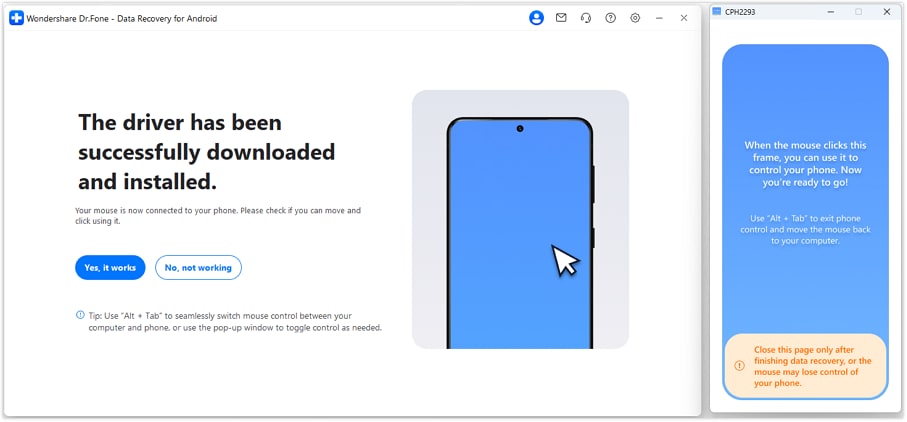
For a phone whose display is on but not responding to touch, the official workflow attempts to install the required driver and let you use a computer mouse in the right-hand panel. Success depends on device recognition, connection, security prompts, and the available recovery method. A black screen instead requires checking the separate supported Samsung model workflow; there is no verified highest-success-rate claim or guarantee that any WhatsApp chat or file will be extractable.
-
Step 1 Launch Dr.Fone Data Recovery
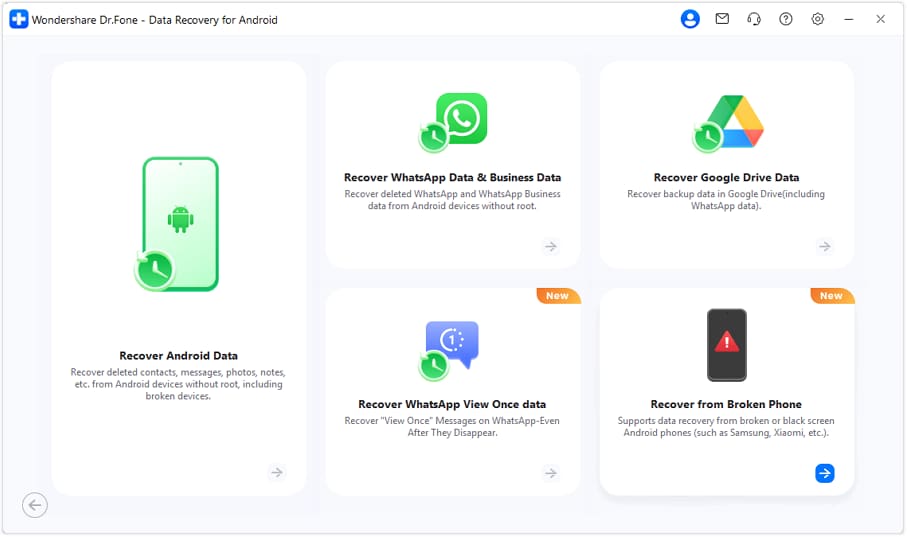
Install Dr.Fone on a computer, open Toolbox > Data Recovery, choose Android, then select Recover from Broken Phone. Keep the device connected to power if its battery is low, and check any security request on the handset before continuing.
-
Step 2 Specify the Type of Fault
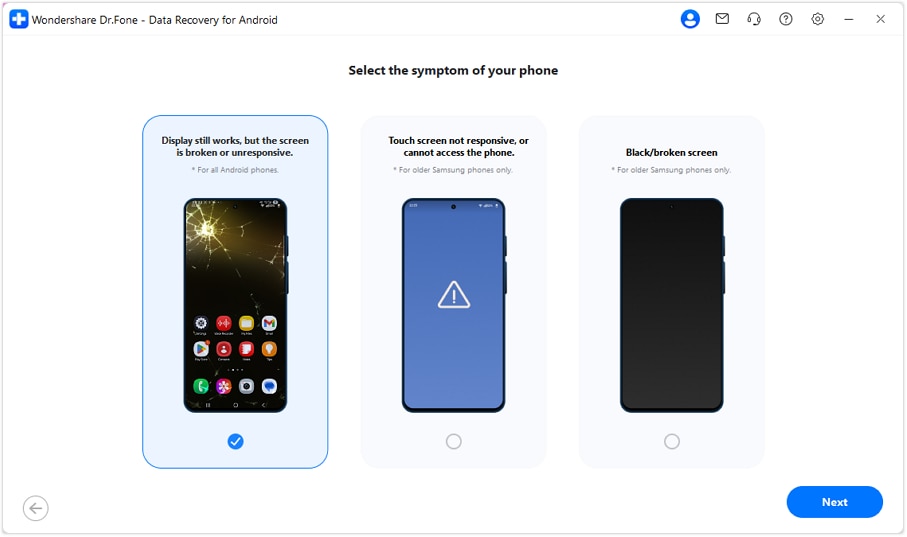
Choose Screen On but Unresponsive only when the phone boots and the display still shows its interface, but touch does not work. Then connect only the target phone using a data-capable USB cable and click Next. If the screen stays black, stop here and check the separate model-limited black-screen path instead.
-
Step 3 Establish Remote Control
Wait while the program downloads and installs the driver, if needed. If it recognizes the device, the right panel may let you operate the phone with a PC mouse; select Yes, it works only after verifying actual control. Drivers do not authorize a new ADB connection or unlock encrypted data: standard ADB requires previously enabled USB debugging and device-side approval of the computer.
-
Step 4 Select the Desired Data to Extract
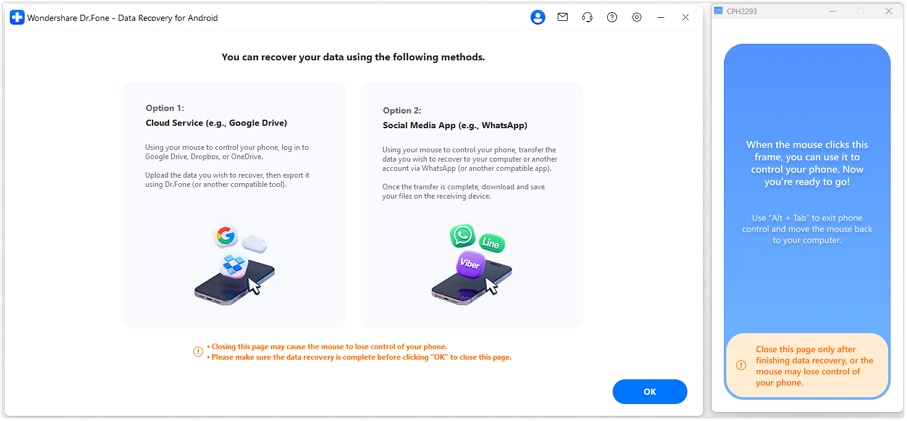
Follow the available on-screen options and verify which files can actually be accessed or transferred. The illustrated next screen offers Cloud Service and Social Media App routes; it does not prove an automatic deep scan of all internal files. Save an accessible backup before troubleshooting further and preview the result before purchasing a recovery plan.




Part 3: How Can I Screen Mirror My Phone if the Screen is Broken?
Mirroring is useful when the phone still boots and can complete a USB or wireless connection. It shows the phone interface on a PC; it does not repair a dead device, unlock an unknown passcode, or automatically extract inaccessible files. With a black display, verify a usable connection method before assuming a computer can show it.
Dr.Fone Basic provides a Screen Mirror feature. Its Android guide describes QR-code pairing with Dr.Fone Link on the same Wi-Fi, or a USB connection after the phone is recognized and Dr.Fone Link is installed. Both may require interaction with or authorization on the phone; assess whether that is possible with your particular damage.
- Effortlessly manage data through preview, delete, export, etc.
- Transfer all data between devices.
- Robust backup solutions for reliable data protection.
- Mirror screens to PC for meetings, teaching, and control.
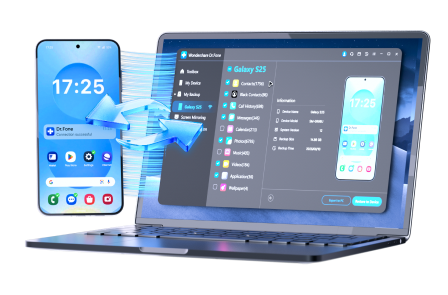
Use the following platform-specific steps only if your device still works well enough to establish a connection. The Basic banner describes the broader product; it is not a promise that every broken screen can be controlled. If the connection needs an on-device scan, installation, permission, or unlock that you cannot complete, return to backups or device repair.
1. Screen Mirroring iPhone to Computer
-
Step 1 Connect to the Same Network
For wireless iPhone mirroring, connect the iPhone and computer to the same Wi-Fi network and confirm the phone is unlocked and usable enough to approve the connection. A broken display or failed touch can prevent first-time setup.
-
Step 2 Access the Mirroring Tool
Open Dr.Fone on your PC and choose Screen Mirror. Follow the version-specific on-screen instructions; do not assume the phone connects without a device-side action.
-
Step 3 Link the Devices
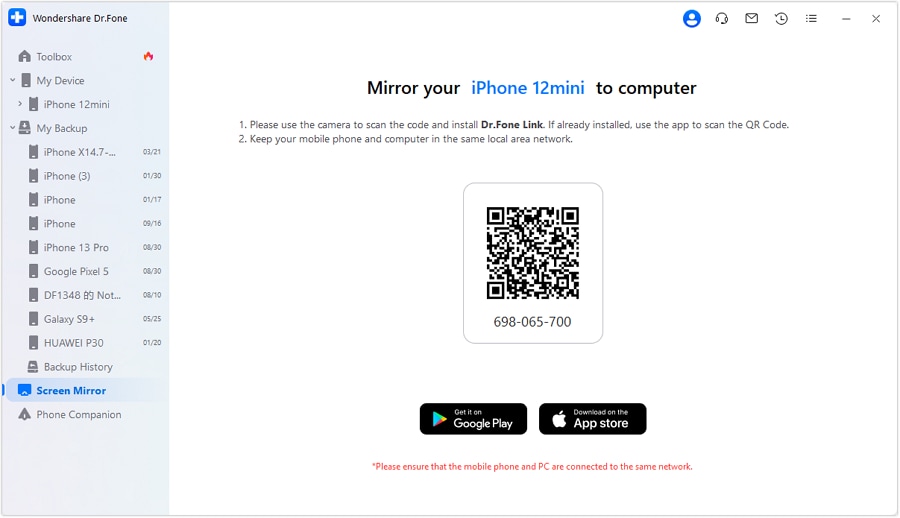
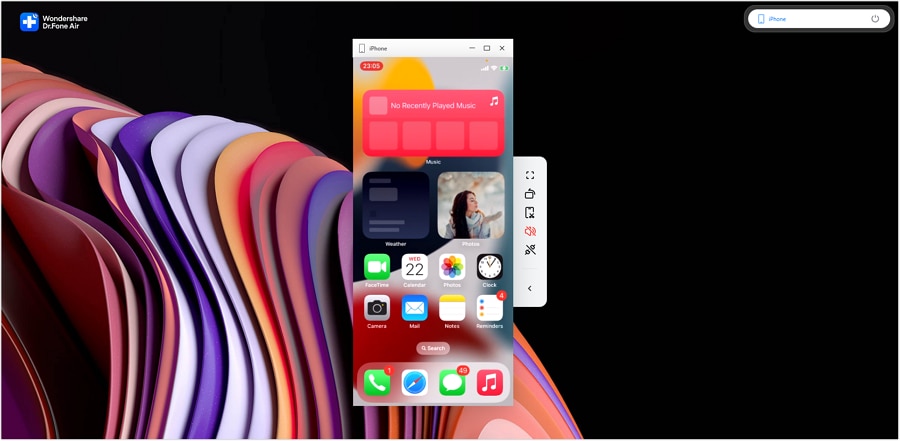
If the iPhone can still be operated, use Dr.Fone Link to scan the QR code shown on the PC and approve any required prompt. If you cannot scan or grant access, use an existing iCloud or local backup instead.
-
Step 4 Control the iPhone
Once the connection actually succeeds, check whether the iPhone screen appears on the computer. Mirroring and remote input depend on device and software support; a fully unresponsive phone cannot be assumed controllable.
2. Screen Mirroring Android to Computer
-
Step 1 Launch the Mirror Function
Open Dr.Fone on your PC and select Screen Mirror. Keep the phone on and unlocked where possible; mirroring is a separate feature from broken-phone data extraction.
-
Step 2 Establish a Connection
For wireless mirroring, the official guide describes connecting both devices to the same Wi-Fi and scanning the PC QR code with Dr.Fone Link on the Android phone. For USB, the device must be recognized and Dr.Fone Link may need to be installed or approved on the phone. Neither route is assured when the display and touch are both unusable.

-
Step 3 View and Manage Your Phone
When pairing succeeds, the mirrored Android screen should appear in Dr.Fone. Confirm that it actually displays the phone and responds to input before relying on it for a backup. If pairing or permission fails, check an existing cloud backup or a device-specific repair route.

Part 4: How Can I Transfer Files from a Broken Phone to My Computer?
File export is a useful backup of an accessible phone, not a substitute for recovering an inaccessible black-screen device. First confirm that the handset starts, can be recognized by the PC, and can be unlocked or authorized if prompted. A phone stuck in a boot loop or unable to power on cannot normally be mirrored or exported through the steps below.
The existing export or import your data from your smartphone to your PC guide describes exporting selected data types from a recognized Android or iOS device. For a phone with a usable display or OTG-assisted access, make a backup before further troubleshooting. Standard USB file transfer (MTP) similarly depends on a data cable, an operating phone, and often unlocking and choosing the file-transfer mode. An encrypted, locked phone is not exposed as a readable disk just because it is plugged into a PC.
-
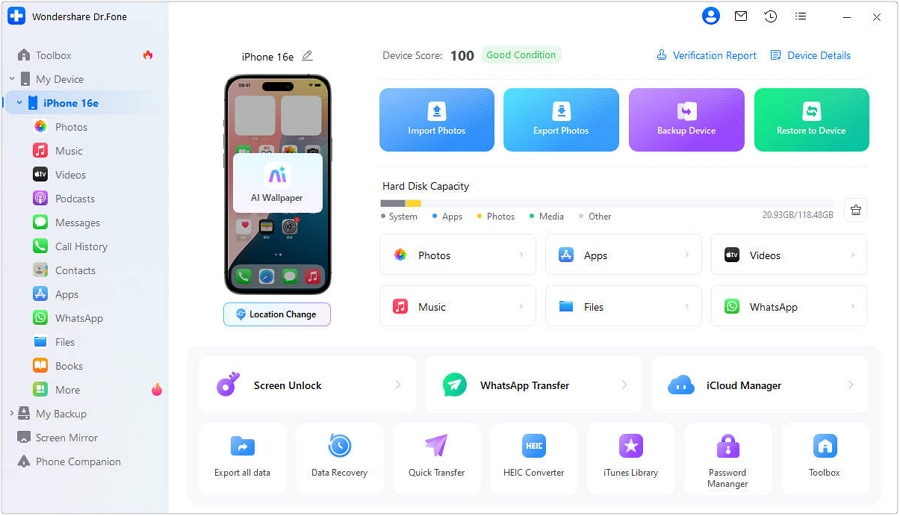
Step 1 Connect the Broken Device
Open Dr.Fone and connect the phone using a working data cable. For a device that is detected and authorized, select Export all data from its device screen. The existing screenshot illustrates an iOS connection; Android screens may look different. If the PC only charges the phone or requests on-device permission, resolve that access requirement first rather than assuming export can bypass it.
-
Step 2 Filter and Select Critical Files
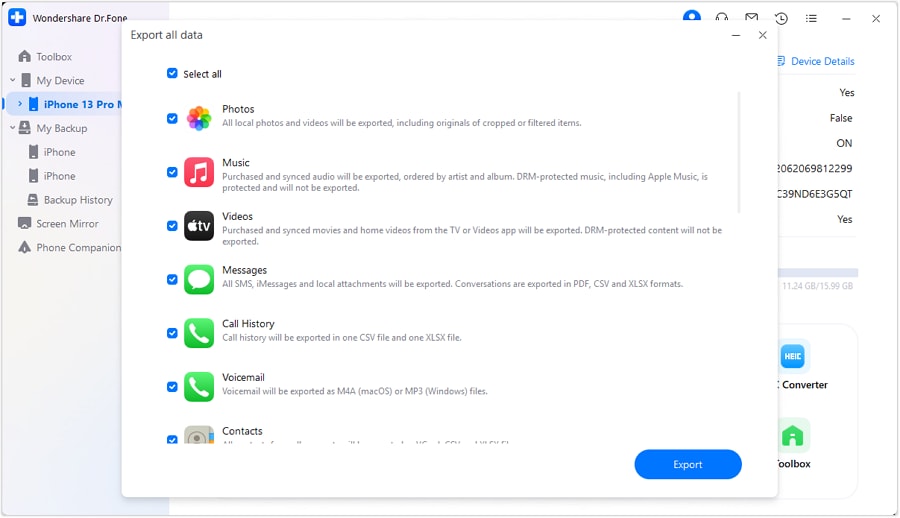
Choose the data types offered for the connected device and a destination on your PC, then start the export. Available Android and iOS categories differ; not every app file or private folder is included. The screenshot here depicts an iOS export choice, not evidence of an Android internal-storage scan.
-
Step 3 Complete the Export Process
Wait for the export to finish, then open the destination folder and verify that the expected files are readable. Follow any encryption-password prompt shown by the iOS flow and store that password safely. If a device cannot be unlocked or recognized, use backups or consult a qualified repair service that will preserve the data.
Conclusion
A broken display can leave data intact, but the safe route depends on which part of the phone still works. Prioritize existing backups; for visible-screen touch failures, try compatible OTG input. If normal access fails, check exact device compatibility before attempting Dr.Fone broken-phone recovery. Never factory-reset or flash a device just to test an unverified promise of recovery.
Use the official guides for Screen Mirror, Data Manager, and Data Recovery to confirm the applicable steps. Screen mirroring and Data Manager export need a working, recognized connection; the broken-screen extraction route is distinct and has model restrictions. A black display, boot loop, forgotten passcode, or unpowered phone may require professional repair or an existing backup rather than desktop software.
Separate promotion: The following Xiaomi account-unlock panel is not a broken-screen recovery method. Its promotional claims, including a claim of universal removal, should not be read as a guarantee that a forgotten lock, encryption, or phone activation can be bypassed; confirm eligibility and ownership through the relevant manufacturer before acting.
FAQ
-
1. Can I recover data if the broken screen is completely black and touch is unresponsive?
Not always. First check whether the phone powers on and whether files were backed up or synced. OTG alone is not useful without visual feedback; external display output is an option only for compatible models. The official Dr.Fone black-screen route applies to certain older Samsung models and requires an exact model match. A non-booting, locked, or unsupported phone cannot be promised recoverable. -
2. Do I need to enable USB debugging beforehand to access my broken phone on PC?
For ADB-based PC access, USB debugging must already be enabled and this computer must be authorized on the phone; a new RSA prompt cannot be approved from a locked, inaccessible screen. Ordinary MTP transfer does not require debugging, but may require unlocking and selecting File transfer on the phone. A downloaded driver is not permission to bypass a PIN or encryption. Check the specific Dr.Fone recovery path and model requirements separately. -
3. Will using a standard OTG mouse work on my broken iPhone?
The Android OTG-mouse steps are not a general iPhone recovery method. iPhone peripheral support varies by model and adapter; do not assume a mouse lets you unlock a black or inaccessible iPhone. Check an existing iCloud or local backup and whether the computer is trusted. -
4. How do I safely mirror an Android phone to my PC if the touch screen doesn't work?
Try Dr.Fone Screen Mirror only if the Android phone powers on and can complete the connection. Wireless setup uses the phone to scan a QR code with Dr.Fone Link; USB setup requires recognition and may require on-device installation or permission. If the screen is black and touch cannot approve a new connection, mirroring is not guaranteed; check a prior backup or seek data-preserving repair.
 Add Wondershare Dr.Fone as a preferred source on Google