
How to Flash a Samsung Phone Safely

Nov 10, 2026 • Filed to: Phone Repair Solutions • Proven solutions
 TL;DR:
- Choose the task: use Settings or Smart Switch for an available routine update; use the firmware workflows below for a deliberate repair or reinstall.
- Match the phone: confirm the full model number, carrier/CSC and acceptable bootloader revision before selecting a flash file. A similar Galaxy name is not enough.
- Choose the tool: Dr.Fone guides firmware preparation for supported Samsung models; Odin gives experienced users manual file and installation control. Both workflows here use Windows.
- Decide about data: Dr.Fone's Samsung repair erases data. In Odin, CSC performs a clean installation; HOME_CSC is intended to retain data during a compatible update, not guarantee recovery or prevent every wipe.
- Do not interrupt a write: wait for the computer's completion status. If it reports a failure, record the error and diagnose it before retrying.
Ask AI for a summary
 ChatGPT
 Perplexity
 Gemini
 Claude
 Grok
If your Samsung phone keeps crashing, boot-looping, freezing, or showing a black screen, flashing the firmware can reinstall the system and bring the device back to a usable state. It is also a high-risk repair step: flashing can erase your data, fail if the firmware does not match your exact model, and leave the phone stuck if the process is interrupted.
This guide explains the safest preparation steps, when to use a guided repair tool, and when Odin is the better advanced option for Samsung firmware flashing.
To flash a Samsung phone, use firmware that matches its exact model and supported bootloader revision. Choose Dr.Fone for guided Samsung firmware repair or Odin for manual stock-firmware installation on Windows. If you only want a normal Android update, check Settings or Smart Switch first; an update does not automatically require manual flashing.
Prepare Before Flashing Samsung Firmware
Before you flash a Samsung phone, finish these checks first. They reduce the chance of data loss, firmware mismatch, or a failed repair.
- Charge the phone. Keep the battery comfortably above 50%, and leave the computer plugged in during the repair.
- Back up your data. Flashing or system repair can erase photos, messages, app data, and local files. Verify important backups before proceeding. If Android cannot start or unlock, do not assume a computer can back up encrypted data from Download Mode.
- Confirm the exact model. Check the device model, region, carrier, and Android version before choosing any firmware file. Use the full model number from Settings > About phone when accessible; use recorded device information or the model shown in Download Mode when it is not.
- Install Samsung USB drivers. Use the Samsung developer USB driver page for Windows, rather than a driver bundled with an unknown download. A stable USB connection is required for both workflows.
- Use a reliable cable and port. Avoid loose hubs or cables that disconnect during firmware transfer.
- Know the risk. If the device powers off, disconnects, or receives the wrong firmware, it may remain stuck or require professional repair.
Match the Samsung flash file before you start
For a manual Odin installation, obtain a complete stock-firmware package for the exact model number, intended carrier/CSC configuration and supported firmware revision. Do not mix BL, AP, CP or CSC files from different releases. US carrier and factory-unlocked variants can have different full model identifiers; do not treat a shared Galaxy marketing name as permission to cross-flash them.
Samsung's rollback protection sets a minimum acceptable bootloader version. An older Android release is not automatically flashable just because its file is available. If the required bootloader revision is below the phone's accepted revision, stop rather than trying a patched tool or bypass. For a Galaxy tablet or a specific A-series phone, use its own model's package and mode instructions; this guide is not a promise that every model is supported by either tool.
Know the Samsung and Google account credentials already associated with the phone before a data-erasing repair. Stock-firmware flashing is not an account, finance-lock or organization-policy removal method. Custom images and rooting introduce separate security consequences, including a potentially irreversible Knox Warranty Bit change; they are outside this stock-firmware workflow.
If you only need a normal Samsung software update
Open Settings > Software update (or System updates) and select Download and install or Check for updates. Follow the offered update prompts. If you prefer a computer, connect the phone to Samsung Smart Switch on Windows or Mac; choose Update if Smart Switch offers one and keep it connected until finished. Neither method forces an Android version that is not available for your device and carrier.
For that supported desktop update route, get Samsung Smart Switch. It is not a general substitute for manually loading arbitrary Odin firmware, and an emergency-recovery option should only be used when offered for the relevant failed-update situation.
Can you flash Samsung without a computer? Not with the Dr.Fone or Odin workflows in this guide. Buttons can open Download Mode or Recovery, but do not by themselves install a new firmware package. A Recovery factory reset erases user data; it is not a firmware reflash. If Android works and no computer is available, check the normal on-device update instead.
How to Flash Samsung with Dr.Fone - System Repair (Android)
If a Samsung phone is stuck in a boot loop or has a software-related freeze, crash or failed update, Dr.Fone - System Repair (Android) provides a guided firmware-repair path. It brings device identification, compatible firmware preparation and repair progress into one Windows workflow, reducing the manual file-selection work needed with Odin.
Use it when the tool lists the exact Samsung model you intend to repair. Firmware repair addresses supported software faults, not physical damage.

Dr.Fone - System Repair (Android)
Guided Samsung Firmware Repair Without Manual Odin Setup
- Repair supported Samsung software problems such as boot loops, failed updates and repeated system crashes.
- Prepare compatible firmware through guided device selection instead of manually sorting every Odin package file.
- Follow model-specific connection and Download Mode instructions as part of the repair workflow.
- Track firmware preparation and repair progress on screen, then check whether the device starts normally.
- Get 24/7 chat and email support if you need help with the repair workflow.
Steps to flash Samsung firmware with Dr.Fone
Before proceeding: the Samsung repair workflow erases device data. Back up accessible files first and proceed only if you accept losing unbacked-up data. Android System Repair runs on Windows; full firmware repair requires a paid license. The free installer is not a promise of free complete repair.
Set up: install and open Dr.Fone on Windows, connect the Samsung phone with a reliable USB cable, and open Toolbox > System Repair.
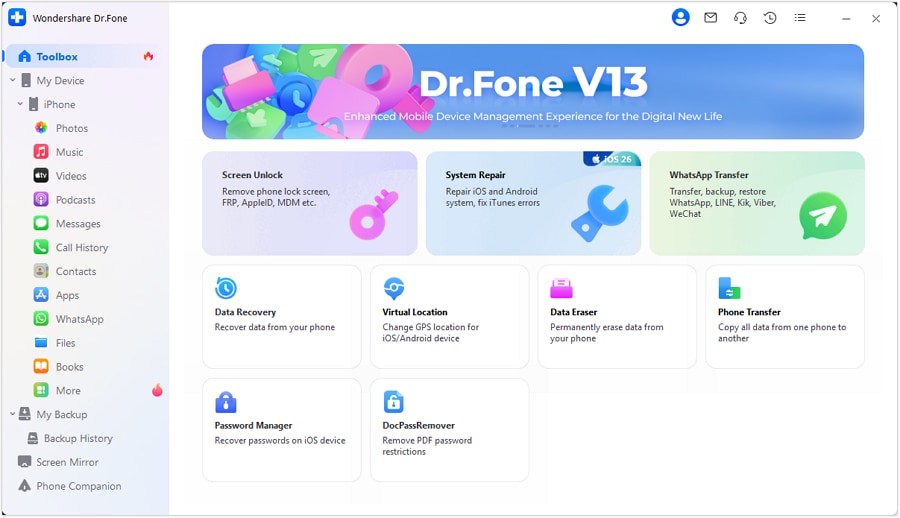
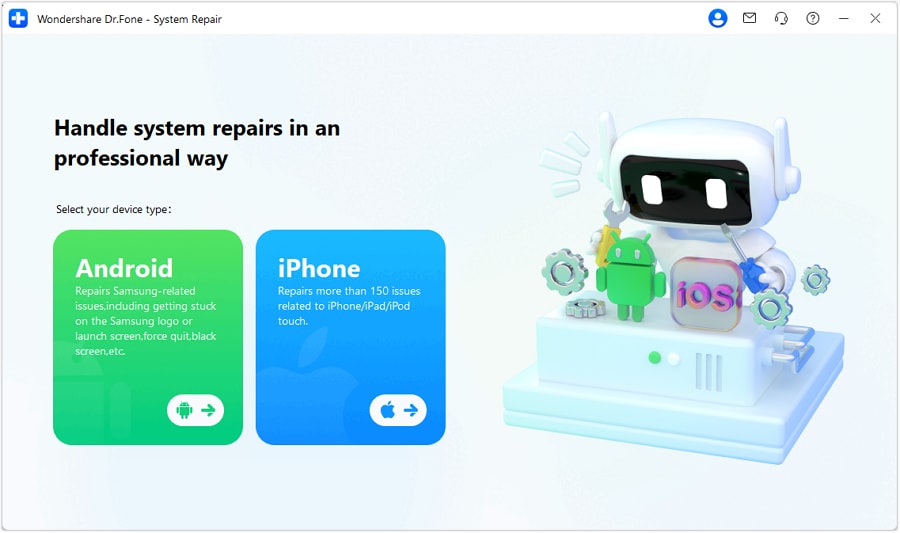
- Choose Android Repair. Select Android as the device type.
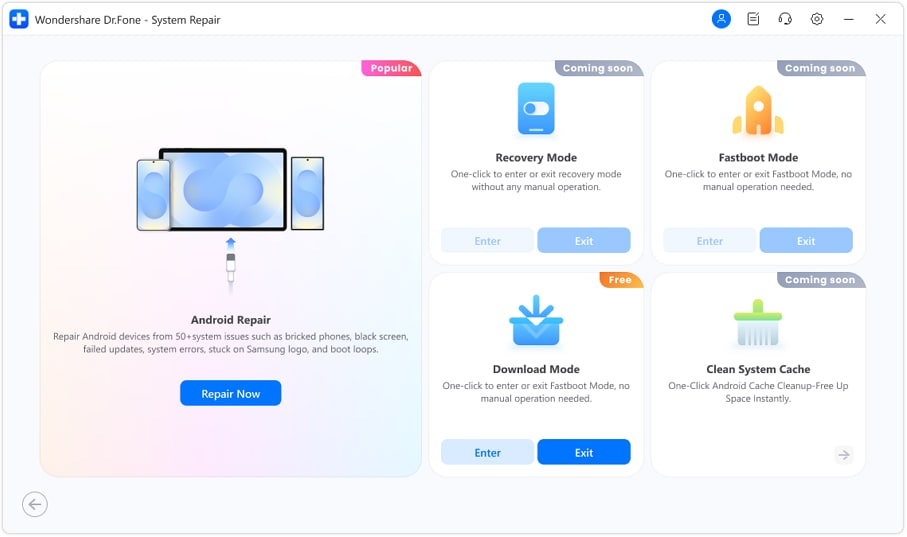
Choose Android Repair > Repair Now.
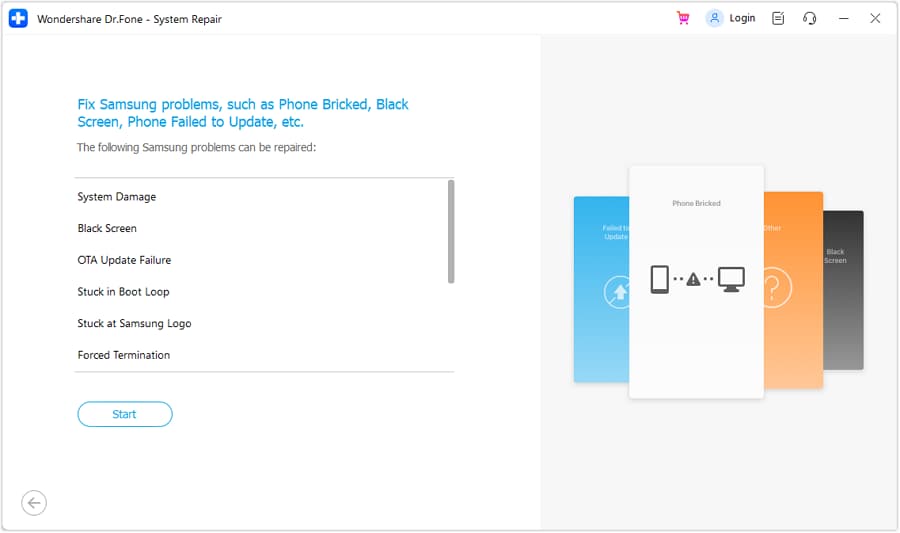
Select Samsung as the brand when prompted, then continue with Start on the Samsung repair screen.
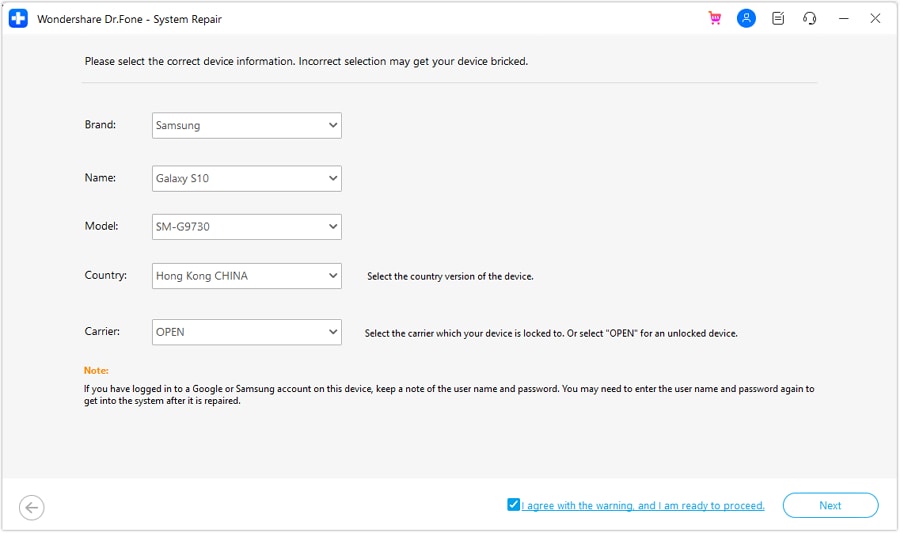
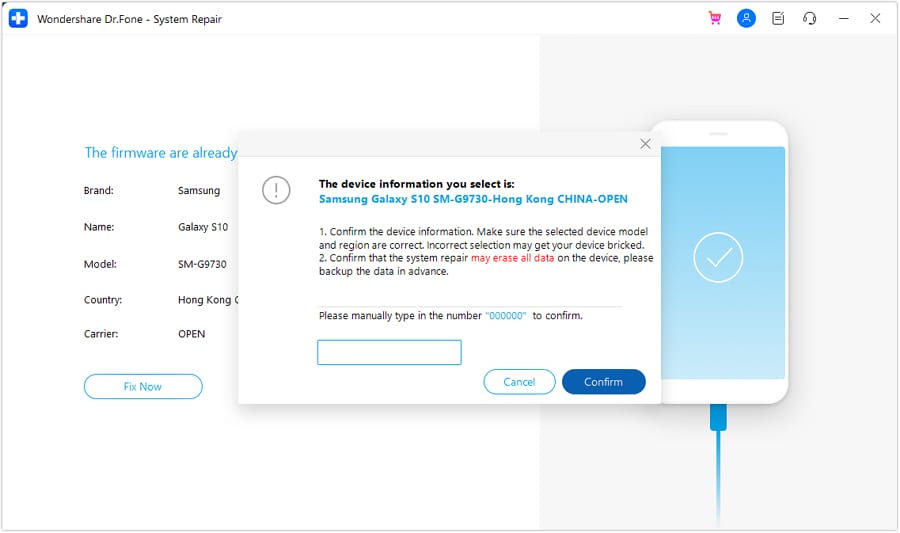
- Confirm device details. Select the requested name, exact model, country and carrier. Use OPEN only for the unlocked-carrier option described by the tool. Read and acknowledge the warning, then choose Next. Stop if the exact device is not offered.
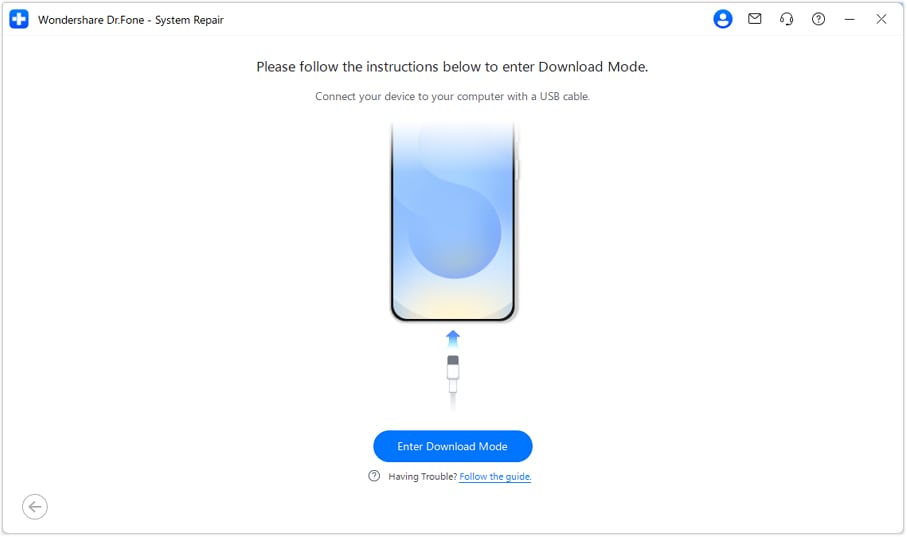
- Put Samsung into Download Mode. If the connected, unlocked device offers Enter Download Mode, use that guided option. Otherwise follow the on-screen button instructions for that exact model; do not apply an older Home-button sequence to a phone without one.
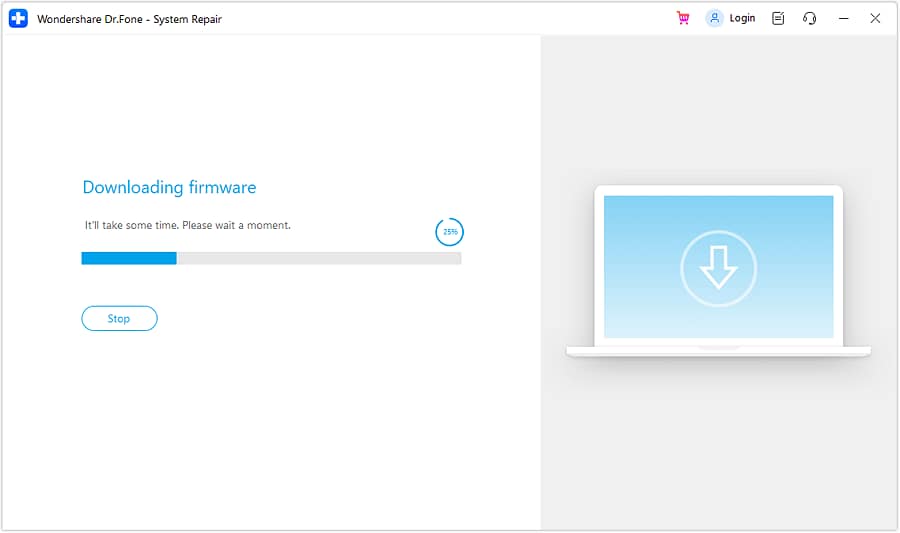
- Download and prepare firmware. Keep the device connected as Dr.Fone downloads the matching package. Review the model information and let verification finish before starting installation.
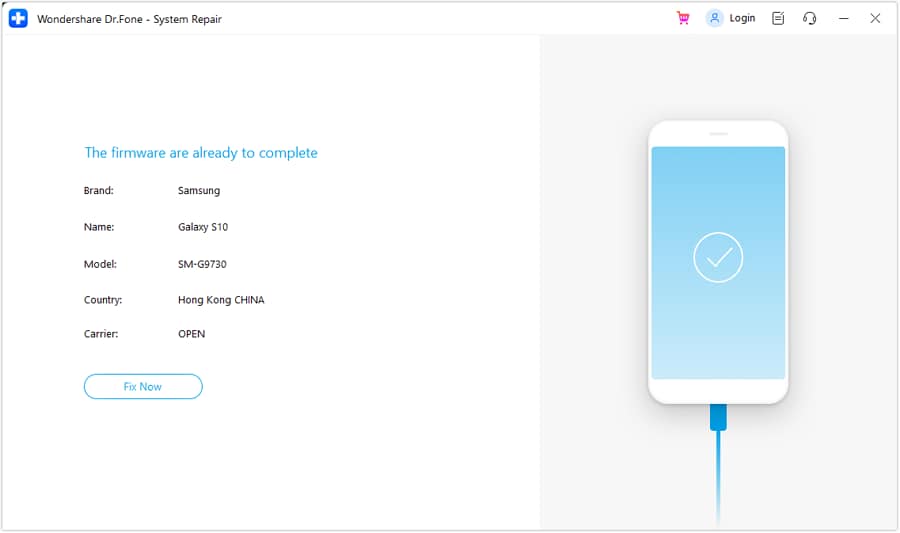
- Confirm the data-erasing repair. Choose Fix Now after the firmware is verified.
The next confirmation authorizes data erasure. After accepting that consequence, enter 000000 and choose Confirm when prompted. Keep the cable connected and do not operate the phone during installation.
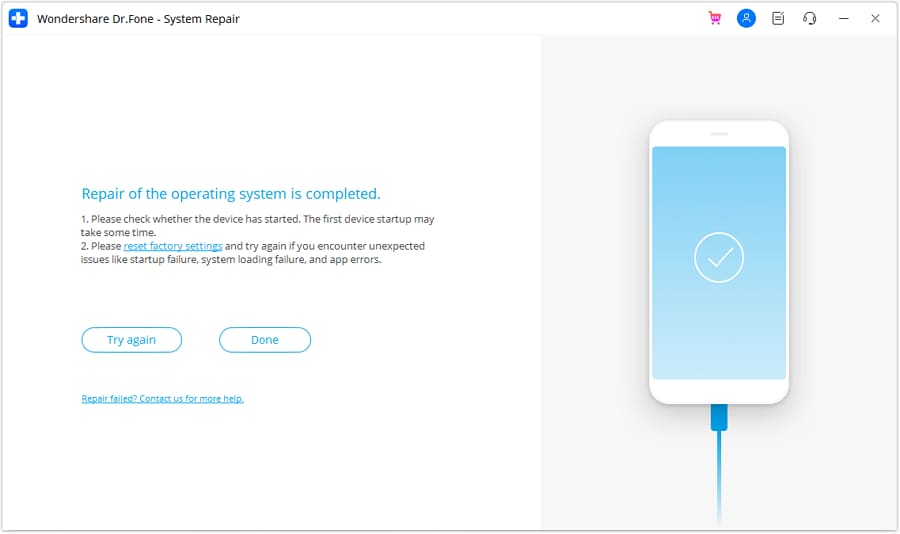
- Finish and check the phone. When repair completes and the phone starts normally, choose Done. Complete device setup, then check startup and the original software problem. If repair fails or the device still will not start, record the result and seek model-specific support instead of repeatedly flashing.
 safe & secure
How to Flash Samsung Firmware with Odin
Odin is an advanced Windows flashing utility commonly used for Samsung firmware packages. It gives more manual control, but it also requires you to identify the exact firmware and place the phone into Download Mode correctly.
Choose the download carefully. A website calling itself an "official Odin" community is not proof that Samsung operates it or certifies its binaries. Follow a maintained, model-specific technical guide with identifiable file provenance, scan downloaded executables, and avoid patched tools or instructions to disable security software. The desktop Odin workflow below uses a Windows executable, not an Android APK. Do not treat a mobile "Odin APK" or a file with a familiar name as an equivalent tool.
Stock-firmware installation is different from rooting or loading a custom recovery. Do not enable OEM unlocking, unlock a bootloader or flash modified images merely to follow this stock-repair guide. If a package requires a different security state, stop and obtain instructions appropriate to your exact device.
| Odin slot | Matching package file | What to check |
|---|---|---|
| BL | BL_... | Bootloader file; its revision must be accepted by the phone. |
| AP | AP_... | Main system package; loading and verification may take time. |
| CP | CP_... | Modem component, when supplied for that device. |
| CSC | CSC_... or HOME_CSC_... | Choose one according to the data decision below, not both. |
CSC or HOME_CSC? CSC performs a clean installation and wipes user data. HOME_CSC is intended to preserve apps, settings and data during a compatible stock-firmware update; it is not a backup, a damaged-data recovery method or permission to downgrade or change carrier firmware. Back up first whichever you choose. If you need a clean install to address the fault, accept the wipe explicitly rather than choosing a file just to avoid the warning.
- Prepare the matching files. Finish the preparation checks, install the Samsung USB driver, and extract the stock-firmware download on Windows. A typical modern multi-file package contains BL, AP, CP and CSC/HOME_CSC files ending in .tar.md5 or the package's specified Odin format. Do not load the outer download ZIP or rename an incompatible file to make it fit. Use one matching release throughout.
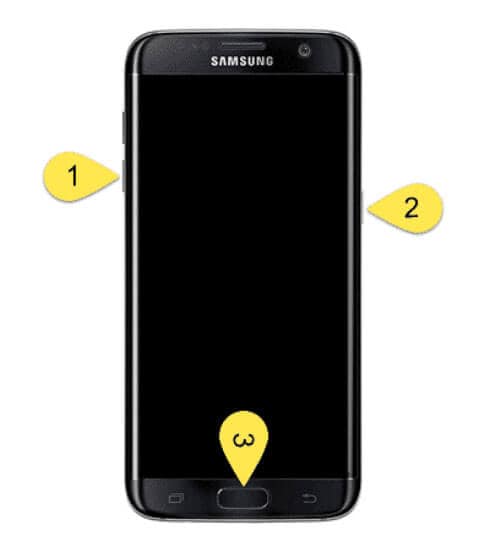
- Enter Download Mode, also called Odin Mode. This is the Samsung firmware-transfer environment, not Recovery or an ordinary app download. Power off the phone. On models using the USB-and-volume-key route, hold Volume Up + Volume Down while connecting USB to the computer, then use the displayed Volume Up confirmation. Older models with a physical Home button may instead use Volume Down + Home + Power, followed by the on-screen confirmation. Use only the route documented for your exact model and follow its screen; do not choose a bootloader-unlock prompt.
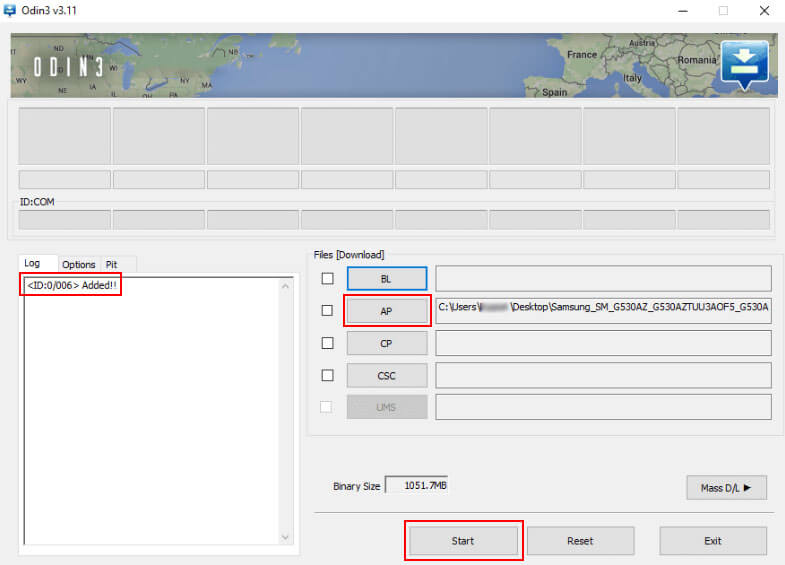
- Confirm the connection in Odin. Open Odin on Windows and connect the phone in Download Mode. Wait for a populated ID:COM field and an Added!! log message. If it is not detected, do not start a flash; use the connection checks.
- Load each file into its matching slot. Use BL, AP, CP and CSC as shown in the table. At CSC, select the single file consistent with your data decision. Wait for file verification, particularly for AP. Do not mix models, releases or both CSC files.
- Review the options before writing. For a standard stock package, retain the usual Auto Reboot and F. Reset Time settings. Leave Re-Partition and Nand Erase off and do not add a PIT file for this workflow. If a package needs a different partitioning procedure, it is outside these instructions.
- Start the flash. Recheck the model, files, CSC choice and connection, then click Start. Do not unplug the phone, restart it or close Odin while firmware is being written. Do not use a fixed number of minutes alone to decide a write is finished.
- Verify completion and startup. Wait for PASS! and the phone's automatic reboot under the standard settings. Disconnect after the tool confirms completion. Allow the first boot to finish, then check Settings > About phone > Software information, mobile service and the original fault. PASS indicates that the flashing operation completed; it does not prove every hardware or software problem is fixed.
If Odin does not detect the phone or reports FAIL
- No ID:COM or Added!! before a flash: confirm Download Mode, reinstall the Samsung USB driver if needed, and test a different data-capable cable or direct USB port. Close other phone-management programs that could claim the connection, then reopen Odin. These checks are for an idle connection, not permission to unplug an active write.
- FAIL, a revision error or a model mismatch: save the full Odin log and any phone-screen error. Recheck the exact model, accepted bootloader revision and package integrity before considering a retry. Do not bypass rollback protection or switch random firmware files.
- PASS but Android still will not start: do not assume a second flash or factory reset will save your files. If keeping unbacked-up data matters, stop and seek Samsung service or model-specific technical help before an erasing action.
If you are only on an idle Download screen and no write is active, use the separate Samsung stuck in Download Mode guide for an exit path. An active transfer or an uncertain write state needs assessment, not an improvised key combination.
Which Samsung Flashing Method Should You Choose?
| Situation | Recommended path | Why |
|---|---|---|
| You want guided repair for boot loop, black screen, or system crashes | Dr.Fone - System Repair (Android) | Guided device/firmware preparation on Windows for supported models. Full repair is paid and the Samsung workflow erases data. |
| You know your exact firmware package and need manual control | Odin | Manual stock-firmware control on Windows. Common community distributions are free; you remain responsible for package provenance, file placement and the CSC data decision. |
| You only need an available update, including from a Mac | Settings or Samsung Smart Switch | Use the supported update offered for your phone. Smart Switch desktop runs on Windows and Mac; it does not load arbitrary Odin packages. |
| You are unsure about the model, region, or firmware version | Stop and verify first | Wrong firmware is one of the highest-risk flashing mistakes. |
Conclusion
Flashing a Samsung phone can fix serious software problems, but it should be treated as a repair step with real data-loss and device-stability risks. Start with a backup, confirm the exact model, then choose Dr.Fone for guided repair or Odin for advanced manual flashing.
Odin remains useful when you understand the exact stock package and manual steps. Dr.Fone offers guided firmware preparation for supported Samsung software-repair cases on Windows. Choose the method and accept its data consequences before starting, then verify both tool completion and a normal phone startup. If Odin cannot detect the phone, diagnose the idle connection first; if a write fails, preserve the error log before deciding what to do next. For a separate, idle-mode exit problem, see the guide to a Samsung phone stuck in Download Mode.
safe & secureYou Might Also Like

Samsung Issue
- Samsung Phone Issues
- 1. Fix Samsung Camera Failed
- 2. Fix Samsung Phone Hang
- 3. Samsung Phone Not Displaying Incoming Calls
- 4.Fix a Bricked Samsung
- 5. Downloading Do Not Turn Off Target
- 6. Fix Samsung Stuck in Download Mode
- 7. Fix Samsung S5 Won't Turn On
- 8. Fix Samsung Pay Not Working
- 9. Samsung ROM Download & Install
- 10. Samsung Firmware Download
- 11. Fix Samsung Sudden Death
- 12. Fix Samsung Stuck on Boot Screen
- 13. Fix Samsung Frozen on Startup
- 14. Full Guide to Fix 'Samsung Galaxy Phone Keeps Restarting'
- 15. Fix Samsung S3 Won't Turn On
- 16. Fix Samsung J7 Problems
- 17. Fix Samsung S10 Gone Dead
- 18. Fix Samsung S10 Won't Turn On
- 19. Fix Samsung Galaxy S7
- Samsung Screen Issues
- 1. Fix Unresponsive Touchscreen
- 2. Fix Black Screen After Dropping
- 3. Resolve Screen Stuck on Boot Issue
- 4. Fix Samsung Fold Screen Issues
- 5. Fix Samsung Black Screen
- 6. Fix Samsung Screen Not Working
- 7. Fix Half of Screen Not Working
- 8. Fix Samsung Stuck on Bootloop
- 9. Fix Samsung Screen Blacked Out
- 10. Fix Screen Blacked During a Call
- 11. Fix Samsung Stuck on the Screen
- 12. Solve Samsung Yellow Screen
- 13. Fix Samsung Flip Screen Not Working
- 14. Fix Screen Won't Respond
- Samsung Tablet Issues
- Samsung Update
- 1. Flash a Samsung phone
- 2. Samsung Mobile Software Update
- 3. Update Samsung Kies for Mac
- 4. Update Samsung to Android Oreo
- 5. Update Samsung Kies on PC
- 6. Update Android 6.0 for Samsung
- Samsung Useful Tricks
- 1. Remove Google Account Bypass
- 2. Hard/Factory Reset Samsung
- 3. Samsung Root Software
- 4. Transfer Files from Samsung to PC
- 5. Top 5 Samsung Kies Alternatives
- 6. Bypass Samsung Lock Screen Pin
- 7. SIM Network Unlock PIN
- 8. Transfer Whatsapp to iPhone
- 9. Samsung Auto Backup
- 10. Recover File on Samsung
- ● Manage/transfer/recover data
- ● Unlock screen/activate/FRP lock
- ● Fix most iOS and Android issues
- Free Download Free Download Free Download



Alice MJ
staff Editor
Generally rated4.5(105participated)