Recover photos, messages, WhatsApp, and more — no backup
needed.
Recover photos, messages, WhatsApp, and more — no backup
needed.

 100% Security Verified | No Subscription Required | No Malware

 :
: 
 ChatGPT
 Perplexity
 Gemini
 Claude
 Grok
Grok
Experiencing an issue where your SIM card is suddenly not detected can instantly disrupt your day. Modern mobile phones rely entirely on these tiny chips—or their eSIM counterparts—to connect to cellular networks, process calls, receive essential texts, and maintain internet access on the go. When a SIM card is not recognized by the system, you are effectively cut off from digital communication.
Seeing your android phone saying no SIM card is a remarkably common error that stems from various hardware and software glitches. Fortunately, diagnosing why no SIM card is detected on your device does not necessarily mean you need to purchase a new phone or replace the card immediately. Below, we provide a comprehensive breakdown of the root causes alongside eight effective troubleshooting solutions designed to restore your cellular connection rapidly.

In this article
- Part 1. Why Your Android Phone Might Not Detect a SIM Card?
- Part 2. How To Fix a "No SIM Card" Error on Android Phones?
- Solution 1: Reboot or Restart Your Phone
- Solution 2: Remove and Put Back the SIM card
- Solution 3. Toggle Airplane Mode On and Off
- Solution 4: Clean the SIM Card
- Solution 5: Test the SIM Card in Another Phone
- Solution 6: Change the Network Type
- Solution 7: Clear SIM Toolkit App Data
- Solution 8: Reset Network Settings
- Part 3. Bonus Tip: Recover Data From Android Device in Case of Data Loss?
- Conclusion
Part 1. Why Your Android Phone Might Not Detect a SIM Card?
When an android no SIM notification pops up on your screen, it is natural to panic and assume the device is permanently broken. However, a SIM card not found error is frequently triggered by simple connectivity disruptions or minor system misconfigurations.
There are several prominent reasons why your Android phone is saying "no SIM card". If you have recently swapped devices or traveled, the physical SIM may not be perfectly seated in its delicate tray, leading to misaligned contact pins. Over time, environmental factors like dust, lint, or moisture can build up on the metallic surface, preventing the phone's internal reader from scanning the chip. Software updates, corrupted network cache, carrier service outages, or sudden drops can also cause a temporary software mismatch where the operating system fails to register the cellular hardware.
By understanding these underlying triggers, you can logically work through the troubleshooting steps without risking further damage to your device. Let's delve into actionable methods to eliminate the no SIM card detected android issue.
Part 2. How To Fix a "No SIM Card" Error on Android Phones?
Fixing a device where the SIM card is not recognized requires a systematic approach. Since the root cause could be hardware misalignment or a software crash, work your way through these eight proven methods until your cellular signal returns.
Solution 1: Reboot or Restart Your Phone
Whenever you face the no SIM card detected android bug, restarting your mobile device should always be your first course of action. A system reboot flushes out the RAM, terminates glitchy background processes, and forces the operating system to re-initialize its hardware connections, including the SIM card reader.
To safely restart, press and hold the Power button on your Android device until the power menu appears. Tap the Restart or Reboot option. Once the device boots back up, wait a few moments for the cellular radio to scan for your carrier's network.

Solution 2: Remove and Put Back the SIM card
Physical displacement is a leading reason why a SIM card is not detected. Dropping your phone, even in a protective case, can slightly dislodge the tray. Re-seating the card guarantees that the gold contacts align perfectly with the phone's internal reading pins.
Carefully insert a SIM ejector tool or a paperclip into the small hole beside the SIM tray. Slide the tray out, verify that the SIM card sits flat within the correct cutout, and gently push the tray back into the device until it clicks flush with the frame. Restart the device if it doesn't automatically detect the network.

Solution 3. Toggle Airplane Mode On and Off
Airplane mode temporarily disables all wireless communications—cellular, Wi-Fi, and Bluetooth. Toggling it effectively performs a "soft reset" of your network antennas without requiring a full device reboot, prompting your phone to search for cellular towers from scratch.
Step 1: Swipe down from the top of your screen to open the Quick Settings panel.
Step 2: Locate and tap the Airplane Mode icon to activate it. Wait for about 30 seconds.
Step 3: Tap the icon once more to turn Airplane Mode off. Check the top status bar to see if the network signal bars reappear.

Solution 4: Clean the SIM Card
Continuous use, ambient humidity, and pocket lint can obscure the conductive gold pads of your chip. This debris creates a physical barrier, resulting in an android no SIM notification because the reader simply cannot establish an electrical connection.
Step 1: Power down your Android smartphone and safely eject the SIM tray.
Step 2: Using a clean, dry microfiber cloth, gently wipe the golden contacts of the SIM card. Avoid abrasive materials like paper towels that might scratch the surface.
Step 3: If available, use a quick burst of compressed air to clear any dust resting inside the phone's internal SIM slot. Do not blow into it with your mouth to avoid introducing moisture.
Step 4: Reassemble the tray, insert it, power the phone on, and check for a connection.
Solution 5: Test the SIM Card in Another Phone
Isolating the variable is critical. You must determine if the fault lies with the SIM card itself or your specific smartphone's hardware. By placing your current SIM card into a secondary or friend's unlocked phone, you can diagnose the root problem.
If the secondary device connects to the cellular network effortlessly, your phone's SIM reader, antennas, or software may be damaged. Conversely, if the secondary phone also displays a SIM card not found error, the chip is likely degraded or deactivated, requiring a replacement from your service provider.
Solution 6: Change the Network Type
If your device is stuck trying to force a 5G or 4G LTE connection in an area where only 3G is supported, it might glitch and drop the SIM recognition entirely. Manually adjusting the preferred network topology can sometimes trigger the phone to recognize the network again.
Step 1: Open your Android Settings application and navigate to Wi-Fi & Network or Network & Internet.
Step 2: Tap on Mobile Network, followed by Preferred network type.
Step 3: Change the current selection (e.g., from 5G/4G Auto to 3G or 2G only). Wait a minute to see if the network registers. If it works, switch it back to Automatic.

Solution 7: Clear SIM Toolkit App Data
Android devices utilize a background system application known as the SIM Toolkit to manage cellular parameters and carrier services. If the cache for this background app becomes corrupted, your operating system will struggle to communicate with the hardware chip.
Step 1: Navigate to Settings > Apps (or Apps & Notifications).
Step 2: Ensure you select "Show system apps" from the menu, then search for SIM Toolkit.
Step 3: Tap on Storage & Cache, then select Clear Data and Clear Cache. Rebooting your phone afterward will force the app to generate fresh, uncorrupted files.

Solution 8: Reset Network Settings
When simple toggles fail, resetting your entire network configuration deletes custom APNs, saved Bluetooth pairings, and Wi-Fi passwords, returning cellular configurations to their factory default state. This step is highly effective for resolving deep-rooted software glitches causing the no SIM card detected android problem.
Step 1: Open your device Settings and scroll down to System or General Management.
Step 2: Select Reset Options or Reset.
Step 3: Choose Reset Wi-Fi, mobile & Bluetooth (or Reset Network Settings).
Step 4: Confirm your lock screen PIN or password, then tap Reset Settings to finalize the process. Wait for the phone to restart.

Part 3. Bonus Tip: Recover Data From Android Device in Case of Data Loss?
Dealing with sudden hardware failures, such as when your SIM card is not recognized, often puts your sensitive digital data at risk. In older devices or specific configurations, contacts and text messages might be saved directly to the SIM memory. If the card or phone completely fails, these files may become inaccessible. Therefore, maintaining consistent local and cloud backups is crucial for digital safety.
If you have already experienced unexpected data loss during network troubleshooting, relying on professional data extraction tools can rescue your memories. We highly recommend utilizing Wondershare Dr.Fone – Data Recovery (Android) to retrieve crucial information securely.
Designed with a remarkably intuitive interface, Dr.Fone – Data Recovery can pull deleted contacts, text messages, call logs, photos, and WhatsApp records straight from the phone’s internal storage, SD card, or even broken devices. You do not need to be a technology expert to understand how to recover data; the platform walks you through every requirement step-by-step.
- Industry-leading data retrieval success rates.
- Deep scanning capabilities for both internal and external memory sources.
- Ability to salvage data from damaged, broken, or bricked Android models.
- Direct integration to restore files from Google Drive backups.
- Comprehensive compatibility with over 6,000 distinct Android devices.
 Scan Android phones and tablets directly.
- Preview and recover only what you want.
- Supports WhatsApp, photos, videos, contacts, and more.
- Works with 6000+ Android devices.
Follow These Detailed Steps to Recover Data Using Dr.Fone - Data Recovery (Android):
-
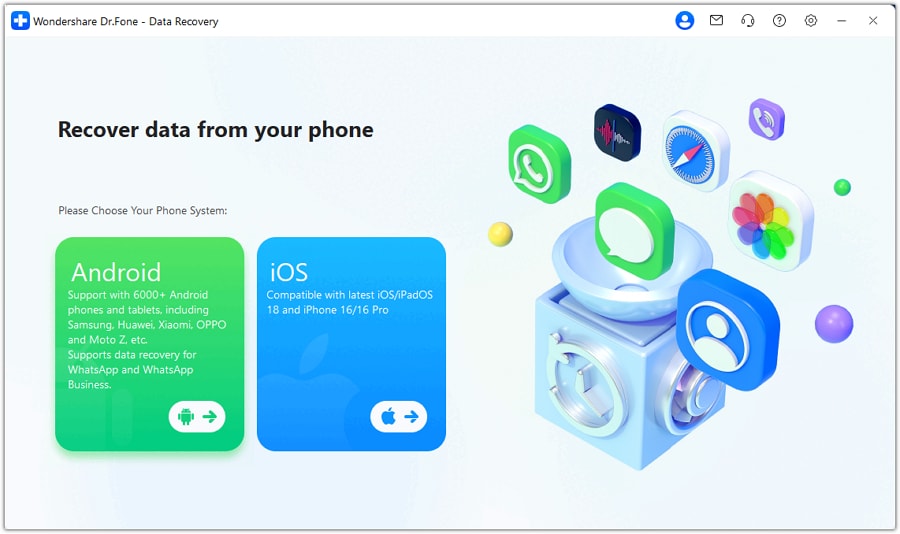
Step 1 Start Data Recovery Tool and Select Android For Recovery
Download and launch Wondershare Dr.Fone on your PC or Mac. Navigate through the primary dashboard and select the Toolbox tab, then click on Data Recovery. When prompted with the operating system selection screen, explicitly choose Android to proceed with the specialized extraction protocol.
-
Step 2 Proceed To Select Function For Recovery
From the subsequent menu of available recovery features, select Recover Android Data to command the software to scan the internal flash memory.
-
Step 3 Connect Your Android Device to Computer
Use a reliable, data-capable USB cable to link your malfunctioning Android smartphone to your computer. Allow a few moments for the software interface to detect and authenticate the connected hardware properly.
-
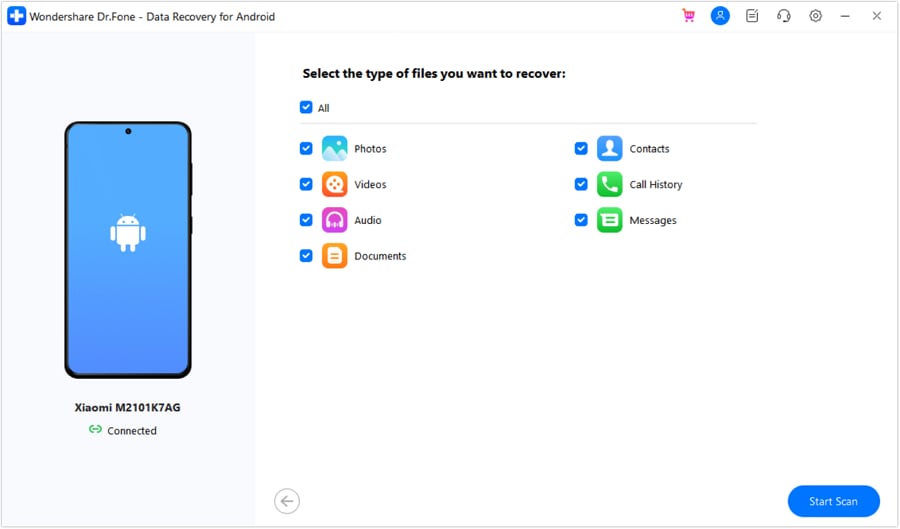
Step 4 Select File Types To Recover
The interface will present a checklist of supported file extensions and categories, including media, documents, and communication logs. Mark the checkboxes corresponding to your lost data types and initiate the deep scan by clicking Start Scan at the bottom right corner.
-
Step 5 Go Through All Recovered Android Data
Once the intensive scan finalizes, you can preview all detectable files displayed on the dashboard. Utilize the integrated filter tools located at the top to sort the data seamlessly, ensuring you only target the exact files you wish to salvage.
-
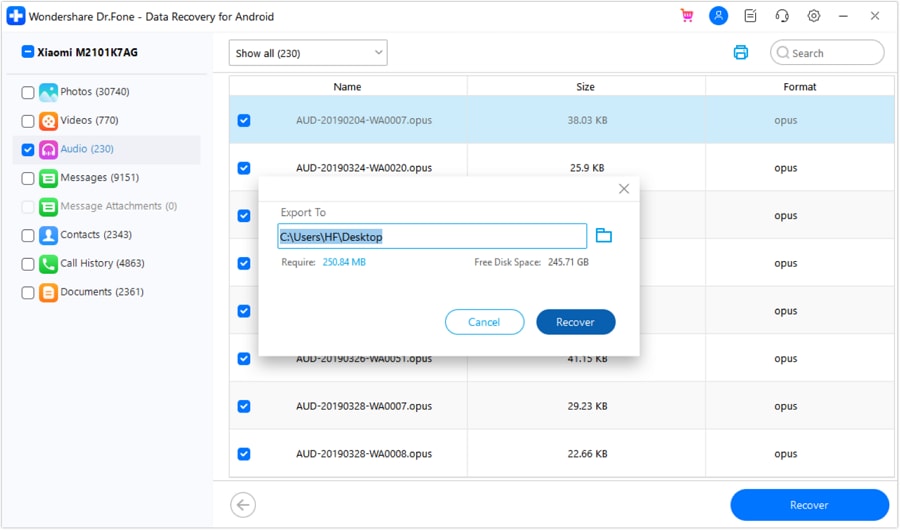
Step 6 Recover Data To Computer
After verifying your required files by checking their respective boxes, click the Recover button. Specify a safe directory on your computer's local drive where the extracted data should be saved, and finalize the secure transfer.
Conclusion
Dealing with a scenario where the SIM card is not detected can undoubtedly disrupt your daily routine. However, by methodically checking your physical hardware alignment, cleaning the contact plates, and resetting key internal network software, you can usually rectify the situation in a matter of minutes. These eight straightforward solutions apply across all major brands and operating system variants, providing a reliable troubleshooting framework to restore your mobile connectivity.
If extensive troubleshooting fails and your network connectivity remains completely disabled, your device may be suffering from structural damage to the logic board or cellular modem. Before handing over your phone to specialized technicians for invasive repairs, it is imperative to secure your personal information. Utilizing tools like Wondershare Dr.Fone – Data Recovery (Android) guarantees that you retain access to vital contacts, conversations, and media files, regardless of what happens to the physical device.




FAQ
-
1. Can a damaged SIM card reader be fixed?
Yes, a damaged internal SIM card reader can be replaced or re-soldered by a professional technician. However, the procedure requires micro-soldering skills and specific replacement parts. If your hardware is still under warranty, contact the manufacturer before attempting third-party logic board repairs. -
2. Does a factory reset solve the "no SIM card detected" error?
A factory data reset can resolve software-induced "SIM not recognized" errors by wiping corrupted operating system caches, improper network setups, or conflicting background applications. Always back up your critical internal storage files before initiating a permanent device reset. -
3. Why does my phone say no SIM card randomly?
Intermittent drops in SIM card detection frequently trace back to a loosely fitted SIM tray, microscopic dust particles breaking the electrical connection, or cellular baseband software crashes. Cleaning the SIM's gold contacts and safely updating the Android OS generally stabilizes intermittent signal interruptions. -
4. Will I lose my contacts if my SIM card is not recognized?
No, failing to read the SIM card does not inherently delete its contents. The data remains stored on the physical microchip. If you place the SIM into another functioning device, your saved phonebook entries will reappear. Modern Android devices also default to backing up contacts via Google Drive to prevent such data isolation.
 Add Wondershare Dr.Fone as a preferred source on Google