Recover photos, messages, WhatsApp, and more — no backup
needed.
Recover photos, messages, WhatsApp, and more — no backup
needed.

 100% Security Verified | No Subscription Required | No Malware

 :
: 
 ChatGPT
 Perplexity
 Gemini
 Claude
 Grok
Grok
The vast ecosystem of applications on your Android phone has fundamentally transformed how you communicate, accomplish professional tasks, and entertain yourself on a daily basis. These applications act as digital vaults, storing crucial data such as private photos, extensive chat histories, sensitive documents, and personalized configurations. However, unexpected accidents occur quite often—essential files might get wiped out by a mistaken tap, sudden system updates can corrupt local storage, or an app crash might disrupt your synced configurations. Losing this data can trigger significant frustration, especially when it involves precious memories or critical business information.
Fortunately, permanently losing this information is rarely the final outcome. There are highly effective strategies to retrieve your lost information directly from your Android device. This comprehensive guide is designed to help you strictly understand how to recover deleted app data on Android without unnecessary complications. Even if you lack advanced technical expertise, we provide straightforward native techniques, device configuration tips, and professional software interventions to ensure you can seamlessly get your lost data back. Our ultimate objective is to make the retrieval process incredibly simple and stress-free in 2026, empowering you to regain complete access to your important data efficiently.
In this article
Part 1. How To Recover Deleted App Data on Android by Reinstalling Apps?
Accidentally uninstalling or deleting an application on your Android device does not instantly dictate that all associated progress, settings, or media files are permanently erased. Frequently, the simple act of reinstalling the application can trigger the retrieval of lost files. This is highly probable if the application's core data is synchronized continuously with a dedicated cloud service or securely cached within the deeper local directories of your Android system.
To maximize the success rate of this method, ensuring that your device's "Automatic Restore" feature is activated beforehand greatly simplifies the overall recovery pipeline. Follow these streamlined steps to successfully recover deleted app data on Android by leveraging the reinstallation method:
-
Step 1 Access the Backup Settings on Your Device
Begin by unlocking your device and navigating to the main "Settings" application. Scroll through the options and select "Backup & Reset" (this might be labeled differently depending on your Android version, such as "System" > "Backup"). Verify that the toggle for "Automatic Restore" is firmly enabled within this specific menu.

-
Step 2 Reinstall the Target Application
Next, proceed to launch the Google Play Store on your smartphone. Utilize the search bar to locate the specific application you previously removed. Tap on the "Install" button to initiate the fresh download and installation process. Upon opening the app for the first time, if prompted by the system to restore your existing backup data, confidently select "Yes" or "Restore" to sync your information.

Part 2. How To Recover Deleted App Data on a New Android Phone?
Transitioning to a brand-new Android device is usually an exciting experience packed with new features to explore. However, it simultaneously brings major concerns regarding the safety and transfer of your historical application data. The primary worry for most users is leaving behind crucial progress or accounts. Fortunately, modern Android ecosystems offer integrated methods to seamlessly migrate and retrieve deleted application data. The most highly recommended and secure approach utilizes Google's native backup infrastructure. Here is exactly how to recover deleted app data from Android devices when moving to a new phone via Google Backup:
-
Step 1 Configure Google Backup on the Old Device
Take your previous Android smartphone and explore the native "Settings" app. Scroll down to locate the section labeled "System" followed by "Backup." Make absolutely certain that the feature designed to save device data automatically to your primary Google Account is turned on and that a recent sync has been completed.

-
Step 2 Authenticate on the New Smartphone
When powering on your new Android phone for the very first time, proceed through the initial setup wizard. It is critical that you log into the exact same Google account that you utilized on your former device. During this configuration phase, your new phone will automatically detect previous backups and offer you an explicit prompt to restore data from the cloud.
-
Step 3 Complete the Restoration Procedure
Follow the intuitive on-screen instructions to command the device to restore your saved data, which encompasses all supported apps, preferences, and system settings tied to your Google Account. Once the applications are fully downloaded onto your new home screen, simply log into them. The applications will autonomously communicate with their respective servers and sync your data seamlessly.

Part 3. The Most Powerful Data Recovery Toolkit To Recover Deleted App Data on Android
If you have unfortunately lost critical app data on your Android device and do not have a pre-existing cloud backup to rely on, there is no need to panic. The specialized Dr.Fone - Data Recovery (Android) software is engineered specifically to help you overcome this exact scenario. Designed as a comprehensive and user-friendly desktop application, it excels at retrieving deeply deleted Android files by offering an intuitive interface paired with robust deep-scanning algorithms. Whether your missing files consist of gallery photos, local videos, SMS messages, or intricate WhatsApp attachments, Dr.Fone natively supports the retrieval of diverse data categories. Furthermore, it boasts immense compatibility, flawlessly functioning across more than 6000 unique Android models, including industry-leading brands like Samsung, Google Pixel, and Huawei.
 Scan Android phones and tablets directly.
- Preview and recover only what you want.
- Supports WhatsApp, photos, videos, contacts, and more.
- Works with 6000+ Android devices.
Steps To Recover Your App Data From Your Android Device via Wondershare Dr.Fone
Navigating the complex world of data recovery has been made incredibly straightforward by Wondershare Dr.Fone. By providing a clean operational framework, it allows anyone to securely extract stranded data from their Android memory. Review the simple step-by-step instructions required to perform the extraction and get your lost application data back:
-
Step 1 Launch the Data Recovery Tool
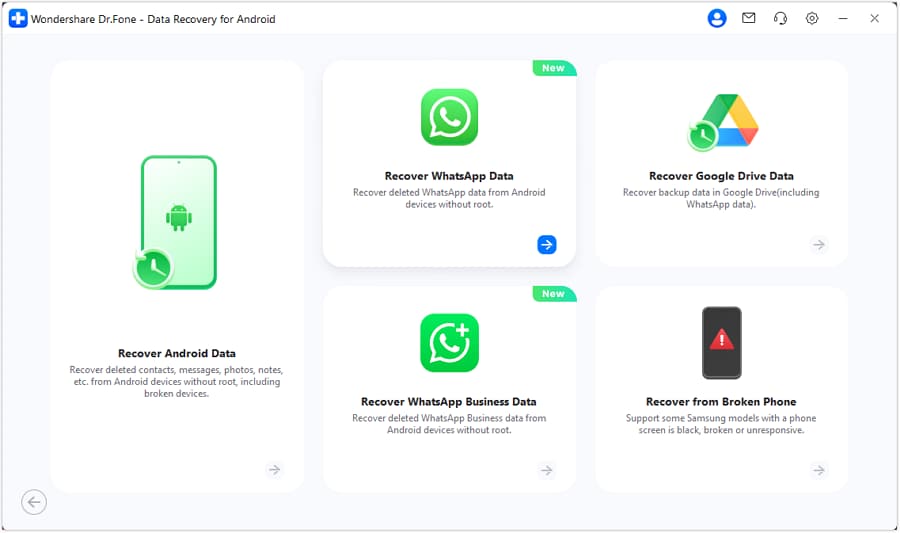
Start the process by securely installing and launching Wondershare Dr.Fone on your Windows or Mac computer. Once the dashboard opens, access the "Toolbox" tab situated on the left navigation panel, and then click on "Data Recovery" from the central grid. Next, carefully select "Android" as your designated device operating system and proceed by clicking on specific recovery modules such as "Recover WhatsApp Data" or standard app data recovery. If you haven't done so already, physically connect your Android smartphone to your computer using a certified USB cable.
-
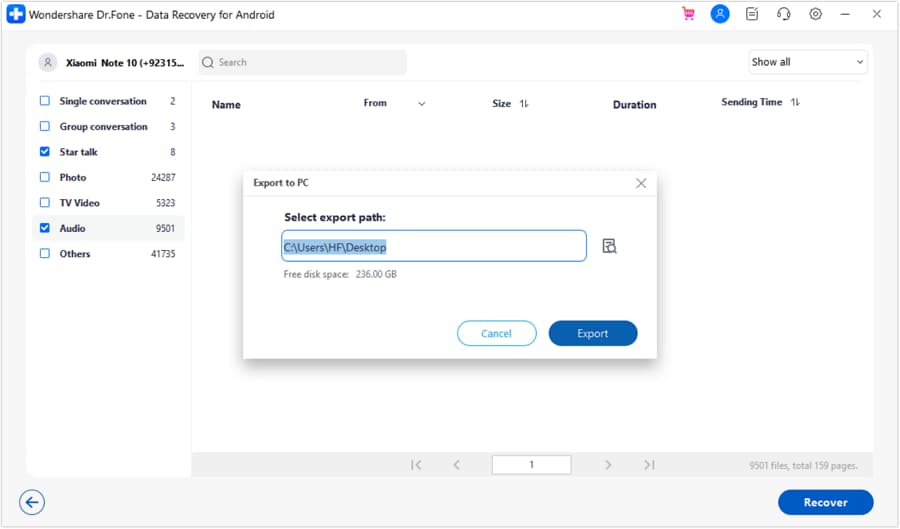
Step 2 Scan, Preview, and Restore the App Data
After your mobile device is successfully connected and recognized by Wondershare Dr.Fone, the software interface will prompt you to meticulously select the distinct data types you aim to recover. Once your selections are confirmed, click "Start Scan" to authorize the software to rigorously analyze your device's storage sectors. As the deeply recovered data dynamically populates on your computer screen, you can utilize the built-in search filters to quickly isolate your targeted files. After you have visually previewed the required app data for accuracy, tap the "Recover" button and assign a safe output directory on your hard drive to save them.


Dr. Fone App-Data Recovery (Android)
Tips: If you are actively looking to bypass the computer requirement and recover data natively on your smartphone, the dedicated Dr. Fone App-Data Recovery (Android) application is your premium mobile-first solution. This robust app strategically allows you to retrieve deleted files directly from the internal memory of your device without ever needing to link up to a desktop, making the entire recovery sequence highly portable and hassle-free. Regardless of whether you have misplaced cherished photos, HD videos, or deeply nested system documents, the Dr.Fone App provides exceptional on-the-go coverage.
With just a handful of quick taps on your touch screen, you can rapidly scan and recover an expansive spectrum of file formats. This includes recovering deleted audio tracks, essential contact lists, historical call logs, SMS text messages, localized WhatsApp cache content, and even disconnected Google Drive records. The interface is meticulously designed to remain universally user-friendly, guaranteeing that anyone can swiftly locate and restore what they have lost. Experience absolute peace of mind knowing that your most valuable digital assets are merely a few screen taps away from being totally restored.


Bonus Tip: How To Access the App Data on Android Smartphones?
Mastering how to securely access the raw app data on your Android smartphone can prove to be exceptionally beneficial. It grants users profound insight into exactly how specific applications warehouse their localized information, and more importantly, allows advanced users to manually manage, extract, or retrieve hidden files whenever strictly necessary. While attempting to dive deep into Android application data typically demands a moderate degree of technical comprehension, carefully following these outlined steps can effortlessly provide you with a clearer perspective regarding your smartphone's internal storage layout:
1. Utilize Comprehensive File Manager Apps
Basic built-in file managers are an expected and highly common utility featured natively across the majority of modern Android smartphones. Alternatively, if your native app is lacking, users always have the superior option to safely acquire capable third-party file manager applications, such as FV File Explorer directly from the official Google Play Store. These highly versatile file management programs empower users to seamlessly tunnel into their device's core internal storage, visually unearth hidden application directories, and effectively manipulate or migrate files as required.

2. Navigate to Critical App Data Folders
By properly using your preferred file manager interface, navigate your way to the root directory of your internal storage drive or inserted Micro SD card. Scroll down until you identify a primary system folder conspicuously titled "Android." Upon opening this foundational directory, you will likely encounter several integral subfolders, most notably those labeled "Data" and "obb."
- Data Folder: The highly pivotal "Data" folder operates as the main hub containing localized user app data for virtually every single application correctly installed on your smartphone. However, it is essential to note that the raw code and databases securely nestled within these directories are frequently encrypted or compressed in a proprietary format that is not effortlessly readable to humans. Comprehending or extracting this information generally requires an advanced text editor or a specialized third-party extraction utility.
- Obb Folder: The supplementary "Obb" folder is predominantly leveraged by massive mobile games and heavy software. It systematically stores colossal expansion packages, heavy graphic assets, and additional background data that specific applications mandate to run smoothly without bloating the core app installer.
3. Explore Secure App-Specific Subfolders
If you proceed further into the core "Data" folder, you will observe that individual application folders are cryptically labeled utilizing specific developer package names (for example, string formats akin to com.example.app). These highly specific folders physically house your app-specific configuration files and saved parameters. Nevertheless, reading, extracting, or actively modifying the files securely nested inside these folders usually mandates that the Android device is fully rooted. The Android operating system intentionally obfuscates and restricts open access to these app data pathways to preserve strict ecosystem security and ensure user privacy is not compromised by malicious background agents.

Conclusion
In summation, realizing that your critical application information has mysteriously vanished can be an immensely disruptive and upsetting ordeal. However, you should not succumb to panic, as this data is incredibly rarely eradicated beyond the point of no return. Throughout this definitive technological guide, we have rigorously explored a multitude of proven avenues detailing how to recover deleted app data on Android phones. Our overarching goal is to effectively arm everyday Android users with the knowledge necessary to feel confident, capable, and prepared whenever they confront unexpected data loss scenarios. As thoroughly discussed, initial remedies should always revolve around seamlessly reinstalling the afflicted applications to trigger cloud synchronization or restoring extensive device states from existing Google Drive backups.
For more severe cases where local backups completely fail, investing in professional-grade software such as Dr.Fone - Data Recovery (Android) serves as the ultimate safety net. Standing prominent among the numerous recovery utilities available today, Dr.Fone uniquely balances an exceptionally user-friendly interface with highly potent, deep-scanning algorithms. It is meticulously crafted to hunt down fragmented data signatures and seamlessly functions across an enormous spectrum of Android architectures. Ultimately, its extensive feature suite and consistently impressive success rates undeniably crown it as the premier solution for restoring entirely deleted app data securely and swiftly.
FAQ
-
1. Can I recover deleted app data without rooting my Android device?
Yes, it is entirely possible to recover deleted app data without performing a root on your device. Most cloud backups, like Google Backup, completely bypass the need for root access. Furthermore, advanced third-party data recovery software like Dr.Fone provides robust "no-root" scanning modes that can safely extract accessible caches and deleted files from non-rooted internal storage environments. -
2. Does reinstalling an application always guarantee data restoration?
Reinstalling an application does not strictly guarantee data restoration. It is only highly effective if the specific application previously saved its core user data to an external cloud server, or if you proactively enabled the "Automatic Restore" feature in your main Android settings prior to the app being deleted. If the app relied solely on local storage without backups, reinstallation will yield a completely blank state. -
3. How long does deleted app data stay on my Android phone before it is overwritten?
The exact duration deleted data remains fully recoverable on your Android phone heavily depends on your device usage. Deleted app data is technically marked as "free space" by the operating system, rather than being instantly shredded. It will persist in the deep storage memory until you download new applications, capture large media, or receive intensive software updates that overwrite those exact storage blocks. Acting immediately vastly improves recovery chances. -
4. Are third-party Android file managers safe to use when exploring root directories?
Reputable third-party file managers downloaded directly from the official Google Play Store, such as FV File Explorer, are exceptionally safe for navigating standard internal storage like the "Data" or "Obb" folders. However, modifying or arbitrarily deleting localized system files located within these deep app-specific directories carries the risk of irreparably crashing the associated app or severely destabilizing the broader Android operating system.
 Add Wondershare Dr.Fone as a preferred source on Google