
iPad Keeps Dropping Wi-Fi? Here's The Fix!

Sep 24, 2026 • Filed to: Phone Repair Solutions • Proven solutions
 TL;DR:
Most Wi-Fi disconnections on models running iPadOS 16, 17, and 18 stem from corrupted network configurations, router frequency limitations, or physical interference, which can typically be resolved through targeted settings resets or band adjustments.
● To clear software-level network corruption, navigate to Settings > General > Transfer or Reset iPad > Reset > Reset All Settings, which requires you to re-enter all network passwords but preserves your personal data and apps.
● If the iPad drops its connection when moving between rooms, manually connecting to the router's 2.4 GHz band rather than the faster 5 GHz band will provide the longer signal range necessary to prevent edge-of-network disconnects.
● For deep firmware issues that survive basic troubleshooting, running the device through the Standard Repair Mode in Dr.Fone - System Repair reinstalls the operating system without triggering the total data loss associated with a traditional factory restore.
Ask AI for a summary
 ChatGPT
 Perplexity
 Gemini
 Claude
 Grok
Grok
"Wifi keeps dropping iPad: iPad keeps disconnecting from wifi!" -- Apple Community
If your iPad keeps dropping Wi-Fi or you notice it constantly disconnecting and reconnecting without warning, you are not alone. This is one of the most commonly reported iPad connectivity issues—affecting users across iPadOS 16, 17, and 18 on models ranging from the iPad mini to the iPad Pro. The problem can manifest in several ways: the Wi-Fi icon disappears from the status bar, pages fail to load mid-session, apps lose their internet connection, or the iPad appears connected to Wi-Fi but has no actual internet access. In some cases, the iPad disconnects every few minutes; in others, it drops only when moving between rooms or waking from sleep mode.
The root causes fall into two broad categories: environmental and hardware factors (such as poor signal reception, signal interference, or a failing router) and software factors (such as corrupted network settings, outdated iPadOS, or conflicting Wi-Fi configurations). The good news is that the vast majority of cases where the iPad keeps disconnecting from Wi-Fi can be resolved with software-level fixes—no hardware repair needed. This guide walks you through every cause and its corresponding solution so you can identify and fix the exact issue affecting your device.
Part I: Why Does My iPad Keep Disconnecting from Wi-Fi?
Before jumping into fixes, it helps to understand what is actually causing your iPad to keep dropping its Wi-Fi connection. Identifying the correct cause saves time and lets you target the most effective solution directly. The following five categories cover the most common reasons why an iPad disconnects from Wi-Fi—each with specific symptoms to help you self-diagnose the problem.
1. Poor Reception
Poor Wi-Fi reception is the single most common—and most commonly overlooked—reason why an iPad keeps dropping Wi-Fi. Unlike desktop computers that sit in a fixed location near the router, iPads are designed for mobility, which means users often carry them into areas with weak signal coverage. How to identify this cause: the Wi-Fi connection is stable when you are in the same room as the router but drops frequently when you move to other parts of your home or office. The Wi-Fi signal indicator may show only one or two bars in certain locations. This issue is especially prevalent in larger homes, buildings with thick concrete or brick walls, or spaces where the router is tucked away in a corner or inside a cabinet.
2. Signal Interference
Wi-Fi signal interference occurs when competing wireless signals on the same or overlapping frequency channels disrupt your router's communication with your iPad. In densely populated areas—apartment buildings, offices, or urban neighborhoods—dozens of nearby Wi-Fi networks can operate on the same 2.4 GHz channels simultaneously. This congestion can cause your iPad to keep connecting and disconnecting from Wi-Fi as the device struggles to maintain a clean signal amid the noise. How to identify this cause: the iPad drops Wi-Fi most often during peak hours (evenings, business hours) when nearby networks are most active, or when multiple devices are connected to your router simultaneously. Microwave ovens, baby monitors, and Bluetooth devices can also cause 2.4 GHz interference.
3. Poor Quality Accessories
Third-party iPad cases and screen protectors—particularly low-quality ones manufactured without adhering to Apple's specifications—can physically block or attenuate the iPad's internal Wi-Fi antenna. The iPad's Wi-Fi and Bluetooth antennae are embedded within the device's aluminum or glass frame, and certain case materials (especially thick metallic or carbon-fiber-lined cases) can significantly reduce wireless signal reception. How to identify this cause: Wi-Fi performance improves noticeably when the iPad is used without its case, or when you hold the iPad in a specific orientation that minimizes the case's interference. If your iPad 2 poor Wi-Fi reception or signal drops coincide with switching to a new case, the accessory is the likely culprit.
4. Hardware Failures
Hardware failures are less common than software issues but cannot be ruled out—particularly on older iPad models or devices that have experienced physical damage (drops, water exposure). Hardware failure points include: the iPad's internal Wi-Fi radio chip or antenna, a failing Wi-Fi router with degraded transmitter power, or a damaged router antenna. How to identify this cause: if your iPad keeps dropping Wi-Fi but other devices are working fine, the problem is likely within the iPad itself. Conversely, if all devices connected to your router are experiencing the same disconnection issues, the router is the more probable hardware failure point. Hardware issues in the iPad typically require professional service, but it is worth exhausting all software-based solutions first.
5. Software Issues
Software-related Wi-Fi disconnection is extremely common and covers a wide range of causes: corrupted network configuration files, an outdated iPadOS version with known Wi-Fi bugs, misconfigured dual-band settings on your router, desynchronized mesh network nodes, or conflicting Wi-Fi settings introduced by a recent iPadOS update. How to identify this cause: the iPad's Wi-Fi issue appeared suddenly after an iPadOS update, or after changing your router settings. The iPad shows "connected" status but has no internet access—a classic sign of a software-level network configuration error. Software issues are almost always fixable without any hardware changes, and Part II below covers six targeted fixes in detail.
Pinpointing which of these five causes applies to your situation is the fastest way to resolve the issue. Use the symptom clues above to guide which fix in Part II you should try first.

Dr.Fone - System Repair
Repair iOS System Errors to Fix iPad Keeps Disconnecting from WiFi Without Data Loss.
- Only fix your iOS to normal, no data loss at all.
- Fix various iOS system issues stuck in recovery mode, white Apple logo, black screen, looping on start, etc.
- Fix iOS errors by yourself. No tech is required.
- Works for all models of iPhone, iPad, and iPod touch.
- Fully compatible with the latest iOS version.

Part II: How to Fix iPad Keeps Disconnecting from Wi-Fi Issue?
 safe & secure
The fixes below are organized to match the five root causes identified in Part I. Start with the fix that matches your observed symptom—this is the most efficient path to resolving your iPad Wi-Fi disconnection issue. Work through the software fixes (Section 4) in order if you are uncertain which cause applies, as software issues are the most common underlying reason.
1. Fix iPad Dropping Wi-Fi Due to Poor Reception
If your iPad Wi-Fi keeps disconnecting only in certain parts of your home or office—but the connection is stable when you are near the router—poor signal reception is the cause. This is particularly common in two-story homes, offices with multiple rooms, or spaces where the router is placed in a non-central location such as a corner, basement, or inside a cabinet. Wi-Fi signals attenuate (weaken) as they travel through walls, floors, and ceilings, and the iPad will disconnect when the received signal strength drops below the minimum threshold required to maintain a stable connection.
There are three ways to fix the situation:
- Option 1: Move closer to the Wi-Fi router. The simplest short-term fix. Position yourself within 10–15 meters of the router with as few walls between you and the device as possible. If the iPad no longer drops Wi-Fi when closer to the router, poor reception is confirmed as the cause.
- Option 2: Relocate the Wi-Fi router to a more central position. Place the router at a central, elevated location in your home or office—ideally on a shelf or desk in the middle of the space. Avoid placing it near large metal objects, microwaves, or inside enclosed cabinets, all of which block or reflect the signal. A centrally located router can dramatically extend usable Wi-Fi range.
- Option 3: Upgrade to a Wi-Fi mesh router system. For larger homes or offices where a single router cannot provide adequate coverage, a Wi-Fi mesh system (such as Google Nest WiFi, Eero, or Apple AirPort) distributes multiple access nodes throughout the space to provide seamless, whole-home Wi-Fi coverage. Mesh systems eliminate dead zones and ensure the iPad always has access to a strong, local signal—completely resolving range-related Wi-Fi dropping issues.
2. Fix iPad Dropping Wi-Fi Due to Signal Interference
If your iPad keeps connecting and disconnecting from Wi-Fi despite being in close proximity to the router, signal interference from neighboring networks or other wireless devices may be the cause. Wi-Fi networks operating on overlapping channels—especially on the congested 2.4 GHz band—can interfere with each other and cause devices to repeatedly drop and reconnect. This is especially common in apartment buildings and urban areas where many routers operate in close proximity.
The solution is to change the Wi-Fi channel on your router to one that is less congested. For the 2.4 GHz band, channels 1, 6, and 11 are the only non-overlapping channels—switching to whichever of these three is least used by nearby networks will reduce interference significantly. For the 5 GHz band, there are more non-overlapping channels available, so interference is generally less of an issue. Most modern routers also offer an "Auto" channel selection mode that periodically scans and selects the least congested channel automatically—enabling this feature is a good first step.
The process to change Wi-Fi channels differs between router brands and models. Log in to your router's admin panel (typically accessed via a browser at 192.168.1.1 or 192.168.0.1) and look for Wireless Settings or Advanced Wireless options. If your router was provided by your ISP, contact them directly—they can often push the channel change remotely or guide you through the steps for your specific model.
3. Fix iPad Dropping Wi-Fi Due to Poor Quality Accessories
Third-party iPad accessories—particularly cases that were not designed to Apple's material and clearance specifications—can physically interfere with the iPad's built-in Wi-Fi antenna. The iPad's antenna is integrated into its aluminum or glass housing, and certain case materials can act as a partial RF (radio frequency) shield, reducing signal reception strength and causing intermittent Wi-Fi drops. This is more common with: thick metallic or carbon-fiber cases, cases that cover the iPad's upper edges where the antenna is located, and poorly manufactured generic cases with unknown material compositions.
To diagnose whether your case is causing the issue, remove it completely and test the Wi-Fi connection with the bare iPad. If signal quality noticeably improves—fewer disconnections, stronger signal bars, more stable internet access—the case is confirmed as the cause. In that scenario, the fix is straightforward: replace the case with an Apple-certified or MFi-certified accessory that is designed not to interfere with wireless performance. Similarly, thick third-party screen protectors made of materials that interfere with antenna signals should also be tested and replaced if necessary.
4. Fix iPad Dropping Wi-Fi Due to Software Issues
Software-related causes are the most common reason an iPad keeps disconnecting from the internet—and fortunately, they are also the most straightforward to fix. From simple restarts to resetting network configurations, the six fixes below cover every software-level scenario that can cause your iPad to repeatedly drop its Wi-Fi connection. Try them in order, starting with the least invasive.
Fix 1: Force Restart The iPad
A force restart clears the iPad's active memory, terminates all background processes, and forces iPadOS to reinitialize all system services—including Wi-Fi networking. This is often enough to resolve temporary Wi-Fi drops caused by software glitches, memory leaks, or a stuck network process. It is always the recommended first step before attempting more invasive fixes. Here's how to restart the iPad:
iPad With Home Button

- Step 1: For an iPad with a home button, press and hold the Power button till the slider screen comes up. Drag the slider to shut down the iPad.
- Step 2: Press and hold the Power button to restart the iPad.
iPad Without Home Button
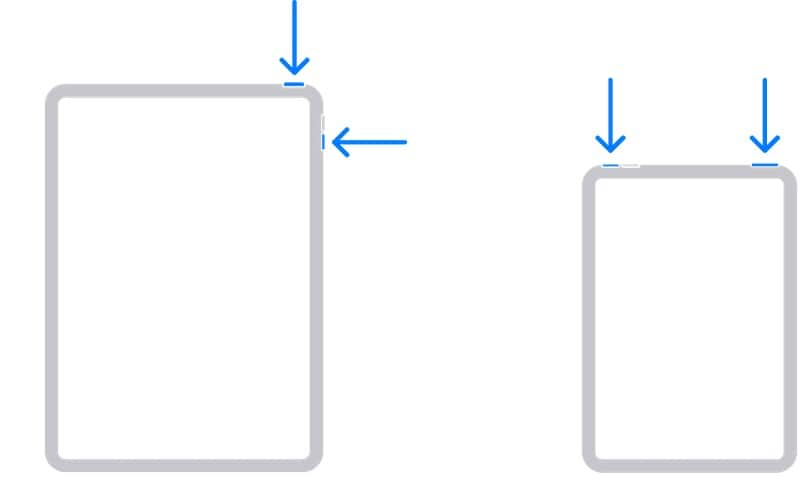
- Step 1: Press and hold any one of the volume keys and the Power button till the slider screen appears. Drag to shut down the iPad.
- Step 2: Press the Power button and hold until the iPad restarts.
After the restart, reconnect to your Wi-Fi network and observe whether the dropping issue persists. If the iPad now maintains a stable connection, the restart resolved a temporary software glitch.
Fix 2: Restart The Wi-Fi Router
Wi-Fi routers are essentially small computers running embedded software, and like all computers, they can develop memory leaks, connection table overflows, and firmware states that degrade their performance over time. A router that has been running continuously for weeks or months without a reboot may struggle to maintain stable connections—particularly for newer iPadOS versions that use more aggressive Wi-Fi handshaking protocols. Power-cycling the router flushes its memory, clears all active connection states, and allows the router firmware to start fresh.
To power-cycle the router: unplug the power cable from the back of the router (do not just press the power button—physically remove the cable), wait at least 30 seconds to allow all residual charge to discharge, then reconnect the power cable. Wait 60–90 seconds for the router to fully boot up and re-establish its internet connection before testing the iPad's Wi-Fi. Many modern routers also support scheduled automatic reboots via their admin settings—enabling a weekly overnight reboot is a good preventive practice for maintaining router performance.
Fix 3: Sync The Wi-Fi Mesh Router System
Mesh Wi-Fi systems solve the coverage problem by deploying multiple interconnected nodes throughout a space. However, when an iPad moves between the coverage zones of different mesh nodes, a "handoff" process occurs where one node passes the connection to a closer node. If the mesh nodes are not properly synchronized, these handoffs can fail—causing the iPad to keep connecting and disconnecting from Wi-Fi as it passes between node coverage zones, even though signal strength appears adequate.
To fix this: locate the Sync button on each mesh node (refer to your specific brand's documentation for its exact location) and perform a manual re-synchronization of all nodes. This re-establishes the inter-node communication protocol and ensures that handoffs occur smoothly. Additionally, check whether a firmware update is available for your mesh system—outdated node firmware is a frequent cause of handoff failures. Most mesh systems allow firmware updates via their companion smartphone app.
Fix 4: Reset Network Settings
iPadOS stores all Wi-Fi network configurations, saved passwords, VPN settings, and network preferences in a dedicated settings store. When an iPadOS update modifies the internal network stack or configuration format, this stored data can become corrupted or incompatible—leading to persistent iPad Wi-Fi disconnection issues that no amount of router restarts or channel changes will fix. Resetting the network settings wipes all stored network data and forces iPadOS to rebuild its network configuration from scratch. Important note: this will erase all saved Wi-Fi passwords—you will need to re-enter passwords for all networks you normally connect to. No personal data (photos, apps, files) is affected. Here's how to reset network settings on the iPad:
- Step 1: Go to Settings > General and scroll down till the end.
- Step 2: Tap Transfer or Reset iPad > Reset.
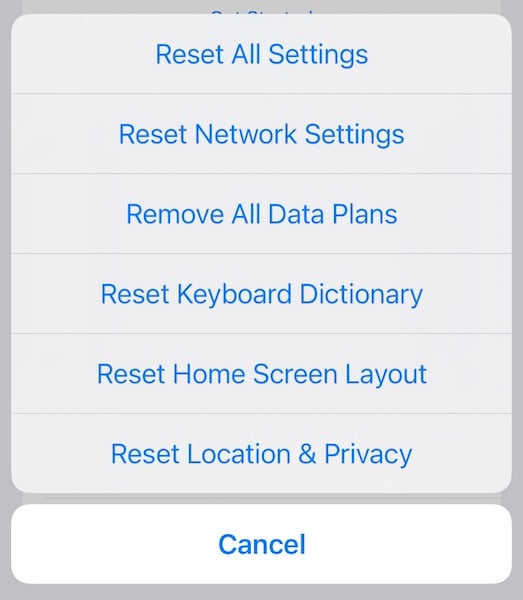
- Step 3: Tap Reset All Settings.
After the iPad restarts, navigate to Settings > Wi-Fi, select your network, enter the password, and reconnect. Test the connection over 15–30 minutes to determine whether the dropping issue has been resolved.
Fix 5: Add The Other Wi-Fi Band to iPad
Most modern routers broadcast on two frequency bands simultaneously: the 2.4 GHz band (longer range, lower speed, more interference-prone) and the 5 GHz band (shorter range, higher speed, less interference). Many users connect to the 5 GHz band because it offers faster speeds—but its shorter range means the iPad can lose signal when moving to rooms farther from the router, causing the iPad to keep dropping internet connectivity. If your iPad is connected to the 5 GHz band and you are frequently at the edge of its range, the connection will drop and reconnect repeatedly as the signal fluctuates around the minimum threshold.
Here's how to add another Wi-Fi network to the list of trusted networks on the iPad:
- Step 1: Go to Settings > Wi-Fi.
- Step 2: You will see the list of available networks.
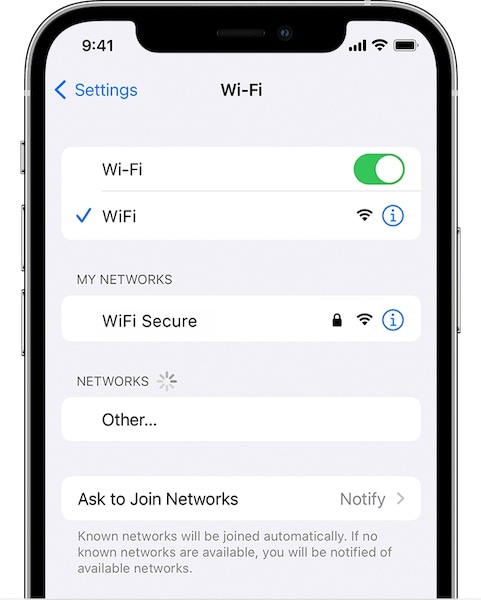
- Step 3: From this list, you will be able to recognize the 2.4 GHz band Wi-Fi network easily since by default they are named clearly.
- Step 4: Connect to it with the password from your existing Wi-Fi. Most likely, it will work. If not, you will need to access the admin settings of your router (check the internet for your brand) and set up a password for the 2.4 GHz band afresh.
Once connected to the 2.4 GHz band, the iPad will have a more consistent signal across a wider area. For an optimized experience, you can also name both bands identically with the same password in your router's admin settings—this allows the iPad to automatically switch between 5 GHz and 2.4 GHz based on signal strength, ensuring both speed and stability depending on where you are in the space.
Bonus Fix 6: Repair iPadOS Quickly With Dr.Fone - System Repair (iOS) [Recommended]
If none of the above fixes have resolved the issue and your iPad still keeps disconnecting from Wi-Fi, the problem likely involves a deeper corruption within the iPadOS system files—something that standard settings resets cannot address. This level of software corruption typically requires a full firmware reinstallation. Apple's official approach using iTunes or macOS Finder can accomplish this, but it often requires a full factory restore that erases all user data. Dr.Fone - System Repair (iOS) offers a superior alternative: it repairs the iPadOS firmware at the system level using Standard Repair Mode, which reinstalls the firmware without deleting any user data—photos, apps, messages, and files all remain intact.
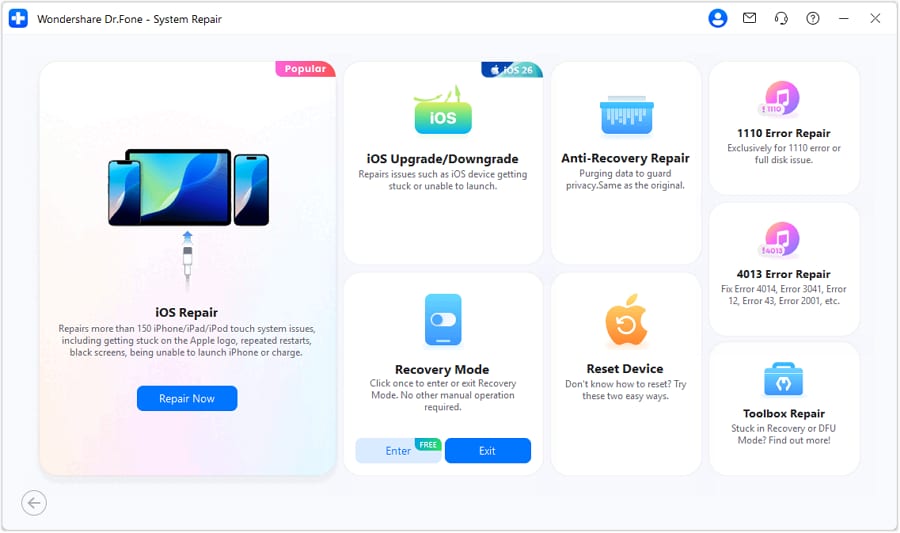
Dr.Fone - System Repair (iOS)
Fix iOS System Issues on Your Own
- Fixes various iOS issues like iPhone stuck on Apple logo, white screen, stuck in recovery mode, etc.
- Works smoothly with all versions of iPhone, iPad, and iPod touch.
- Retains existing phone data during the fix.
- Easy-to-follow instructions provided.
Dr.Fone's System Repair module handles the entire process with step-by-step on-screen guidance—no technical knowledge is required. It automatically identifies your iPad model and iPadOS version, downloads the correct firmware package, verifies it with Apple's servers, and installs it cleanly. For users who want to be extra cautious, Dr.Fone also includes a create backups of user data module that lets you back up all iPad content before the repair and restore it just as easily afterward. If a software-level Wi-Fi bug is the root cause, this approach resolves it definitively.
5. Fix iPad Dropping Wi-Fi Due to Hardware Failures
Hardware failure is the least common but most serious cause of persistent iPad Wi-Fi disconnection. It can involve the Wi-Fi radio module inside the iPad itself, the antenna connectors, or a degrading router that can no longer maintain stable connections. Before concluding that there is a hardware issue, it is important to rule out all software causes using the fixes in Section 4 above—because hardware and software symptoms can appear identical from a user perspective.
How to determine whether the iPad's hardware or the router's hardware is at fault:
- Test with other devices: Connect another phone, laptop, or tablet to the same Wi-Fi network. If your iPad keeps dropping Wi-Fi but other devices are working fine with no disconnection issues, the fault is within the iPad itself rather than the router.
- Test the iPad on a different network: Connect your iPad to a different Wi-Fi network (a friend's home network, a mobile hotspot, or a café Wi-Fi). If the iPad maintains a stable connection on a different network, the problem is with your router—not the iPad.
- Check for physical damage: Inspect the iPad for signs of prior drops, impact damage, or liquid exposure. Physical damage to the device housing can damage the internal antenna connections and cause intermittent Wi-Fi failures.
- Router hardware check: If all devices connected to your router experience similar disconnection issues, the router hardware may be failing. Check the router's signal light indicators for abnormal behavior, check whether the router is overheating (ensure it is in a well-ventilated location), and consider contacting your ISP or replacing the router if it is several years old.
If diagnostics confirm a hardware fault within the iPad itself, contact Apple Support or visit an Apple Authorized Service Provider. If the device is covered under AppleCare+, a repair or replacement may be available at no additional cost.
Conclusion
When your iPad keeps dropping Wi-Fi or constantly disconnects from the internet, the issue is almost always fixable—and in most cases, it does not require a trip to the Apple Store. Start by identifying which of the five root causes applies to your situation using the symptom guides in Part I. For physical causes, simple changes like relocating your router, switching Wi-Fi channels, or removing a poorly made case are quick and cost-free fixes. For software causes, working through the six fixes in Part II—from a simple restart to a full iPadOS repair with Dr.Fone—covers every software-level scenario that could be driving the disconnection. Reserve the hardware diagnostics in Fix 5 for situations where all software fixes have failed and you need to determine whether the iPad or router needs professional attention. With the right fix applied to the right cause, your iPad should maintain a stable, reliable Wi-Fi connection again.
4,624,541 people have downloaded it
 safe & secure
Frequently Asked Questions About iPad Keeps Dropping Wi-Fi
Q1: Why does my iPad keep disconnecting and reconnecting to Wi-Fi automatically?
When your iPad keeps disconnecting and reconnecting to Wi-Fi in a loop, the most likely causes are: (1) a weak or unstable Wi-Fi signal that repeatedly drops below the minimum connection threshold, causing the iPad to disconnect and attempt to reconnect; (2) dual-band confusion, where the iPad repeatedly switches between a 5 GHz and 2.4 GHz network that are named differently but belong to the same router; or (3) a software glitch in iPadOS's Wi-Fi management process. Quick fixes to try: restart the iPad, restart the router, and if the issue persists, reset the iPad's network settings via Settings → General → Transfer or Reset iPad → Reset → Reset All Settings. If the loop happens only in specific locations, the root cause is likely weak signal range—consider upgrading to a Wi-Fi mesh system for better coverage.
Q2: My iPad keeps dropping Wi-Fi but other devices are working fine—what should I do?
If your iPad keeps dropping Wi-Fi but other devices are working fine on the same network, the issue is isolated to the iPad itself rather than the router or network. The most common iPad-specific causes in this scenario are: a corrupted network configuration on the iPad, an outdated iPadOS version with Wi-Fi bugs, or a third-party case blocking the iPad's Wi-Fi antenna. Recommended steps: (1) Remove any third-party case and test the connection bare. (2) Reset network settings: Settings → General → Transfer or Reset iPad → Reset → Reset All Settings. (3) Update iPadOS to the latest version via Settings → General → Software Update. (4) If still unresolved, use Dr.Fone – System Repair (iOS) to repair the iPadOS firmware without data loss. Only consider hardware service if all software fixes fail.
Q3: Why does my iPad keep dropping internet even though it shows as connected to Wi-Fi?
When an iPad keeps dropping internet access while still showing connected to Wi-Fi, the issue is typically a disconnect between the Wi-Fi association layer (which shows as "connected") and the actual IP routing layer (which determines real internet access). Common causes include: your router obtained a new DHCP lease and the iPad's cached IP address is no longer valid; the router is connected to Wi-Fi but its internet upstream (WAN connection to your ISP) has dropped; or the iPad's DNS configuration is corrupted. To fix: first restart the router to renew all IP leases. Then on the iPad, go to Settings → Wi-Fi → tap your network name → Renew Lease. If the problem recurs, reset network settings on the iPad. For persistent cases, repair iPadOS with Dr.Fone – System Repair to address any underlying firmware-level networking issues.
Q4: Why does my new iPad keep dropping the Wi-Fi connection right out of the box?
If your new iPad keeps dropping the Wi-Fi connection from the moment of first setup, the most likely explanation is not a hardware defect—it is almost always a software or configuration issue. New iPads sometimes ship with a version of iPadOS that has known Wi-Fi bugs that were fixed in a later update. The first thing to do is update iPadOS immediately: go to Settings → General → Software Update and install any available update. Next, check whether the issue is related to your router's dual-band configuration—connect specifically to the 2.4 GHz band and test stability. If the problem persists after updating and testing on both bands, try resetting network settings. If a brand new iPad continues to drop Wi-Fi after all of these steps, it is rare but possible to have a hardware Wi-Fi defect—contact Apple Support and request a replacement under your device warranty within the 14-day return window.




Daisy Raines
staff Editor
Generally rated4.5(105participated)