 Teleport your device anywhere instantly with one click.


 100% Security Verified | No Subscription Required | No Malware


 :

 ChatGPT
 Perplexity
 Gemini
 Claude
 Grok
WhatsApp Live Location stops refreshing when the sending phone cannot obtain or transmit a current position. Begin with its internet connection, location permission, and sharing timer. A stationary marker does not, by itself, prove that the person has stopped moving.
WhatsApp supports location sharing in individual conversations and groups, but a one-time location pin behaves differently from a live session. The troubleshooting sequence below applies to Android and iPhone, followed by a separate explanation of GPS simulation and instructions for starting a fresh live share.
In this article
Part 1: What Prevents WhatsApp Live Location from Refreshing?
Find the cause on the phone that is sharing its position before changing settings on the receiving phone. These three checks narrow down the most common problems without deleting anything.
- An interrupted data connection: The device needs a working internet connection to send new coordinates. Mobile coverage can disappear indoors or while travelling, and an apparently connected Wi-Fi network may have no internet access. Check whether ordinary WhatsApp messages can leave the sending phone.
- Location access is unavailable: Turning off the device's location switch, denying WhatsApp permission, or restricting access in the background can interrupt the feed. Permission granted during an earlier session may no longer be sufficient after settings or software changes.
- Incorrect clock or time-zone settings: A badly configured clock can interfere with phone services and make timestamps confusing. Automatic date and time is a sensible check, although it is not a guaranteed cure for a frozen marker.
Also confirm that the original sharing period has not ended. An expired session must be started again; reconnecting Wi-Fi cannot extend it. If the sender selected a static current-location message, that pin was never intended to track movement.
Part 2. Troubleshoot a WhatsApp Live Location That Is Not Updating
Work through the following remedies in order. After each change, keep WhatsApp open briefly on the sending device and ask the recipient to check the session's latest update rather than assuming that a refreshed map means new coordinates arrived.
1. Reconnect to the internet
Switch between a known-working Wi-Fi network and mobile data. If neither responds, briefly enable Airplane Mode, turn it off, and wait for the connection to return. Restart the handset if its network connection remains stuck.
These actions can clear a temporary connectivity fault, but they do not repair every application bug. Both participants need internet access to exchange and view updates. Avoid making this test while someone is relying on the live session for an urgent safety check.
2. Install available WhatsApp and system updates
Open the official App Store or Google Play listing and install any available WhatsApp update. Then check the phone's system-update screen. New releases can address defects and compatibility problems, but an update is not evidence that every location issue has been fixed.
When installation finishes, reopen the conversation and check its sharing status. If the session has expired during troubleshooting, create another one with the intended duration.
3. Restore the required location permissions
On iPhone, open Settings > Privacy & Security > Location Services. Enable Location Services and inspect WhatsApp's permission. Allow the location access WhatsApp requests for live sharing, including background access where offered, and review Precise Location.
On Android, enable Location from Quick Settings or the system Settings app. Then inspect Apps > WhatsApp > Permissions > Location; names differ across manufacturers. Check the available background and precise-location options rather than assuming that the master Location switch grants every permission. If updates stop only when the screen locks, also review background-data and battery restrictions.
4. Recheck location settings on iPhone or Android
For iPhone, a location-permission reset is a later troubleshooting option: go to Settings > General > Transfer or Reset iPhone > Reset > Reset Location & Privacy. This resets permissions for apps, so WhatsApp and other applications will need permission again. It does not erase the phone, but do not confuse it with Erase All Content and Settings.
Android does not have the same universal reset command. Revisit its location and accuracy settings instead:
Step 1Open the location controls
Pull down Quick Settings and touch and hold Location. If the tile is hidden, edit the available tiles or open Location through Settings.
Step 2Inspect location accuracy
Find Location Services or its manufacturer-specific equivalent, then open Google Location Accuracy when the device provides it.
Step 3Retest the position
Enable the available accuracy assistance and test again. Menu availability varies, and switching accuracy off is not a general recommendation for improving a live feed.
5. Reinstall WhatsApp only after protecting your chats
If connectivity, permissions, and updates have not helped, consider a fresh installation from the official store. First verify a usable chat backup and the account details required to restore it. Uninstalling without that preparation can put messages or media at risk.
After reinstalling, sign in, restore the supported backup if needed, grant location access, and begin a new live session. If the sending phone cannot locate itself accurately in a maps app either, investigate the device's location service rather than repeatedly reinstalling WhatsApp.
Part 3: Understand GPS Simulation Before Changing a WhatsApp Location
 Set your map route to simulate GPS movement.
- Set your wanted movement speed.
- HD and large map view to check location.
- Fake GPS location to anywhere.

Dr.Fone - Virtual Location changes the GPS position reported by a supported connected device and can simulate movement along a chosen route at an adjustable speed. It is relevant when you intentionally want to test a different map position, not when you need to repair a missing connection or obtain your true location.
A simulated position is not protection against spyware, and it does not replace WhatsApp's privacy controls. Compatibility depends on the device, operating-system version, and application behavior; do not assume every app accepts simulated coordinates. Use it only with appropriate consent, and never present a test position as an emergency whereabouts update.
Step 1Launch the desktop location module
Install the appropriate desktop edition and connect the phone with a USB data cable. Open Virtual Location and follow the Get Started prompt if that interface is displayed.
Step 2Authorize your own device
Complete the connection prompts for the platform. On iPhone, respond to the required trust and device prompts. On Android, the workflow may ask for file-transfer mode and USB debugging in Developer options. Android debugging instructions do not apply to iPhone, and the menu path varies by manufacturer.
Step 3Select and verify the simulated destination
Activate Teleport Mode, search for the intended place, and inspect the map pin. Confirm with Move Here. For route simulation, select the supported movement mode and set the route and speed before starting.
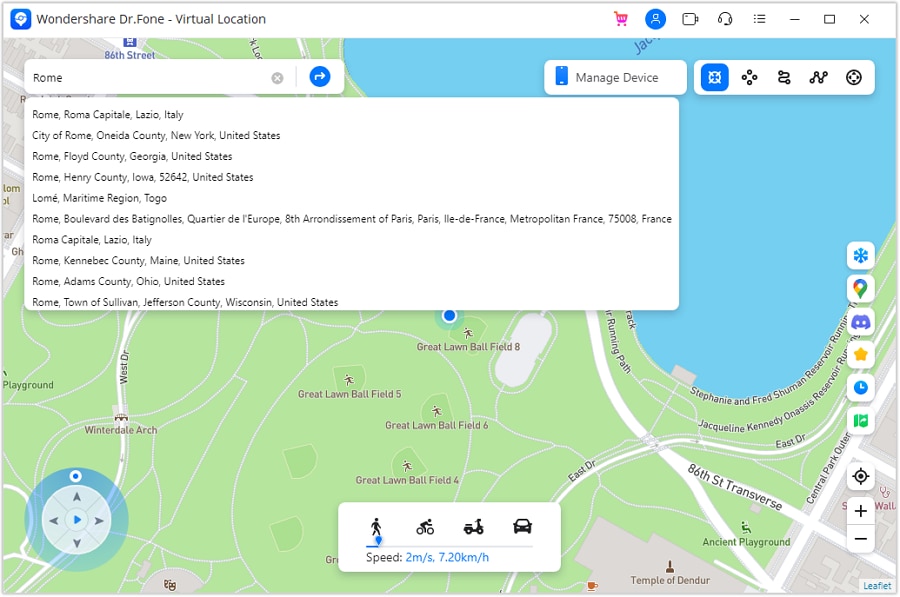

Check the phone's map first, then test WhatsApp only if the device and app support the setup. When finished, follow the program's restoration prompt or restart the device to return to its actual position.
A changed map pin confirms only the position shown in that test. It does not guarantee uninterrupted WhatsApp live updates, repair chat backups, or make a location share anonymous.




Part 4. Start a WhatsApp Live Location Share
Live sharing lets a trusted individual or group follow your changing position for a selected period. The choices described in the original workflow are 15 minutes, 1 hour, or 8 hours. You can stop sooner from the conversation. Stopping prevents further live updates; it cannot erase information that recipients already saw or saved.
Choose the recipient carefully before transmitting location data. For an ordinary meet-up, share your real position rather than a simulated point so the other person does not travel to the wrong place.
Step 1Enable the phone's location service
Use Android's Location control or the iPhone Location Services screen. A system permission prompt may still appear later.
Step 2Open the intended conversation
Select the individual or group that should receive your position and verify its name before continuing.
Step 3Open the location attachment
Tap the attachment control on Android or the plus control on iPhone, then choose Location.

Step 4Select the live option
Grant the requested location permission and choose Share Live Location. Sending your current location as a single pin is a different action.

Step 5Set the duration and send
Pick the time period, add an optional comment, and press Send. Check the session afterward and use Stop Sharing when it is no longer needed.
Location accuracy matters: WhatsApp uses the position available from the phone's location service. Intentional GPS simulation can change what a supported device reports, but it should not be used to diagnose whether real-world tracking is accurate.
Part 5: Keep Other WhatsApp Problems Separate from Location Troubleshooting
Missing conversations, phone migration, and Business backups require data-management tools and suitable backups. They are separate from the GPS-changing features discussed above; no single location setting fixes all three.
1. Investigate missing messages
Check archived conversations and available WhatsApp backups before attempting recovery. The inherited Data Recovery tool link actually points to WhatsApp Transfer, so its label should not be taken as proof of unrestricted deleted-message recovery. Available restoration options depend on the platform, retained data, and backup state; recovery cannot be promised with one click.
2. Move WhatsApp data to another phone
A handset upgrade does not automatically require abandoning your chat history. Review WhatsApp's supported migration options and the separate utility described by backup, restore, and transfer all WhatsApp data. Confirm device compatibility, backup requirements, and whether the operation replaces existing destination data before proceeding.
3. Preserve WhatsApp Business conversations
A Business account can hold customer enquiries, order details, invoices, and automated replies. Keep an appropriate backup and confirm that the selected transfer workflow explicitly supports WhatsApp Business on your source and destination devices. These tasks belong to backup or transfer software, not Virtual Location.
Conclusion
Restore connectivity, review location permission, and confirm the live-sharing timer before trying disruptive fixes. Updates and a carefully prepared reinstall are later options. Dr.Fone - Virtual Location is a separate choice for intentional GPS simulation on a supported setup, not a repair for WhatsApp networking or a replacement for chat-transfer software.
FAQ
1. Why does the WhatsApp location marker stay in one place?
The sender may have lost connectivity or location permission, the live session may have ended, or the message may be a static location pin. Check those conditions before assuming the marker reflects the person's current position.2. Where are iPhone location permissions for WhatsApp?
Open Settings > Privacy & Security > Location Services and select WhatsApp. Review its available location and precision permissions, including the background access requested for the feature.3. Can restarting a connection extend an expired live share?
No. Reconnecting may restore transmission during an active session, but the sender must start another session when the selected sharing duration has expired.4. Does Virtual Location recover WhatsApp conversations?
No. Its role is GPS simulation. Restoring chats or moving them between phones requires the relevant WhatsApp backup or transfer workflow and depends on the available data.
 Add Wondershare Dr.Fone as a preferred source on Google



