 Teleport your device anywhere instantly with one click.


 100% Security Verified | No Subscription Required | No Malware


 :

 ChatGPT
 Perplexity
 Gemini
 Claude
 Grok
You can change your Hinge location directly in the app on iPhone or Android. Open your profile editor, find My Vitals and Location, choose the area on the map or search for it, then save. Hinge also provides a My Neighborhood control through dating preferences. A VPN or GPS simulator is not required for this manual change.
The important distinction is between the location saved in your dating profile, the device location you may choose to share, and your network's IP address. These are not interchangeable. This guide keeps the source's manual and VPN approaches while correcting outdated menu descriptions and explaining where a separate GPS tool does, and does not, fit.
In this article
Can you change Hinge location, and what actually changes?
Yes. Hinge lets you choose the location associated with your profile and discovery area. If you move or travel, review that saved selection instead of assuming it follows you automatically. A city selected earlier can remain in your profile until you edit it, which explains why matches may still be centered on your previous area.
However, describing Hinge as unable to use device location at all is inaccurate. Its official instructions include a compass button that can use your current device location with permission. You can instead search manually by city, neighborhood, address, or postal code and adjust the map pin before saving.
Think of the compass as an optional input to the editor, not evidence that every later trip automatically rewrites the saved profile. The profile's chosen neighborhood and your maximum-distance preference jointly affect the experience you are configuring. After an edit, verify both rather than changing phone settings at random.
The source's description of mandatory Facebook-based mutual-friend matching is not a dependable account setup instruction for the current app. Use the sign-in options Hinge presents to your account, and do not assume that changing a Facebook city will change Hinge's saved neighborhood.
Why change your Hinge location?
Moving home or planning a trip. Someone who lives in New York and later visits Paris may want discovery centered on the destination instead of the old neighborhood. A manual update lets you make that choice explicitly. Be clear about whether you live locally, are visiting briefly, or have not arrived yet; a map setting is not proof of physical presence.
Making your discovery radius useful. A correct city paired with an overly narrow radius can still produce unexpected results. Review Maximum Distance in dating preferences, and check any available dealbreaker control. Choosing a wider area can change who is eligible to appear, but cannot guarantee a particular match or response.
Reducing unnecessary profile precision. Hinge says the neighborhood name can be made broader by changing the map scale or searching for a more general place. That can be more appropriate than publishing a very specific area. It is not equivalent to hiding your account, deleting network information, or making your activity anonymous to the service.
The original privacy discussion conflated a profile label with collection of technical data. Editing your neighborhood does not erase an IP address, device identifier, or information already held by a service. Review app permissions, profile visibility, and the platform's privacy information separately, and avoid sharing home or workplace details with unfamiliar people.
How to change Hinge location on iPhone and Android
Start with the app's own controls. They address the saved location directly and avoid confusing it with the phone's GPS or a VPN server. Menu placement can vary by build, but the official routes below identify the functions to look for.
Method 1: Update your location manually inside Hinge
Use My Neighborhood in dating preferences
The retained source screenshot illustrates an older interface. Use it as a visual reference, not a promise that every current button occupies the same position.
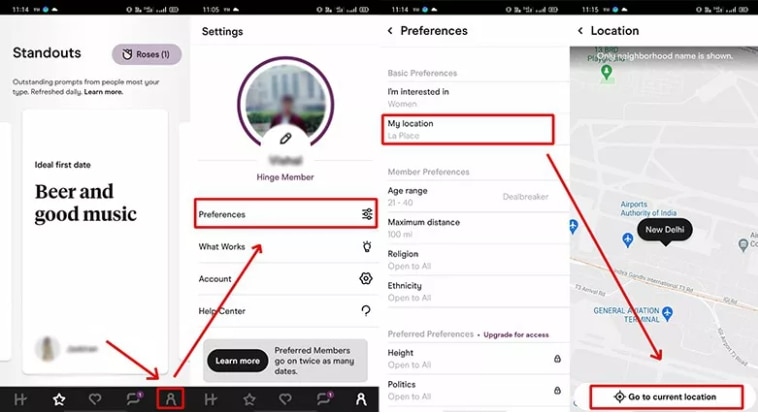
Step 1 Open the preferences control
Launch Hinge and sign in. From the Discover feed, tap the sliders icon to open Preferences, following the equivalent navigation in your installed version.
Step 2 Choose My Neighborhood
Open the location selector. Search for the desired city or neighborhood, move the pin on the map, or use the compass if you want to supply your current device position.
Step 3 Confirm the area
Inspect the selected place, save or return using the control provided by your build, and reopen the editor to verify the result. Also review your preferred distance.
Use the profile editor, not the phone's system Settings app
The source labeled the following route as Phone Settings, but the pencil icon and My Vitals are Hinge profile-editing controls. iOS Settings and Android Settings manage permissions; they do not contain a Hinge profile pencil that changes your neighborhood. Keep these tasks separate.
On iPhone:
Step 1 Open your profile
Inside Hinge, tap your photo in the navigation bar, then tap the pencil beside your profile picture to edit.
Step 2 Find the saved location
Under My Vitals, choose Location. This is the field you are editing, rather than a location permission switch in iOS.
Step 3 Select and save
Search for the intended place or adjust the pin. The compass requires location permission if you use it; a manual search supplies the location without that compass step. Press the back arrow or the save control shown to retain the edit.
On Android:
Step 1 Enter Hinge's editor
Open your profile photo, choose the pencil icon, and locate My Vitals. Do not start in Android's system settings unless you are troubleshooting an app permission.
Step 2 Set Location
Enter a neighborhood or city in the search bar, or position the map where you want the profile location to be. Check the place name carefully when several search results look similar.
Step 3 Review visibility and confirm
If your build presents a Visible on Profile control, consider that setting separately from the map selection. Save the location and inspect the resulting profile rather than assuming a visibility toggle itself sets the city.
For the latest navigation, see Hinge's official location settings instructions. They also note that a new account's initial location must be in a country where Hinge is available for download. Changing a pin is not a supported way around account availability rules.
Method 2: Understand what a VPN changes before using one
A VPN routes traffic through its server and can change the public IP address a service sees. That is different from editing the city in Hinge or simulating GPS coordinates. A server in another country does not, by itself, guarantee a new Hinge neighborhood, expanded dating availability, or permission to use an unsupported region.
Step 1 Choose a VPN for the network task
If you independently need a VPN, obtain a reputable application and review its permissions, privacy terms, and cost. It is not a prerequisite for Hinge's manual profile editor.
Step 2 Establish the network connection
Select an appropriate server and verify the VPN connects. This checks network routing, not the saved dating location.
Step 3 Edit Hinge separately
Open Hinge's own Location or My Neighborhood control and choose the intended area. Use the manual instructions above rather than expecting an IP change to perform this edit.
Step 4 Check the result
Inspect your saved location and distance preferences. If Hinge cannot connect through the VPN, troubleshoot the network or disconnect it; do not assume another server will bypass the platform's rules.
These are separate layers of configuration. A VPN is not a guarantee of anonymity, and a profile-location edit is not a substitute for reviewing privacy permissions. The same separation applies to dedicated GPS utilities.
Dr.Fone - Virtual Location: A separate GPS tool, not a required Hinge step
 Set your map route to simulate GPS movement.
- Set your wanted movement speed.
- HD and large map view to check location.
- Fake GPS location to anywhere.

Dr.Fone - Virtual Location is relevant when you need to test a supported phone's reported GPS position. It offers map-based destination selection and simulated movement controls, but Hinge already provides an in-app location selector. Do not purchase or install a GPS tool on the assumption that it is necessary to edit My Neighborhood.
It also differs from the general phone-management toolkit promoted in the source's old marketing box. Virtual Location is not an all-in-one promise of data recovery, device unlocking, or network encryption; those separate functions should not be imported into this location workflow. The replacement product box below concerns GPS features only.
Step 1 Check requirements and connect
Confirm current device support, open the desktop Virtual Location module, connect the phone, and complete the required authorization prompts.
Step 2 Select a virtual destination
Choose Teleport mode, search the intended place or coordinates, inspect the map pin, and confirm with Move Here in the installed interface.

Step 3 Verify the correct layer
Check the phone's Maps application to assess reported GPS. If your task is only to change Hinge discovery, use Hinge's own saved-location field instead; successful map simulation does not prove that Hinge's saved city changed.
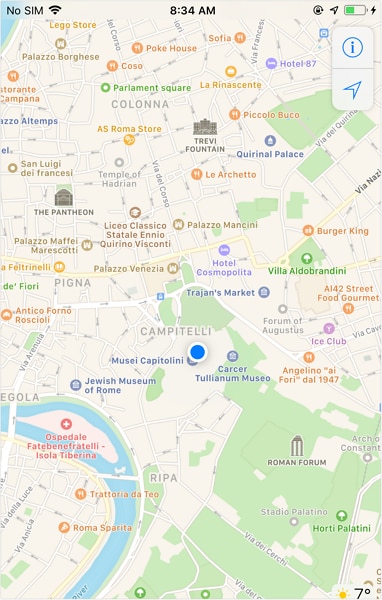
When the GPS test is complete, follow the utility's restoration prompt and restart the device to return to its actual position. Confirm the result in Maps. GPS simulation does not erase account information, hide an IP address, or guarantee that any third-party application accepts the simulated location.




Conclusion
For a move or trip, the simplest way to change Hinge location is to edit Location under My Vitals or use My Neighborhood in preferences, then verify the saved area and distance. Keep optional device-location permission, VPN routing, and GPS simulation separate from that profile change. Dr.Fone - Virtual Location is a separate GPS tool, not evidence that extra software is required for Hinge.
FAQ
1. Can I change Hinge location on both iPhone and Android?
Yes. Use the Hinge profile editor's Location field or My Neighborhood in dating preferences, choose the intended area, and confirm the saved selection.2. Does Hinge automatically change my profile city when I travel?
Do not assume it does. Review the saved location after moving or traveling. Hinge can optionally use device location through the compass, but you still select and save the profile location.3. Will a VPN update My Neighborhood?
Not by itself. A VPN changes network routing and may change your public IP address. Edit the neighborhood inside Hinge to change the saved profile area.4. Do I need Dr.Fone - Virtual Location to edit Hinge?
No. Hinge's built-in controls handle the manual edit. Virtual Location is a separate GPS-simulation option for supported devices, not a required profile-setting tool or a privacy guarantee.
 Add Wondershare Dr.Fone as a preferred source on Google



