 Teleport your device anywhere instantly with one click.


 100% Security Verified | No Subscription Required | No Malware


 :

 ChatGPT
 Perplexity
 Gemini
 Claude
 Grok
The right Hola Fake GPS alternative depends on whether you want a different device coordinate or a different apparent network region. A GPS simulator changes a location signal delivered by a supported phone. Hola VPN routes supported internet traffic through another connection. Those functions are not interchangeable, even when both are described casually as changing location.
If you searched for a Hola Fake GPS APK, first verify the exact app, developer, and official distribution source. An old screenshot or a familiar filename does not establish that an installer is current or trustworthy. This review keeps the original Android walkthrough, benefits, limitations, safety questions, and Pokémon discussion, but separates verified guidance from claims the source did not substantiate.

In this article
Part 1. Hola Fake GPS and Hola VPN: An Overview
The original review blends an Android mock-location app with Hola's VPN and browser-extension products. Its Android screenshots illustrate choosing a map point, while its web-access explanation describes routing requests through another IP address. Keep those two mechanisms separate when deciding whether Hola GPS matches your task.
A routed connection may affect the region a website infers from your IP, but it does not automatically replace satellite-derived or operating-system location data. Likewise, a simulated GPS point does not encrypt browser traffic. Neither technique guarantees access to Netflix, YouTube, or a particular game feature, and no bandwidth benchmark was supplied in the source to justify a universal streaming verdict.
The source also uses an aggregate user count and makes broad malware and breach allegations without linked evidence. Those statements are not used here as current measurements or established findings. For a purchase or installation decision, the exact product, its permissions, its current policy, and your intended use matter more than an unattributed popularity figure.
1. What Is Hola Fake GPS Used For?
A mock-location application is useful for authorized testing of location-aware software: select a point, supply it as test data, and observe the app's behavior. A network-routing product instead changes the route used for supported connections. Access to a region-specific website may depend on that network signal, whereas a phone app may request precise coordinates directly.
The original examples include visiting restricted pages and moving around in Pokémon GO without travel. These are not equivalent use cases. Website access remains subject to local rules and service terms; Pokémon GO's official player guidelines prohibit falsifying location. Do not treat successful GPS simulation as approval to use it in a live game.
2. Key Features to Check Before Choosing Hola GPS
- Location selection: Confirm whether the specific app offers a coordinate/map selector or only a country selector for traffic routing.
- Interface: The source depicts a simple map workflow, but current controls and prerequisites must be checked in the actual installed version.
- Map display: Satellite or street-map views affect how you select a point; they do not prove that another app accepts its coordinates.
- Receiving apps: Tinder, Facebook, navigation apps, and games can handle location data differently. No universal Android-app compatibility claim is warranted.
- Sharing: A simulated position is not a privacy control or a reliable way to conceal whereabouts from friends, family, account providers, or emergency services.
Part 2. The Android Hola Mock-Location Workflow
The source's three-stage process is reproduced below as an explanation of the Android workflow, not confirmation that the depicted Hola app remains available in every store. If an official, compatible listing cannot be verified, stop rather than installing an unknown APK to reproduce an older screen.
Step 1 Verify and install the intended app
Locate the official distribution page for the actual Hola GPS application, review its developer and permissions, then install it only if the listing is available and appropriate for your device. Open it and grant only the permissions needed for the documented function. A VPN app with a similar name is not necessarily a GPS simulator.

Step 2 Configure Android's mock-location provider
In Settings, locate About phone and Build number; some manufacturers put the build number under Software information. Tap it seven times, complete any device-authentication prompt, and return to Developer options. Where available, open Select mock location app and select the verified GPS app. The older phrase Allow mock location in the source does not match every modern Android menu.

Step 3 Select a test point and verify its effect
Return to the location app, choose the intended map position, and start its simulation using the controls actually provided. The source mentions joystick and keyboard movement; check the current app before assuming either is included. Verify the result in a map app, then stop the simulation and remove the mock provider when your authorized test is finished.

A map showing the selected point verifies only that particular result. Other apps can reject mock locations or use additional signals, so an unchanged app location does not necessarily mean you selected the wrong city.
Part 3. Benefits and Drawbacks of the Hola Approach
Evaluate GPS simulation and network routing independently. Calling both features a location changer can hide important differences in permissions, data collection, resource sharing, and the kinds of results you should expect.
Pros: Where These Tools May Be Useful
- Controlled testing: A compatible mock-location tool lets an app developer examine place-dependent behavior without repeating the same physical trip.
- Regional network checks: A supported routing connection can help inspect IP-dependent web behavior where such testing is permitted.
- Convenience: Map pins and country selectors can reduce setup effort, but they serve different kinds of location tests.
- Limited exposure of one signal: A routed IP or simulated coordinate changes a particular input; it should not be described as comprehensive online protection.
Cons: Permissions, Detection, and Policy Limits
- Service restrictions: Apps can reject simulated locations, and prohibited use can lead to account action. A paid product does not remove that risk.
- Local and network rules: Review applicable law, service terms, and the network owner's policy. The original article did not establish a universal fine or legal outcome.
- Data and resource trade-offs: Hola documents conditions under which free usage involves peer resources; the exact platform and edition matter.
- Encryption scope: Hola's FAQ lists different protocols and split-tunneling behavior across products. Neither 'no encryption anywhere' nor 'all traffic is always protected' accurately describes that documentation.
What Can Be Concluded From the User Comments?
The source attributes two contrasting comments to Vikas Divyakirti and Sheron on G2, but provides no review URLs, dates, or product identifiers. Their authenticity and applicability to a current Hola GPS app cannot be checked from that material. They are therefore not presented as verified testimonials or independent evidence of malware, speed, or security.
The positive account emphasizes ease of use and a free location-changing workflow; the negative account raises privacy and quality concerns. Those themes are reasonable questions to investigate, but a decision should rest on attributable recent reviews of the exact app, permission disclosures, and reproducible behavior rather than these unverified quotations.
Part 4. Is Hola Fake GPS Safe?
There is no defensible one-word safety verdict covering every Hola product and version. Hola's privacy policy states that information may include IP address, account information, selected mobile apps, and log data; browser-extension log data may include browsing history. Its free-service disclosure also describes possible participation in the Bright Data network. Read those terms against the permissions and edition you intend to use.
The same policy says Hola does not sell personal information and describes circumstances in which it shares information with service providers, affiliates, or for legal and security purposes. That does not justify the original blanket claim that it sells all user activity. It also does not establish zero collection or anonymity. A provider's own policy is a disclosure of its practices, not an independent security audit.
Similarly, the official FAQ describes platform-dependent encryption and routing, so the claim that every free product is unencrypted is too broad. Historical store-removal and malware allegations in the source were not accompanied by verifiable evidence; they are not repeated as current findings. Avoid unknown installers, check permissions, and select another tool if the documented trade-offs do not meet your needs.
Bonus Tips: HolaVPN, GPS Simulation, and Pokémon GO
A network connection issue, a download-region restriction, and an in-game GPS requirement are three different problems. Combining a VPN with a location tool does not automatically solve all of them. In particular, Pokémon GO's player guidelines identify location falsification as cheating, so this comparison is not a recommendation to spoof during live play.
1. What Is HolaVPN?
HolaVPN is a routing service with free and Premium offerings. Its official FAQ describes browser extensions and apps on multiple platforms, with network behavior varying by product. The source's claim that it always changes the connection for every app is not reliable: split tunneling or selected-traffic handling can leave other traffic on the normal route.
2. Why Do Players Consider HolaVPN for Pokémon GO?
The original motivations are regional availability and blocked school or organization networks. A VPN may change a supported connection's exit region, but it does not grant a right to bypass a network policy or a game's regional rules. On a managed network, contact the administrator or use a permitted connection rather than trying to defeat the restriction.
3. Understanding the Original Four-Stage VPN Workflow
Step 1 Install and authenticate
Use an official HolaVPN distribution and sign in or create an account only after reviewing the relevant plan and policies. Do not substitute an unverified Hola Fake GPS APK.
Step 2 Identify the actual signal being tested
The original step calls for spoofing GPS on Android or iPhone. That is a separate device operation, not a feature supplied merely by signing into a VPN. Do not perform it in Pokémon GO where it violates the game's guidelines.
Step 3 Choose the permitted routing destination
For an authorized network test, select an available country in the VPN interface and connect. Available countries and access depend on the product and plan.
Step 4 Verify routing separately from GPS
Check the network-region result independently from the phone's map position. A successful connection does not instantly teleport the handset or guarantee access to Pokémon GO. Disconnect when the permitted test is complete.
Wondershare Dr.Fone: Choose the Location-Focused Module
 Set your map route to simulate GPS movement.
- Set your wanted movement speed.
- HD and large map view to check location.
- Fake GPS location to anywhere.

For a computer-assisted GPS alternative, Dr.Fone - Virtual Location offers Teleport Mode and map-route simulation on supported iOS and Android devices. This is the location-focused product, not a transfer utility or a substitute for VPN routing.
Use the supported-device requirements to decide whether this workflow fits your test. The desktop map lets you select a destination and inspect the resulting position, while movement modes can represent a route and speed. These functions do not encrypt traffic or establish compatibility with every receiving app.
Step 1 Connect a supported phone
Open the desktop software, choose Virtual Location, and complete the legitimate device-connection prompts.
Step 2 Search in Teleport Mode
Activate Teleport Mode, search for your intended test point, inspect the map, and confirm with Move Here.

Step 3 Verify and restore
Check the phone's map app rather than assuming a third-party service accepted the change. End the test and follow the restore prompt; the official guide describes restarting the device to return to its actual position.
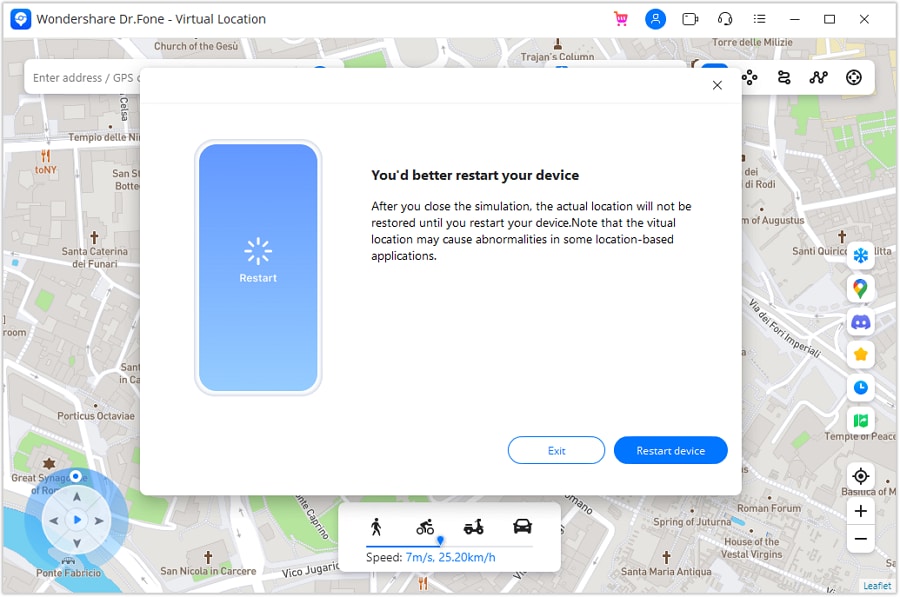
A useful alternative makes the GPS workflow clearer; it does not remove service rules or make the device anonymous. Use it for authorized location testing and verify that normal location behavior has returned afterwards.




Conclusion
Choose an alternative to Hola according to the job: a map-based GPS workflow for device-location testing, or a network-routing service for IP-dependent behavior. Neither should be sold as a universal way to hide identity, unlock services, or make prohibited gameplay safe. For the GPS-focused alternative, use Dr.Fone - Virtual Location rather than assuming a generic phone toolkit provides the required module.
FAQ
1. Is Hola Fake GPS the same as Hola VPN?
No. The original GPS workflow selects a device-location point, while a VPN routes supported network traffic. Verify the exact app rather than treating the two names as equivalent.2. Where should I get a Hola Fake GPS APK?
Only consider a verified official distribution for the exact developer and app. If a current compatible listing cannot be established, do not install an unknown file to reproduce an older tutorial.3. Does using HolaVPN make Pokémon GO spoofing safe?
No. A VPN does not validate GPS data or remove the game's rules. The official player guidelines prohibit falsifying location and allow account penalties for violations.4. Is Virtual Location an alternative to VPN encryption?
No. It addresses supported device GPS simulation through a map interface. Select a separate, appropriate network-security solution if your requirement is traffic protection.
 Add Wondershare Dr.Fone as a preferred source on Google



