Teleport your device anywhere instantly with one click.


 100% Security Verified | No Subscription Required | No Malware

 :

 ChatGPT
 Perplexity
 Gemini
 Claude
 Grok
A fake location on WhatsApp can mean a selected static map point or simulated device GPS, and those are not the same operation. If you only want to send a meeting place rather than disclose your whereabouts, select a place in the location menu and describe it as a destination. That does not require making the phone believe you are there.
Live Location is different: it shares changing position information during an active session. GPS simulation may affect the input an app receives, but it does not guarantee that WhatsApp will use the simulated coordinates or never reveal a real update. This guide separates static and live sharing, explains iPhone and Android workflows for your own device or a consent-based test, and shows why unusual map behavior is not proof that somebody is lying.

In this article
- Part 1. WhatsApp static/Current Location vs Live Location: What Changes After You Send It?
- Part 2. Why People Change the Location They Share on WhatsApp
- Part 3. Solution 1: Change WhatsApp Location on iPhone With Dr.Fone - Virtual Location
- Part 4. Android Mock Location WhatsApp Method Using Developer Options
- Part 5. How to Detect Fake WhatsApp Location: 6 Signs to Check
Part 1. Understand Static, Current, and Live WhatsApp Locations
The location menu contains choices that can look similar in a chat. 'Send Your Current Location' sends a snapshot of the device's reported position. Choosing a nearby establishment or another available map point sends that selected place. Both are static messages; neither is an ongoing tracker.
'Share Live Location' starts a time-limited share that can refresh as position reports arrive. Its usefulness depends on location permissions, connectivity, and the phone continuing to provide updates. A delayed or motionless marker can therefore reflect a technical problem, not an intentional GPS change.
| Question | Static or Current Location message | Active Live Location share |
|---|---|---|
| What is displayed? | One selected place or a snapshot of the reported current position | A position that can refresh during the session |
| Does moving change it? | No; later phone movement does not move the sent pin | New position reports can change the marker |
| How long does it last? | It behaves like a sent message, not a timed location session | Common choices are 15 minutes, 1 hour, or 8 hours; check the current screen |
| How do you stop it? | There is no continuing feed to stop; GPS changes do not retract the message | Use Stop Sharing before the timer ends if you no longer want updates sent |
| What about battery use? | The message itself does not require an ongoing stream of position updates | Continued location and network activity can use more battery |
| Does it work in groups? | The location message can be sent into a group conversation | Sharing into a group exposes the active share to that conversation's participants |
| When is it useful? | Sharing an address, meeting destination, or one-time position | Letting trusted recipients follow your progress for a defined period |
For a destination, open the intended chat, use the + menu on iPhone or attachment menu on Android, select Location, and inspect the available place or map-selection controls. Send the destination with a clear label such as 'Meet here.' A manually selected pin is not evidence that the sender is physically at that point.
If the goal is privacy, do not start a Live Location session you do not want. To end an existing session, use its Stop Sharing control and confirm. Ending updates does not undo what a recipient has already seen or saved.
Part 2. Match the Sharing Method to the Reason
People searching for WhatsApp fake location methods often want less disclosure, not a sophisticated moving simulation. Start with the least invasive option: share a public destination, decline a location request, or stop an unwanted live session. Those controls are more direct than relying on a mock GPS input to protect you.
- Keeping an address private: suggest a public meeting place rather than sending your home position.
- Personal safety: review the recipient and every member of a group before sharing. A simulated pin is not a reliable safety boundary against unwanted tracking.
- Preserving a surprise: discuss the event destination without claiming that the destination is your current position.
- A playful map example: keep it consensual and identify the pin as a joke or demonstration, particularly if someone might otherwise act on it.
- Unwanted invitations or pressure: set a sharing boundary instead of creating false travel evidence or depending on fabricated GPS to manage the situation.
A different location does not make an account anonymous. Other messages, images, previously shared positions, and information visible elsewhere may still reveal where you are. The workflows below are for understanding your own device and authorized testing, not secretly monitoring another person or misleading someone who depends on your real location.
Part 3. Test iPhone Location Input with Dr.Fone - Virtual Location
 Set your map route to simulate GPS movement.
- Set your wanted movement speed.
- HD and large map view to check location.
- Fake GPS location to anywhere.
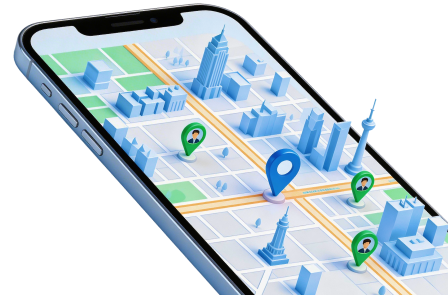
Dr.Fone - Virtual Location provides device-level GPS simulation on supported iPhones. The official product page describes teleporting to a chosen point and movement along routes without normally requiring a jailbreak. It also names WhatsApp as an example of social-app use.
That is a vendor-described capability, not a verified guarantee for your particular WhatsApp and iOS combination. The distinction matters most with live sharing: a successful position change in Maps does not establish that WhatsApp will keep sending only the same simulated input. Do not rely on it to conceal a real location, and do not use a test account or chat without the other participant's knowledge.
Which GPS Functions Are Relevant?
The program changes what a supported device reports while simulation is active. It does not edit an already sent location message, change who belongs to a chat, or remove information a recipient has retained.
- Teleport Mode: chooses one virtual device position for a stationary-coordinate test.
- One-Stop Route: models movement from a starting point to an endpoint.
- Multi-Stop Route: uses multiple selected points for a longer simulated path.
- Movement settings: configure supported speed and repeat controls for the route being tested.
- No normal jailbreak requirement: check the current connection and operating-system requirements before assuming every setup follows the same steps.
For a simple destination message, the built-in place picker remains the easier option. Teleport and route modes are relevant when you specifically need to study how your own device supplies coordinates, rather than merely send an address.
Four Steps for a Static-Position Sharing Test
Step 1 Connect the intended iPhone
Launch the desktop program and open Virtual Location. Connect the phone with a compatible cable and follow the connection prompts. Check that the selected device is yours and is recognized before applying a location change.
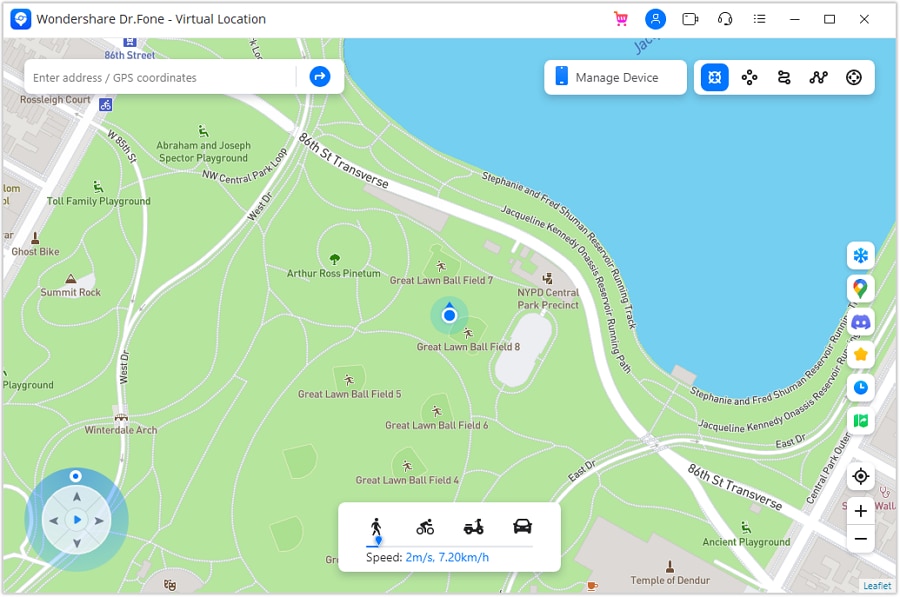
Step 2 Locate a test destination
Choose Teleport Mode and search for the address, place name, city, or coordinates you intend to examine. Review the search result on the map rather than assuming the first match is correct.
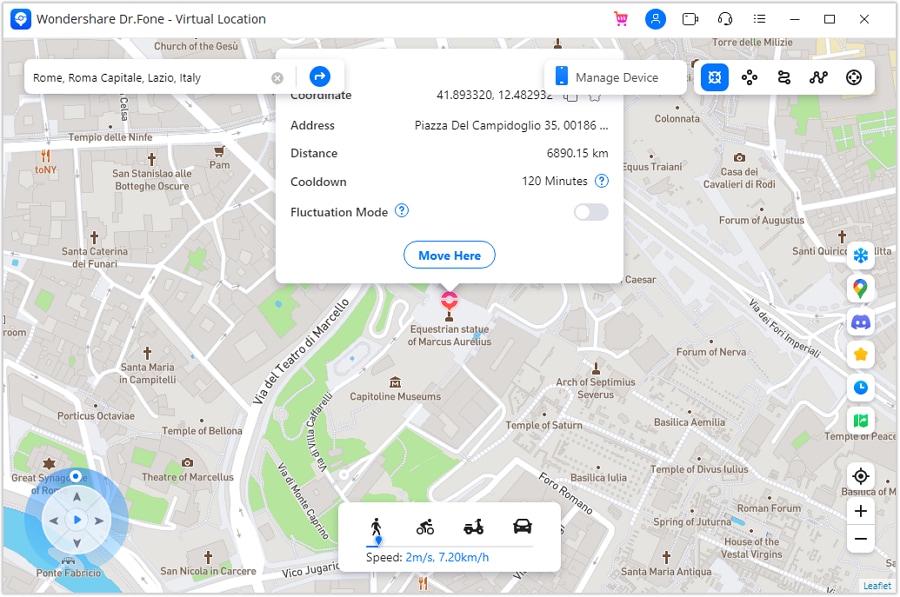
Step 3 Apply and verify the point
Adjust the selected pin if necessary and use Move Here. Inspect Maps on the phone to see whether it reports the intended test point. If it does not, pause and check the product's current setup guidance rather than claiming success.
Step 4 Inspect the WhatsApp location preview
Open a chat with an informed test participant, tap +, and choose Location. Check the preview and identify the message as a simulation before sending a current-position snapshot. If it shows an unexpected or real position, stop; do not assume the desktop map has overridden every location source.
A static message produced during the test stays at the coordinate sent. Stopping the desktop tool later will not move that old message to your real position, but neither will it erase an earlier message that already disclosed it.
How Route Simulation Differs from a Live Location Share
Moving the simulated GPS point and starting a WhatsApp live session are separate actions. A route is a tool-generated stream of coordinates; WhatsApp decides which position data it uses and when updates reach the recipient. The phrase 'WhatsApp live location spoofing' should not be read as a promise of undetectable, uninterrupted, or exclusively simulated reporting.
Step 5 Configure the route and observe a consensual test
Choose One-Stop Route for two points or Multi-Stop Route for a sequence. Inspect the path, select the supported trip or repeat settings, choose the simulation speed, and use Move Here for One-Stop Route or Start Moving for Multi-Stop Route. In a clearly labeled test chat, open Share Live Location only if the participant has agreed, select a limited duration, and compare the received updates with the planned route.
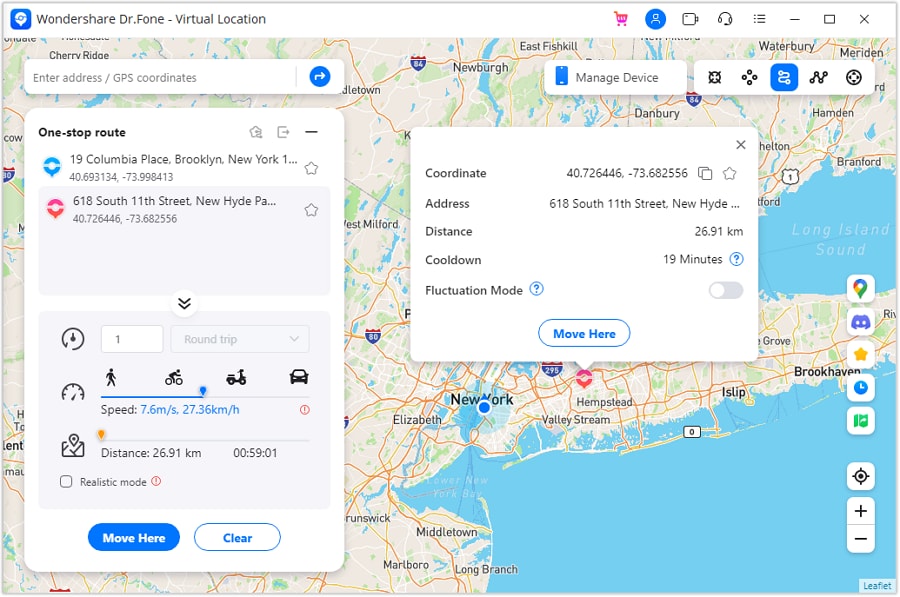
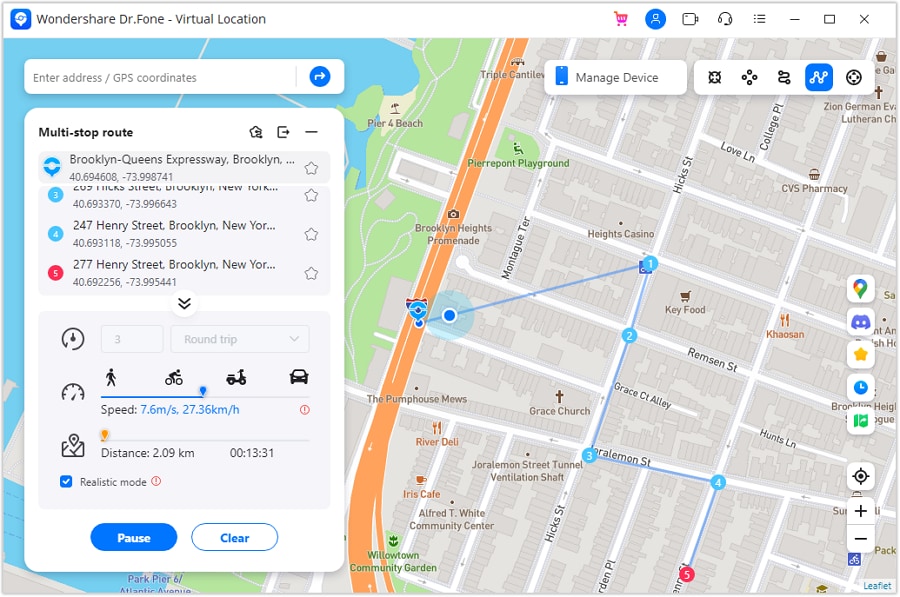
If updates freeze, differ, or show the real position, stop the session instead of treating simulation as privacy protection. Do not use a simulated journey as evidence of actual travel.
End WhatsApp live sharing first, then stop the route and restore the phone's real position using the current product controls. Check Maps again before navigation or any genuine location share. If necessary, follow the product's restoration guidance and restart the device; verify the result rather than assuming that unplugging always resets it.




Part 4. Android Mock Locations and Developer Options
Android includes a developer setting for selecting a mock-location provider. Google's documentation describes it as a way to test an app's behavior in other locations. It is not a WhatsApp privacy feature or an assurance that every app accepts the resulting coordinate.
The general requirements are an enabled Developer options menu and an installed GPS mock app selected as the provider. Manufacturer menus and current app interfaces differ, so use the named settings rather than treating one screenshot as universal.
Four Steps to Examine a Mock Position on Android
Step 1 Reveal Developer options
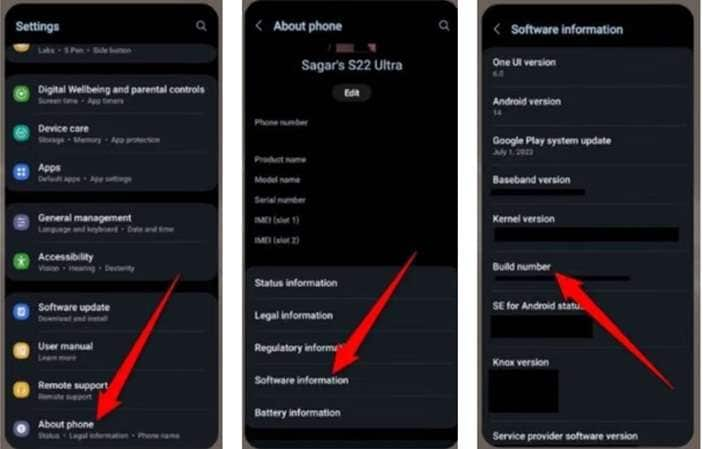
Find Build number in Settings. Some phones place it directly under About phone; others use About phone > Software information. Tap Build number seven times and complete the device's confirmation if prompted. Return to find Developer options.
Step 2 Choose a provider you have reviewed
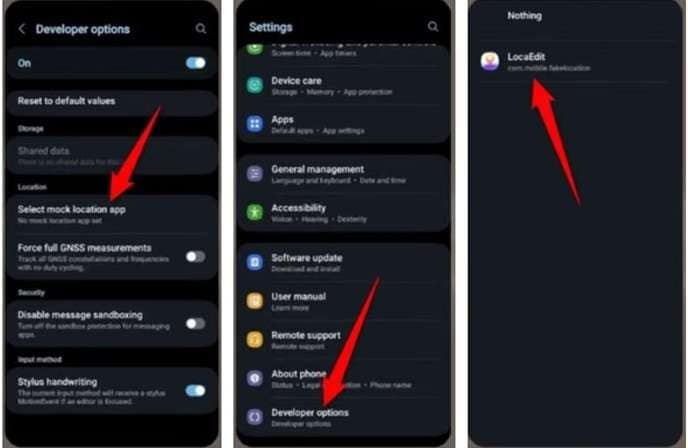
Install a suitable mock-location app from its authentic store listing and review its permissions and publisher. In Developer options, open Select mock location app and choose that provider. This setting does not normally require switching on unrelated debugging controls.
LocaEdit Fake GPS Location is one source example with a Google Play listing. The original guide also named Lexa, ByteRev, and IncorporateApps products; those names are not evidence of current availability, security review, or WhatsApp compatibility. Do not obtain an APK from an unknown mirror simply because it uses a familiar name.
Step 3 Set a test point
Open the selected provider, inspect a location on its map, and use its current apply or start control. The supplied LocaEdit example labels this action Move, but button wording can change. Inspect a map on the phone to check what the device now reports.
Step 4 Review before sharing anything
Open a WhatsApp chat with an informed participant, tap the attachment icon, and select Location. Inspect the current-position preview. Send only a clearly labeled test snapshot if it matches the intended result. A successful static test is not a guarantee that Live Location behaves identically or that future updates will stay simulated.
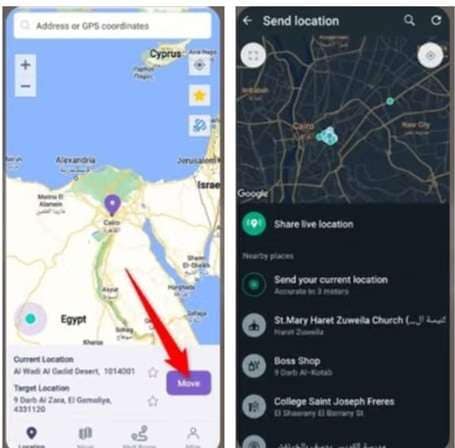
When finished, end any active live share, stop the mock app, clear its selection where available, and confirm the real position in Maps. Refer to the Android Developer options documentation for the system setting; it documents a testing function, not an endorsement of misleading recipients.
Part 5. Six Location Anomalies Are Clues, Not Proof
There is no reliable visual test in this guide that proves a WhatsApp location is genuine or fake. First establish whether you are viewing a static message, an active live session, or an expired share. A fixed pin behaving like a fixed pin is not suspicious.
| Observed pattern | Why it may seem unusual | Ordinary explanations to consider |
|---|---|---|
| A large jump | A marker appears far away on its next refresh | A poor location fix or delayed updates can make movement look abrupt |
| An implausible route or speed | The visible track appears to cross space too quickly | Transport, gaps between updates, or location error can distort the path |
| A marker that stops moving | A live session appears stuck | The phone may be offline, out of power, or affected by background restrictions |
| An exactly repeated point | The displayed position looks unusually steady | The phone may actually be stationary, or you may be looking at a static pin |
| A surprising place or time | The location differs from an expected routine | Plans change, and a delayed report can refer to an earlier moment |
| Two apps disagree | A network-based area differs from a map coordinate | IP and GPS are different signals; VPN routing or stale data can produce a mismatch |
Repeated inconsistencies justify a conversation or troubleshooting, not an accusation. Ask the sender to confirm what type of location they intended to send and whether updates are current. Do not demand device access, install monitoring software, or attempt to infer an exact address without consent. This article does not establish WhatsApp's internal spoofing-detection methods.
Conclusion
The practical answer depends on the message type. Send a selected place when you mean a destination; send Current Location when you intend a snapshot of the reported position; choose Live Location only when trusted recipients should receive updates for a defined period. Stopping a session is a privacy control, whereas changing GPS is not a guarantee that your real whereabouts remain undisclosed.
Dr.Fone - Virtual Location offers supported iPhone simulation tools, and Android provides a mock-location testing setting. Both should be evaluated on your own device with informed participants, followed by a real-position check. Neither rewrites past messages, proves another person's location, or replaces clear consent and sharing boundaries.
FAQ
1. Is sending a different WhatsApp location illegal?
There is no universal answer without considering local law and purpose. Sharing an identified meeting point is different from using fabricated location evidence for fraud, harassment, or another prohibited act. An app's terms can also restrict behavior independently of criminal law.2. What are the risks of misusing GPS simulation?
Misleading a recipient can damage trust or create safety and legal consequences, and untrusted software can expose device information. Account action depends on the service's rules and conduct; this guide does not establish that any single simulated coordinate automatically causes a WhatsApp ban.3. When is a simulated location appropriate?
A test of your own device with informed participants is different from covert tracking or passing a simulated trip off as real. For ordinary privacy, decline sharing, send a labeled destination, or stop an active live session rather than relying on simulation to hide your position.4. Can a recipient or WhatsApp reliably identify a fake pin?
A selected static pin never proves physical presence, and jumps or freezes in a live marker can have technical causes. This article does not verify WhatsApp's internal detection signals or offer a conclusive recipient-side authenticity test.
 Add Wondershare Dr.Fone as a preferred source on Google