 Teleport your device anywhere instantly with one click.


 100% Security Verified | No Subscription Required | No Malware


 :

 ChatGPT
 Perplexity
 Gemini
 Claude
 Grok
You cannot permanently freeze Snapchat location with a single native switch. You can hide your map position from friends, restrict who receives it, or limit when Snapchat can obtain device location. These controls solve different problems, and leaving a stale pin temporarily is not the same as guaranteeing that one position stays visible indefinitely.
Start by choosing the privacy outcome you actually want. The five native methods below cover visibility, background access, and active sharing. A separate GPS simulation walkthrough follows for supported testing on your own device, with no promise that Snapchat will always display a selected coordinate or conceal a change.
In this article
Part 1. What 'Freeze Snapchat Location' Can Mean
People use freeze to describe a location that stops moving on Snap Map. That can happen when fresh updates stop arriving, but Snapchat does not provide a permanent-pin feature under that name. A saved or old position can expire, and reopening an app with location permission can allow a new reading.
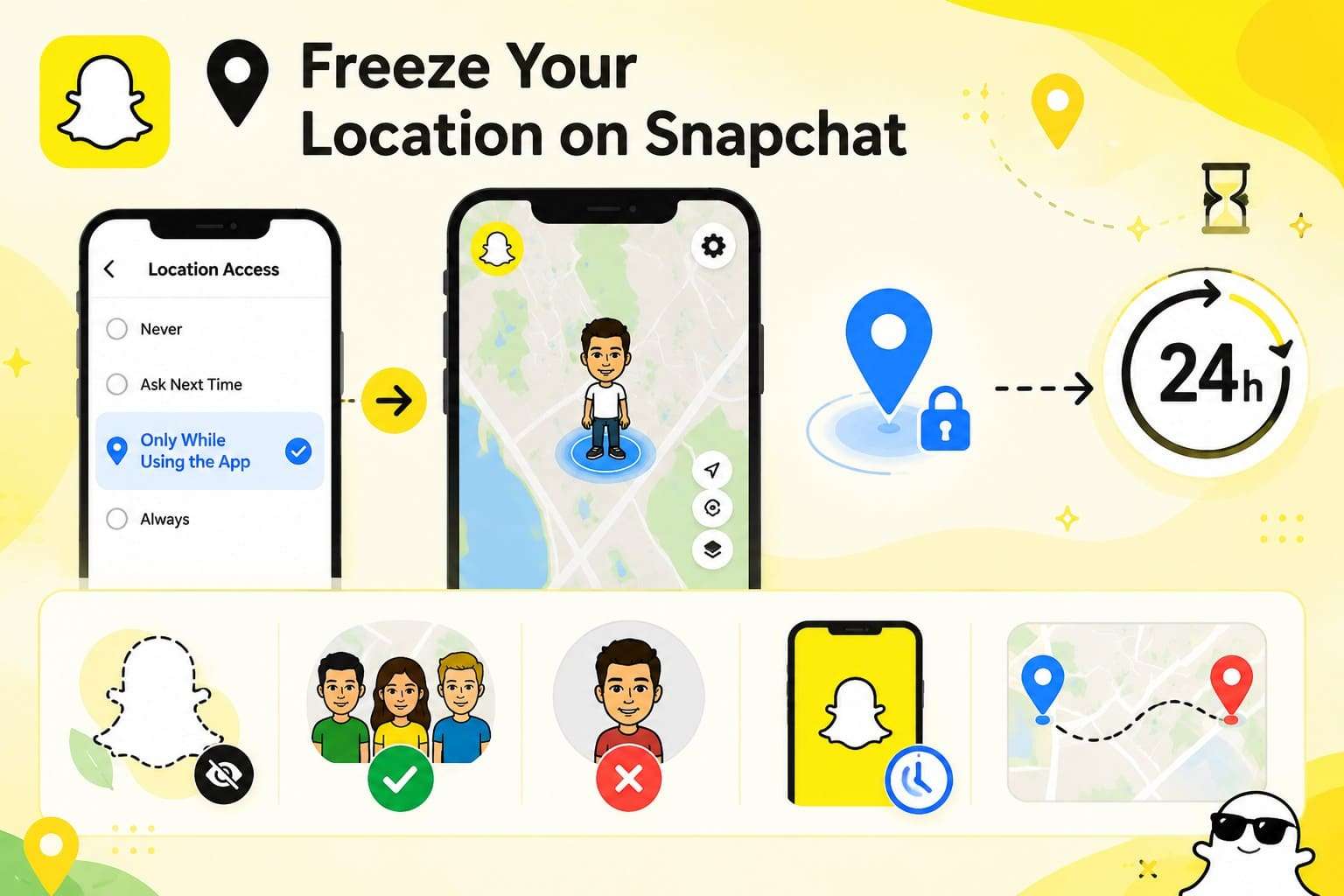
With foreground-only location permission, the normal map workflow uses location while the app is in use rather than continuing ordinary background access. Snapchat's support description gives a 24-hour expiry for the map position under 'Only while using'. Treat that as a permission-dependent behavior, not a way to control every Live Location session or guarantee an exact pin for a full day.
Freeze, Hide, Pause, and Simulate Are Not the Same
Separate the audience question from the data-access question. A friend not seeing your location does not necessarily mean Snapchat has lost permission to obtain it. Likewise, a simulated coordinate changes an input rather than choosing an audience.
| Intended outcome | Likely map effect | Location-access distinction | Relevant control |
|---|---|---|---|
| Keep an old point temporarily | A previous position may remain until expiry | Foreground updates can resume when the app is used | Foreground-only permission, not a permanent freeze |
| Hide the normal pin from friends | Friends cannot view that map position | Snap can still receive location where permission allows | Ghost Mode |
| Stop ordinary background updates | No fresh background position through that permission route | In-app use may still obtain coordinates | While Using the App or Android equivalent |
| Exclude particular friends | The excluded audience cannot view the shared pin | Does not revoke app location permission | My Friends, Except |
| Allow only a chosen group | The selected audience receives normal map sharing | Does not change when the phone supplies location | Only These Friends |
| Remove device location permission | No new device-location reading through that permission | Not a promise of zero approximate information from every source | Never or Don't allow |
| Test another reported coordinate | A supported app may show a simulated point | Does not hide an audience or stop location collection | GPS simulation on a compatible setup |
Review Live Location and Background Sharing Separately
Ordinary Snap Map updates and an active friend-specific Live Location share need separate attention. When background sharing is enabled, simply closing Snapchat may not stop updates. Inspect the active sharing relationship as well as the phone's permission setting.
App labels and sharing interfaces can vary. Do not rely on an old screenshot, Ghost Mode alone, or a stale pin as proof that all live sharing has ended. Review who can see your position, whether any session is active, and whether background location remains allowed.
Part 2. Five Native Ways to Change Snapchat Location Privacy
These are settings for your own account and phone. They do not require access to another person's account. Make one change at a time, read the current confirmation screen, and check the resulting settings instead of assuming that every method has the same effect.
Method 1. Use Ghost Mode to Hide Normal Map Visibility
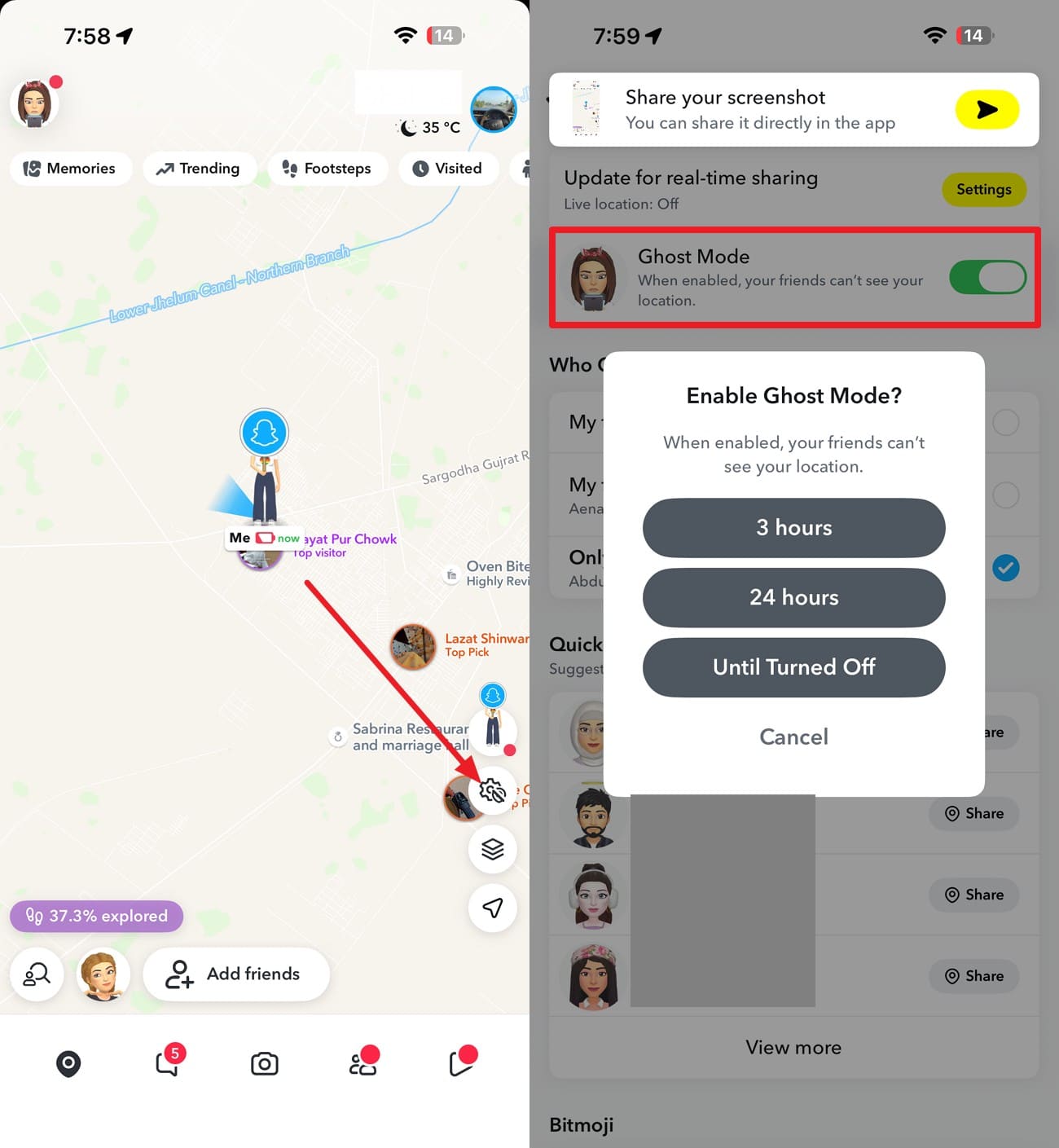
Ghost Mode addresses friend-level map visibility. It does not revoke the phone's location permission, erase previous data, or make you anonymous to Snap. That distinction matters if your goal is reducing app access rather than merely hiding a Bitmoji.
Open Snap Map, enter its settings through the gear icon, and enable Ghost Mode. If a duration choice is shown, choose the intended period and note whether it will expire automatically or remain until changed. Interface position and available timer options can vary.
Also inspect any active live/background sharing. Content you deliberately submit to a public map may still reveal location context independently of your normal friend pin. Do not treat Ghost Mode as a universal control over every location-related feature.
Method 2. Choose a Smaller Sharing Audience
Use audience controls when you want some trusted friends to see your map location but not everyone. Switching away from Ghost Mode can restore visibility to the selected audience, so read the whole list before saving.
Step 1 Use the exclusion list if appropriate
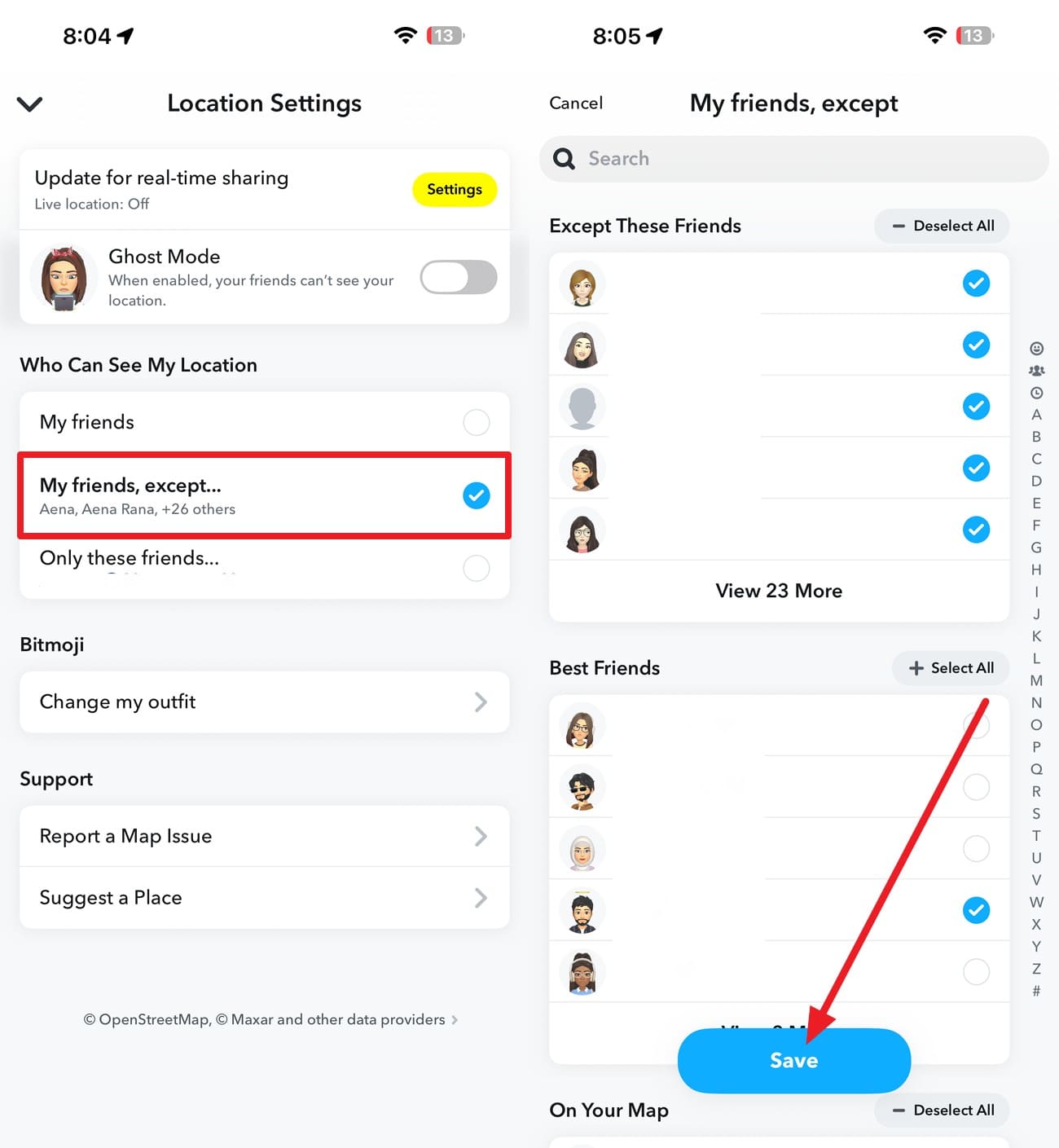
In map location settings, select My Friends, Except and choose the people to exclude. Review the saved selection. This is a deny-list approach: its purpose is different from approving only a small group.
Step 2 Alternatively, approve only named friends
Choose Only These Friends and select the intended recipients, then save. This is usually easier to review when only a few people need access. Snapchat's support description says friends are not notified merely when selected for this list; that narrow statement is not a guarantee of invisible changes across all sharing features.
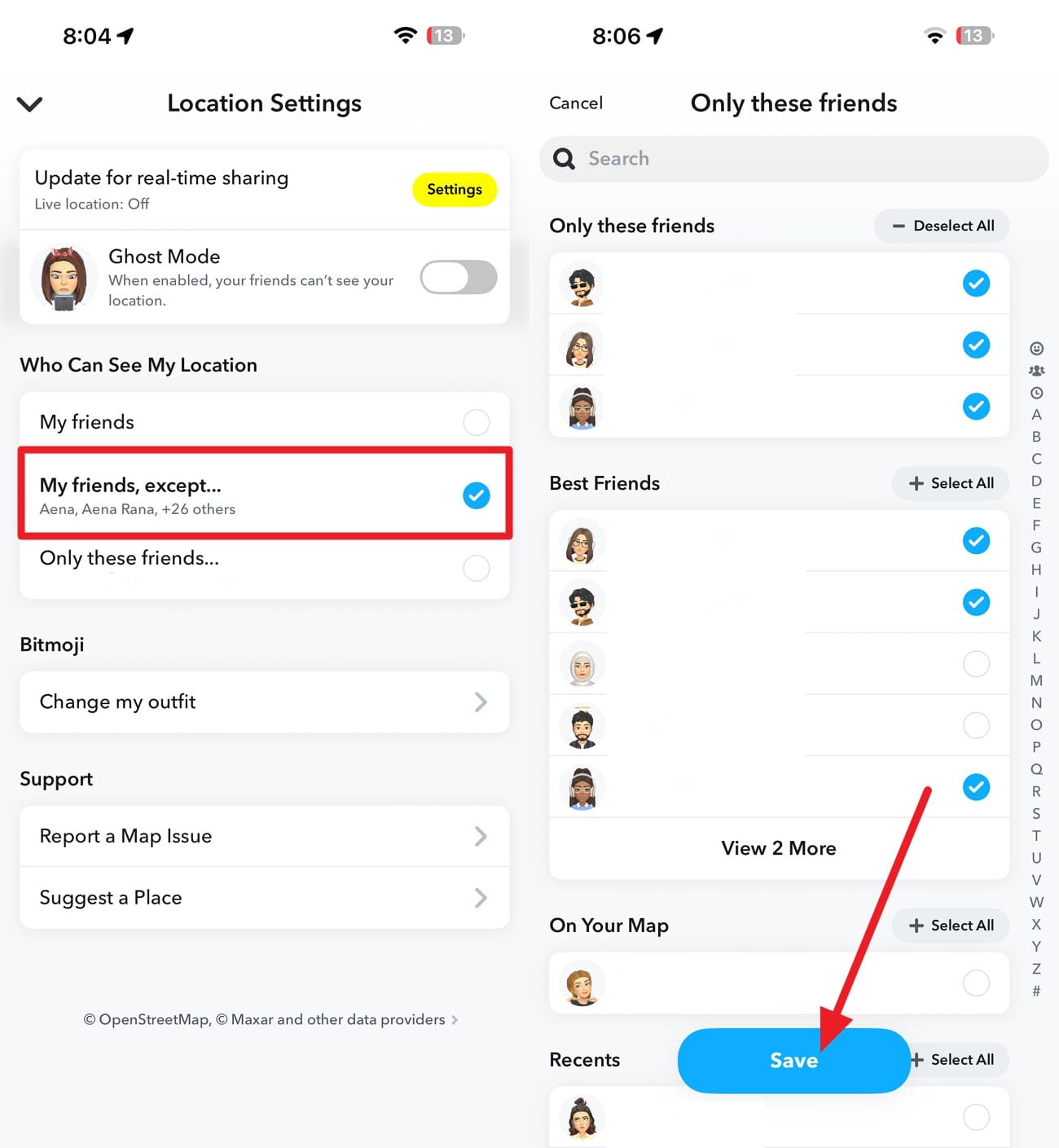
Revisit the audience after friendship changes or when privacy needs change. Restricting the friend list does not itself stop Snapchat from reading location while the phone still permits it.
Method 3. Restrict Location to Foreground Use
Choose foreground-only permission to limit ordinary location access when Snapchat is not being used. This is the closest match for pausing normal map updates, but it does not create an indefinitely fixed location. Using the app again may allow a fresh position, and active sharing should still be reviewed.
iPhone Permission Route
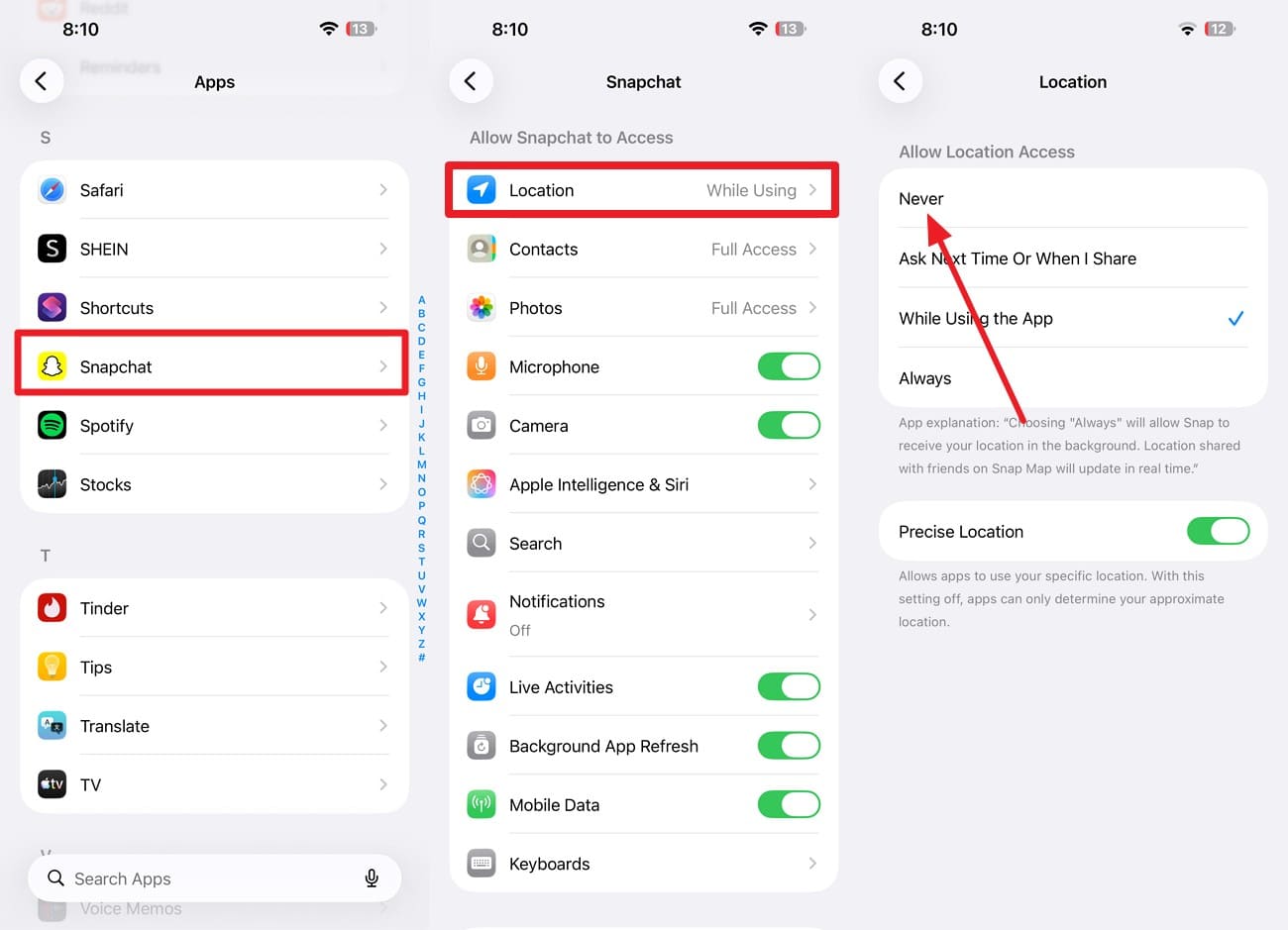
Open Settings > Apps > Snapchat > Location on versions with the Apps menu, or find Snapchat under Settings > Privacy & Security > Location Services. Select While Using the App where available. Check the actual choice rather than following an older menu path blindly.
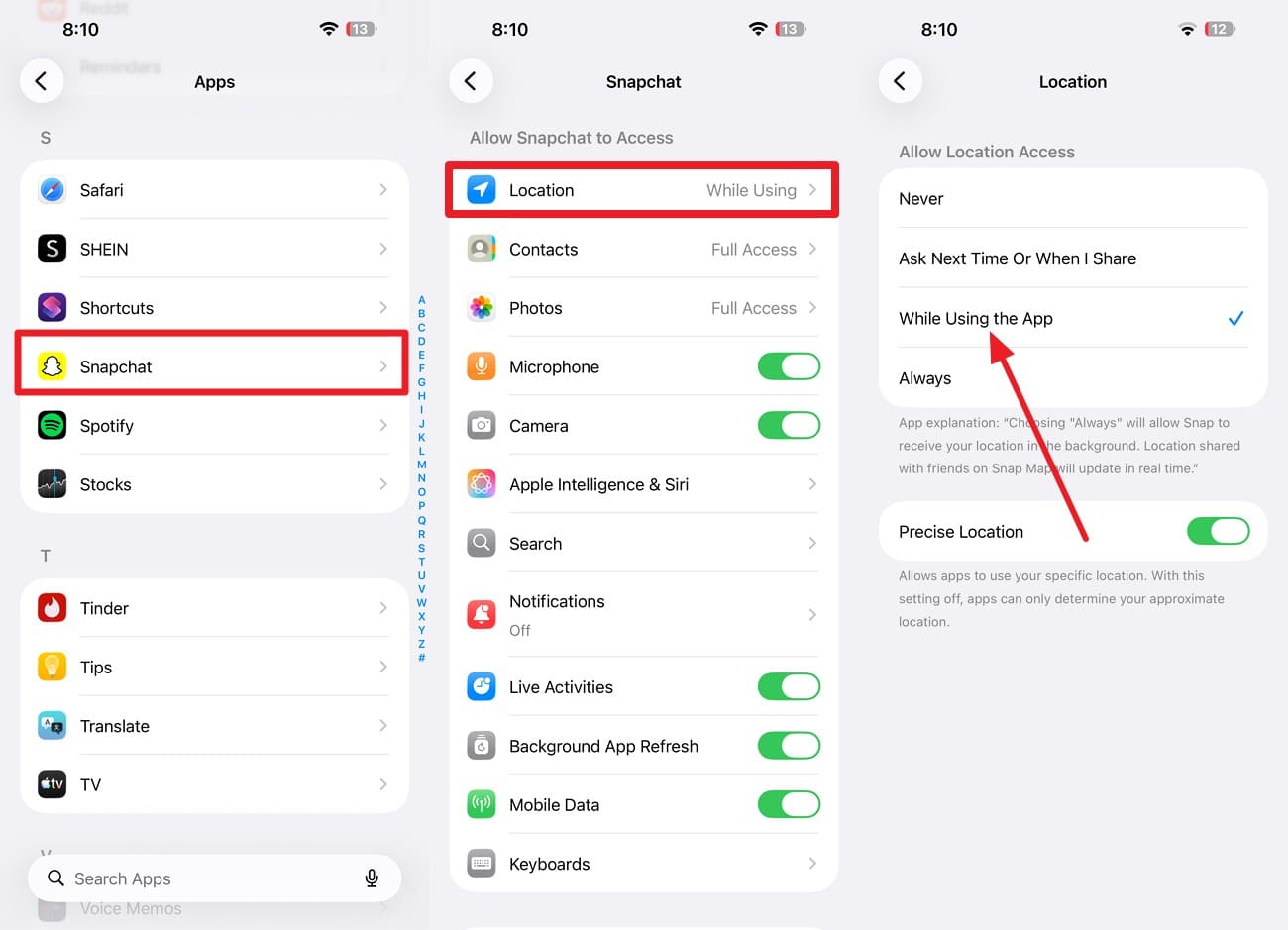
Android Permission Route
Step 1 Set the location permission
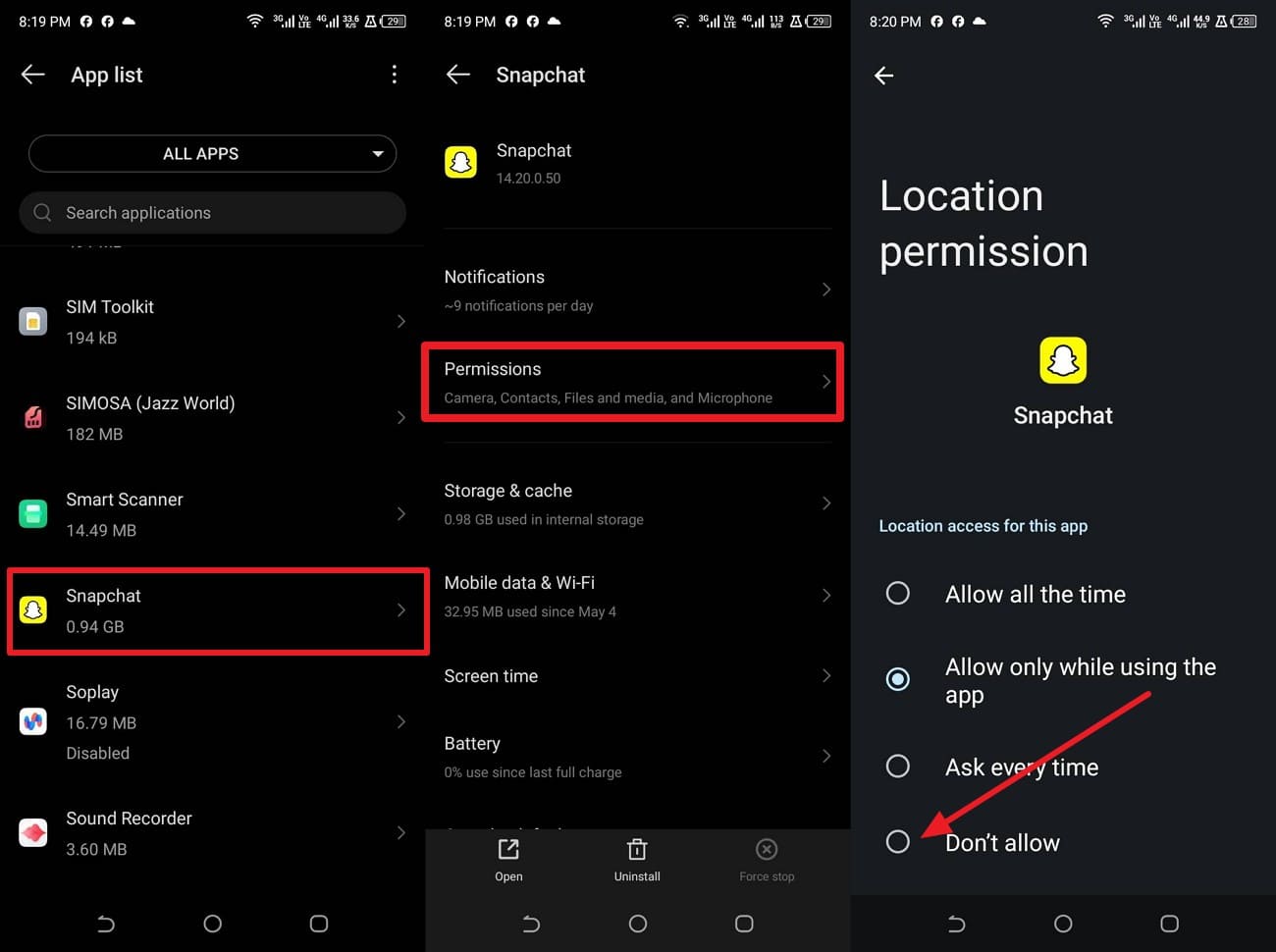
Open Settings > Apps > Snapchat > Permissions > Location and choose Allow only while using the app, or the equivalent label. Some phones show App list or use a different menu order.
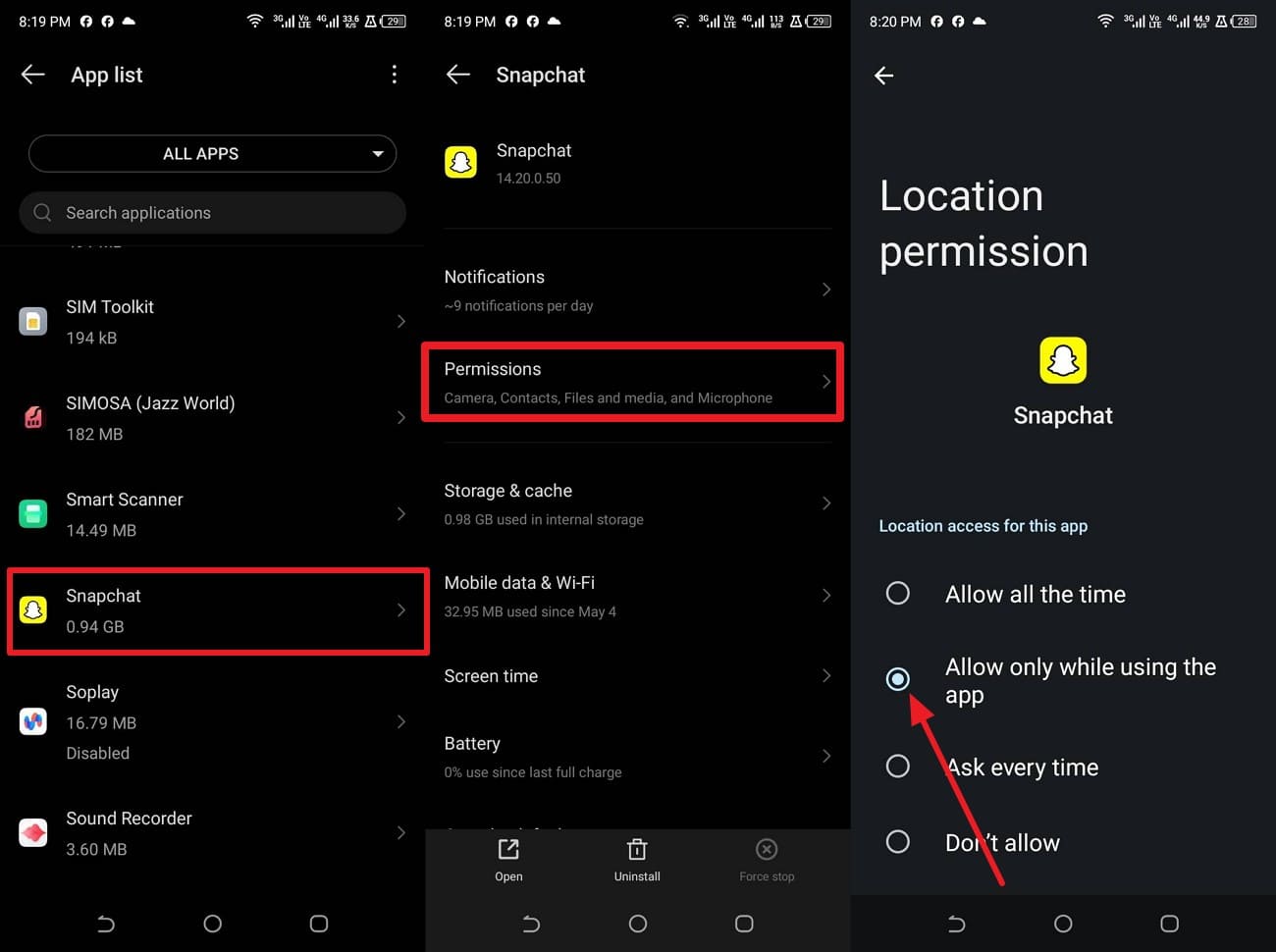
Step 2 Understand what reopening does
If you reopen Snapchat to inspect the setting, the app may obtain your current location under the permission you just granted. Closing it afterward limits ordinary background access; it does not lock the earlier coordinate against all future updates.

Method 4. End an Active Live Location Share
Review any friend-specific live session rather than assuming ordinary map settings cover it. Open the relevant chat or friendship profile and inspect the current location-sharing controls. In the illustrated interface, a three-dot menu leads to Location Settings and a Share Location switch; the wording may differ on your installed version.
Stop the active share with that recipient and confirm the resulting status. Repeat for any other recipient who should no longer have live access. To prevent ordinary background updates as well, review the system permission from Method 3 rather than relying only on closing the chat.
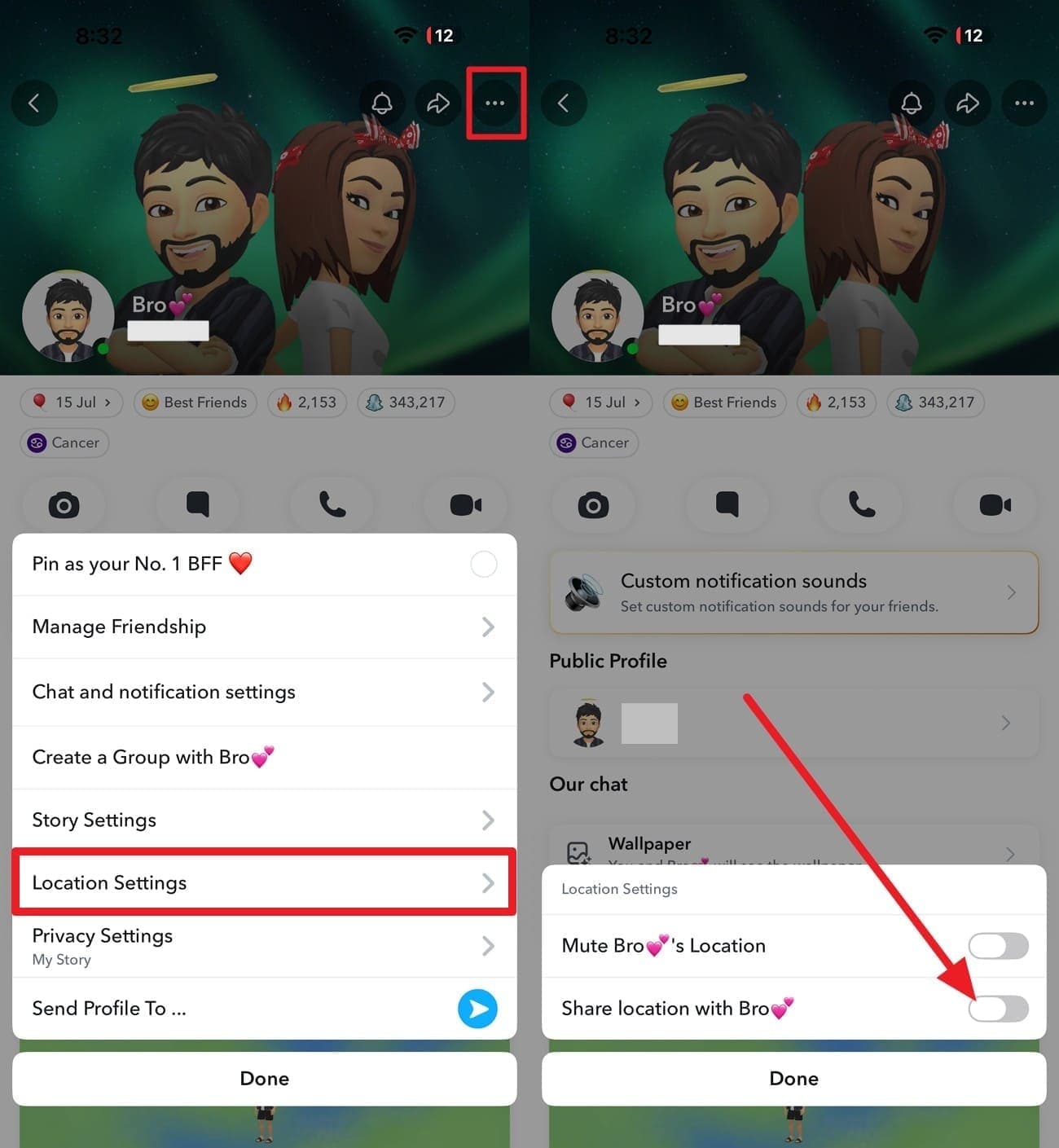
If you cannot find the control, use Snapchat's in-app help for the current interface. Do not assume the absence of one old menu label means the share is off. Location privacy is best verified in settings, not inferred from whether somebody comments on your map position.
Method 5. Revoke Snapchat's Device Location Permission
Choose permission removal when the aim is preventing Snapchat from obtaining device location through the operating system's location access. This can limit Snap Map and local filters or Lenses, while ordinary messaging and other non-location functions can remain available.
On iPhone
Find Snapchat's Location permission through Settings > Apps > Snapchat or the Location Services list, and choose Never. Read any prompt if you later reopen a location feature; granting access again changes the privacy result.
On Android
Open Snapchat's app permissions, enter Location, and choose Don't allow. If the app subsequently requests permission, decline unless you actually want to restore the feature. Manufacturer labels vary, so confirm the final permission state.
This does not promise that Snap has no approximate information from an IP address, user-posted content, or other sources. It also does not necessarily erase an already displayed position instantly. Review visibility and active sharing separately if hiding an existing map presence is the goal.
Part 3. Simulating a Position Is Different from Hiding It
 Set your map route to simulate GPS movement.
- Set your wanted movement speed.
- HD and large map view to check location.
- Fake GPS location to anywhere.

Dr.Fone - Virtual Location changes GPS coordinates reported on supported devices and apps. It includes teleport controls and route or joystick-based movement for compatible setups, with workflows described without jailbreak or root. This is useful for permitted location demonstrations on your own phone, not a replacement for choosing who receives your location.
Changing a reported coordinate can let you demonstrate another location without travelling there, but Snapchat behavior is not guaranteed. A simulated position can be ignored, rejected, or reflected differently by an app or feature. It does not change IP-based information, prevent screenshots, hide Story views, guarantee a permanent freeze, or ensure that others cannot notice a change.
A Two-Step Virtual GPS Demonstration
Check the software's current device requirements and Snapchat's applicable rules before using a location-changing workflow. Use built-in privacy controls when the actual objective is to stop sharing; the following is a simulator walkthrough rather than an invisibility procedure.
Step 1 Connect your phone and open the map controls
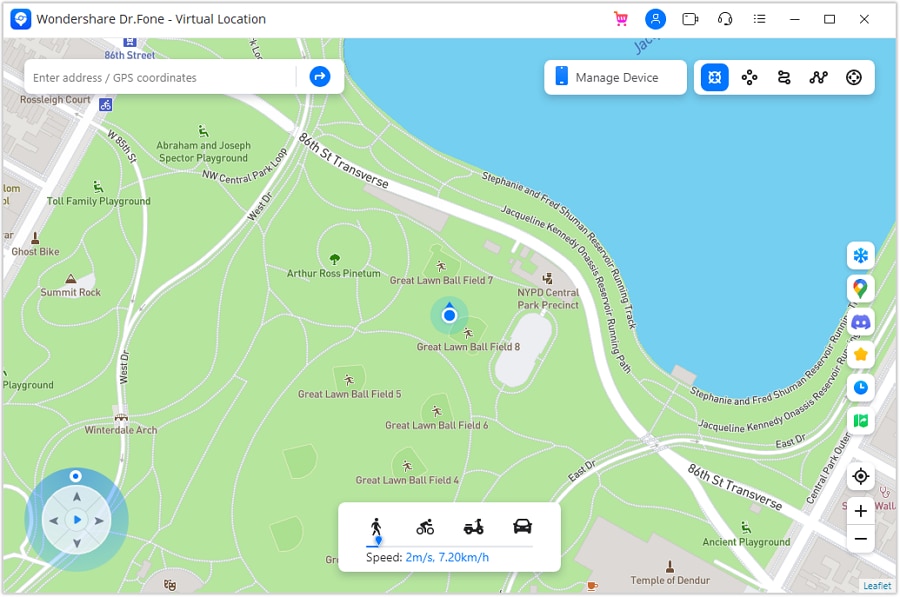
Start the appropriate desktop location module, connect the device you control, and complete its setup prompts. Open Teleport Mode to select a test destination. Platform-specific instructions may differ from the screenshot.
Step 2 Apply a destination and check the result
Search for the intended test point, inspect it on the map, and select Move Here. Verify behavior in a supported app on your own device. Do not assume this makes every Snapchat view show the same point. Stop the simulation and restore real positioning when finished.





Part 4. Match the Control to the Privacy Goal
Do not choose a method merely because it is described as freezing. Select the control whose job matches the requirement, and check any remaining sharing routes. The following seven scenarios pair each choice with its practical limit.
| Goal | Control to inspect | Expected scope | Important limitation |
|---|---|---|---|
| Leave the last point temporarily | Foreground-only location access | Stops normal background updates after use | Old positions expire; reopening may refresh them |
| Hide normal map visibility from friends | Ghost Mode | Friend-facing map visibility | Does not revoke Snap's permitted location access |
| Exclude named friends | My Friends, Except | Removes those friends from the map audience | Review any separate live session too |
| Approve only a few trusted people | Only These Friends | Restricts normal map sharing to the chosen list | Still allows sharing with that list |
| Limit background location | While Using the App or equivalent | Controls the ordinary permission timing | Inspect active live sharing and current app settings |
| Remove device location access | Never or Don't allow | Stops access through the system location permission | Can limit local features and does not erase every other location clue |
| Run a permitted alternate-coordinate test | A supported GPS simulator | Changes reported GPS input where supported | Not guaranteed Snapchat behavior, privacy, or invisibility |
The dividing line: Audience controls affect who sees sharing; permission controls affect access and timing; GPS simulation affects a reported input. No one setting should be described as doing all three.
Conclusion
For Snapchat privacy, hide the normal map pin with Ghost Mode, restrict its audience with friend controls, or change system permission to limit access. Check Live Location separately. Foreground-only access can leave an older map position temporarily, but that is not a permanent freeze or a guarantee of unnoticed changes.
Dr.Fone - Virtual Location belongs in the separate category of supported GPS simulation. If the goal is genuine privacy, start with the app and device controls rather than relying on a false map point, especially when another person depends on an accurate safety check-in.
FAQ
1. Are Snapchat privacy changes guaranteed to be invisible to friends?
No. The specific statement about not notifying friends selected for Only These Friends should not be expanded into a promise about every setting or live session. Even without a direct alert, people may notice a missing or stale map position.2. How long can the last map position remain after closing Snapchat?
Snapchat's support description gives a 24-hour expiry when permission is Only while using. Background permission and active sharing can change the situation, and reopening may allow a new update. It is not a permanent-pin feature.3. Will limiting background location improve battery life?
It can reduce location-related background activity, but there is no measured saving established here. Battery use also depends on the device, network, app use, and other settings. Choose the permission for its privacy scope rather than a promised battery improvement.4. Can virtual GPS affect other Snapchat features?
It may affect features that use reported coordinates, such as map views or location-related filters and Lenses, where supported. Results are not guaranteed, and changing GPS does not remove other location signals or automatically hide your activity.
 Add Wondershare Dr.Fone as a preferred source on Google



