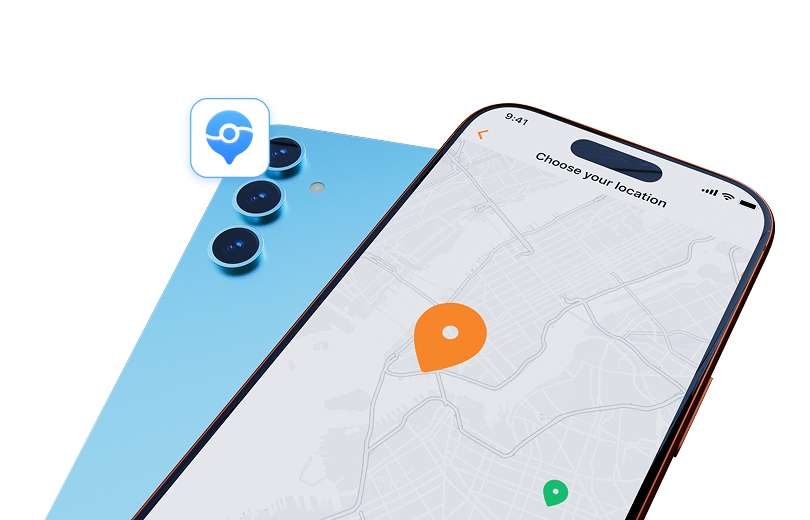
Teleport your device anywhere instantly with one click.


 100% Security Verified | No Subscription Required | No Malware

 :

 ChatGPT
 Perplexity
 Gemini
 Claude
 Grok
There is no official Find My Friends app for Android. For voluntary location sharing, Google Maps is a practical starting point; Family Link serves supervised children, Snap Map suits existing Snapchat contacts, and Glympse focuses on temporary sharing. The right choice depends on whose device is involved, whether everyone consents, and how long the session should last.
A location pin can help a family coordinate a school pickup or help friends meet in a crowded area, but it is not proof of someone's exact position or safety. A weak signal, an offline phone, missing permissions, or an old update can all affect what appears on the map. This 2026 comparison explains the original Apple service before examining four Android alternatives and their different privacy boundaries.
In this article
Part 1. What Find My Friends Does and Where It Works

Find My Friends was Apple's people-location service. Its role is now handled by the People area of Find My on supported Apple devices. If an older tutorial tells you to install a separate Find My Friends application, look for Find My instead. An Android phone does not gain access to Apple's native people-sharing experience by installing an unrelated application with a similar name.
On an iPhone, the current setup starts in Find My: enable Share My Location under Me, open People, choose Share My Location, and select a contact and sharing duration. The recipient can decide whether to reciprocate. This is an invitation-based arrangement, not a way to locate anybody from a phone number. Typing an email address or contact name identifies a recipient; it does not bypass permission.
Distinguish sharing a person's whereabouts from finding a device or supported item. Find My also contains device and item functions, but those are not interchangeable with its People tab. Similarly, the availability of an Apple web service does not turn an Android browser into the full native Find My Friends application. For an Android-and-iPhone group, a shared cross-platform service is usually easier to manage.
Privacy depends on account security as well as in-app controls. Check the recipient list, secure the account, and stop sharing when the reason for sharing ends. Even a well-designed service cannot guarantee uninterrupted tracking or protect information already seen by a recipient. For urgent situations, use direct contact and appropriate emergency assistance rather than relying solely on a moving map.
Key Features to Look for in a Replacement
The original application's useful ideas remain a sensible checklist for comparing Android options. Focus on consent, understandable controls, and a clear indication of whether a displayed position is current. Do not select an app merely because its name resembles Apple's former service.

- Audience controls: choose specific recipients and review who currently has access, rather than broadcasting a private trip by accident.
- Duration settings: use a timed session for a journey and an ongoing arrangement only when everyone understands it.
- Manageable invitations: use supported contacts or account details to establish sharing; proximity or AirDrop is not a universal requirement across replacement apps.
- Optional reciprocity: receiving someone's location need not mean that your own position is automatically shared back.
- Arrival and departure notices: where supported, configure the relevant place and notification permissions instead of assuming every map pin generates an alert.
Find My on Apple devices can bring people, devices, and supported items into one application. A replacement does not have to replicate every one of those functions. A group seeking occasional meeting coordination has different needs from a parent managing a child's supervised Android device. Before switching, ask everyone to test sharing and stopping it on their own phone.
Dr.Fone - Virtual Location: GPS Simulation Is a Separate Task
 Set your map route to simulate GPS movement.
- Set your wanted movement speed.
- HD and large map view to check location.
- Fake GPS location to anywhere.
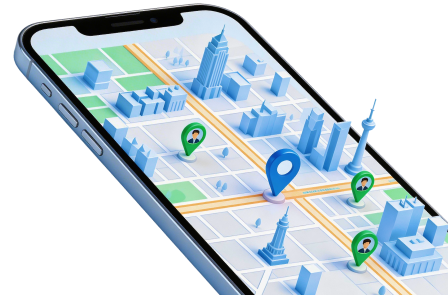
Dr.Fone - Virtual Location changes a supported phone's reported GPS position and can simulate movement along a chosen map route. That is different from the four sharing services below: it is not a consent-based friend locator, an emergency tracker, or a mechanism for discovering somebody else's private location. The wider Dr.Fone toolkit contains separate phone-management functions; those should not be attributed to this GPS module.
A relevant use is testing how a location-aware app behaves at a selected coordinate on your own supported device. Before using a simulation, tell any people who rely on your shared location that the pin may not represent your physical whereabouts. Check the current device and operating-system requirements, and do not assume that every app will accept a simulated position.
Step 1 Connect the supported phone
Open the desktop program, select Virtual Location, connect your device, and complete the connection and trust prompts shown for that device.
Step 2 Select a test coordinate
Choose Teleport Mode, search for the intended place, and inspect the map marker before confirming Move Here. A matching place name alone is not enough if several search results appear.
Step 3 Check and restore
Inspect a maps app on the phone to verify the reported position. When finished, follow the program's restoration prompt; the official guide describes restarting the device to return to its actual location.
Use real location for family safety arrangements. For privacy, the appropriate first action is the sharing service's own stop-sharing control, not a promise that GPS simulation will freeze or conceal every location signal.




Part 2. Four Android Alternatives for Different Sharing Needs
These applications solve related but distinct problems. Google Maps connects consenting contacts; Family Link supports parental supervision; Snapchat adds sharing to a social network; Glympse emphasizes a time-limited session. Compare them by the intended relationship and permissions, not by an unsupported claim that every service tracks continuously with perfect accuracy.
Google Maps

Best fit: everyday sharing between consenting friends and relatives. Google Maps combines navigation with location sharing, so a group may not need another dedicated tracking app. Sharing is off until someone enables it. Depending on the arrangement, a recipient can see information such as a name, profile picture, recent position, and battery status.
Open your profile menu in Maps, choose Location sharing, start a new share, and select the intended recipients and available duration. Confirm that the phone has an internet connection and device location enabled. After setup, inspect the active sharing list and stop the specific session when it is no longer needed. Account, region, administrator, or supervision restrictions can change which options appear.
Maps is a strong general-purpose candidate, not an assurance of a pinpoint result. Google's documentation explicitly warns that a nearby business or point of interest can sometimes be shown incorrectly in busy areas. Check the update context and contact the person if the marker does not make sense.
Google Family Link

Best fit: a parent locating a child's eligible supervised device. Family Link is a parental-management service, not a general friend-tracking network. The original suggestion that you can simply add any adult friend and monitor them is misleading. A parent using an iPhone to manage settings is also different from locating a child's iPhone: Google's documented child-location feature concerns Android and compatible Fitbit devices.
In the parent's Family Link app, open Location, select Set up location or the relevant child, enable location sharing, and complete the confirmation. Where available, configure family places and arrival or departure alerts separately. Google requires the appropriate accuracy settings for those notifications.
A powered-off, disconnected, or recently unused device may not report its location. If several devices use the child's account, the displayed result may be the most actively used one. Explain the supervision arrangement to the child and check the actual device eligibility before treating Family Link as your chosen alternative.
Snapchat's Snap Map

Best fit: friends who already communicate through Snapchat. Snap Map adds a map-based layer to the messaging app, letting users control which contacts can see a shared position. It can be convenient for arranging a meetup without introducing a second social account, but it is not a substitute for dedicated parental supervision.
Review Snap Map's audience settings before enabling a share. A normal map position and an explicitly enabled live-location session should not be treated as identical: permissions, background access, session settings, and app behavior determine when updates occur. Choose only the intended friends and recheck any active sessions when you stop sharing.
Do not describe every marker as continuously live or perfectly accurate. Location access restricted to app use can produce a different update pattern from background sharing. If someone does not appear on the map, that alone does not establish their physical whereabouts or prove they have blocked you.
Glympse

Best fit: sharing a journey or arrival window temporarily. Glympse is a useful candidate when an ongoing family circle would be excessive. The essential workflow is to choose who receives the session, select the available expiry, and send the invitation or viewing link. Confirm that the recipient can open it before setting off.
Use the timer shown in your installed version rather than assuming a universal 12-hour maximum with an automatic second 12-hour extension. Different products, releases, or account arrangements can expose different controls. End or adjust a session through the app when plans change, and share the link only with people you intend to inform.
Temporary sharing reduces the need to remember a permanent arrangement, but the phone still needs the required permissions, connectivity, and power to send updates. A recipient's saved information does not disappear merely because a session expires. Review the current app listing and privacy terms before choosing it for a sensitive journey.
The listed services offer ways to start basic sharing, but optional features and regional availability can differ. Most importantly, cross-platform installation does not mean every monitored device or feature is supported on both operating systems. Verify the precise function your group needs instead of relying on an all-apps-are-equivalent claim.
Conclusion
For a Find My Friends alternative on Android, start with the relationship and purpose: Google Maps for mutual everyday sharing, Family Link for eligible child supervision, Snap Map for Snapchat contacts, and Glympse for a temporary journey. Test permissions, recipients, update behavior, and the stop-sharing control before depending on any service. GPS simulation serves a separate testing purpose and should never be mistaken for reliable information about a loved one's physical safety.
FAQ
1. Can I install Apple's Find My Friends on Android?
No official Android version provides Apple's native people-sharing experience. Find My now handles that role on supported Apple devices; mixed-device groups can choose a compatible sharing service instead.2. Which option is a practical free starting point for friends?
Google Maps is a reasonable first option when everyone has the required account access and agrees to share. Check the recipients, duration, and device permissions before relying on the result.3. Can Family Link locate any friend's phone?
No. Its documented location features are designed around eligible supervised child devices. It is not a universal tracker for arbitrary adult contacts or every child's iPhone.4. Does changing GPS turn off location sharing?
No. GPS simulation and sharing permissions are separate controls. Stop the relevant sharing session in the app, and do not assume that a simulated pin hides all location information or remains fixed.
 Add Wondershare Dr.Fone as a preferred source on Google