Teleport your device anywhere instantly with one click.


 100% Security Verified | No Subscription Required | No Malware

 :

 ChatGPT
 Perplexity
 Gemini
 Claude
 Grok
To find an Android phone's local IP address, open the details for its connected Wi-Fi network. To find the public address visible to a website, use a reputable IP-checking page in the phone's browser. These checks answer different questions, so a different result on each screen is usually expected rather than evidence of a fault.
You do not need to memorize an IP address for everyday phone use. It becomes useful when diagnosing a connection, identifying your own device in router records, or configuring a local file-sharing service. This 2026 guide explains the distinction first, then preserves the five-step Settings method and three-step browser method with the original screenshots.
In this article
What an IP address does on an Android phone
An Internet Protocol address identifies an interface for communication on a network. It helps packets reach the intended destination and supports return traffic. A phone can have more than one address, and addresses can change when it switches networks or renews a connection; an IP address is not a permanent personal identity or a device password.

The familiar dotted format, such as 192.168.1.25, is IPv4. Its four decimal groups each range from 0 to 255. That description does not cover IPv6, which uses a longer hexadecimal format separated by colons. Seeing an IPv6 entry in Android's network details is therefore not an error.
On a typical home Wi-Fi network, the router assigns a local address, usually through DHCP. The internet provider supplies connectivity and addresses on the internet-facing side; mobile carriers have their own network arrangements. Address-allocation organizations coordinate address space, but ICANN does not individually choose the Wi-Fi address displayed on every Android phone.
Several devices may share one public IPv4 address through a router or carrier network. Conversely, an IPv6-enabled phone may have globally routed addresses of its own. Always identify which interface and address family you are checking before comparing results.
Why checking the Android IP address can help
The useful question is not simply 'What is my IP?' but 'Which address does this task require?' A local connection usually needs the phone's address on the same network, while a website sees the address used by the internet connection carrying the request.

- Diagnose connectivity: compare the phone's network details with the intended Wi-Fi connection and the information available on your own router. An address helps identify the interface, but it does not by itself diagnose every DNS, signal, or internet-service fault.
- Review authorized network records: an administrator can use an address to correlate permitted router or firewall records with a device at a particular time. Knowing an IP alone does not reveal a complete browsing history, decrypt traffic, or authorize monitoring another person.
- Connect a local sharing service: some file-sharing or device-access tools ask for a local IP and a port. Use the address appropriate to that service and retain its authentication. Not all sharing methods require manual IP entry, and the number alone does not grant file access.
Wondershare Dr.Fone: separate phone-management and GPS tasks
 Set your map route to simulate GPS movement.
- Set your wanted movement speed.
- HD and large map view to check location.
- Fake GPS location to anywhere.
The original toolkit overview concerns phone management, including functions offered by separate transfer, management, mirroring, recovery, repair, or unlock modules. Those capabilities should not all be attributed to a GPS-changing module. Nor is installing a toolkit necessary merely to read the address already available in Android Settings.
For a different task, Dr.Fone - Virtual Location offers supported-device GPS destination and route simulation. It can help demonstrate how a compatible location-aware app responds to coordinates, but it does not change the Wi-Fi address, assign a new public IP, encrypt traffic, or replace a VPN. Changing a map pin will not make a public IP checker report the pin's location.
Step 1 Prepare a permitted location demonstration
Check device compatibility, install the appropriate desktop version, and connect your own supported phone. Open Virtual Location and follow the legitimate pairing prompts.
Step 2 Select a test coordinate
Choose Teleport Mode, search for the intended destination, inspect the result, and apply it with Move Here. Route simulation is a separate option when movement rather than a single position is required.
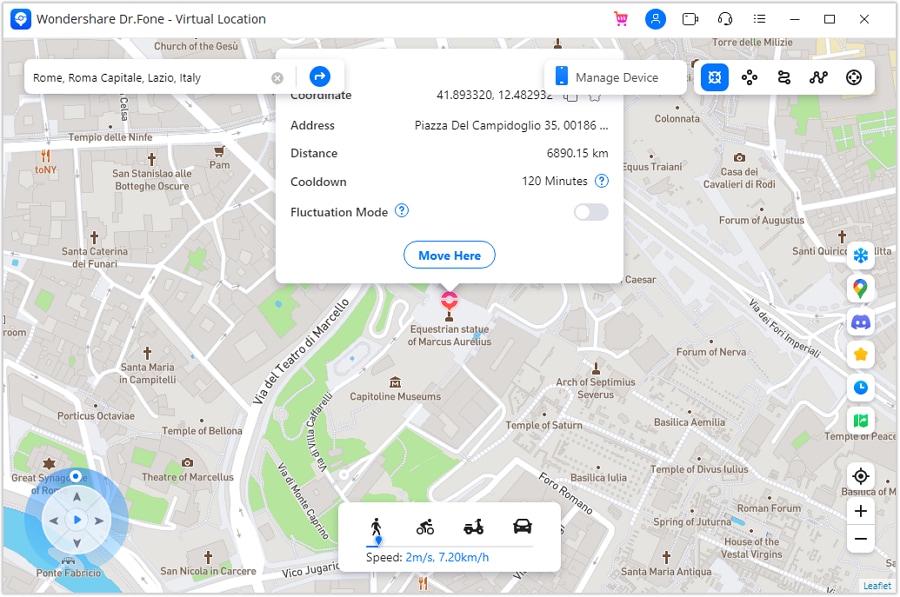
Step 3 Verify the correct kind of result
Inspect a compatible maps app to check GPS reporting, then restore real-location reporting after the test. Use the IP checks below for network addresses instead; GPS and IP results need not describe the same place.
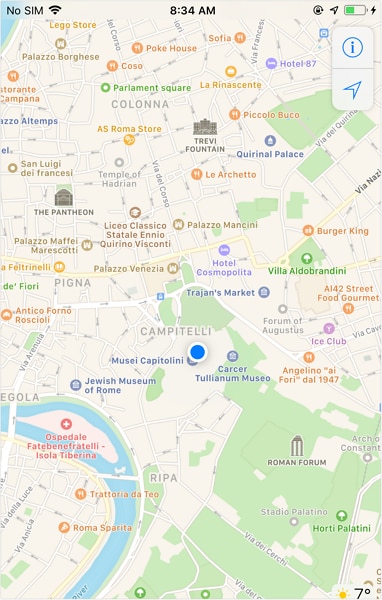
The location demonstration is complete. It is intentionally separate from the network-diagnostic methods that follow, and should not be used as evidence that an IP address, router configuration, or internet connection has changed.




How to find your Android phone's IP address
Connect to the network you intend to inspect before recording an address. Wi-Fi details describe that Wi-Fi connection; a public-IP website describes the route used by the browser request, which might instead use cellular data or a VPN. Avoid changing static-IP or router settings just to read the existing value.
Find the local address in Wi-Fi details
The following path resembles a standard Android layout. Manufacturers may use labels such as Connections, Wi-Fi, Network details, Advanced, or View more. The goal is the connected network's detail screen, not an identical menu name on every phone.
Step 1 Open Settings
Launch the phone's Settings app while it is connected to the Wi-Fi network you want to inspect.
Step 2 Enter network settings
Select Network & internet, or the equivalent connection menu on your device.

Step 3 Open Internet or Wi-Fi
Choose Internet and locate the currently connected Wi-Fi network rather than a saved network that is not active.

Step 4 View that network's details
Tap the gear or information control next to the active Wi-Fi network. Some phones open the same screen when you tap the network name.

Step 5 Read the IP address field
Scroll through the details, expanding advanced information if needed, and find IP address. Record the address relevant to your task. A dotted IPv4 value is common, but IPv6 addresses may also appear.


A local private address may be reused on many unrelated home networks. It is normally meaningful only within its own network context. If you reconnect elsewhere, check it again rather than relying on an old note.
Find the public address with the phone's browser
A public-IP checker displays the source address visible to that website. On home Wi-Fi this is often the router's public IPv4 address; on cellular it may be shared through the carrier. With a VPN, the site may see the VPN exit address. An IPv6-capable checker may show a different address family from the local IPv4 entry you recorded above.
Step 1 Open a browser on the Android phone
Use the phone itself, on the connection you are investigating, rather than a computer that may take a different network path.
Step 2 Visit a reputable public-IP checker
The original examples include IP.ME, WhatIsMyIP, and What Is My IP Address. Use a legitimate HTTPS page and avoid lookalike advertisements, extension downloads, or password requests; a basic address check does not need your account credentials.

Step 3 Read and label the result
Wait for the page to display the address, then note whether it reports IPv4 or IPv6 and whether you used Wi-Fi, cellular, or a VPN. The value is visible on the phone's browser screen, not necessarily a separate computer.
Public-IP geolocation is an estimate based on network information, not a live GPS reading of the handset. A nearby city, carrier location, or VPN server location may appear instead of your street address. An approximate map result alone does not prove that the phone is being tracked or that its GPS is malfunctioning.
Conclusion
Use Android's connected Wi-Fi details for the local address and a trusted browser checker for the public address seen by websites. Label the network and address family whenever you record a result, and repeat the check after changing connections. These details can support authorized troubleshooting and local sharing without requiring a phone-management installation.
Keep GPS simulation separate: it changes supported location reporting, not the network address or the encryption of your traffic. An IP address is useful diagnostic context, but it is neither a complete activity log nor a permanent identity for the person carrying the phone.
FAQ
1. Why do Settings and an IP-checking website show different numbers?
The Wi-Fi detail screen commonly shows a local address, while a website sees the public source address of your request. Router translation, carrier sharing, a VPN, or different address families can explain the difference.2. Must every Android IP address have four dotted numbers?
No. Four groups from 0 to 255 describe IPv4. IPv6 uses a longer hexadecimal form with colons. Record the address family relevant to the network tool you are using.3. Can I share files using only the phone's IP address?
Only if the chosen sharing service supports that method and its other requirements are satisfied, such as the same local network, the correct port, and authentication. Many sharing tools handle discovery without asking you to type an IP address.4. Does changing GPS location change my public IP?
No. GPS coordinates and network addressing are separate. A location simulator does not reassign the router's or carrier's public address, provide VPN encryption, or make an IP checker display the simulated map position.
 Add Wondershare Dr.Fone as a preferred source on Google