Teleport your device anywhere instantly with one click.

 100% Security Verified | No Subscription Required | No Malware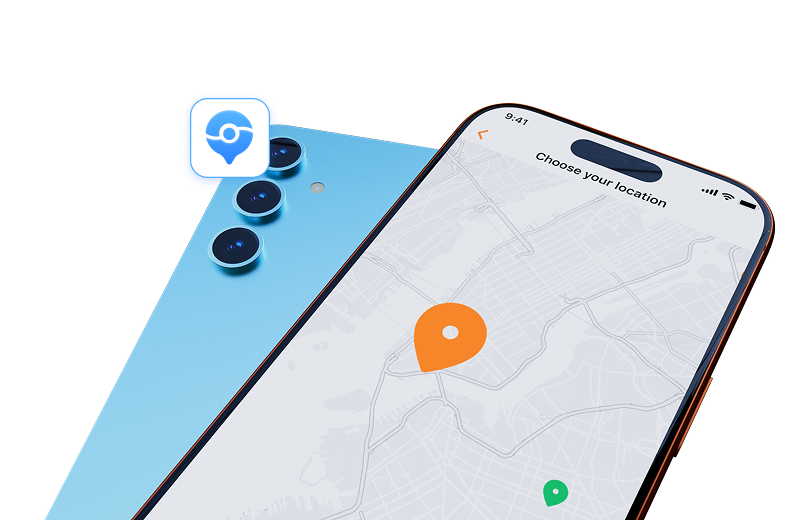

 :
: 
 ChatGPT
 Perplexity
 Gemini
 Claude
 Grok
Grok
On Life360, privacy is not just about whether a map dot moves. The app can also reveal why fresh location updates have stopped. Ghost mode Life360 is the unofficial idea of limiting your real whereabouts without simply appearing offline or turning sharing off. That distinction matters because a paused location, disabled permission, or lost connection can leave visible clues for Circle members. Life360 ghost mode therefore involves more than freezing a position. It requires understanding what the app can still report and how different privacy choices affect what others see.
This guide separates genuine Life360 location sharing privacy controls from location changes, explains their limits, and helps you judge which approach fits your privacy needs without relying on misleading “invisible” claims.
In this article
- Part 1 — Life360 Ghost Mode: What It Means and Why People Use It
- Part 2 — Can Circle Members Tell When Life360 Ghost Mode Is Active?
- Part 3 — Ways to Hide Location on Life360: Start With a Virtual GPS Solution
- Part 4 — Which Ghost Mode Life360 Method Is Less Noticeable?
- Part 5 — Life360 Location Sharing Privacy: What to Keep in Mind
Part 1 — Life360 Ghost Mode: What It Means and Why People Use It
Life360 ghost mode is not a built-in Life360 feature. It is an unofficial way to keep your real position private while staying connected to a Circle. With GPS-changing tools, the location shown in the app can differ from your actual location.
This approach can appeal to users who want more control over their privacy without leaving a family or friend group.
Why Use Ghost Mode Life360?
- Protect your privacy: Keep your exact movements from being followed in real time.
- Keep more personal space: Move around without sharing every location change with your Circle.
- Stay in the Circle: Remain connected with family or friends while limiting access to your real position.
- Switch locations easily: Change between a virtual position and your actual location when needed.
- Keep the app active: Maintain your connection to Life360 instead of leaving the group completely.
- Gain more independence: Reduce constant location visibility while still using the app.
In short, ghost mode in Life360 is mainly about balancing connection with privacy. The next question is whether built-in phone settings can create a similar result.
Part 2 — Can Circle Members Tell When Life360 Ghost Mode Is Active?
With an unofficial Life360 ghost mode setup, the goal is to change or hold the location shown in the app instead of simply turning off location sharing. Because the app still displays a chosen position, Circle members may not receive a direct alert that a virtual location is being used.
What May Happen in Ghost Mode Life360?
- No direct Ghost Mode alert: Circle members won't see a special message saying Ghost Mode has been enabled.
- A selected location stays visible: Others may continue seeing the position you choose to share.
- The location can stay fixed: A virtual point may remain in one place instead of following your real movement.
- Another position can be shown: You can use a different location while keeping your actual position private.
- Your Circle connection remains active: You can stay part of the group instead of removing yourself from location sharing completely.
The main difference is how privacy appears inside the app. A spoofed or fixed position can still look like an active location, while turning location access off may make the interruption more obvious.
Ghost Mode Life360 vs. Turning Off Location
| Feature | Ghost Mode Life360 | Turning Off Location |
|---|---|---|
| Location shown | Selected or fixed position | Location hidden |
| Direct alert | No dedicated Ghost Mode alert | A status change may be visible |
| Control | Virtual location can be changed | Requires manual location control |
| Privacy approach | Keeps a displayed position | Stops real location access |
| Circle presence | Can remain visually active | Location sharing may appear interrupted |
So, ghost mode in Life360 keeps your location visible while limiting access to your real position. Turning location off takes a more direct approach by stopping location access altogether.
The next section compares simpler phone-based options, including Airplane Mode, Wi-Fi and mobile data controls, and location permissions, to see how each one affects Life360 sharing.
Part 3 — Ways to Hide Location on Life360: Start With a Virtual GPS Solution
There is more than one way to limit what Life360 shows. Some options stop location access or internet updates. Others change the GPS position that the phone reports.
The second approach offers more control because it can keep a chosen location visible rather than simply freeze or cut off updates.
Solution 1 — Set a Fake Life360 Location With Dr.Fone - Virtual Location
Dr.Fone - Virtual Location lets you change the GPS position on a supported iPhone or Android phone. You can set one fixed point or simulate movement along a route.
This makes it useful for a ghost mode Life360-style setup where a virtual position appears instead of your real one.
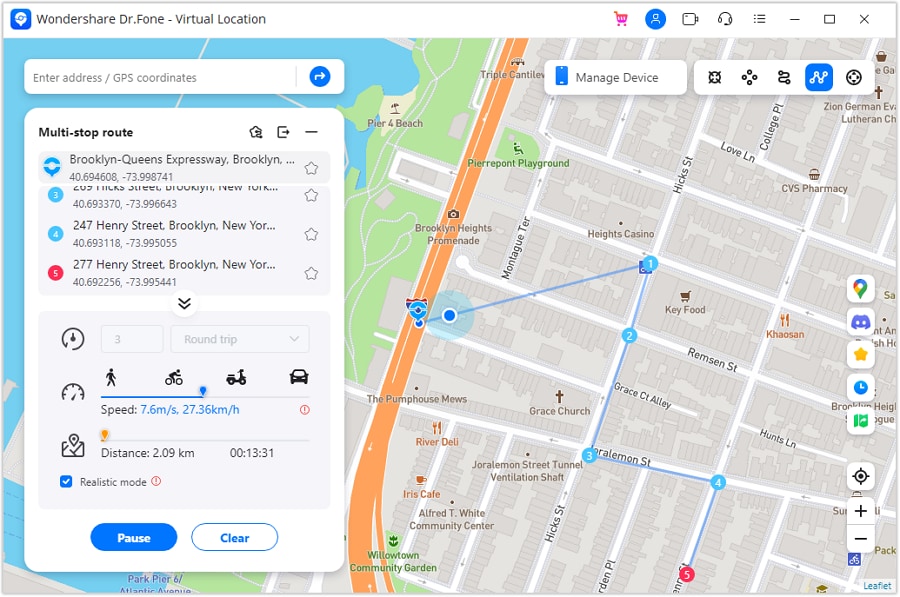
 Set your map route to simulate GPS movement.
- Set your wanted movement speed.
- HD and large map view to check location.
- Fake GPS location to anywhere.
Key Features of Dr.Fone - Virtual Location
- Teleport to one place: Move the device GPS to a location you select.
- Simulate movement: Create travel between one or several map points.
- Adjust travel speed: Control how fast the virtual position moves.
- Choose route behavior: Use round-trip or loop movement where supported.
- Use joystick controls: Change direction with 360-degree movement.
- No root or jailbreak: Supported devices can use the tool without these system changes.
How to Use Dr.Fone for Life360 Spoofing
-
Step 1 Connect your phone
Open Dr.Fone on your computer and connect your iPhone or Android device. Launch Virtual Location and complete the connection process.
-
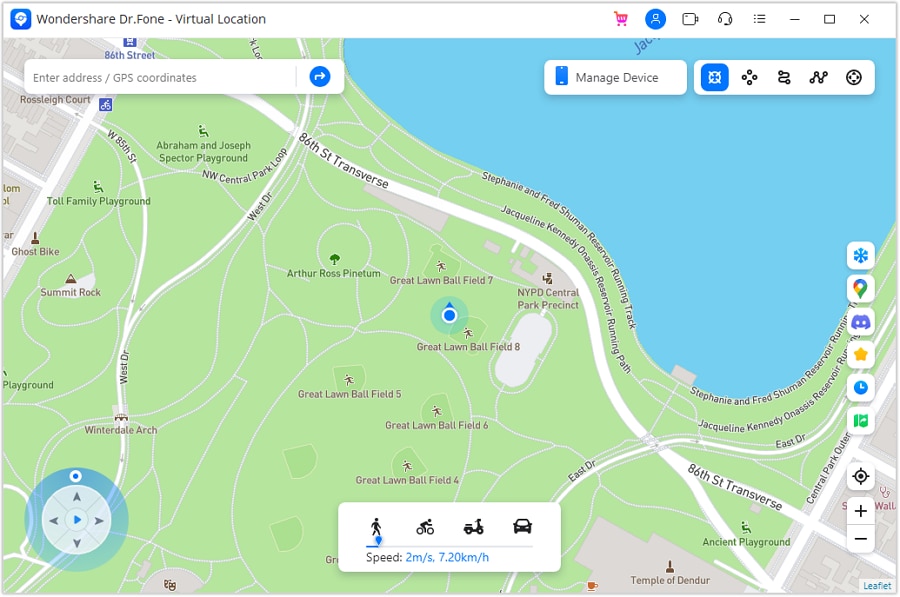
Step 2 Choose a virtual position
Open Teleport Mode from the top-right menu. Search for your preferred place and select it on the map.
-
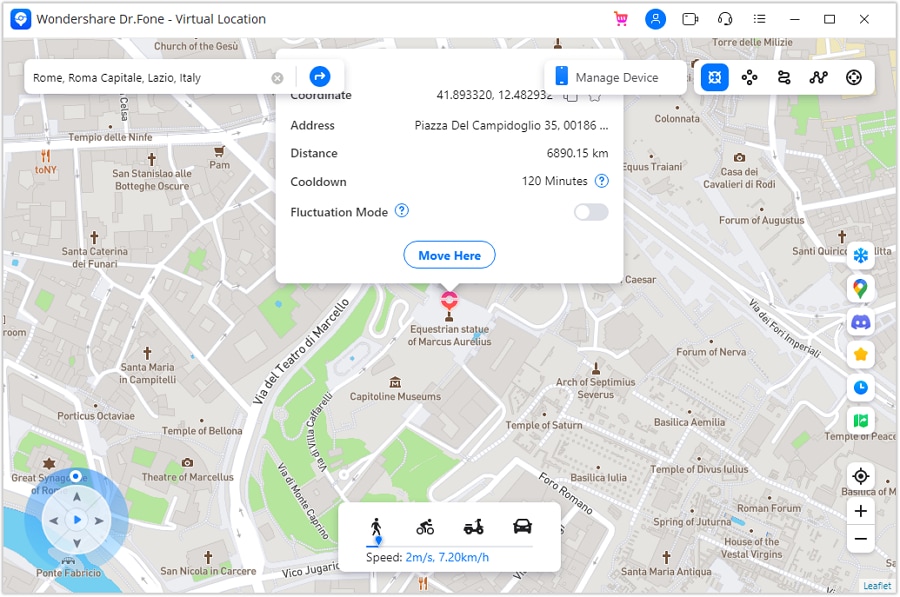
Step 3 Change the GPS location
Click Move Here. The phone should now report the selected virtual position.
-
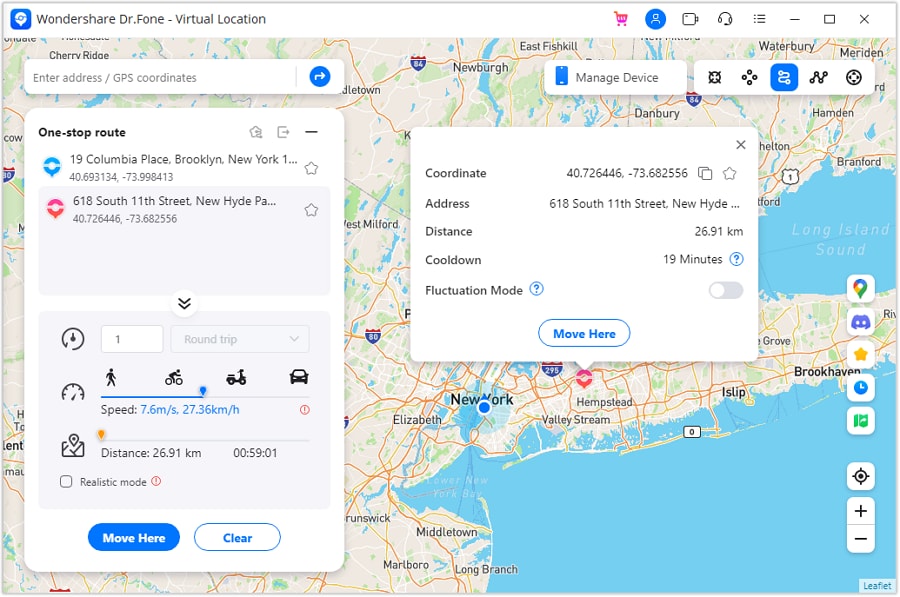
Step 4 Simulate movement if needed
Switch to One-Stop Route or Multi-Stop Route. Add your destination, choose the speed and trip style, and start the route. You can pause or clear the movement when needed.
-
Step 5 Restore your real location
Restart the phone when you want the device to return to its actual GPS position.




Android Option — Dr.Fone App - Change Location
Android users also have a more direct option through Dr.Fone App - Change Location (Android). It is designed to change the phone’s GPS location without relying on the desktop workflow each time.
With the Android app, you can:
- Change your GPS position from the phone.
- Move to another virtual place with a simple location change.
- Manage saved virtual locations more easily.
- Use the changed GPS position with supported location-based and social apps.
- Control your location without staying connected to a computer.
For Android users who want a simpler mobile setup, Dr.Fone App - Change Location can make virtual GPS control more convenient.
Dr.Fone changes the location reported by the device rather than simply cutting Life360 off from location data. That makes it different from basic phone settings.
Dr.Fone offers a virtual GPS approach, but phone settings can also limit Life360 tracking. The following native options are easier to access, yet they work by blocking location or network access. That can make the change more noticeable.
Solution 2 — Disable Location Access for Life360
You can stop Life360 from using your phone’s location permission on both iPhone and Android.
On iPhone:
-
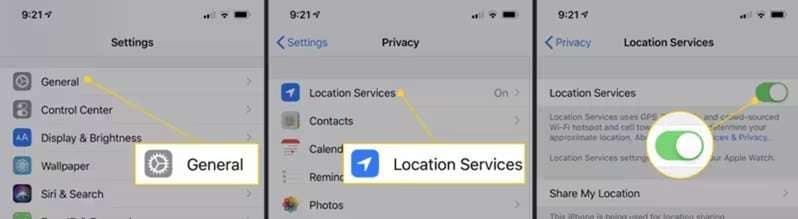
Step 1 Open Settings > Privacy > Location Services.
-
Step 2 Find Life360 and set location access to Never.
On Android:
-
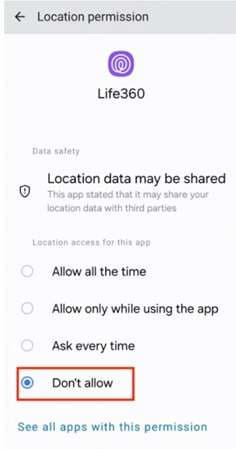
Step 1 Open Settings > Apps > Life360.
-
Step 2 Go to Permissions > Location.
-
Step 3 Select Deny or Ask every time.
This can hide location on Life360 by preventing the app from receiving fresh GPS data. However, it does not create a new location. Updates simply stop, which can make the change easier to notice.

Solution 3 — Turn Off Wi-Fi and Mobile Data
Another option is to stop Life360 from using an internet connection.
-
Step 1 Open Life360, then disable Wi-Fi and mobile data.
-
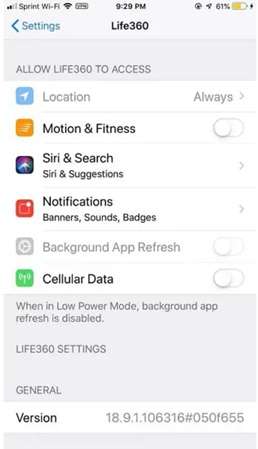
Step 2 On iPhone, you can also open Life360 settings and switch off Cellular Data, Background App Refresh, and Motion & Fitness.
Without a working connection, Life360 may stop sending fresh updates. The last known position can remain on the map instead of following your current movement.
The drawback is clear: a location that stays fixed for a long time can look unusual. This makes the method less discreet than showing an active fake Life360 location.
Solution 4: Turn Off GPS or Enable Airplane Mode
The simplest workaround is to disable GPS or switch on Airplane Mode.
Once GPS or the network is unavailable, Life360 may show messages such as “Location/GPS off” or “No network.”
This can stop your live position from updating, but it has two limits:
- Navigation apps may also lose the services they need.
- Circle members can more easily see that tracking has been interrupted.
For that reason, Airplane Mode is better viewed as a temporary tracking break than a true Life360 ghost mode.
Part 4 — Which Ghost Mode Life360 Method Is Less Noticeable?
| Method | What it changes | Location shown | Main advantage | Why it may be detectable |
|---|---|---|---|---|
| Dr.Fone - Virtual Location | Changes reported GPS position | Selected or moving virtual location | Can show a chosen point or simulated route | An unrealistic or fixed route may look unusual |
| Disable Location Permission | Blocks Life360 from accessing GPS | Fresh location stops updating | Simple and built into the phone | Location updates stop instead of continuing normally |
| Turn Off Wi-Fi / Data | Blocks network updates | Last position may remain static | Quick to switch on or off | A frozen location can become obvious |
| Turn Off GPS / Airplane Mode | Cuts GPS or network access | Tracking stops | Very easy to use | “Location/GPS off” or “No network” may appear |
Why Native Workarounds Often Leave Clues
Most native tricks do not replace your real GPS with another active location. They simply stop Life360 from receiving fresh data.
That can create visible signs such as:
- A location that stays fixed for too long.
- No fresh movement on the map.
- A GPS or network warning.
- An obvious break in normal tracking.
So, these methods may improve Life360 location sharing privacy, but they do not always create a smooth Life360 ghost mode effect.
Part 5 — Life360 Location Sharing Privacy: What to Keep in Mind
Virtual GPS tools can change the location reported by the phone. This may also affect other apps that use device location.
Life360 uses location data for features such as Place Alerts, driving activity, and Crash Detection. Crash Detection requires location access to stay enabled. Bubbles are Life360’s built-in option for sharing an approximate area while keeping safety features active.
For privacy, use virtual locations carefully when accurate GPS matters, especially during emergencies.
Conclusion
Life360 ghost mode is not a built-in feature, but the idea reflects a real privacy need: limiting what others see without fully leaving a Circle. Native options such as Airplane Mode or disabled permissions can stop updates, yet they may also leave obvious clues. Bubbles offer a cleaner built-in choice when approximate sharing is enough.
For a flexible fake Life360 location, Dr.Fone - Virtual Location can set a fixed point or simulate movement on supported devices. Whatever route you choose to go, find the right balance between Life360 location-sharing privacy and safety, trust, and emergency location-accuracy needs.
FAQs About Life360 Ghost Mode
-
1. Does Life360 Have an Official Ghost Mode?
No. Life360 ghost mode is an unofficial term. Life360 instead offers features such as Location Sharing controls and Bubbles. -
2. Can I Hide Location on Life360 Without Anyone Knowing?
Not with Life360’s native controls. Pausing sharing, disabling location permission, or losing connection can leave visible status clues. -
3. Does Airplane Mode Freeze Life360?
It can stop fresh updates, but it is not invisible. The last location may become stale, and connection information can change. -
4. Can a VPN Create a Fake Life360 Location?
No. A normal VPN changes your IP address, not the phone’s GPS coordinates. -
5. What Is Life360’s Best Built-In Privacy Option?
Bubbles are designed for approximate location sharing. They hide the exact position but remain visible to Circle members. -
6. Can Life360 Spoofing Affect Safety Features?
Yes, potentially. If the phone reports a virtual position, location-based alerts and safety information may no longer match the device’s real location.
 Add Wondershare Dr.Fone as a preferred source on Google