Teleport your device anywhere instantly with one click.


 100% Security Verified | No Subscription Required | No Malware


 :

 ChatGPT
 Perplexity
 Gemini
 Claude
 Grok
In the original Pokémon Sapphire for Game Boy Advance, the normal Master Ball comes from Team Aqua's Hideout; cheat-code results depend on your game revision and emulator. Back up your save before trying any code. A list labelled 'unlimited Master Balls' is not proof that every line belongs to the same cheat or works on every release.
This 2026 reference preserves the source's code list and both desktop and smartphone workflows while correcting several important mix-ups. Sapphire is not Pokémon Alpha Sapphire, the Nintendo 3DS remake, and neither game is Pokémon GO. Their save formats, cheat systems, and use of location are different. Choose instructions for the game you actually own rather than combining similarly named guides.

In this article
Part 1: Obtain a Master Ball in Pokémon Sapphire Without Cheats
A Master Ball catches an eligible wild Pokémon without the usual capture failure. Its scarcity is what makes it useful for an especially difficult encounter. Before modifying your game, distinguish the normal item sources from claims that require a cheat or a separate duplication exploit.
- Team Aqua's Hideout: collect the Master Ball available inside the hideout near Lilycove as you progress through the story. Search carefully rather than assuming it is handed out at the start.
- Lilycove lottery: the top lottery prize can be a Master Ball when the selected number matches all five digits of a Pokémon's original Trainer ID. This is a chance-based reward, not a guaranteed daily supply.
- Starting another game: a new Sapphire save does not begin with a free Master Ball. Starting over also risks replacing existing progress; do not reset a save merely because an earlier guide suggested an immediate reward.
- Trading: a compatible traded Pokémon can carry a legitimately obtained Master Ball. Trading does not itself clone the item, and duplication tricks from another game should not be assumed to work in Sapphire.
- Poké Marts: ordinary unmodified Sapphire shops do not sell Master Balls. A shop displaying them after a cheat is not evidence that they are a normal retail item.
- Cheat-based acquisition: a compatible inventory or item-slot code may create a Master Ball, but it can replace an existing item or damage a save. Work only on a backed-up copy.

The original article also included a mobile GPS product promotion. That is a separate topic from Sapphire's item inventory: changing a phone's location cannot add a Master Ball to a GBA save file or enable a GameShark code.
 Set your map route to simulate GPS movement.
- Set your wanted movement speed.
- HD and large map view to check location.
- Fake GPS location to anywhere.

Dr.Fone - Virtual Location is a desktop-controlled GPS simulation tool for supported iOS and Android devices. Its map destination and route controls are relevant to location testing, not to the internal inventory of Pokémon Sapphire. It does not convert Sapphire codes into Alpha Sapphire codes or supply Pokémon GO items.
If you separately need a location test, keep it independent of emulator troubleshooting. Compatibility depends on the device and software version, while location-based games may prohibit simulated positions and apply account restrictions. The fixed product panel is not a promise of undetectable use or guaranteed access to rare Pokémon.
-
Step 1 Open the location module separately
Launch Dr.Fone on your computer, choose Virtual Location, and connect a supported phone using the program's instructions. Do not select or edit a Sapphire save file in this workflow.
-
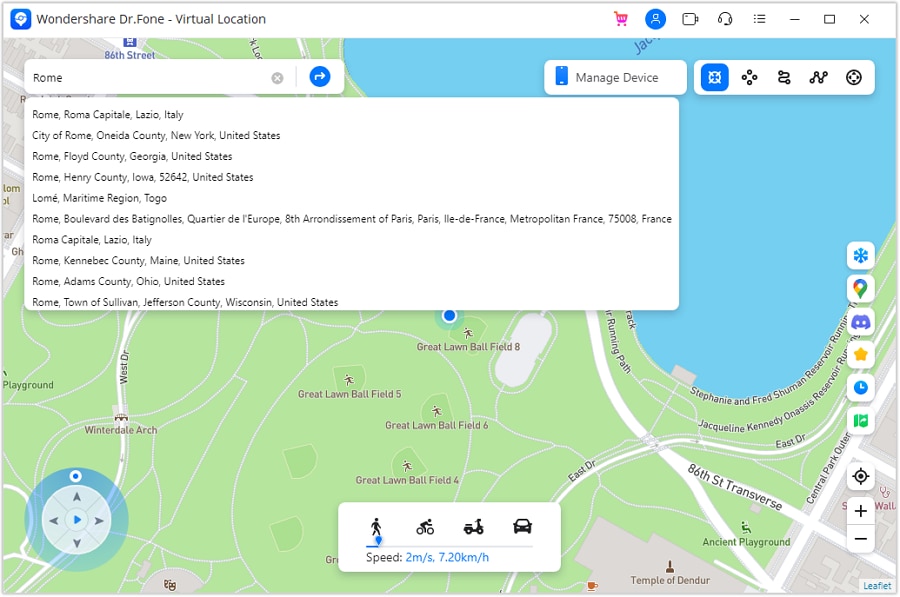
Step 2 Choose a test destination
Select Teleport Mode, search for the intended place, and inspect its marker before applying the position.
-
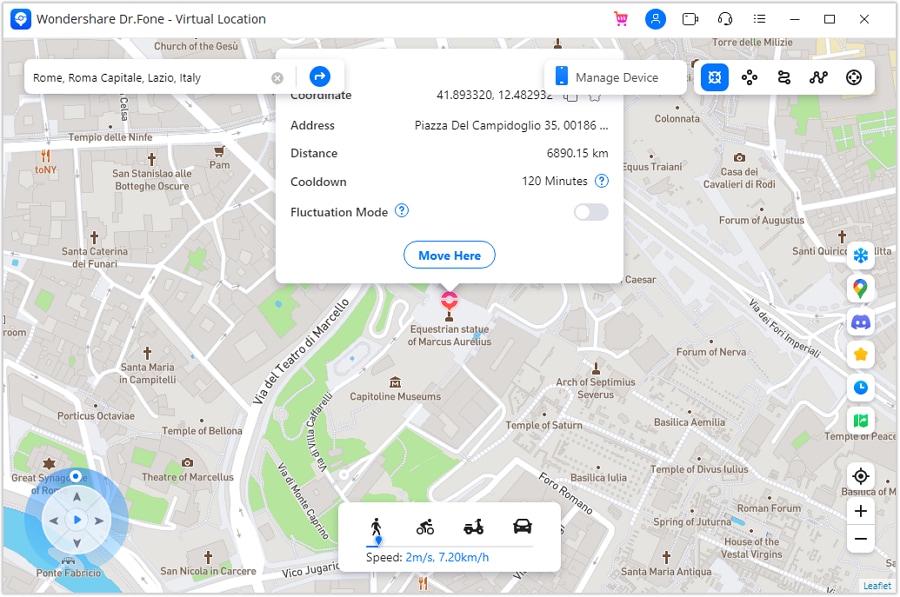
Step 3 Confirm the simulated position
Use Move Here and check the phone's maps app. If you need route testing, configure the supplied route controls rather than expecting a stationary coordinate to simulate travel.
-
Step 4 Finish the test
Stop the simulation and follow the program's restart guidance to restore the actual location. This has no effect on a Sapphire cheat list.
Use the remaining sections only for the original Sapphire emulator workflow. Keep its save backup and cheat configuration separate from any phone-location experiment.




Part 2: Sapphire Master Ball, Cash and Rare Candy Code Reference
The following strings are retained exactly from the source article for identification. They are not presented as newly tested or universally working codes. The source does not identify a ROM region, revision, or fully verified format for every entry, and its Master Ball column combines item-related lines with apparent enabling-code material.
| Source Master Ball group | Source cash code | Source Rare Candy group | Source Pokédex group |
|---|---|---|---|
DCEEEC34AFEADC26 |
1B3E8B0CE075B270 |
361E3586CD38BA79 |
8B4DD03454A1 |
A historical GameShark Advanced submission identifies DCEEEC34 AFEADC26 as a first-PC-slot Master Ball code and 910C4AFB 679BA66A as a first-bag-item-slot variant. It also lists 9E6AC862 823AB7A8 with 8365F8FA 817CF3E9 as an enabling code. That historical report is useful for distinguishing purposes, but it is not a compatibility test on your own emulator.
Do not paste every table row into one GameShark entry, assume all lines are interchangeable, or repeatedly switch formats until something happens. A 12-character line in one column and a 16-character line in another may belong to different code systems. Check your emulator's documented format and the exact game revision before enabling anything. The unverified 68E6EAC16AB638B4 entry should not be treated as an essential component merely because it appears beside other lines.
Item-slot modifications may overwrite an item already stored there; historical submissions explicitly warn about that risk. Inspect the intended slot in a backed-up save and disable a code once its effect is understood. If the inventory becomes corrupted or the game crashes, return to the clean backup instead of saving over it.
Part 3: Add and Disable Cheat Codes in a Sapphire Emulator
The general sequence is to protect your save, create a cheat entry, choose the correct code type, test a single effect, and disable it when finished. Menu labels vary. VisualBoyAdvance is a desktop example; My Boy! is an Android emulator, not another PC application. 'GBA' names a console platform and does not identify one universal smartphone app.
Method 1: Configure a Code on a Desktop Emulator
Use an emulator that documents a compatible cheat system for your legally obtained original Sapphire game. The screenshots illustrate an older VisualBoyAdvance-style interface; current forks and other emulators may place the same functions elsewhere.
-
Step 1 Save progress and keep an independent backup
Save normally within the game, then use the emulator's save or export function as appropriate. Keep a separate copy of the battery-save file before changing cheats. A save state created after a bad code has run may already contain the problem.

-
Step 2 Open the list and add one compatible entry
In the illustrated interface, open Cheats > Cheat List, then choose the relevant add-code control. Select GameShark only when your chosen code is documented for that system. Give the entry a descriptive name so you can identify its target and remove it later.
Enter the correctly formatted code, save the entry, and enable it for a controlled test. Check the intended inventory location rather than assuming a success message guarantees a correct result. Return to Cheats > Cheat List to disable the entry. Reload a clean save if the test produces unexpected behavior.
The separate location tool mentioned earlier should not be confused with these emulator controls. Dr.Fone - Virtual Location addresses phone GPS simulation rather than GameShark memory changes. Older marketing claims about operating up to five iOS devices should be checked against the current license and compatibility information, not treated as an unconditional entitlement.
Method 2: Configure a Code on a Smartphone Emulator
First check whether your chosen mobile emulator actually supports cheats and the required code format. The source's screenshots show a Cheat Codes screen with a plus button, but an app named or described as a GBA emulator may have different menus or no cheat support at all. Back up the save before testing, just as on desktop.
-
Step 1 Find the game's Cheat Codes screen
Load original Pokémon Sapphire, open the emulator's additional-options menu, and look for Cheat Codes or the equivalent documented setting. Review which entries are already enabled before adding another.

-
Step 2 Add, label and test the entry
Disable conflicting entries and use the plus control to create a new one. Do not delete the only record of a working configuration until you have a backup.

Enter a meaningful name, choose GameShark only if it matches the documented code, and paste the required lines without accidental punctuation. Save the entry and check whether it is enabled; saving alone is not identical to activation in every app. Inspect the result, then turn the cheat off when you no longer need it.

When a code does nothing, check game region, revision, code type, required enabling codes, and emulator support before trying another entry. These instructions do not apply to Pokémon Alpha Sapphire on Nintendo 3DS. A similarly named item is not evidence that the underlying memory addresses match.
Conclusion
For an unmodified Sapphire playthrough, prioritize the Team Aqua Hideout Master Ball and the chance-based Lilycove lottery. For an emulator experiment, keep a clean backup, identify the code system, test a single documented effect, and disable it afterward. The preserved code table is a source reference rather than a promise of unlimited items on every version.
Do not expect a new game, an ordinary shop, a routine trade, or a GPS changer to create unlimited Master Balls. Keep Sapphire, Alpha Sapphire, and Pokémon GO separate when choosing instructions, and restore the backup if a test changes more than you intended.
FAQ
-
1. Can I buy Master Balls at a normal Sapphire Poké Mart?
No. The original game's ordinary shops do not sell them. The story item in Team Aqua's Hideout and the top Lilycove lottery prize are different from a cheat-modified shop. -
2. Are the listed Sapphire codes also Alpha Sapphire codes?
No. Original Sapphire is a Game Boy Advance game, while Alpha Sapphire is a Nintendo 3DS remake. Do not reuse memory codes across those games. -
3. Why might a Master Ball code fail on my emulator?
The code type, game region or revision, enabling code, or emulator support may differ. Test only after backing up, and do not assume the entire source column is one verified code. -
4. Can Virtual Location generate Sapphire Master Balls?
No. It simulates supported phone GPS positions and routes. Sapphire inventory changes are part of the emulator and game save, not phone location.
 Add Wondershare Dr.Fone as a preferred source on Google