 Teleport your device anywhere instantly with one click.


 100% Security Verified | No Subscription Required | No Malware


 :

 ChatGPT
 Perplexity
 Gemini
 Claude
 Grok
If Tinder shows the wrong location, first check location permission, the phone's own map position, and any active Passport destination. Seeing a distant profile is not always a GPS failure. Troubleshooting your actual position and intentionally choosing another city are different tasks.

Tinder discovery uses location and preferences to help surface potential matches. In a smaller area, you may exhaust nearby suggestions or want to explore somewhere you plan to visit. Those situations do not necessarily mean that the app has lost your coordinates.
Before changing anything, decide whether you want accurate local discovery, a different travel destination, or a controlled GPS test. The methods below retain the original Android, iPhone, Passport, and Facebook topics while explaining what each can and cannot change.

In this article
How Tinder Uses Location for Discovery
The app requests the location information it needs for nearby discovery. Your phone's location service can combine GPS, Wi-Fi, and cellular information; the exact access available to Tinder depends on its permissions and system behavior. Opening the app can refresh its position, but it does not guarantee an immediate update in every part of the service.
Do not assume that closing Tinder proves it has no location access. Review the permission actually granted by your operating system, including any background options. Equally, a new city is not a guaranteed visibility boost or a promise of additional matches.

Hiding a distance label, changing the city used for discovery, and denying device-location permission have different consequences. A hidden label is not anonymity, and removing permission can prevent location-dependent functions from working. It is not a reliable way to keep normal nearby matching while concealing all location information.
Third-party GPS simulation changes the reported position on a supported device, but Tinder may not accept it. Other account and connection signals still exist. A mismatch between those signals can make a result confusing, so restore the real position when diagnosing a genuine location error.

For intentional discovery elsewhere, Tinder supplies Passport. Its official help information describes city search or map-pin selection, available through supported subscriptions and a standalone purchase option. Check the current offer rather than assuming a fixed monthly price or that Gold is the only eligible tier.
To inspect subscription choices, open your profile, go to Settings, and review the available Plus, Gold, or Platinum offer. Read the price, billing period, renewal terms, and included features before entering payment information. Purchasing a plan is not necessary merely to check a location permission.
Choose a Destination with Tinder Passport
When Passport is available for your account, use Tinder's own location control rather than editing unrelated profile fields:
Step 1Open your Tinder profile
Use the profile control inside the application to reach the account's options.
Step 2Find Location in Settings
Open Settings and scroll to Location. Older interfaces may use a label such as Swiping In.
Step 3Add a new place
Select Add a New Location or the equivalent control offered by the app.
Step 4Confirm the destination
Search for the city or choose the map point and verify that the intended area is selected. Passport places discovery in one city at a time.
Step 5Review optional distance visibility
If your account provides a distance-display control, choose whether to show it. This preference is separate from changing the Passport city and does not erase the service's knowledge of location.
The 24-hour detail is often misunderstood. Tinder explains that people you Liked in a previous Passport location may still see your profile for up to 24 hours after a change. That is not a mandatory 24-hour activation delay before a new city can work.
Displayed distance and discovery position can also reflect recent travel or another person's Passport use. Do not infer someone's exact current whereabouts from a distance label alone. The original New York-to-Texas example illustrates why a chosen discovery area and physical separation can differ, not a rule that everybody will reject a travelling profile.
If you are physically travelling and want local discovery, verify the phone's actual position and the active destination. Do not assume that a hidden-distance setting is required for travel or that showing a distance guarantees perfect measurement.

Dr.Fone - Virtual Location: Separate GPS Simulation from a Repair
 Set your map route to simulate GPS movement.
- Set your wanted movement speed.
- HD and large map view to check location.
- Fake GPS location to anywhere.

Dr.Fone - Virtual Location offers map-based destination selection and movement simulation on supported iOS and Android setups. Routes can include chosen points and speeds, making the tool relevant to a deliberate location test rather than a fix for a broken internet connection.
The source also references Pokemon Go, Snapchat, Instagram, and Facebook. Those are related location topics, not a universal compatibility guarantee. Simulating a coordinate does not purchase Passport, hide account activity, or prove that Tinder will accept that signal.
Step 1Confirm compatibility and connect
Check the phone and desktop requirements, attach your device, and complete its authorization prompts before opening the location module.
Step 2Select the test position or route
For a single destination, use Teleport Mode, search the place, and confirm Move Here. For movement, select the supported route mode and configure its points and speed.

Step 3Check and end the test
Inspect a maps app on the phone first. Evaluate any target app separately and follow its terms. When testing ends, follow the restoration prompt or restart the device to recover its real position.
Use the normal location-permission and Passport checks below when your goal is accurate Tinder discovery. Replacing a wrong position with an intentionally simulated one does not diagnose the underlying fault.




Identify the Tinder Location Problem You Are Seeing
The original six symptoms fall into access, stale-position, and discovery-distance issues. Identifying which one applies helps you avoid changing the wrong setting.
- Tinder cannot access location: Check the system permission and whether the device's master location service is enabled.
- The position stays the same after travel: Check the phone's map, reopen Tinder, and look for an active Passport destination or mock-location setup.
- Suggested profiles are far away: Review discovery distance preferences, possible Passport use, and recent travel before treating it as a phone-location failure.
- A displayed place appears incorrect: Compare the actual device reading with the city selected for discovery; those are not necessarily the same field.
- A location-loading screen never completes: Confirm the internet connection and restart the app before changing location coordinates.
- Location continues failing to load after another attempt: Recheck permissions, update the application, and use official support if the problem persists.
Tinder's help page also notes that discovery can sometimes include profiles slightly beyond your preferences. Inspect the available control beneath the distance slider if you want to limit those exceptions.
Fix Incorrect Tinder Location Before Trying a Simulated One
Begin with a simple app restart, then restart the phone if needed. Confirm that a trusted maps app can obtain the correct real-world position, that the network works, and that Tinder has suitable location permission. Update Tinder through the official store.
If only some profiles are distant, revisit Discovery settings rather than trying to repair GPS. Tinder's official troubleshooting also suggests logging out and back in, then reinstalling if necessary. Check that you can sign in again before removing the app; do not delete the account as a substitute for reinstalling.
The source proposes spoofing as another location solution. Treat the following Android and iOS workflows as intentional simulation instead: they do not repair a failing GPS receiver, restore missing permission, or guarantee a compliant Tinder location change.
For Android Users: Review Mock Location Settings Carefully
Android interfaces vary, and the old Allow Mock Locations label is not universal. A previously selected mock-location app can itself explain why a map remains at the wrong place. Turn that setup off first if you want your genuine coordinates.
Step 1Choose a trustworthy tool only for an intentional test
Review the official store listing, permissions, and compatibility. Availability on Google Play alone is not proof that Tinder permits or supports the tool.
Step 2Inspect Developer options
Find the available mock-location control. Current devices commonly provide Select mock location app rather than a simple Allow Mock Locations checkbox.
Step 3Select the intended app
If the test requires this control, select only the application you chose. Leave it unselected when you are trying to restore real location.
Step 4Apply, verify, and undo the simulated position
Choose the test point in the app and confirm it using its own controls. Inspect the phone's map, then stop simulation and clear the mock-location selection when finished. Before uninstalling the test app, remove its developer-setting selection and verify that normal positioning has returned.
A mock location is not guaranteed to persist until a particular action occurs; device and application behavior vary. If a stale point remains after ending the test, restart the phone and check its map again.
For iOS Users: Connect, Teleport, and Verify
- Set your map route to simulate GPS movement.
- Set your wanted movement speed.
- HD and large map view to check location.
- Fake GPS location to anywhere.
The iPhone workflow in the source uses Dr.Fone - Virtual Location through a connected desktop. It is not an Android-style mock-location setting. Check the supported device and OS before beginning, use your own device, and complete the required trust prompts.
The software changes a reported GPS coordinate and can simulate supported routes. It cannot guarantee that Tinder adopts the changed signal or that a third-party location test is accepted under Tinder's rules. Prefer Passport for choosing a discovery city within Tinder itself.
Step 1Open the connected-device module
Attach the iPhone or iPad to the computer with a data cable, open Virtual Location, and continue through the displayed connection and Get Started prompts after reviewing the software's terms.
Step 2Teleport to the chosen point
Activate Teleport Mode on the map interface. Search for the desired area, inspect the pin, and select Move Here to confirm it. The source's Transport Mode and Move Now wording should not override the current official interface labels.
Step 3Compare the desktop and phone readings
The selected position appears in the application. Open Apple Maps or Google Maps on the iPhone and verify its current reading as described in Dr.Fone's teleport guide. Check Tinder separately; a changed map does not prove a changed discovery account setting.
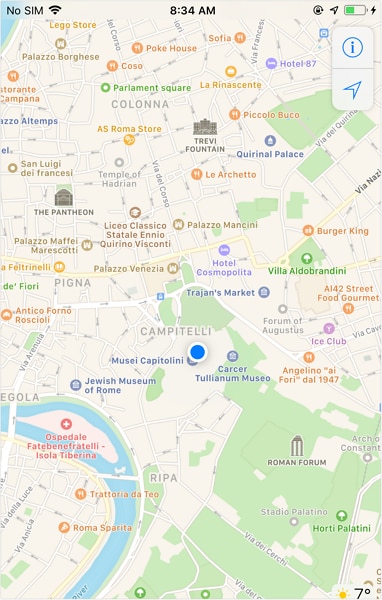
After this controlled test, use the restoration prompt or restart the phone to return to its actual location. Retest Tinder with normal permissions if the original goal was to fix inaccurate local results.
The Facebook Current-City Method: Profile Editing, Not a GPS Fix
The original article proposes editing Facebook as though it controls Tinder's live location. Do not rely on that claim. A Facebook current-city entry is profile information, not the phone's position or Tinder's Passport destination. Linking an account does not make every Facebook field a Tinder discovery control.
If you also need to correct Facebook's own public city information, the original navigation sequence can be understood as the following separate task. Interface names may differ:
Step 1Open Facebook
Launch its app and use your profile controls rather than a third-party form.
Step 2Open your profile information
Select your profile, then About or Edit Details, depending on the interface.
Step 3Locate the city field
Find Places Lived or the current-city entry. Review which details are already public.
Step 4Save accurate city information
Use Add City or Edit, select the correct city and region, review the audience setting, and save the change.
Step 5Return to Tinder for its own controls
Leave Facebook and reopen Tinder. For Tinder location, check the device permission or Passport destination rather than expecting the Facebook edit to act as a teleport command.
Conclusion
Accurate local discovery begins with a correct device position, suitable permissions, and the intended Tinder settings. Distant profiles can have explanations other than a GPS fault. Passport is the built-in destination tool; GPS simulation is a separate, compatibility-dependent test, and Facebook profile edits are not a replacement for either workflow.
FAQ
1. Why does Tinder show people outside my distance range?
Possible reasons include Passport, recent travel, or discovery settings that allow some suggestions beyond the chosen range. Check those controls before assuming that the phone's GPS is wrong.2. Must I wait 24 hours for a Passport city to activate?
The official 24-hour explanation concerns continued visibility to people you Liked in a previous destination. It is not a universal required activation wait for the next city.3. Does changing Facebook's current city update Tinder GPS?
Do not rely on that method. Facebook's city is profile information; Tinder's discovery location and the phone's coordinates are controlled through their own settings and services.4. Is GPS simulation a fix for missing Tinder location permission?
No. Restore the required permission and connectivity first. A simulated coordinate is a deliberate device-location test and does not grant Tinder access that the operating system has denied.
 Add Wondershare Dr.Fone as a preferred source on Google



