Teleport your device anywhere instantly with one click.


 100% Security Verified | No Subscription Required | No Malware

 :

 ChatGPT
 Perplexity
 Gemini
 Claude
 Grok
A free PPTP VPN connects your device to a remote server, allowing websites to see a different public IP address without a paid subscription. Windows 10 and Windows 11 still support PPTP through their built-in VPN clients, making setup relatively simple. However, this protocol dates back to the 1990s and relies on outdated authentication and encryption methods with known security vulnerabilities.
This guide covers free PPTP VPN servers, current VPNBook login details, Windows setup instructions, and the security risks you should know. It also explores safer VPN alternatives for protecting your internet traffic. Since a VPN changes your IP-based location but not your phone's GPS coordinates, you'll also learn how Dr.Fone - Virtual Location helps simulate a different GPS location.
In this article
- Part 1. What Is a Free PPTP VPN and How Does It Work?
- Part 2. Free PPTP VPN Server List with Addresses and Login Details
- Part 3. How to Set Up a Free PPTP VPN on Windows 10 and Windows 11
- Part 4. Is a Free PPTP VPN Safe to Use in 2026?
- Part 5. Can a Free PPTP VPN Bypass Geo-Restrictions?
- Pro Tip. How to Change GPS Location Without a VPN Using Dr.Fone - Virtual Location
Part 1. What Is a Free PPTP VPN and How Does It Work?
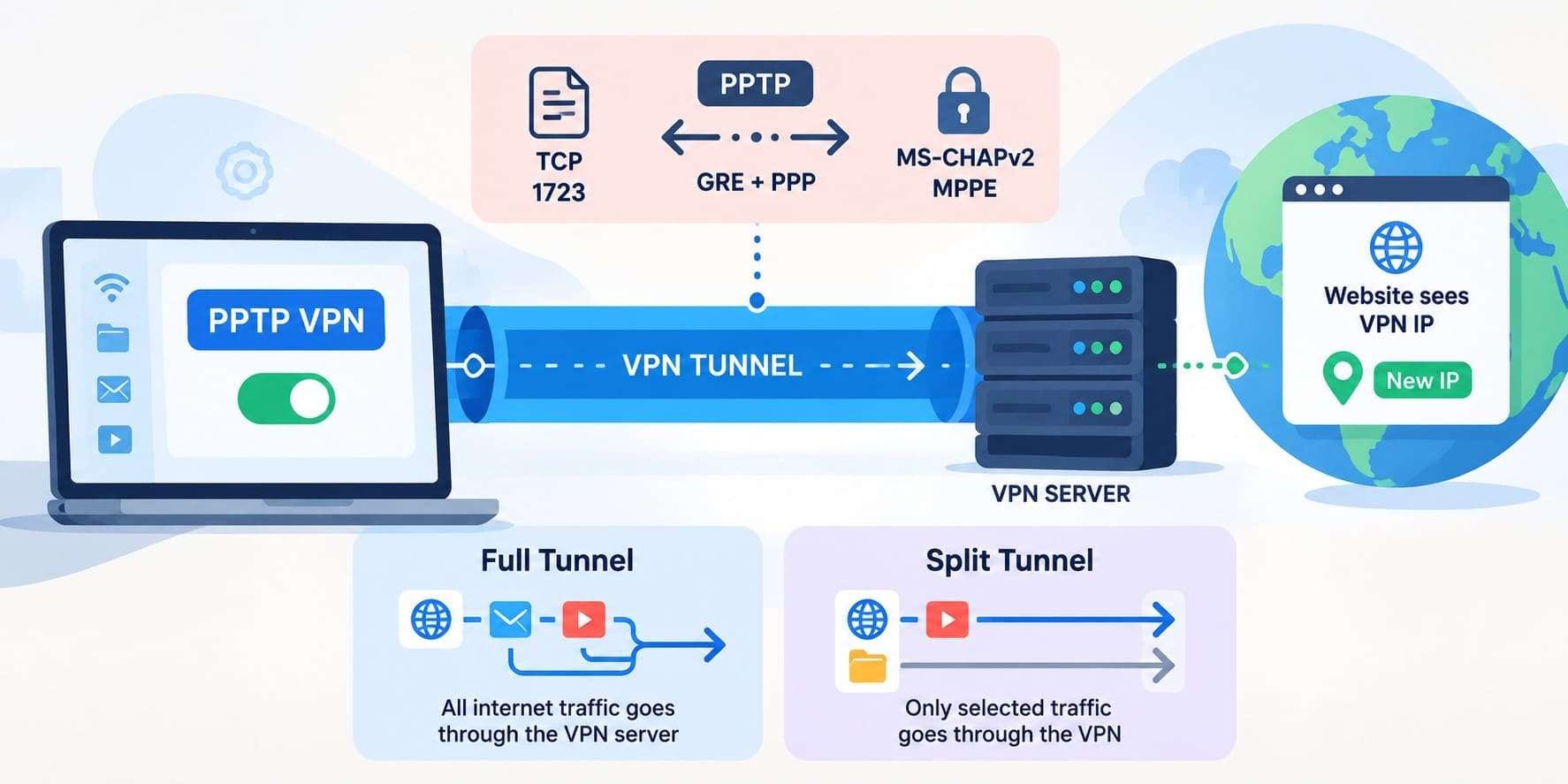
A free PPTP VPN uses the Point-to-Point Tunneling Protocol, an older VPN protocol that transfers network traffic between your device and a remote server. According to RFC 2637, PPTP uses TCP port 1723 to manage tunnel connections and enhanced GRE to transport PPP packets. With a full-tunnel connection, internet traffic passes through the VPN server instead of directly through your regular connection.
As a result, websites see the VPN server's public IP address instead of yours. Split tunneling works differently, routing only selected traffic through the VPN. PPTP itself does not require a particular authentication or encryption method. However, older implementations commonly use MS-CHAPv2 authentication and Microsoft Point-to-Point Encryption (MPPE). MPPE relies on outdated RC4 encryption and supports 40-bit, 56-bit, and 128-bit session keys.
Why Do People Still Use Free PPTP VPN Services?
If you need a free VPN for PC, PPTP still offers some practical uses, especially on older devices with built-in VPN support. Despite its security limitations, some users continue choosing PPTP for these 4 reasons:
- Regional Website Access: Connecting to a server in another country changes the IP-based location websites detect. However, platforms like Netflix can identify and block known VPN addresses.
- Older Systems: Some legacy routers and operating systems still support PPTP. This provides compatibility when newer VPN protocols are unavailable.
- Shared Login Details: Certain providers publish server addresses and shared credentials through a free VPN server list. Users can connect without creating individual accounts.
- Built-in Windows Setup: Windows 10 and 11 include native VPN clients that support PPTP connections without installing additional software.
Part 2. Free PPTP VPN Server List with Addresses and Login Details
Before starting a PPTP VPN setup on Windows, you need an active server address and valid login credentials. VPNBook's PPTP server page lists 3 servers across Poland and Canada, sharing the same username and password. Review the server details below and confirm the latest credentials before connecting:
| Free PPTP VPN Server | Country | Username | Password | Provider |
|---|---|---|---|---|
| pl134.vpnbook.com | Poland | vpnbook | Check official website | VPNBook |
| pl140.vpnbook.com | Poland | vpnbook | Check official website | VPNBook |
| ca225.vpnbook.com | Canada | vpnbook | Check official website | VPNBook |
VPNBook typically updates its shared password every 1–2 weeks, so check the official PPTP page for current credentials. Connection speeds and server availability vary, especially when multiple users share the same server.
According to VPNBook's privacy information, the provider records IP addresses and connection timestamps to prevent misuse. These records are deleted weekly. Although VPNBook states that it does not log browsing activity, users should not consider the service completely anonymous.
How to Choose a Free PPTP VPN Server?
If you need to connect to an older PPTP server instead of using a modern PPTP VPN alternative, consider its compatibility, location, and connection reliability. The following 5 factors can help you select a suitable server:
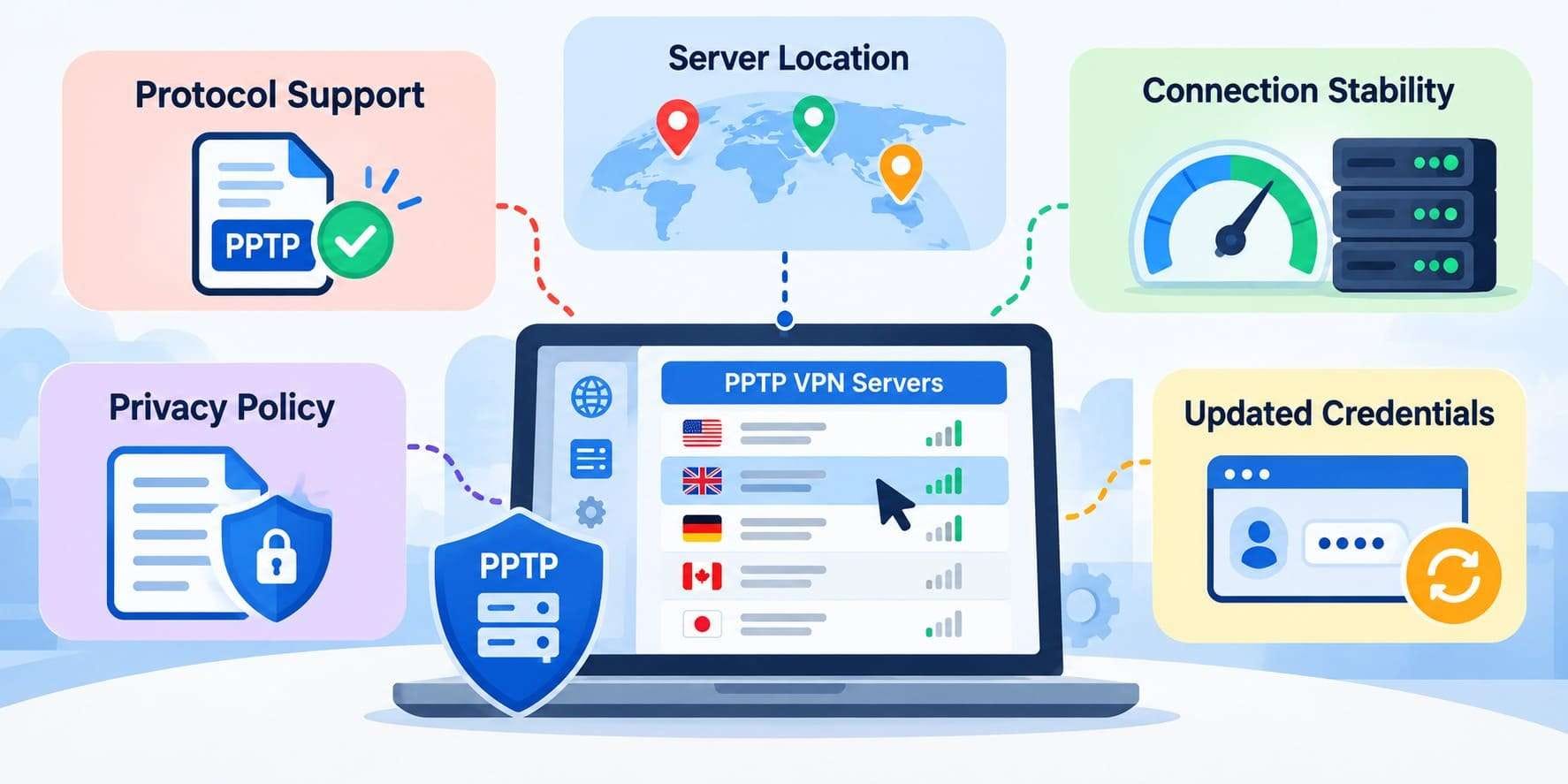
- Protocol Support: Verify that the server supports PPTP rather than only OpenVPN or WireGuard. Check the provider's official website for supported protocols.
- Server Location: Select a server in the country matching your preferred IP-based location. Remember that some websites detect and block VPN connections.
- Connection Stability: Compare available servers based on connection speed, reliability, and disconnections to find one that performs consistently.
- Privacy Policy: Review what connection information the provider collects and how long it retains those records. Check VPNBook's privacy information as an example.
- Updated Credentials: Always obtain current server addresses, usernames, and passwords from the provider's official website instead of relying on outdated third-party lists.
Part 3. How to Set Up a Free PPTP VPN on Windows 10 and Windows 11
Setting up a PPTP VPN on Windows 10 or Windows 11 is straightforward because both versions include a built-in VPN client. You only need a working server address and valid login credentials to establish the connection. Although the Settings menus differ slightly, the overall process remains similar. Follow Microsoft's official VPN setup guide and the instructions below to configure your PPTP connection:
-
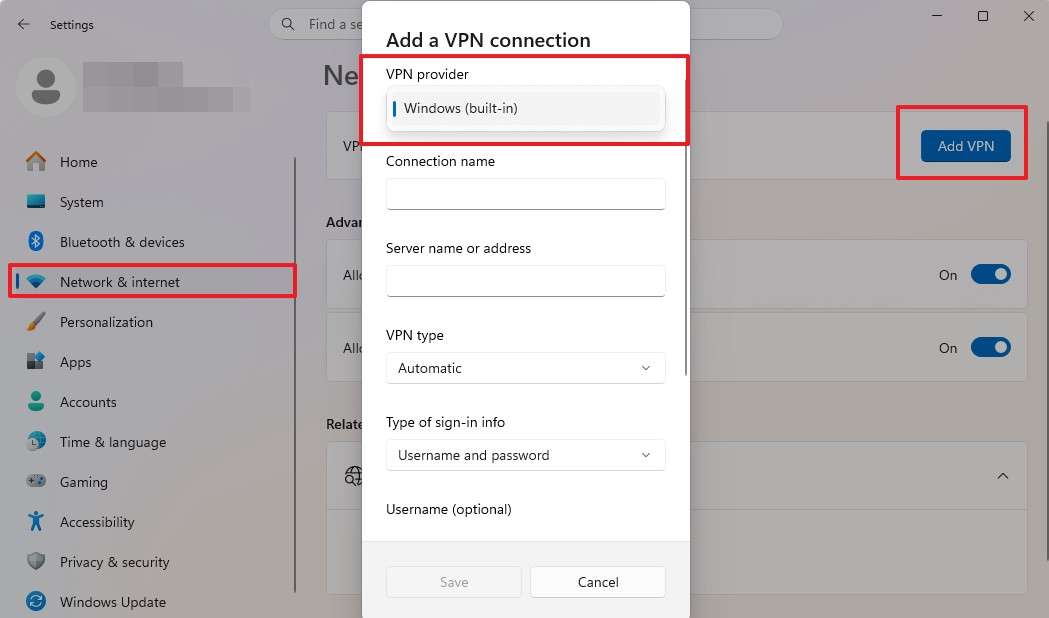
Step 1 Open the VPN Settings and Add a New Connection
Open "Settings > Network & Internet > VPN" and select "Add VPN" on Windows 11 or "Add a VPN connection" on Windows 10. Choose "Windows (built-in)" under "VPN provider." Enter a connection name and a verified server address, such as pl134.vpnbook.com.
-
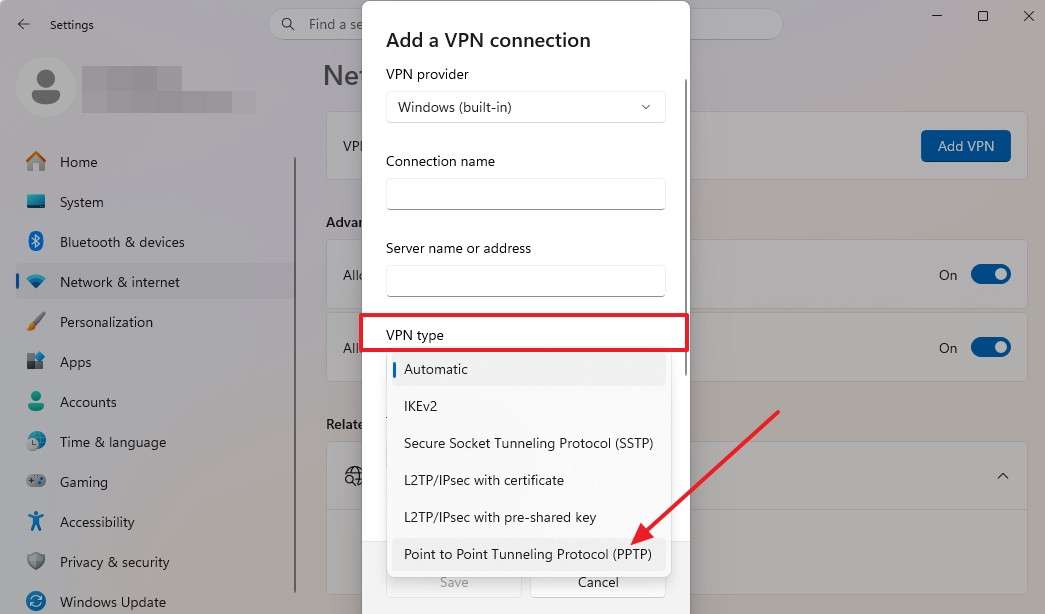
Step 2 Select PPTP as the VPN Type
Under "VPN type," choose "Point to Point Tunneling Protocol (PPTP)" from the dropdown menu.
-
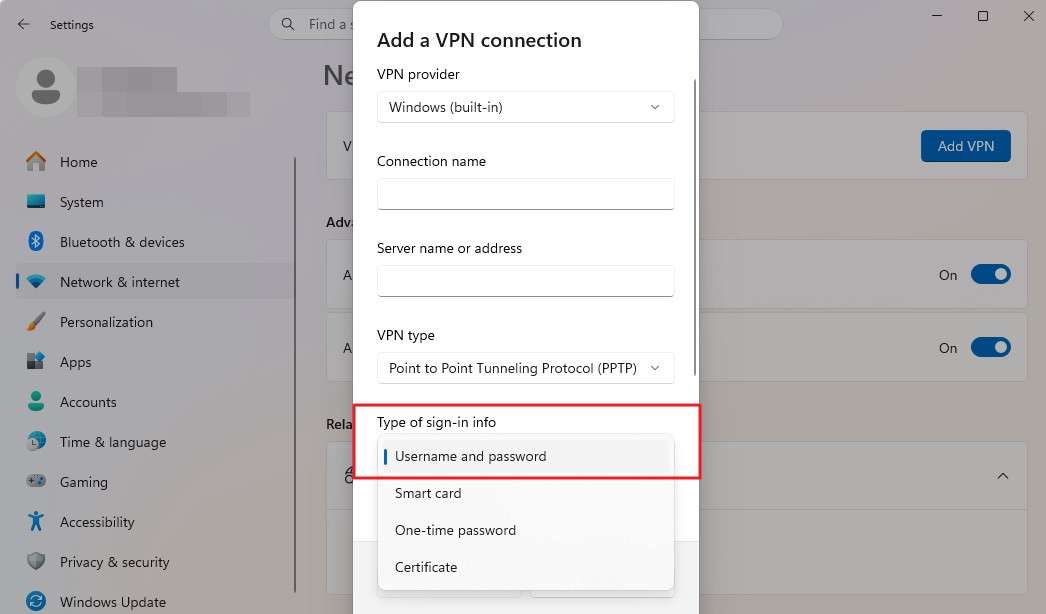
Step 3 Enter Your Login Credentials and Connect
Set "Type of sign-in info" to "Username and Password," then enter your current VPN credentials. Select "Remember My Sign-in Info" if preferred, and click "Save." Choose "Connect" and verify the connection status. Visit an IP-checking website to confirm your public IP has changed.
To Disconnect: Open "Settings > Network & Internet > VPN," select your VPN connection, and click "Disconnect." On Windows 11, you can also disconnect through the VPN option in Quick Settings.

Can You Use a Free PPTP VPN on Android or iPhone?
Most modern smartphones no longer support PPTP through their built-in VPN settings. Android 12 and later lack native PPTP support, while Apple discontinued the protocol with iOS 10 and macOS Sierra.
For a safer PPTP VPN alternative, choose a reputable VPN provider supporting WireGuard, OpenVPN, or IKEv2/IPsec. Avoid downloading PPTP apps from untrusted websites, as VPN software can handle your internet traffic and potentially expose sensitive information.
Part 4. Is a Free PPTP VPN Safe to Use in 2026?
PPTP remains available as a free VPN for PC, but built-in Windows support does not guarantee security. Microsoft confirms that attackers can recover credentials from captured MS-CHAPv2 authentication exchanges. PPTP connections using MPPE rely on outdated RC4 encryption with 40-bit, 56-bit, or 128-bit session keys. Microsoft announced PPTP deprecation in 2024, and new Windows Server 2025 RRAS configurations no longer accept PPTP connections by default.
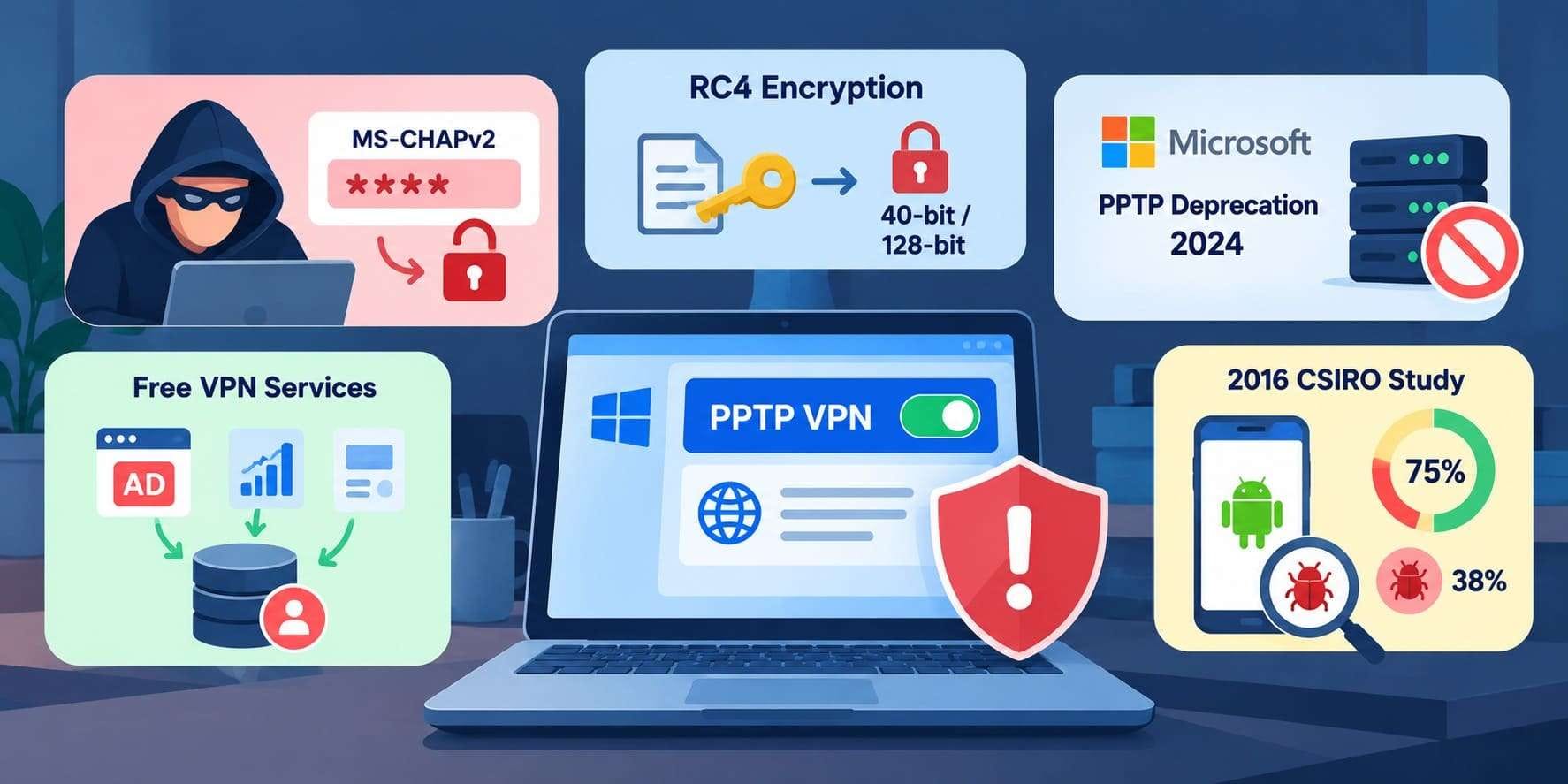
Free VPN services also need revenue, which some generate through advertising, analytics, or data collection. A 2016 CSIRO-led study examined 283 Android VPN apps and found tracking libraries in 75% of privacy-focused apps. Researchers also detected malware indicators in at least 38% of tested apps. These historical findings don't represent every modern provider, and paying for PPTP cannot eliminate its security vulnerabilities.
Free PPTP VPN vs Modern Free and Paid VPN Services
If you're wondering "Is PPTP Safe," the biggest difference lies in encryption, privacy, and device compatibility. Modern free and paid VPNs use stronger security protocols, while PPTP relies on outdated protection. However, performance, server availability, and privacy policies still vary between providers. The following comparison helps you choose the right option:
| Factor | Free PPTP VPN | Modern Free VPN | Modern Paid VPN |
|---|---|---|---|
| VPN Protocol | PPTP | WireGuard, OpenVPN, or IKEv2 | WireGuard, OpenVPN, or IKEv2 |
| Encryption and Authentication | RC4-based MPPE, commonly with MS-CHAPv2 | Modern authenticated encryption | Modern authenticated encryption |
| Privacy and Logging | Depends on provider | Policies vary; audits less common | Policies vary; some independently audited |
| Server Availability | Often limited shared servers | Restricted server locations | Wider global server networks |
| Connection Speed | Depends on congestion | Sometimes speed-restricted | Often fewer speed restrictions |
| Bandwidth Limits | Depends on provider | Limited or unlimited, depending on service | Generally unlimited |
| Windows Support | Built-in PPTP client | Provider apps or manual setup | Provider apps and manual setup |
| Android and iOS Compatibility | No native PPTP support | Compatible provider apps | Compatible provider apps |
| Advanced Features | Usually minimal | Basic protection, limited extras | Often kill switch, split tunneling, and specialty servers |
| Customer Support | Often limited | Self-service or limited support | Frequently live chat or email |
| Best Use Case | Legacy compatibility and IP testing | Basic browsing with limited needs | Daily use, travel, and broader server access |
Modern free and paid VPNs can offer equally strong encryption, but paid services generally provide more servers, fewer restrictions, and additional privacy features. Free VPNs suit basic browsing when offered by trustworthy providers. Before choosing, check logging policies, security audits, and available features through Privacy Guides.
What Are the Best Free PPTP VPN Alternatives?
If you're looking for a free VPN for PC, WireGuard, OpenVPN, and IKEv2/IPsec offer stronger security than outdated PPTP connections. These modern protocols support secure encryption and are widely used by reputable VPN providers. Here's how they compare:
- WireGuard: A lightweight VPN protocol known for fast connections and efficient performance. It uses modern cryptography, including ChaCha20, to protect network traffic.
- OpenVPN: An open-source VPN protocol that supports strong encryption, including AES-GCM. It works across multiple platforms and is supported by many free and paid VPN services.
- IKEv2/IPsec: A secure VPN solution that uses IKEv2 to negotiate IPsec connections, as documented in RFC 7296. It supports Windows, iOS, and Android, with efficient reconnection when switching networks.
All three require a compatible VPN server or service provider. For everyday browsing, choose a reputable provider offering one of these protocols, a transparent privacy policy, and reliable security practices.
Part 5. Can a Free PPTP VPN Bypass Geo-Restrictions?
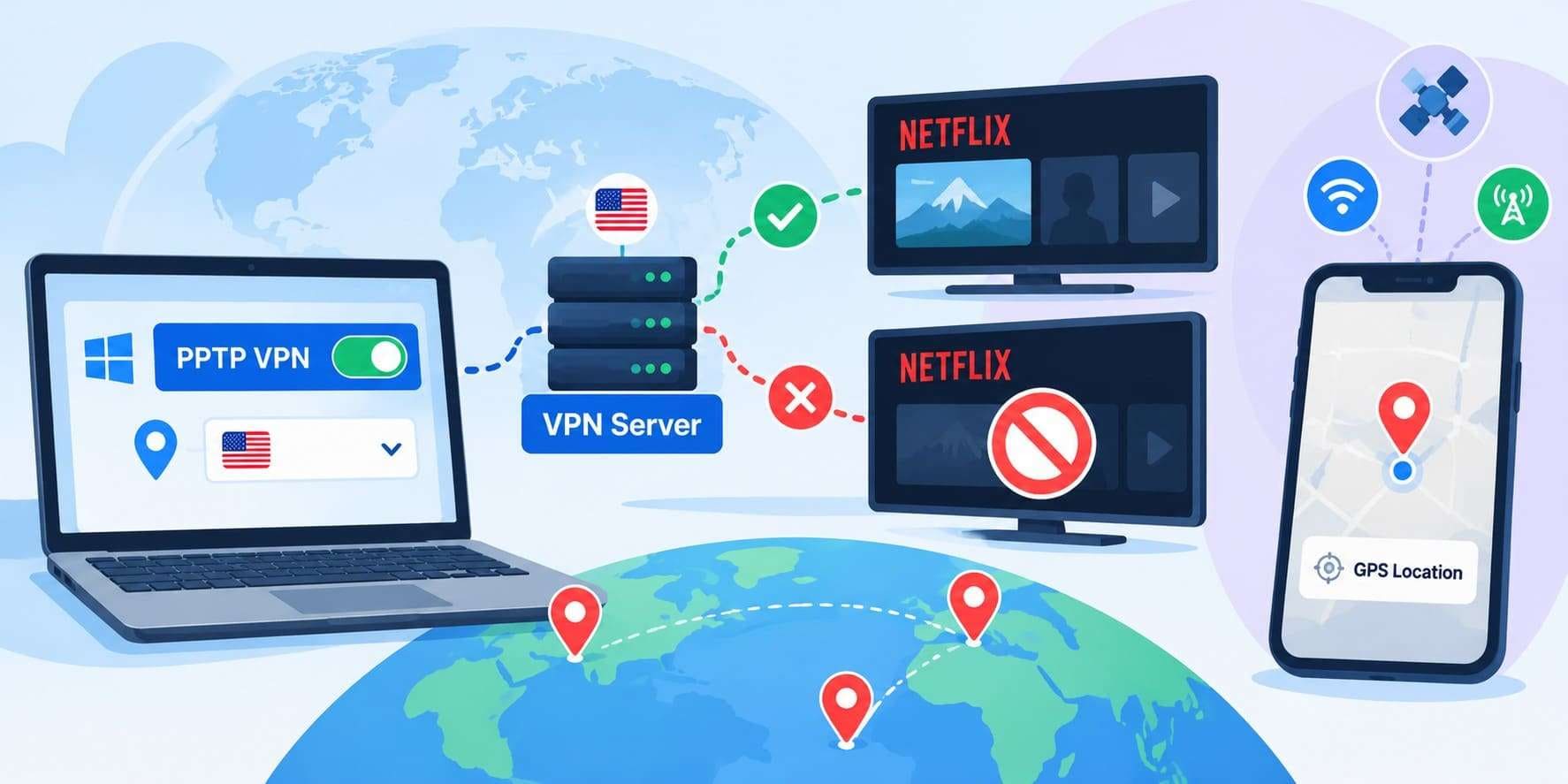
A bypass GEO restriction VPN changes the public IP address websites use to identify your approximate location. PPTP can provide this functionality by routing traffic through a server in another region. However, access is not guaranteed, as streaming platforms like Netflix can detect VPN connections and restrict certain content.
A VPN does not change your smartphone's GPS coordinates. Location-based apps can use GPS, Wi-Fi networks, cellular signals, and account settings to determine your position. According to Google's location documentation, Android combines multiple signals to estimate device location.
IP-Based vs GPS-Based Geo-Restrictions: What's the Difference?
A free PPTP VPN changes your IP-based location, but it cannot directly modify GPS coordinates, browser location permissions, or account settings. The table below explains how different location signals work, whether a VPN affects them, and which alternatives are suitable.
| Location Restriction | How It Works | Can a VPN Change It? | Suitable Approach |
|---|---|---|---|
| Public IP Address | Websites estimate location using your public IP | Yes | Use a modern VPN |
| Smartphone GPS Location | Apps access GPS-based device coordinates | No | GPS simulation for supported apps |
| Browser Geolocation | Browsers use device location with permission | Sometimes, if IP-based | Manage permissions or device location |
| Wi-Fi and Cellular Location Signals | Nearby networks and cell towers help estimate location | No, not directly | Location simulation, with limitations |
| Account or Billing Region | Services check registered country or billing details | No | Update account settings where permitted |
| Combined Location Verification | Services compare IP, GPS, and other location signals | Partially | Address each location signal where permitted |
Pro Tip. How to Change GPS Location Without a VPN Using Dr.Fone - Virtual Location
A PPTP VPN alternative can protect your internet traffic and change your public IP address, but it cannot modify your phone's GPS location. For apps that rely on GPS coordinates, Dr.Fone - Virtual Location offers a practical solution. This virtual location tool lets you simulate a different GPS location on a compatible iPhone or Android device without physically traveling.
With Teleport Mode, you can instantly switch to a searched location. The One-Stop Route and Multi-Stop Route modes also simulate movement along selected routes, with adjustable speeds up to 67 mph. Unlike a VPN, Dr.Fone does not change your public IP address or encrypt network traffic. You can use both tools together when needed, although location-based services can still detect inconsistencies or restrict simulated locations.
 Set your map route to simulate GPS movement.
- Set your wanted movement speed.
- HD and large map view to check location.
- Fake GPS location to anywhere.
Tutorial to Change Your GPS Location with Dr.Fone - Virtual Location
Unlike a free PPTP VPN, Dr.Fone - Virtual Location lets you simulate GPS coordinates instead of changing your public IP address. The following 3 steps demonstrate how to change your GPS location on an iPhone and restore your actual position afterward:
-
Step 1 Attach the Device and Approve the Setup Prompts
From the "Toolbox" tab, select "Virtual Location," plug in the phone, and tap "Get Started." For iOS, choose the "No Device" option, select your iPhone, and tap "Next" to continue. Once the window shows that the device is trying to connect, follow the instructions to enable "Developer Mode."

-
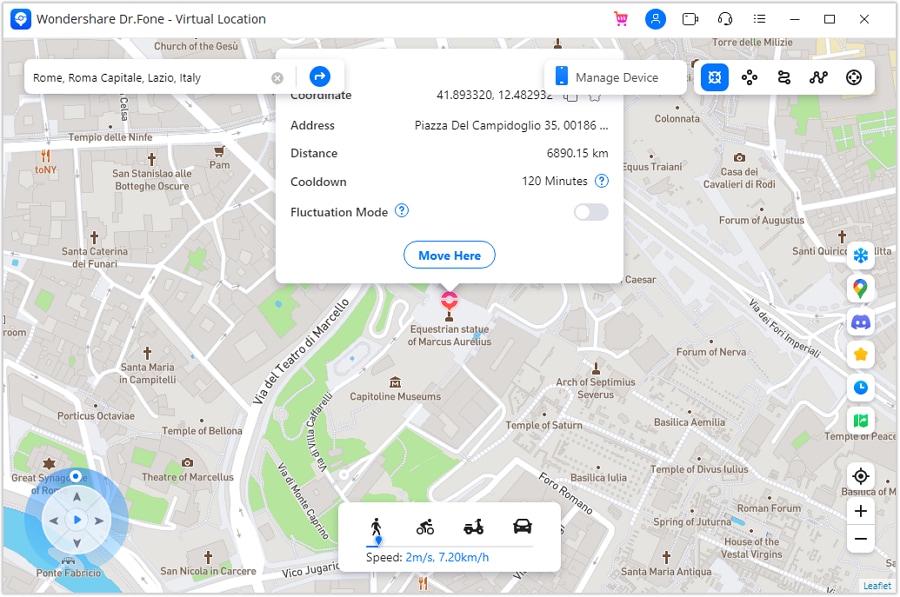
Step 2 Choose New Coordinates in Teleport Mode
Select "Teleport Mode" from the upper-right icons and enter your desired location in the search bar. Press "Enter," verify the location pin on the map, and click "Move Here" to update your iPhone's GPS position.
-
Step 3 Verify the New Location and Restore Your Real GPS
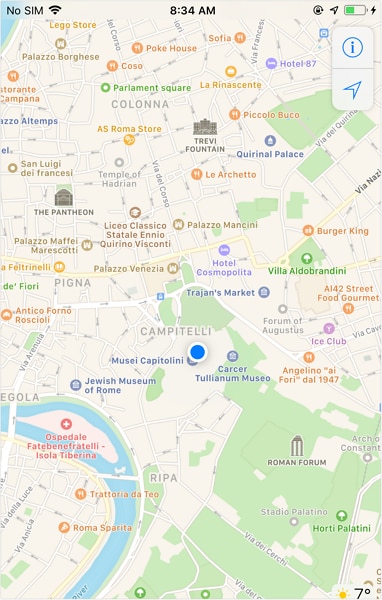
Open a maps app on your iPhone to confirm the new GPS location. Once finished, close the Virtual Location window and select "Restart Device" when prompted. Your iPhone will restart and restore its actual GPS position.
Conclusion
A free PPTP VPN can change your public IP address through Windows' built-in VPN settings, but its outdated encryption and authentication create serious security risks. Shared servers and connection logging also raise privacy concerns. For safer browsing, banking, or work, choose a reputable VPN provider supporting WireGuard, OpenVPN, or IKEv2/IPsec.
However, a VPN cannot change your smartphone's GPS coordinates. For location-based apps, Dr.Fone - Virtual Location offers a separate solution to simulate GPS movement and restore your actual location afterward on compatible devices.




Frequently Asked Questions
-
1. Why does a PPTP VPN connection show Error 806 or 807 on Windows?
According to Microsoft's VPN error codes, Error 806 indicates that a firewall or router is blocking GRE traffic required for PPTP. Check firewall settings or enable PPTP passthrough. Error 807 indicates an interrupted VPN connection, potentially caused by network instability, server issues, or latency. Try reconnecting or switching servers. -
2. Can you configure a free PPTP VPN directly on a Wi-Fi router?
Yes, some Wi-Fi routers support PPTP through their built-in VPN clients. For example, TP-Link's VPN Client supports PPTP configurations using a server address, username, password, and encryption settings. Compatible models also let you select which connected devices use the VPN tunnel. However, PPTP remains insecure, even when configured directly on a router. -
3. Can a PPTP VPN leak DNS requests even when the connection is active?
Yes, DNS leaks can occur when requests bypass the VPN tunnel and reach your regular network's DNS servers. Windows' smart multi-homed name resolution can send DNS queries across multiple network interfaces. Run a DNS leak test after connecting, and check whether unexpected ISP DNS servers appear in the results.
 Add Wondershare Dr.Fone as a preferred source on Google