 Teleport your device anywhere instantly with one click.


 100% Security Verified | No Subscription Required | No Malware


 :

 ChatGPT
 Perplexity
 Gemini
 Claude
 Grok
A hardware VPN is a router or security appliance that establishes VPN tunnels for traffic routed through it. That can simplify a home or office deployment, but buying the box alone does not provide a commercial VPN subscription. A gateway configured for remote access to your office also serves a different purpose from a router configured as a client of an internet privacy service.
For a useful VPN hardware comparison in 2026, look beyond an attractive marketplace price: check firmware support, the required VPN role, encrypted throughput, and client compatibility. The eight devices below retain the original review's lineup and order. Several are legacy products, so this is a specification comparison rather than a claim that all eight remain sensible new purchases. The alternative section explains when existing computers, phones, or a compatible router may be enough.
Part 1. Eight VPN Hardware Devices: Features and Buying Limits
Start with the exact model and hardware revision, not the brand name alone. Gigabit Ethernet describes a physical link rate; it does not promise gigabit VPN transfers. Likewise, a firewall session, an IPsec tunnel, and a licensed remote user are different capacity measures. Check those figures separately before selecting hardware VPN for home use or a small business.
Price and warranty context: Dollar amounts below are historical references carried over from the earlier article, not verified 2026 offers. Availability, subscriptions, regional warranties, and second-hand transfer rights need a fresh check. An Amazon hardware VPN listing is a place to inspect the seller's item, not proof of ongoing security maintenance.
1. Cisco RV325: Dual-WAN Connectivity for a Wired Office
The Cisco Systems Gigabit Dual WAN model linked in the original review is the RV325. Its main distinction is a relatively large wired port count combined with two internet connections. That design suits an office layout where many endpoints need Ethernet and administrators want a backup uplink.
- Ports and continuity: Fourteen Gigabit LAN ports sit alongside dual Gigabit WAN connectivity, with load-balancing and failover options.
- Tunnel roles: Site-to-site IPsec and SSL VPN functions address branch and remote-worker access; they should not be confused with an included consumer VPN account.
- Administration: A browser-based wizard and SPI firewall help with configuration and traffic policy. User management is not, by itself, an employee-productivity measurement system.
- Speed interpretation: The earlier 100 Mbps description should not replace the Gigabit port specification. Actual encrypted performance depends on tunnel settings and traffic.
2026 buying limit: The RV325 has passed the final support milestone in Cisco's model-specific lifecycle notice. It should not be presented as a currently supported new deployment choice. The older article's $172 reference and 90-day warranty note do not establish today's price or service entitlement.
Original marketplace listing: Buy it here

2. Zyxel ZyWALL 110: Separate Tunnel Capacity from Firewall Sessions
The Zyxel Next Generation VPN Firewall entry points to the ZyWALL 110. Its office-oriented feature set focuses on remote connectivity and connection resilience. Read the model-specific table rather than treating every ZyWALL family member as the same appliance.
- Capacity: Published specifications distinguish 100 concurrent IPsec tunnels from 60,000 concurrent sessions. The latter is not a claim that 60,000 people can open separate VPN tunnels.
- Performance: The historical figures are 300 Mbps AES VPN throughput and 1 Gbps SPI firewall throughput under vendor test conditions, not guaranteed application speeds.
- Resilience: Dual-WAN fallback and failover provide an alternate path when the main connection fails.
- Remote access: The original feature set includes SSL VPN, IPv6, and L2TP-related mobile access. Current client support still depends on the device's firmware and operating system.
- Cryptography: Do not repeat the old 'SHA-3 encryption' claim. Zyxel's family datasheet refers to SHA-2; SHA algorithms provide hashing or integrity functions rather than the encryption cipher itself.
The manufacturer's ZyWALL 110/310/1100 datasheet separates the family members' capacities. The earlier $450, $950, and $1,350 references are neither current quotations nor evidence that a ZyWALL 110 can simply be licensed to the other quoted tunnel counts. Confirm the exact model, lifecycle status, and regional coverage instead of assuming the old two-year warranty note still applies.
Original marketplace listing: Buy it here

3. GL.iNet GL-AR150: A Compact Travel-Router Design
The GL.iNet GL-AR150 Mini Travel Router takes a different approach from an office firewall: portability and USB power matter more than a large port bank. It illustrates how a small router can handle VPN configuration for a travel setup, but its age matters when assessing a purchase.
- Physical design: One WAN connection, one LAN connection, USB, and a Micro USB power input fit a small travel-oriented enclosure.
- Hardware: GL.iNet's documentation lists 64 MB DDRII memory, 16 MB flash, and a weight of approximately 39 g.
- Power: A suitable USB supply may come from an adapter, computer, or power bank, provided it meets the unit's input requirements.
- VPN software: OpenVPN and Tor-related functions are firmware-dependent. Compatibility with VPN providers does not mean that twenty paid subscriptions are included, and Tor is not another name for a VPN.
2026 buying limit: GL.iNet lists the GL-AR150 among its discontinued products with ended support. Its old $22 reference is not a current deal recommendation. Use the official hardware documentation to identify an existing unit, and assess supported equipment for a fresh internet-facing installation.
Original marketplace listing: Buy it here
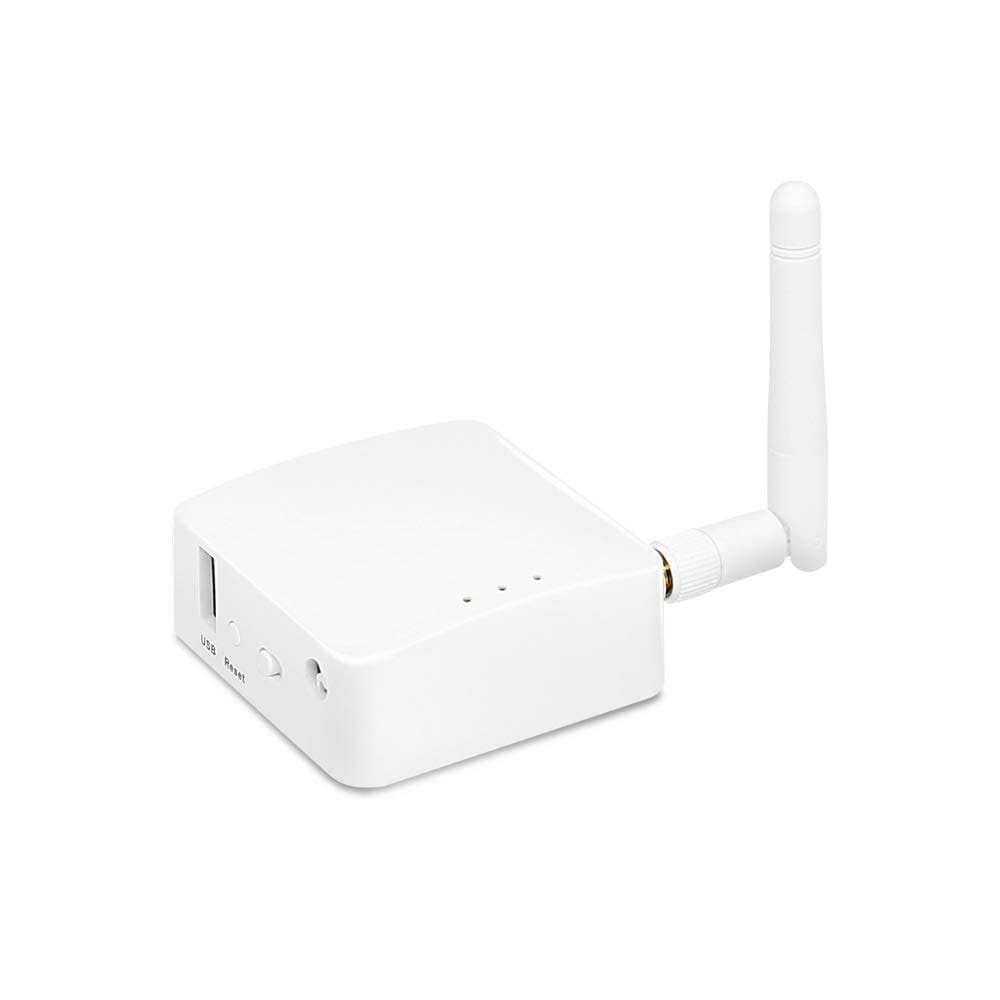
4. UTT HiPER 518: A Budget Dual-WAN Gateway with Fast Ethernet Limits
The UTT HiPER 518 targets a small network that needs basic routing controls and two broadband uplinks. Its quick-configuration approach may reduce the initial setup burden, but the original 10/100 Mbps model must not be confused with similarly named Gigabit revisions.
- Connection backup: The dual-WAN design allows load distribution or a main-and-backup internet arrangement. 'Real-time backup' here concerns connectivity, not automatic backups of personal files.
- Network controls: NAT, firewall policies, access restrictions, and IP/MAC binding address gateway administration.
- VPN capacity: The earlier listing describes five tunnels. Confirm the exact firmware's protocol support and simultaneous-connection limits before building a remote-access plan.
- Wired ceiling: Its 10/100 Mbps WAN and LAN connections, including auto-negotiation and auto-MDI/MDIX, cannot provide Gigabit Ethernet. A 100 Mbps forwarding reference is not an encrypted-throughput promise.
Purchase check: The $40 amount and one-year warranty were earlier listing references. Establish the manufacturer's current support position, return policy, and revision before relying on this older hardware VPN. The HiPER 518's low historical price is not enough to determine its total deployment cost.
Original marketplace listing: Buy it here

5. SonicWall TZ300: Check the Appliance Variant and Security Licenses
The device described as the Dell Sonicwall TZ300 belongs to an older SonicWall security-appliance family. It combines VPN access with gateway security functions, which makes the firmware, client, and subscription details as important as the hardware itself.
- VPN methods: IPsec and SSL VPN address different remote-access arrangements. Neither removes the need to verify a compatible client for Windows, macOS, or Android.
- Security services: Antivirus, antispyware, and intrusion-prevention features depend on the appropriate service entitlements and support conditions; they are not automatically a lifetime benefit of a used box.
- Interfaces: USB functionality has to be checked against the exact appliance and supported use case rather than assumed to be another universal network port.
- Setup: Firewall rules, user access, and tunnel parameters need deliberate configuration. The wireless-AC wording in the original purchase URL is a reason to check the SKU, not to assume every TZ300 variant is identical.
2026 buying limit: The regular TZ300 and TZ300W variants have passed their final support dates in SonicWall's lifecycle table. Do not substitute the separate TZ300P timeline. The earlier $554 figure does not confirm a supported appliance, active licenses, or a current retail price.
Original marketplace listing: Buy it here

6. Linksys LRT224: Dual WAN Does Not Mean Gigabit VPN Speed
The Linksys Business Dual WAN VPN Router entry corresponds to the LRT224. This small-office design combines a wired gateway, remote access, and site-to-site connectivity. Its specifications are a useful example of why different throughput numbers must stay separate.
- Ethernet: Gigabit interfaces describe a 1,000 Mbps link rate, not the encrypted performance of a tunnel.
- Published throughput: Linksys lists 110 Mbps for IPsec and 900 Mbps for firewall traffic. Both are vendor specification figures rather than measurements from this article.
- Connection capacity: The family supports up to fifty IPsec tunnels and five OpenVPN tunnels. OpenVPN access is not limited exclusively to phones, even though iOS and Android clients are highlighted.
- Uplink options: The LRT224's two-WAN configuration provides failover and load balancing for supported arrangements.
The Linksys LRT214/LRT224 datasheet provides the model comparison. Treat the older $165 reference as background only, and check firmware availability, client requirements, and remaining support before considering this legacy hardware.
Original marketplace listing: Buy it here
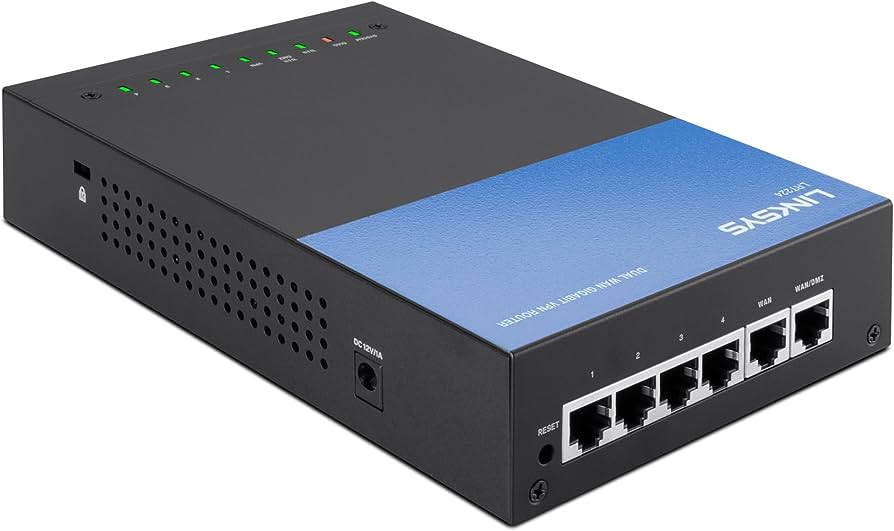
7. D-Link DSR-250: An Eight-Port Layout with a Critical Lifecycle Limit
The D-link 8-port Gigabit VPN Router in the original list is the DSR-250, not the newer DSR-250v2. Its wired design combines local switching and remote-access features. That historical feature list must be read alongside the original model's support status.
- Local network: Eight Gigabit LAN connections and a Gigabit WAN interface suit a wired small-office layout; the Green Ethernet features concern power management, not VPN security.
- Remote connections: Original specifications describe IPsec, PPTP/L2TP, and up to five SSL VPN tunnels. GRE availability and tunnel counts must be matched to the firmware and revision rather than added together as a guaranteed user capacity.
- Administration: Browser-based configuration and filtering controls address access policy. Dynamic content-filtering services may have separate entitlement or availability conditions.
- Protocol choice: A legacy protocol appearing in a specification is not a recommendation to deploy it. Avoid PPTP for a new security-sensitive setup, and remember that GRE alone does not encrypt traffic.
2026 buying limit: D-Link's North American end-of-service advisory covers the original DSR-250 across hardware revisions and recommends migration. The old $130 reference and 'limited lifetime warranty' wording must not be read as a promise of ongoing firmware fixes or current coverage.
Original marketplace listing: Buy it here
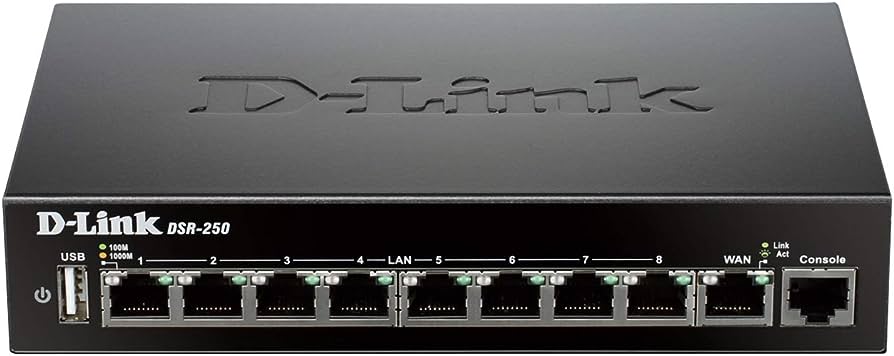
8. TP-Link TL-R600VPN: Match SafeStream Features to the Revision
The TP-Link SafeStream entry links to the TL-R600VPN. Hardware revisions matter: a port layout or VPN feature from one revision should not silently be applied to every unit sold under the same product name.
- Connections: The earlier layout provides one Gigabit WAN port and four Gigabit LAN ports. Later documentation also describes configurable WAN/LAN interfaces, so inspect the label before planning the network.
- Tunnels: The legacy specification lists twenty IPsec tunnels and sixteen PPTP tunnels. Capacity is separate from the security suitability of those protocols.
- Cryptography: The listed algorithms include AES-128/192/256 alongside legacy DES, 3DES, MD5, and SHA-1 options. Those older choices should not be described as uniformly advanced or selected merely because the router exposes them.
- Administration: Manual or IKE key management, SPI inspection, and denial-of-service defenses are part of the original gateway feature set. They do not guarantee protection from every attack.
TP-Link's TL-R600VPN revision-specific datasheet helps distinguish the older configuration. The $57 figure and one-year warranty note are historical references, not verified current terms. Check regional firmware support and choose mutually supported, appropriate VPN settings before deployment.
Original marketplace listing: Buy it here

Part 2. Alternative: Run a VPN on Equipment You Already Have
A separate appliance is not essential when the goal is a VPN connection on a computer, phone, or television. A provider's app may cover a single device, while a compatible router acting as a VPN client can route selected network traffic through that provider. Check actual client support: a router advertising 'VPN passthrough' or a VPN server is not automatically able to connect to the commercial service you choose.
The original article links to NordVPN as a software-service alternative. Its current documentation changes some of the older comparison points:
- Account allowance: Official support describes up to ten simultaneous device connections, subject to its server and protocol conditions, rather than the six stated in the previous version. A compatible router connection uses one account slot.
- Platforms: Windows, macOS, Linux, Android, and iOS have app options; Android TV also has a documented app setup. Router installation depends on supported firmware and protocols, not just having a router.
- Assistance: The provider advertises round-the-clock live-chat and email support. This is separate from the hardware manufacturer's maintenance policy.
- Subscription cost: Check the current plan, billing period, renewal terms, and taxes. The old roughly $3 monthly figure is not a current quotation, and the original references to CNN or BuzzFeed do not establish that either is a current business customer.
Check the provider's simultaneous-device policy, Android TV instructions, and support options before paying. Select the app or supported router-client setup that matches the devices you need, then verify the connection. For office-to-office tunnels, evaluate a maintained gateway and a compatible endpoint instead of assuming a consumer app replaces that architecture.
The practical choice is therefore about deployment, not just a box versus an app: identify which traffic needs a tunnel, where that tunnel must terminate, and who will maintain it. Keep the eight original listings as references, but weigh support and total ownership cost before making a purchase.
Wondershare Dr.Fone: GPS Positioning Is Separate from VPN Protection
A different location-related task is changing a phone's GPS position. The Dr.Fone toolkit includes Virtual Location for that purpose. This is a separate option for GPS-related needs, not a ninth VPN hardware device or a substitute for the VPN service discussed above.
 Set your map route to simulate GPS movement.
- Set your wanted movement speed.
- HD and large map view to check location.
- Fake GPS location to anywhere.

Dr.Fone - Virtual Location changes GPS coordinates on supported iOS and Android devices and can simulate movement along a chosen map route with adjustable speed. Those are location-simulation functions: they do not create an encrypted network tunnel or change the public IP address in place of a VPN.
Use it only when the task concerns the device's GPS location, and check compatibility for your specific phone and operating system. If the requirement is network encryption, an IP-based connection location, or secure access to an office network, choose an appropriate VPN arrangement instead. GPS simulation does not guarantee that an app will disregard its other location checks or usage rules.




Conclusion
Choose a hardware VPN by its supported tunnel role, encrypted performance, and maintenance status, not an old marketplace price or the Gigabit label on its ports. The original eight devices show different office and travel designs, but legacy equipment needs careful lifecycle checks. A VPN app or compatible existing router may avoid a dedicated purchase when it fits the requirement. Keep GPS simulation separate: Dr.Fone - Virtual Location addresses device coordinates, while a VPN addresses network traffic.
FAQ
-
1. What is the difference between VPN hardware and VPN software?
A hardware VPN runs tunnel functions on a router or security appliance. A software VPN runs on an endpoint or other compatible equipment. Coverage depends on configuration: only traffic routed through the relevant tunnel is covered. Hardware does not automatically include a paid VPN service. -
2. Does a Gigabit VPN router deliver Gigabit VPN throughput?
Not necessarily. Gigabit describes an interface's link rate. Encryption, processor limits, protocol choice, and enabled inspection can reduce tunnel throughput. For example, the Linksys LRT224 specifications distinguish 110 Mbps IPsec throughput from 900 Mbps firewall throughput. -
3. Should I buy one of these older VPN devices for home use in 2026?
Check the exact revision and current security-maintenance status first. Some original models listed here are beyond manufacturer support. Historical prices and warranty descriptions are not current offers. A maintained appliance or compatible software solution is a better starting point than an unsupported bargain. -
4. Can Dr.Fone - Virtual Location replace a VPN?
No. It changes supported devices' GPS coordinates and can simulate GPS movement. It does not replace a VPN's encrypted tunnel or public-IP routing. Match the tool to the requirement, and do not assume that changing GPS coordinates changes every location signal an app uses.
 Add Wondershare Dr.Fone as a preferred source on Google



