 Teleport your device anywhere instantly with one click.


 100% Security Verified | No Subscription Required | No Malware


 :

 ChatGPT
 Perplexity
 Gemini
 Claude
 Grok
When your iPhone location is wrong, start by asking what is wrong: the current-position marker, an app's last displayed location, or a saved address. These are different problems. A disabled location setting can stop an app obtaining a fresh position, while an incorrect saved Home address can remain wrong even when the phone knows exactly where you are.
Before relying on directions, check location access, connectivity, and software versions. The four causes and four remedies below keep the original troubleshooting sequence but explain how to verify each result. A phone map is a useful navigation aid, not a guarantee of the safest route or a reason to ignore road conditions.
In this article
Part 1: Why Your iPhone May Show the Wrong Location
Location information can come from several signals and pass through several permission checks before an app displays it. First compare the affected app with Maps while you are in the same place. If only one app is wrong, investigate that app's access or data. If multiple apps are wrong, start with the device-wide settings and connection.
Reason 1: Location Services Is Turned Off
Location Services is the iPhone's main control for giving applications location information. If it is disabled, an app may be unable to obtain a fresh position or may display a previous result. That is different from the GPS receiver proving that you are somewhere else.
Check this switch before trying advanced resets. A previous privacy change may have turned it off intentionally, so consider which apps actually need access rather than enabling every location permission indiscriminately.
Reason 2: Connectivity Is Unreliable
An unstable cellular or Wi-Fi connection can interfere with map loading, address lookup, or refreshing an app's location display. The iPhone uses available GPS, Bluetooth, Wi-Fi, and cellular information to determine position; internet connectivity is not identical to GPS reception.
For that reason, a map that will not load and a location marker that is inaccurate are related but distinct symptoms. If the network is weak, test again on a stable connection and allow the app to refresh before deciding its reported position is still incorrect.
Reason 3: iOS May Need an Update
Older system software can contain bugs that later releases address. The original article accidentally described being fully updated as the cause; the useful check is whether a supported update is available, not whether the phone is already current.
Updating is a reasonable maintenance step, but it does not guarantee a cure. If the symptom began after an update, record when it started and which apps are affected instead of assuming that another download will necessarily solve it.
Reason 4: The App Does Not Have Suitable Permission
The main Location Services switch and an individual app's access are separate controls. Maps or another app can be denied permission even while location is enabled for the phone. An app allowed only approximate location may also behave differently from one allowed an exact position.
Look at the affected application's setting and decide what its task requires. Navigation generally needs more specific information than a broad local recommendation. Grant only the access appropriate to the app rather than treating unrestricted background access as the default fix.
Part 2: Four Ways to Address iPhone Location Accuracy Problems
Work through the following checks and reopen the affected app after each relevant change. Testing between changes makes it easier to identify what helped. Do not select an arbitrary replacement coordinate merely to make the map look right: that would conceal rather than diagnose a real-position problem.
Option 1: Enable Location Services and Review App Access
Begin with the privacy controls. Current iOS versions use Privacy & Security; older screenshots or instructions may call this menu simply Privacy.
Step 1 Open the location settings
Go to Settings > Privacy & Security > Location Services. On an older interface, use the equivalent Privacy menu.
Step 2 Check the main switch and application
Turn on Location Services if it is off. Open the affected app's entry, choose suitable access such as While Using the App, and enable Precise Location if that app needs your exact position. Return to the app and check its current-location control.
If you are trying to change your home address on iPhone, inspect the saved Home entry separately. Moving the live-location marker or granting permission does not rewrite a stored address. The same distinction applies when a Google Maps place or search result is wrong rather than the phone's own position.
Option 2: Install an Available iOS Update
Check for a supported update after the basic permissions. Preserve a recent backup and follow the phone's power and connection requirements before installing. Updates can include corrections, but they should not be advertised as preventing every future location error.
Step 1 Open General settings
In Settings, choose General and then Software Update.
Step 2 Review and install the offered release
If an update is available for your device, follow the on-screen installation process. After the phone restarts, reopen Maps and the affected application under comparable conditions to see whether the symptom remains.
Option 3: Update the Application That Displays the Wrong Position
A single outdated app may mishandle a location refresh even when the system's positioning is working. Open the App Store, inspect the available app updates, and install the relevant update if offered.
Then reopen that application, confirm its permission, and ask it to refresh the current position. Compare it with Maps again. If the two disagree, note the app name and what it displays before contacting its support team; this is more actionable than saying only that the entire iPhone location is wrong.
Option 4: Refresh the Existing Location Services Setting
If Location Services was already enabled but a stale result persists, a one-time off-and-on check can help you retest the setting. Do this while you are stationary and not depending on active navigation or another important location function.
Step 1 Return to Location Services
Open Settings > Privacy & Security > Location Services and confirm that you are changing the device-wide control, not a saved address.
Step 2 Toggle once and verify
If it is on, turn it off and then back on. Check the affected app's access again, reopen the app, and allow time for a fresh result. Stop repeating the toggle if nothing changes; investigate the specific app or broader device problem instead.
Reset Location & Privacy is a different, broader action that can require granting permissions again. It is not necessary merely to perform the switch check above. If you have been using a GPS simulator, also end that session and restore the real position before evaluating accuracy.
Dr.Fone - Virtual Location: Simulate a Position Without Confusing It With a Repair
 Set your map route to simulate GPS movement.
- Set your wanted movement speed.
- HD and large map view to check location.
- Fake GPS location to anywhere.

The product's map controls let a supported connected phone use a selected virtual position. Route and speed settings also support simulated movement. These features can help you test how a location-based application responds to a chosen point while keeping that experiment separate from real-world navigation.
Do not use a simulated pin to judge whether GPS accuracy has recovered. It is intentionally not your physical position, and individual applications may accept or reject it. Check the product's current support requirements and avoid active simulations when you need trustworthy directions or location sharing.
Step 1 Establish a supported connection
Open the desktop software, enter Virtual Location, and connect your own compatible iPhone. Complete the displayed device-connection prompts.
Step 2 Select a test point
Choose Teleport Mode, search for the intended place or coordinates, and inspect the map marker before confirming with Move Here.

Step 3 Compare the reported location
Open Maps on the phone and verify the selected virtual position. Test the relevant app separately; a correct simulated map result does not guarantee the same behavior in every service.
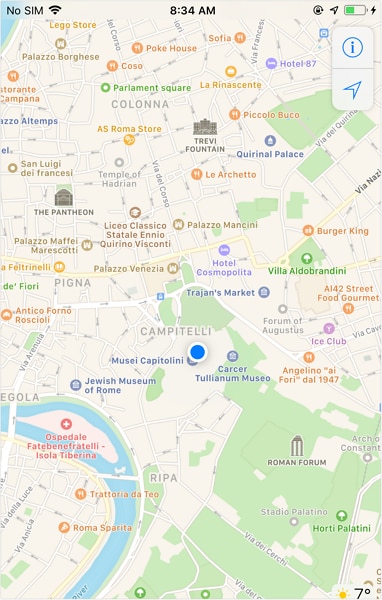
Step 4 Restore the actual position
When you finish, follow the software's restart-device prompt. Reopen Maps after the restart and assess the real position before resuming the accuracy checks above.
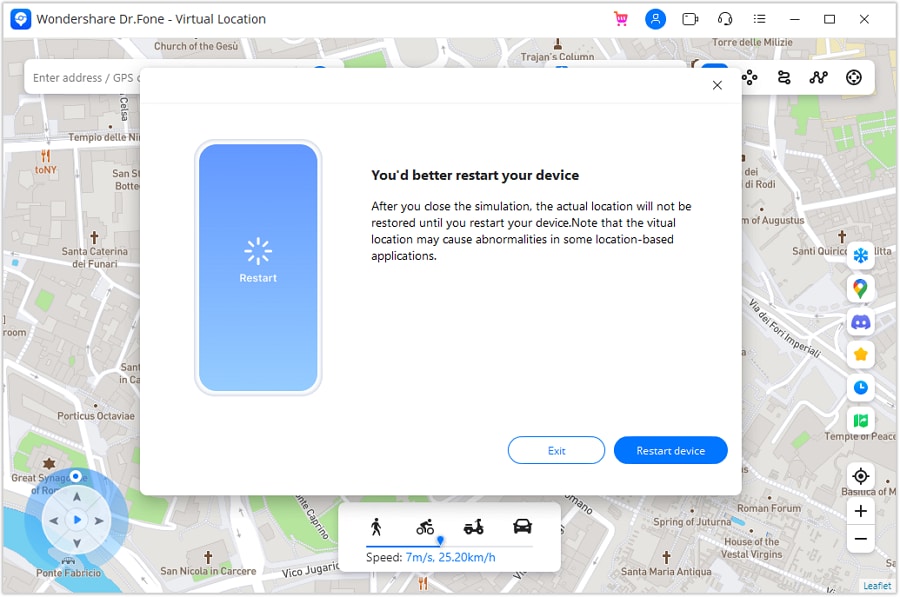
Keep a clear boundary between a planned location simulation and troubleshooting a wrong live position. Restore normal positioning before traveling or relying on a shared location.




Conclusion
For an incorrect iPhone position, verify Location Services, the app's permission, network access, and available updates in that order. Compare results after each change and separate current-position problems from saved-address mistakes. If the fault persists across apps, seek device-specific support instead of trusting an invented coordinate.
Dr.Fone - Virtual Location addresses intentional GPS simulation. It belongs in a controlled test, not in a claim that replacing your coordinates repairs the phone's ability to locate you.
FAQ
1. Where are location settings on iPhone?
Open Settings, then Privacy & Security, then Location Services. Older versions can show Privacy instead. Review the main switch and each affected app separately.2. Why is one app inaccurate while Maps looks correct?
That app may have different permissions, approximate rather than precise access, an outdated version, or stale data. Check those conditions before assuming the phone's GPS is faulty.3. Does fixing GPS also change my saved Home address?
No. A stored address is separate from the current-position reading. Edit the Home entry in the relevant map application if the saved destination is incorrect.4. Can a GPS simulator repair location accuracy?
No. It supplies an intentionally selected position for supported tests. End the simulation and restore the actual location before checking whether the phone can locate you correctly.
 Add Wondershare Dr.Fone as a preferred source on Google



