Teleport your device anywhere instantly with one click.

 100% Security Verified | No Subscription Required | No Malware

 :
: 
 ChatGPT
 Perplexity
 Gemini
 Claude
 Grok
Grok
I'm interested in testing location-based security protocols and AR games. Is HackRF One GPS spoofing still effective in 2026, and how do I set it up?
Tech Researcher & Cybersecurity Analyst

In the evolving landscape of 2026 technology, Global Positioning System (GPS) signals remain a fundamental pillar for everything from autonomous navigation to social media tagging. GPS operates through a constellation of satellites that transmit precise time-stamped signals; your smartphone or device calculates its coordinates based on the delay between these signals. However, since civilian GPS signals are unencrypted, they are susceptible to manipulation via Software Defined Radio (SDR) technology.
HackRF One has emerged as the premier entry-level hardware for exploring this domain. By using HackRF GPS spoofing, enthusiasts and researchers can generate and transmit their own simulated satellite signals to override local data. This guide provides an exhaustive technical breakdown of faking location using HackRF One, while also highlighting the most efficient software alternatives for those who prefer ease of use over complex hardware configuration.

In this article
Part 1. Deep Dive: What is HackRF One?
The HackRF One is a highly versatile Software Defined Radio (SDR) peripheral designed to bridge the gap between software and the radio spectrum. Unlike traditional radios that are hardwired to specific frequencies, the HackRF is programmable, allowing it to operate across a massive range from 1 MHz to 6 GHz. This makes it an all-in-one transceiver capable of interacting with Wi-Fi, Bluetooth, cellular networks, and most importantly, the GPS L1 band.
In the context of HackRF one GPS spoofing, the device acts as a micro-satellite transmitter. By connecting it to a computer, you can instruct it to broadcast custom data packets that mimic real GPS satellites. While this is a powerful educational tool for signal analysis and security testing, users must remain strictly compliant with local regulations, as unshielded broadcasting can disrupt critical infrastructure and emergency services.

Part 2. Step-by-Step Execution: GPS Spoofing with HackRF
Executing gps spoofing hackrf involves two main phases: generating a mathematical model of the satellite constellation (the simulation) and transmitting that model via the HackRF hardware. This process is favored by researchers due to its ability to fool the GPS receiver at the hardware layer, rather than just the software layer.
2-1. Required Technical Prerequisites
To ensure a successful simulation, you need a specific combination of open-source software and precise data files. Missing even one element can lead to a failure in location locking on your target device.
Essential Software Stack
- GPS-SDR-SIM: The core engine used to create the simulated GPS signal. It is available on GitHub.
- Broadcast Ephemeris (brdc): These are daily files containing the exact orbital parameters of current GPS satellites. You can source them from NASA CDDIS (requires a free account).
- HackRF Tools: Specifically `hackrf_transfer`, a command-line utility bundled with SDR software packages like PothosSDR or URH.
Essential Hardware
- HackRF One SDR: Preferably equipped with a TCXO (Temperature Compensated Crystal Oscillator) for better frequency stability.
- Processing PC: A Windows or Linux machine to run the signal generation commands.
- Mobile Device: An Android or iOS phone to receive and verify the spoofed coordinates.
2-2. Step-by-Step Command Process
Step 1 Environment Preparation
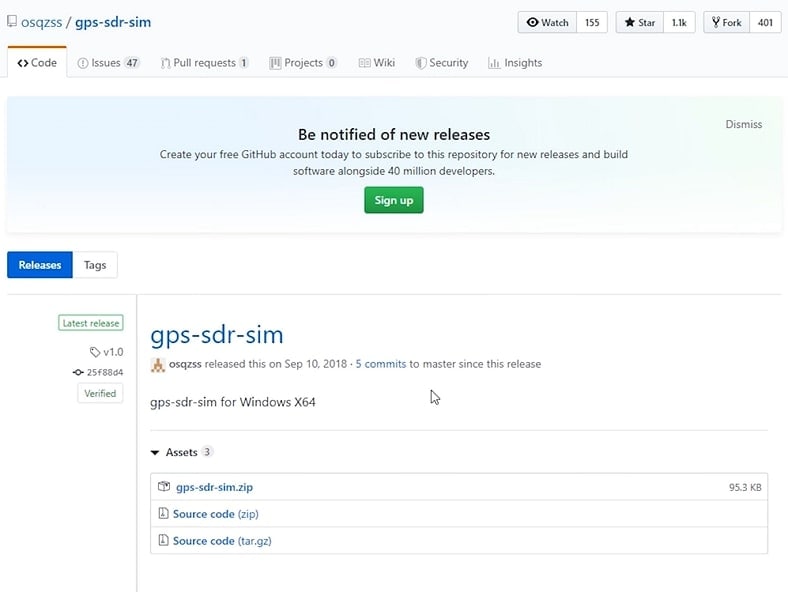
Download the GPS-SDR-SIM repository and extract it. Place your downloaded NASA ephemeris file (the `.brdc` file) into the same folder. This keeps all your dependencies localized for the command line.
Step 2 Initialize Command Terminal
Open the Command Prompt (CMD) or PowerShell. Use the `cd` command to navigate to the specific folder containing your simulator and ephemeris files. This is vital for the system to recognize the execution path.

Step 3 Coordinate Acquisition
Identify the exact coordinates you wish to spoof. Use Google Maps to drop a pin and extract the Latitude and Longitude. For a high-fidelity simulation, knowing the altitude of the target area is also recommended.

Step 4 Compile the Binary Signal File
Run the simulation command to create a `.bin` file. This file contains the raw IQ data that the HackRF will broadcast. Example command structure:
./gps-sdr-sim -b 8 -e [EPHEMERIS_FILE] -l [LAT,LON,ALT].
Step 5 Integrate with Transmission Tools
Locate `hackrf_transfer.exe` (usually in the bin folder of PothosSDR). Move your newly generated `gpssim.bin` file into this directory to simplify the transmission command.

Step 6 Begin Signal Broadcasting
Connect your HackRF One via USB. In the terminal, execute the transmission command:
hackrf_transfer -t gpssim.bin -f 1575420000 -s 2600000 -a 1 -x 0. This targets the 1.575 GHz frequency used by GPS L1 signals.
Step 7 Location Verification
Open a location testing app (like GPS Status) on your Android or iPhone and place it near the HackRF antenna. Within moments, the fake satellites will be detected, and your system-level location will shift to the spoofed destination.

Part 3. Comparative Analysis: HackRF Pros and Cons
While HackRF one GPS spoofing is a fascinating technical exercise, it is important to weigh the benefits against the inherent complexities of hardware-based radio manipulation. It remains a gold standard for research but presents hurdles for casual users.
- Unmatched Versatility: Can simulate almost any wireless protocol between 1MHz and 6GHz.
- Hardware-Level Spoofing: Bypasses software-only detection mechanisms by mimicking real RF signals.
- Community Driven: Massive library of open-source tools and documentation for 2026.
- Steep Learning Curve: Requires command-line proficiency and basic radio frequency knowledge.
- Signal Instability: Without a high-precision TCXO, signal drift can cause the phone to lose the fake lock.
- Legal Risks: Broadcasting over the airwaves can interfere with emergency frequencies if not handled correctly.
Part 4. Professional Alternative: Dr.Fone - Virtual Location
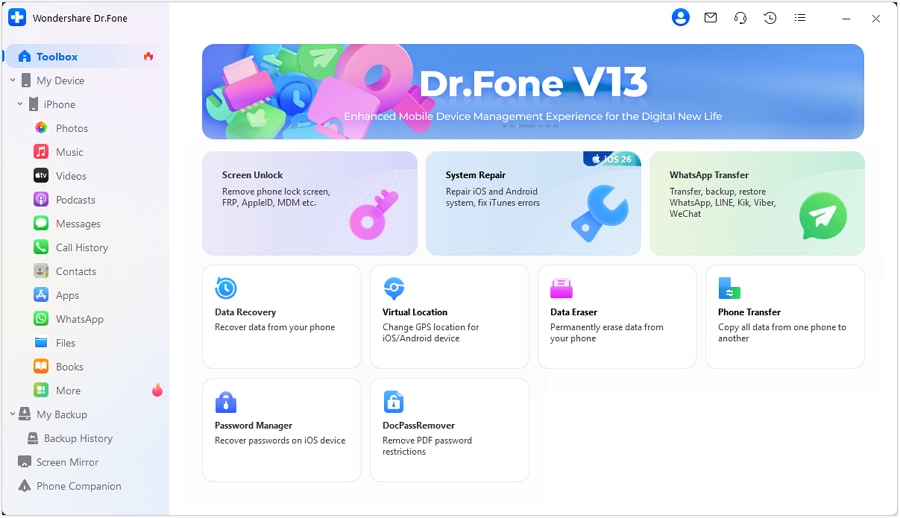
While the HackRF method is rewarding for technical experts, most users simply want a reliable way to change their location for privacy, testing, or gaming. For these users, Dr.Fone - Virtual Location is the definitive solution. It bypasses the need for expensive SDR hardware and complex coding, offering a robust software-level spoofing experience for both iOS and Android in 2026.
By leveraging this tool, you can instantly teleport to any city on the globe, simulate realistic movement along defined paths, and even use a joystick for precision navigation—all while maintaining a secure connection that apps find difficult to distinguish from real movement.
 Set your map route to simulate GPS movement.
- Set your wanted movement speed.
- HD and large map view to check location.
- Fake GPS location to anywhere.
Core Capabilities of Dr.Fone - Virtual Location
- Multi-Device Management: Manage and spoof location on up to 5 devices simultaneously from a single workstation.
- Joystick Navigation: Provides a flexible 360-degree joystick for tactile control in AR games like Pokémon GO.
- Custom Routes: Create multi-stop paths with variable speeds (walking, cycling, or driving) to mimic natural human travel patterns.
Simplified Steps to Change GPS Location
Step 1 Connect and Initialize
Launch Dr.Fone on your computer and select "Virtual Location" from the dashboard. Connect your smartphone via USB or Wi-Fi. Click "Get Started" and your current real-time location will be displayed on the interactive map.
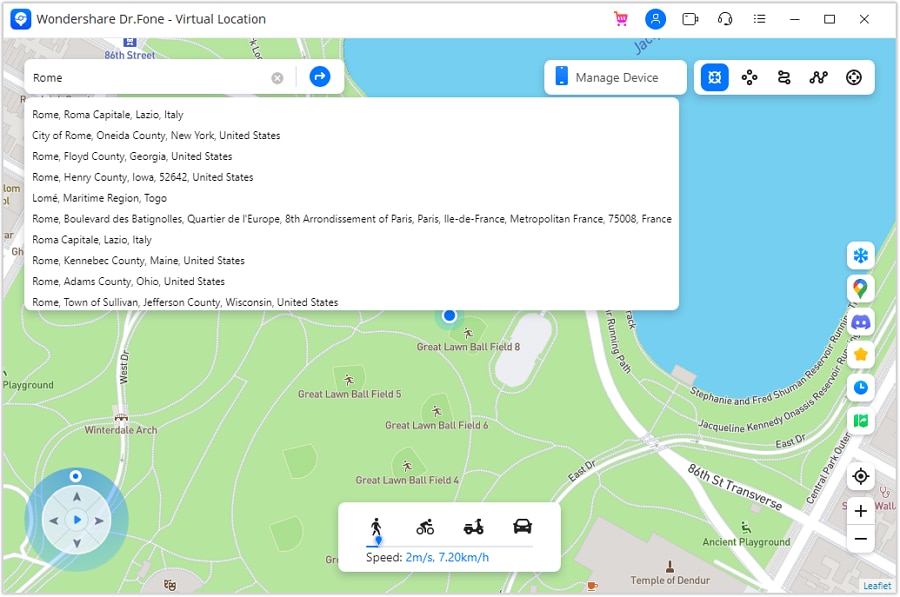
Step 2 Choose Your Destination
Click the "Teleport Mode" icon in the upper right. Use the search bar to find a specific landmark or enter exact GPS coordinates. Hit "Go" to preview the target area, then click "Move Here" to finalize the shift.
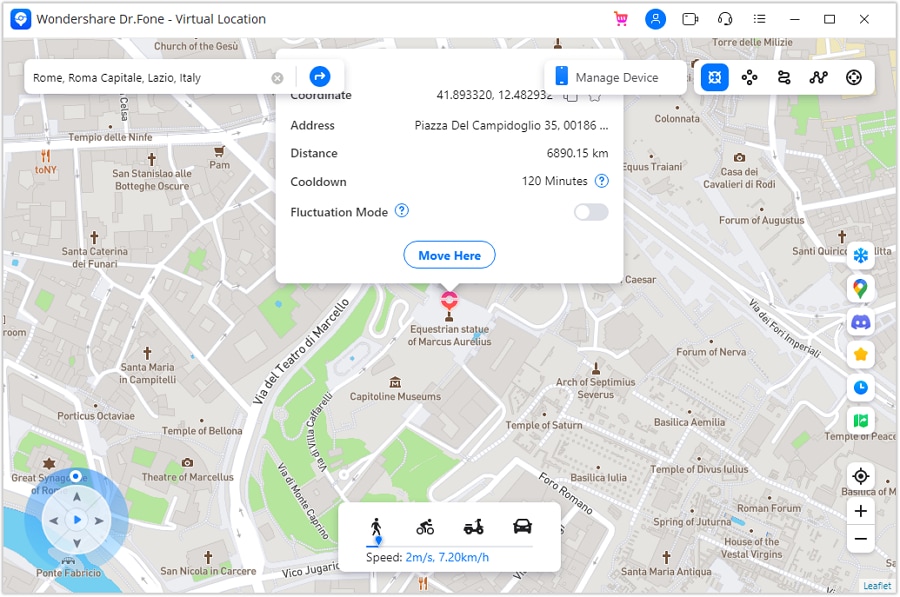
Step 3 Verify and Navigate
Your system-wide GPS location is now updated. You can open any app on your phone—social media, dating, or gaming—to confirm the change. To return to reality, simply close the tool or use the "Reset Location" feature.




Conclusion
The world of HackRF GPS spoofing provides a unique window into the mechanics of radio wave propagation and global navigation security. For those with a technical appetite, mastering SDR hardware is a rewarding 2026 project that offers granular control over signal transmission. However, the hardware complexity and potential legal grey areas make it less ideal for daily use.
For the majority of users who need efficient, safe, and user-friendly location faking, Dr.Fone - Virtual Location stands as the superior software-based alternative. It delivers professional-grade spoofing results without the need for additional antennas or command-line scripting.
FAQ
1. Is broadcasting GPS signals with HackRF legal?
In most jurisdictions, broadcasting on regulated frequencies like the GPS L1 band (1575.42 MHz) is illegal without a license. While testing in a Faraday cage or controlled laboratory is generally allowed for research, open-air transmission can lead to severe penalties.2. Can HackRF spoofing be detected by apps like Pokémon GO?
Because HackRF spoofs the signal at the hardware receiver level, it is significantly harder for apps to detect than basic Android 'Mock Location' settings. However, inconsistencies in signal stability or unrealistic jumps in distance can still trigger anti-cheat algorithms.3. Why do I need a TCXO module for my HackRF?
Standard HackRF One units may have frequency drift due to temperature changes. A TCXO (Temperature Compensated Crystal Oscillator) provides the extreme frequency stability required to maintain a lock on a GPS signal over time.4. Does the HackRF method work on the latest iOS versions?
Yes, since the spoofing happens by broadcasting a real RF signal to the phone's antenna, it is platform-independent. Both iOS and Android devices will process the fake signal as a legitimate satellite broadcast, though iOS often cross-references Wi-Fi and cellular data for verification.
 Add Wondershare Dr.Fone as a preferred source on Google