Teleport your device anywhere instantly with one click.


 100% Security Verified | No Subscription Required | No Malware

 :

 ChatGPT
 Perplexity
 Gemini
 Claude
 Grok
A Pokemon Go cooldown chart is not permission to spoof your location, and its timer is not an account-safety guarantee. Players use the word cooldown for reported waiting intervals between location-sensitive actions. They often use soft ban for temporary catch or PokeStop problems, even when the underlying cause has not been established.
This 2026 guide separates those community terms from formal account enforcement, preserves the source's distance table for reference, and explains how to troubleshoot symptoms without repeatedly forcing interactions. The important distinction is between describing reported behavior and claiming a method is officially approved. Waiting, changing software, or logging out does not turn prohibited location falsification into permitted play.
In this article
- Part 1. Understanding Soft Bans & Cooldown in Pokémon Go
- Part 2. Key Signs: How Do You Know If You're Soft-Banned?
- Part 3. Mastering the Cooldown Rules to Avoid a Soft Ban
- Part 4. The Safest Way to Teleport in Pokémon GO Without Getting Banned
- Part 5. Step-by-Step: How to Teleport in Pokémon Go Using A Professional Tool
Part 1. Cooldowns, Temporary Restrictions, and Formal Strikes
A cooldown is a waiting interval; a soft ban is a community label for a restriction. Neither phrase should be used as a precise diagnosis based only on one failed catch. Ordinary game timers, travel-related interaction limits, GPS errors, network problems, and disciplinary actions can all produce different forms of interrupted play.
In spoofing discussions, cooldown usually means the reported time between interacting in one place and attempting another location-sensitive interaction elsewhere. The source treats this as a distance-based formula with guaranteed results. That interpretation is too strong: this article has no official specification confirming the table, every listed trigger, or a rule that waiting prevents enforcement.
The official Pokemon Go Gameplay Fairness Policy explicitly identifies falsifying GPS location as cheating. It describes warnings, suspensions, and termination, and notes that some behavior can lead to immediate termination without three prior opportunities. A temporary inability to collect items is not the same thing as an official first strike.
Keep these categories separate when seeking help. If you see an actual warning or suspension notice, read that notice and follow official support instructions. If interactions fail without a notice, troubleshoot the app, connection, and real position before assuming that an invisible two-hour timer explains everything.
Part 2. Signs Players Associate with a Soft Ban
There is no reliable diagnosis based solely on a single fleeing Pokemon or one unsuccessful PokeStop spin. Repeated failures across several normal interactions can be consistent with a temporary restriction, but the same observations also require basic troubleshooting. The source's claim that a typical soft ban lasts up to 12 hours is not a universal, verified duration.
- Repeated fleeing after a throw: Note whether this happens across multiple encounters under a stable connection. One flee can be normal; a particular difficult encounter does not establish an account penalty.
- Discs that return no items: Check distance from the PokeStop, whether it was just spun, bag capacity, and any displayed error. A 'Try again later' message does not identify a unique cause.
- Gym interactions that fail: Confirm proximity, eligibility, and the exact message rather than inferring a location penalty from a failed placement or battle alone.
For a practical check, stop interacting, return to a stable real-world location, and confirm the phone's location permissions and network connection. Restart the official app if necessary and see whether the map accurately follows your actual position. Do not keep changing regions or repeatedly testing catches as a way to force an account restriction to end.
If the problem continues, record the error text and contact official support. A warning message, suspended-account screen, and a generic connection failure require different responses. Waiting may resolve some temporary problems, but it does not repair every cause and is not a substitute for an appeal when enforcement has occurred.
Part 3. What the Cooldown Chart Can and Cannot Establish
The original chart is reproduced as a record of the source article's reported intervals, not a set of official requirements or an anti-ban recipe. It may help you understand what people mean when discussing distance and cooldown, but it cannot certify that an action will succeed or that an account will avoid discipline.
3-1. Distance-Based Reference Chart
Each row pairs a distance with the time claimed in the source. These values have not been independently established as current server rules. In particular, the last row's two hours is the end of this table, not a maximum duration for every restriction, warning, or suspension.
| Distance in the source | Reported interval, not an official guarantee |
|---|---|
| One kilometre (1 km) | Half a minute: 30 seconds |
| Five kilometres (5 km) | Two minutes |
| Ten kilometres (10 km) | Six minutes |
| Twenty-five kilometres (25 km) | Eleven minutes |
| Thirty kilometres (30 km) | Fourteen minutes |
| Sixty-five kilometres (65 km) | Twenty-two minutes |
| Eighty-one kilometres (81 km) | Twenty-five minutes |
| One hundred kilometres (100 km) | Thirty-five minutes |
| Two hundred and fifty kilometres (250 km) | Forty-five minutes |
| Five hundred kilometres (500 km) | Sixty minutes, or one hour |
| Seven hundred and fifty kilometres (750 km) | Eighty minutes, or one hour and twenty minutes |
| One thousand kilometres (1000 km) | Ninety minutes, or one hour and thirty minutes |
| At least fifteen hundred kilometres (1500 km) | One hundred and twenty minutes, or two hours; table endpoint only |
Do not use the numbers as evidence that impossible travel becomes legitimate after a timer expires. The game can evaluate location falsification separately from whether a particular catch or spin is currently accepted.
3-2. Interactions the Source Classifies as Cooldown Triggers
The source groups the following actions as location-registering interactions. Preserve the distinction between that reported classification and a verified technical specification: neither this list nor a timer reveals every signal used by the game.
- Wild catches: Catch attempts involving ordinary spawns and those associated with Incense, Lures, or Mystery Boxes appear in the source's trigger group.
- Dropped Poke Balls: The source also counts a ball accidentally released on the encounter screen; this is not presented here as an officially documented server event.
- Berry interactions: Feeding an encountered Pokemon or a visible Gym defender is included in the original classification, although these are different mechanics.
- Gym placement: Adding a defender is another action the source associates with location.
- Gym and raid battles: The source places both in the same group; their individual eligibility requirements still apply.
- Disc spins: It includes attempts at PokeStops and Gyms, even with full item storage.
- A flee during a catch attempt: The source treats an unsuccessful catch as relevant too, rather than only a successful capture.
These descriptions are not instructions for identifying which actions you can hide from the game. If your account has an enforcement notice, stop prohibited behavior instead of experimenting with which interaction will be accepted.
3-3. Activities the Source Places Outside Its Trigger List
The other group contains activities the source claims do not restart its community-described timer. That does not mean they are universally unrestricted, available during a strike, or safe to combine with spoofing. Some depend on separate eligibility, distance, or encounter rules.
- Changing the reported map position: A location change may not involve a catch, but falsifying GPS is still prohibited by the fairness policy.
- Opening an encounter without a throw or berry: Viewing an encounter is distinct from completing a capture, not proof of invisibility to enforcement.
- Egg hatching: This depends on eligible distance tracking; a simulated route does not guarantee credited distance.
- Evolution and power-ups: These collection-management actions consume their required resources and do not erase location history.
- Using items: Incense, Lucky Eggs, and Stardust serve different functions; grouping them together does not certify every subsequent encounter.
- Gifts: Sending or opening them can have daily and account restrictions separate from map interaction.
- Trading: Normal eligibility and proximity requirements remain relevant.
- Research claims: Claiming an item reward and catching a reward encounter are not identical actions.
- Buddy or avatar changes: Editing your selection or appearance does not reset a penalty.
- Trainer battles: PvP availability should not be assumed during account enforcement.
The official policy specifically says a warning can restrict social features, including trading and Gifts. That is one reason the source's 'non-triggering' label must not be interpreted as a promise that an action remains available on every restricted account.
Part 4. No Teleport Tool Can Promise a Ban-Free Account
The inherited table-of-contents label mentions a 'safest' way to teleport without a ban. That is the source's claim, not a conclusion supported here. The official policy prohibits GPS falsification; waiting for a chart interval or logging out before a jump does not create an exemption.
 Set your map route to simulate GPS movement.
- Set your wanted movement speed.
- HD and large map view to check location.
- Fake GPS location to anywhere.
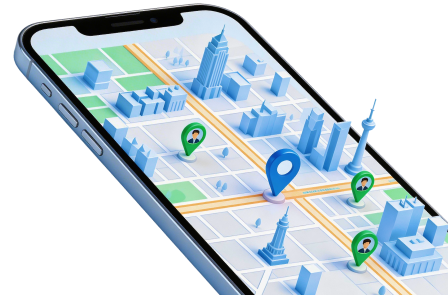
Dr.Fone - Virtual Location provides map-based GPS changes, simulated routes, speed selection, and movement controls on supported devices. Those are location-simulation functions, not a way to clear strikes, change server enforcement, or repair every failed catch.
The official product page states that Android does not support Pokemon Go. For iOS, check present compatibility and the game's rules rather than assuming that a product feature or the fixed banner's marketing language guarantees accepted gameplay. This guide limits the interface walkthrough below to permitted GPS testing, not evading game restrictions.
- Replace timer-based confidence with policy awareness: A successful interaction does not prove that simulated location was authorized.
- Do not rely on logging out: Closing an app or signing out is not an approved method to remove location-related enforcement or make teleportation undetectable.
- Use genuine movement for game progress: Follow local safety rules, avoid playing while driving, and stop if your position is inaccurate.
Part 5. Understand the GPS Interface Without an Anti-Ban Promise
Readers searching for how to teleport in Pokémon Go should distinguish a phone's simulated coordinate from permission to use that coordinate in the game. The following source-based screens illustrate the desktop location tool on your own supported phone. Exact labels can differ by installed version.
Step 1 Open the module and connect your device
Install the desktop software from the approved product source and choose Virtual Location. Before continuing, confirm that your intended app permits GPS simulation; the Android Pokemon Go limitation still applies.
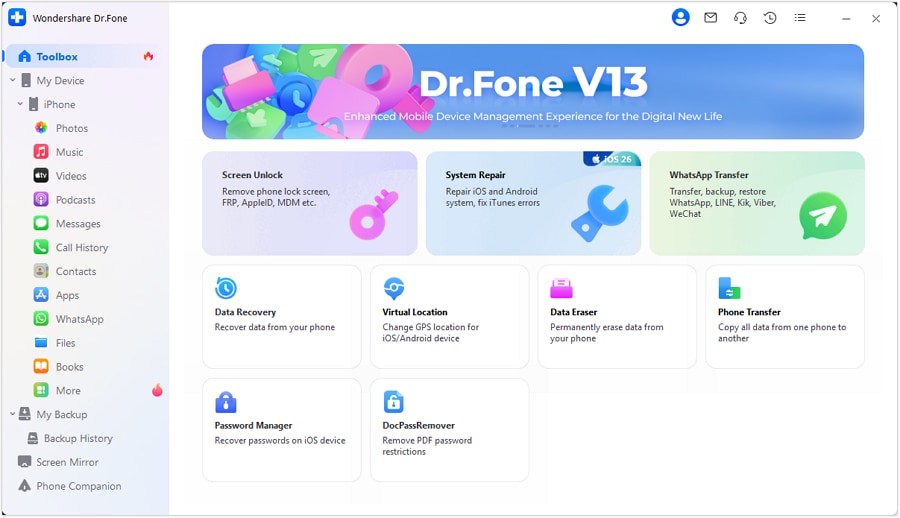
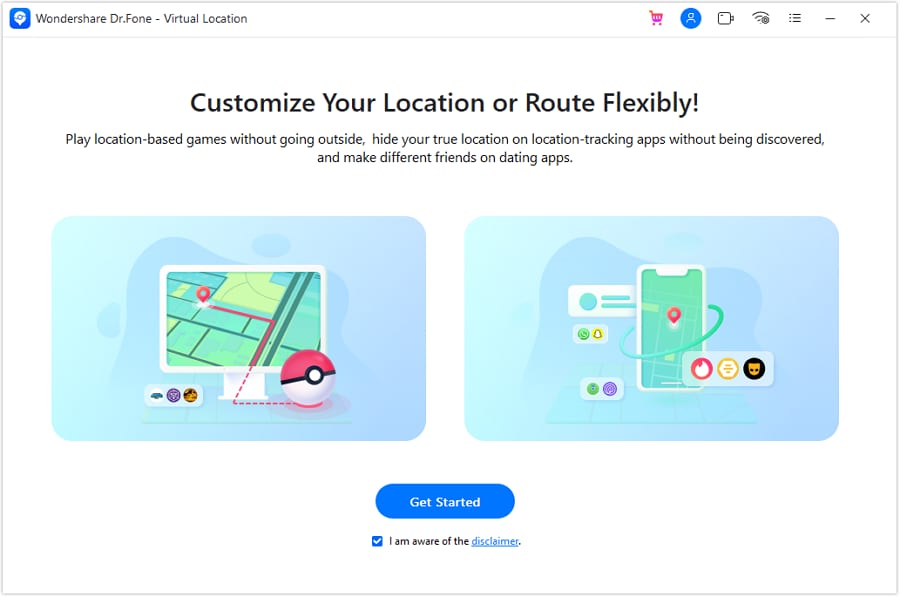
Connect your own supported phone by USB, follow the device's permission prompts, and use Get Started when available. Check that the selected device is the one you intend to test.
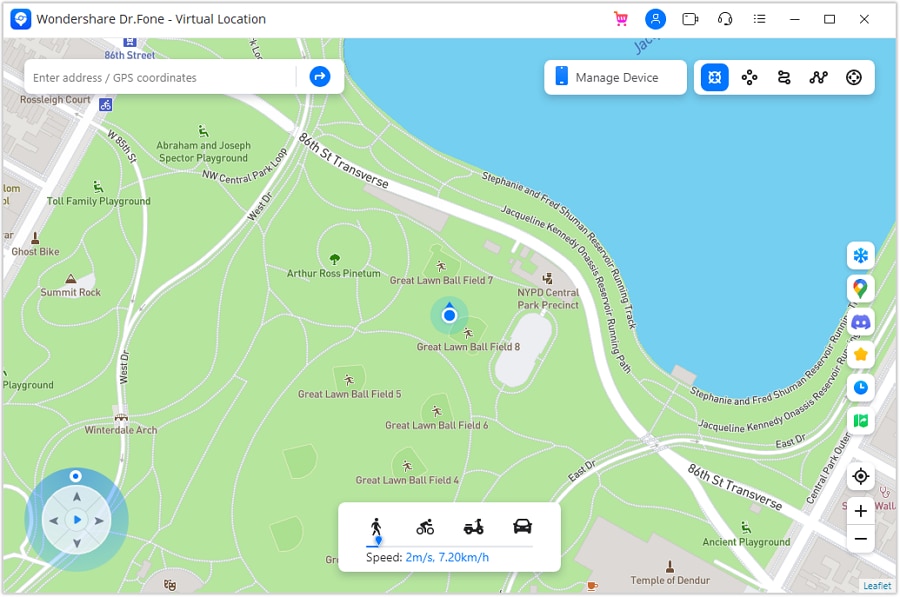
Step 2 Inspect the map and preview a destination
Confirm the starting position on the map. Select Teleport Mode using its label or tooltip rather than assuming the same icon position in every release.
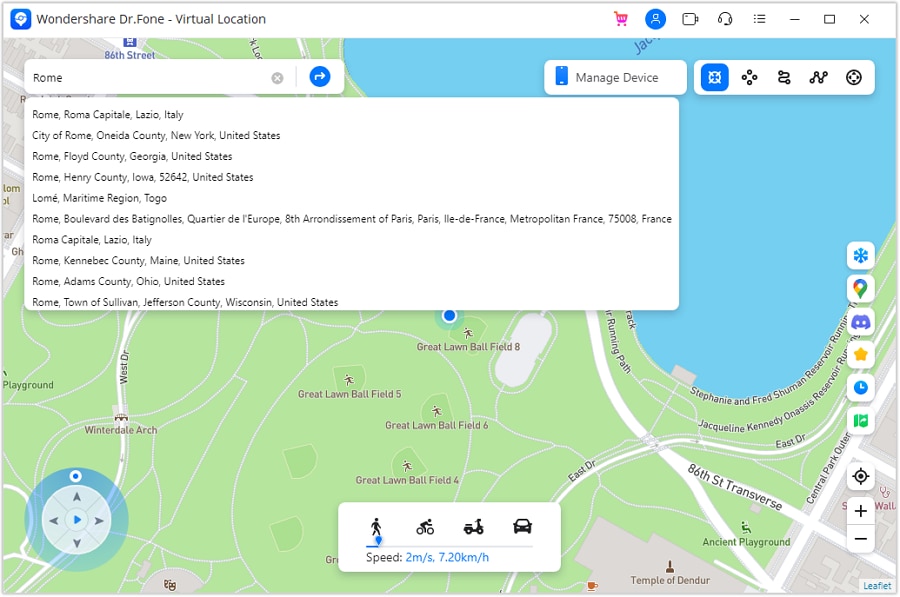
Search for a place name or coordinates appropriate to your authorized test. Inspect the selected pin and avoid applying changes merely to work around an active account restriction.
Step 3 Apply only a permitted test and restore the real position
The illustrated version uses Move Here to apply the selected GPS point. An app may reject, override, or independently evaluate that position; a changed map marker is not evidence that game use is safe.
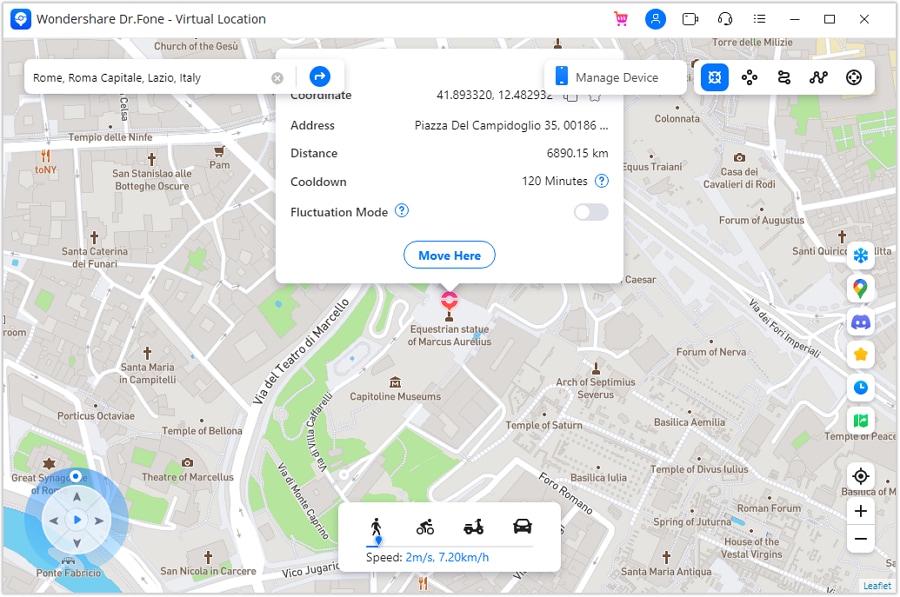
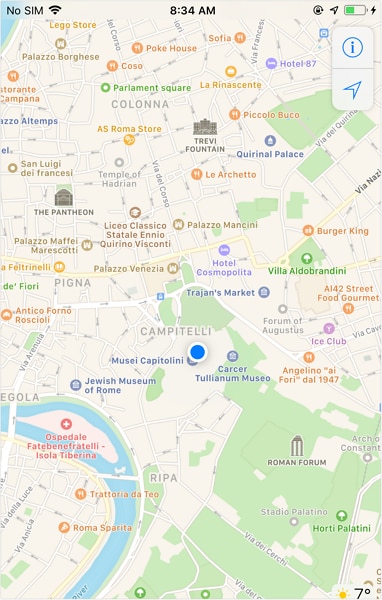
When the authorized test is finished, stop the simulation and verify the actual location on the phone. Do not use the source's cooldown table as a guarantee that Pokemon Go will accept the result or remove a penalty.
A GPS utility changes location reporting on supported devices; it does not control Pokemon Go's server rules. Restore real positioning before returning to ordinary location-based activity.




Conclusion
Interpret the cooldown chart as an unverified source reference, not a protection mechanism. Troubleshoot failed interactions at a stable real position, distinguish them from official warnings, and use the game's support channel when an account notice or persistent error requires investigation.
Dr.Fone - Virtual Location can be assessed for supported, permitted GPS simulation. It cannot certify ban-free teleportation, bypass a suspension, or guarantee that waiting two hours resolves every restriction.
FAQ
1. What do players mean by cooldown in Pokemon Go?
Usually they mean a reported interval between location-sensitive interactions at different places. The community chart reproduced above is not an official specification and should not be confused with ordinary game timers or a formal account strike.2. Do fleeing catches and empty spins prove a soft ban?
No. Repeated failures can be consistent with a restriction, but connection issues, distance, storage limits, and other conditions also deserve checking. Use the actual error or account notice and official support rather than diagnosing a penalty from one symptom.3. Is every Pokemon Go restriction over after two hours?
No. Two hours is simply the final interval in this source table. Official warnings and suspensions follow different rules, and persistent technical problems may need troubleshooting instead of a longer wait.4. Can a reliable location changer make spoofing safe?
No tool can promise that. The fairness policy identifies GPS falsification as cheating, independently of whether a timer has elapsed. The product's Android support also explicitly excludes Pokemon Go, and iOS compatibility does not remove account risk.
 Add Wondershare Dr.Fone as a preferred source on Google